


Enterprise assets have historically been constrained by rigid ownership structures and limited liquidity. Tokenization introduces a programmable layer to these assets, enabling controlled distribution, transparent governance, and more efficient capital formation across institutional ecosystems.
Market projections place tokenized real-world assets beyond $10 trillion by 2030, with strong institutional allocation. This shift is accelerating demand for white label platforms that provide deployment control, regulatory alignment, and seamless integration with enterprise infrastructure.
In this article, we define RWA tokenization in an enterprise context, examine why white label platforms are prioritized, and present a structured approach to develop a white label RWA tokenization platform aligned with enterprise requirements in 2026.
What Enterprises Need to Know About RWA Tokenization
RWA tokenization introduces a controlled digital layer over physical and financial assets, enabling structured ownership, programmable compliance, and institutional-grade distribution. For enterprises, it is an infrastructure decision tied directly to capital efficiency and product strategy.
Core Considerations in RWA Tokenization for Enterprises:
- Tokenization is not asset digitization. It embeds enforceable rules into the asset itself, including transfer restrictions, investor eligibility, and compliance logic, reducing operational dependency on intermediaries.
- Liquidity must be designed at issuance. Enterprises need defined distribution channels, secondary trading mechanisms, and investor onboarding frameworks to ensure assets remain tradeable within regulatory boundaries.
- The tokenized RWA market has already crossed $35 billion in on-chain value, reflecting increasing institutional allocation into private credit, treasuries, and real estate. This growth is pushing enterprises toward scalable, ready-to-deploy infrastructure.
- Regulatory alignment is architectural. Jurisdiction-specific compliance, KYC/AML enforcement, and asset classification must be embedded at both smart contract and application layers from the outset.
- Platform integration determines viability. Tokenization systems must connect with custody, reporting, ERP, and investor management systems to ensure continuity across financial operations and audit processes.
Why Enterprises Choose White Label RWA Tokenization Platforms
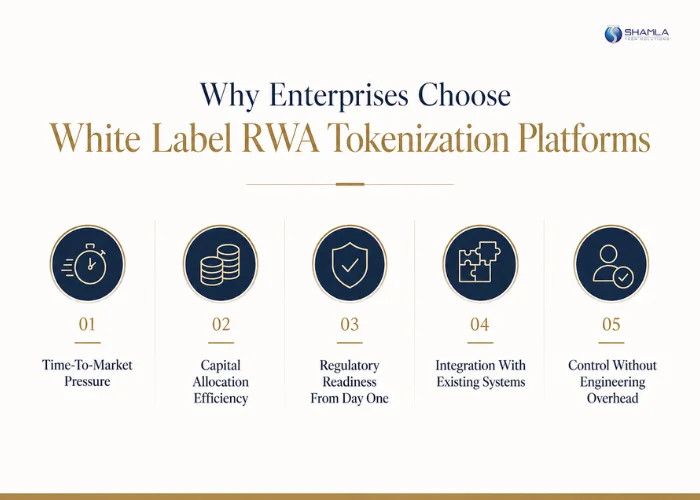
1. Time-To-Market Pressure
2. Capital Allocation Efficiency
3. Regulatory Readiness From Day One
4. Integration With Existing Systems
5. Control Without Engineering Overhead
Key Features of a White Label RWA Tokenization Platform
Feature Area | Enterprise Requirement | Business Impact |
Asset Tokenization | Multi-asset support, fractionalization | Broader product offerings |
Compliance Controls | KYC/AML, jurisdictional rules | Reduced regulatory risk |
Smart Contracts | Configurable logic, automation | Lower operational overhead |
Integration Layer | APIs, ERP, custody connectivity | Seamless enterprise adoption |
Investor Management | Onboarding, reporting, access control | Improved investor experience |
Security Architecture | Audits, key management, access controls | Institutional trust and protection |
Asset Tokenization Engine
Built-In Compliance Framework
Configurable Smart Contract Layer
Enterprise Integration Capabilities
Investor Onboarding and Management
Security and Access Control Framework
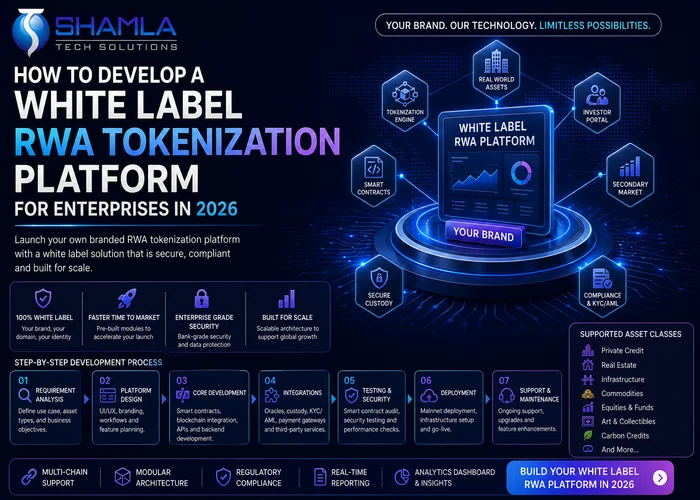
How to Develop a White Label RWA Tokenization Platform in 2026
Developing a white label RWA tokenization platform is a configuration-led initiative built on pre-existing infrastructure. Enterprises focus on asset design, compliance definition, and system integration while leveraging a provider’s core platform to accelerate deployment and maintain operational control.
- Define Asset Strategy and Target Market
Enterprises identify asset classes, investor profiles, and distribution channels before platform configuration begins. These inputs define access controls, issuance models, and lifecycle workflows within the white label platform, ensuring alignment with revenue objectives, investor expectations, and jurisdiction-specific regulatory frameworks governing asset participation and transfer.
- Select a White Label Platform Provider
Enterprises evaluate providers such as Shamla Tech Solutions based on configurability, compliance coverage, security architecture, and integration readiness. The selected partner must support enterprise-grade deployment, enabling internal teams to configure asset workflows, investor rules, and operational processes without dependency on extensive custom engineering efforts.
- Configure Asset Issuance and Investor Rules
Platform modules are configured to define asset structures, fractional ownership models, investor eligibility criteria, and transfer conditions. This setup ensures that every issued asset operates within predefined controls, supporting compliant distribution, consistent execution, and enforceable ownership rules across all transactions within the platform environment.
- Implement Compliance Workflows and Controls
Compliance parameters are configured across onboarding, transaction processing, and asset lifecycle management. This includes identity verification, jurisdiction mapping, and rule enforcement within the platform, ensuring all investor interactions and asset transfers adhere to regulatory requirements and internal governance policies without introducing manual compliance dependencies.
- Integrate With Enterprise Systems
The platform is integrated with custody providers, financial systems, and reporting infrastructure through APIs and middleware. This enables synchronized data flow, accurate financial tracking, and operational alignment across departments, ensuring tokenized assets are fully reflected within existing enterprise processes and reporting structures without fragmentation.
- Deploy Platform and Operationalize
The configured platform is deployed with defined user access controls, onboarding workflows, and asset offerings. Enterprises initiate investor participation, monitor transaction activity, and manage platform operations while maintaining control over configuration, user experience, and ongoing optimization of asset distribution and performance metrics.
Checklist for Choosing a White Label RWA Tokenization Provider
- Deep Configurability: Ensures the platform supports granular control over asset structures, investor rules, and compliance workflows, enabling enterprises to tailor tokenization without requiring custom development or engineering dependency.
- Jurisdictional Compliance Coverage: Supports KYC, AML, and investor accreditation requirements across multiple regions, allowing enterprises to operate within defined regulatory frameworks and manage asset distribution without compliance fragmentation.
- Enterprise Integration Readiness: Provides APIs and middleware to connect with custody, ERP, payment, and reporting systems, ensuring tokenization workflows align with existing enterprise operations and maintain consistent financial visibility.
- Smart Contract Flexibility: Enables configuration of asset behavior, ownership rights, and transfer conditions through pre-built smart contracts, allowing enterprises to define rules without developing contracts independently.
- Security and Custody Standards: Implements strong key management, access controls, and audit mechanisms to protect assets and investor data, ensuring alignment with enterprise security policies and institutional-grade risk management practices.
- Scalable Infrastructure: Supports growth in transaction volume, asset classes, and investor participation, ensuring the platform performs reliably as enterprises expand tokenized offerings and increase operational complexity.
- Support and SLA Clarity: Defines clear service-level agreements, response timelines, and maintenance responsibilities, ensuring enterprises receive consistent support, platform stability, and timely updates aligned with operational requirements.
Bottom Line
Enterprises approaching RWA tokenization are making a structural shift in how assets are issued, governed, and distributed. Success depends on precise execution, strong infrastructure selection, and full control over asset behavior, compliance logic, and investor participation frameworks.
White label platforms enable enterprises to establish tokenization as an operational capability. Through structured configuration, system integration, and aligned provider support, organizations can deploy, manage, and scale tokenized assets within existing workflows while maintaining consistency, governance, and performance.
Develop a White Label RWA Tokenization Platform with Shamla Tech Solutions
Shamla Tech Solutions is a white label RWA tokenization platform development company delivering enterprise-grade solutions. We have built and deployed platforms for clients across global jurisdictions, enabling compliant asset issuance, investor management, and scalable tokenization aligned with regulatory and operational requirements.
Our platforms are designed for configurability, integration, and performance, supporting diverse asset classes and complex compliance frameworks. We work closely with enterprises to implement tokenization strategies, ensuring control over asset structures, seamless system integration, and reliable infrastructure aligned with long-term business objectives.