

Home » Others » Top Benefits of Asset-Backed Stablecoins for Enterprise Finance in 2026

Top Benefits of Asset-Backed Stablecoins for Enterprise Finance in 2026

Share this article:
benefits of asset-backed stablecoins
Table of Contents
About the Author
Balaji
CEO of Shamla Tech, specializes in crypto exchange development, RWA tokenization, blockchain infrastructure, AI solutions, and compliance-ready platforms. He helps enterprises address regulatory, security, and scalability challenges while driving real-world adoption of emerging technologies across industries.
Connect On:

Enterprise finance leaders are reassessing how value moves across global operations, where settlement delays, liquidity fragmentation, and intermediary costs continue to impact efficiency. Asset-backed stablecoins are gaining executive attention as practical instruments for controlled, programmable financial transactions.

Asset-backed stablecoins accounted for a significant share of the stablecoin market, with total sector circulation exceeding $150 billion, signaling strong institutional confidence in reserve-backed digital assets. Enterprises require dependable digital settlement mechanisms aligned with financial control, transparency, and operational precision.

This article examines the benefits of asset-backed stablecoins for enterprise finance, including their role in payments, treasury management, and institutional financial workflows. It also outlines enterprise adoption considerations and practical use cases shaping strategic digital asset implementation in 2026.

Launch Your Enterprise Asset-Backed Stablecoin In 4 Weeks

What Makes Asset-Backed Stablecoins Valuable For Enterprise Finance?

Enterprise finance leaders are prioritizing infrastructure that improves settlement control, liquidity efficiency, and transaction certainty across global operations. Asset-backed stablecoins address these requirements by combining reserve-backed value stability with programmable transfer capabilities suited for institutional financial workflows.

Key Value Drivers For Enterprise Stablecoin Adoption:

  • Stablecoins now represent a market capitalization exceeding $324 billion, signaling substantial institutional and market confidence in reserve-backed digital settlement instruments rather than speculative crypto use cases.

  • Asset-backed stablecoins reduce dependency on fragmented correspondent banking chains, enabling enterprises to execute value transfers with greater control over timing, settlement visibility, and treasury coordination across multiple jurisdictions.

  • Their programmable architecture enables finance teams to embed payment conditions, automated reconciliation logic, and transaction controls directly into settlement workflows, reducing operational friction across accounts payable, treasury, and partner payment functions.

  • Reserve-backed structures provide enterprises with a more predictable digital settlement mechanism for high-value financial operations, supporting stronger working capital planning, reduced exposure to settlement uncertainty, and improved financial execution discipline.

  • As enterprise finance infrastructure expands toward tokenized assets, digital payments, and blockchain-based settlement systems, asset-backed stablecoins serve as a practical interoperability layer connecting traditional treasury operations with modern programmable financial networks.

7 Benefits Of Asset-Backed Stablecoins For Enterprise Financial Operations in 2026

For enterprise finance teams, settlement inefficiencies directly affect liquidity, transaction costs, and financial control. Asset-backed stablecoins introduce reserve-backed digital payment infrastructure designed to deliver the benefits of stablecoins, improve transaction certainty, accelerate capital movement, and support programmable enterprise finance operations at institutional scale.

Stablecoin Benefit

Enterprise Challenge

Business Impact

Price Stability

Payment value fluctuations

Predictable settlements

Faster Settlement

1–5 day payment delays

Settlement in minutes

Lower Costs

3%–6% transaction fees

Reduced payment costs

Better Liquidity

Capital tied in transit

Faster fund access

Transparency

Limited payment visibility

Real-time audit trails

Reduced Risk

Intermediary dependency

Higher settlement certainty

Automation

Manual finance workflows

Faster execution

1. Price Stability For Enterprise Transactions

Enterprise finance operations require predictable transaction values, particularly for supplier payments, treasury transfers, and institutional settlements. Asset-backed stablecoins maintain value linkage to underlying reserve assets, reducing exposure to digital asset volatility. This allows finance teams to use blockchain-based settlement infrastructure without introducing speculative balance sheet risk into operational financial workflows.

2. Faster Cross-Border Settlement Execution

Traditional enterprise cross-border payments often require 24 to 120 hours for settlement due to intermediary validation, banking cut-off windows, and clearing dependencies. Stablecoins for cross-border payments reduce settlement timelines to minutes, allowing enterprises to accelerate supplier disbursements, treasury fund movement, and institutional payment execution while improving capital availability across international operations.

3. Lower Transaction Processing Costs

Cross-border enterprise payments can consume 3% to 6% of transaction value through intermediary banking fees, foreign exchange markups, compliance handling, and reconciliation overhead. Asset-backed stablecoins reduce infrastructure complexity by enabling direct settlement execution, allowing enterprises processing large payment volumes to materially reduce financial leakage and improve payment operation efficiency.

4. Improved Working Capital Efficiency

Delayed payment settlement creates avoidable liquidity constraints for treasury teams managing global operations. A business moving substantial monthly transaction volume through legacy banking rails often carries idle capital awaiting payment finality. Asset-backed stablecoins accelerate capital circulation, enabling faster redeployment into procurement, operational funding, debt servicing, or treasury allocation priorities.

5. Greater Transaction Transparency And Audit Readiness

Enterprise payment infrastructure involving multiple intermediaries often creates fragmented transaction records, delayed confirmations, and reconciliation inefficiencies. Asset-backed stablecoin payments provide timestamped, verifiable transaction records across settlement workflows. This improves audit readiness, strengthens internal financial controls, and gives finance leaders clearer visibility into payment execution across complex business operations.

6. Reduced Settlement And Counterparty Risk

Each additional intermediary in a payment chain introduces execution dependency, processing uncertainty, and counterparty exposure. Failed transfers, delayed confirmations, and routing inefficiencies create operational financial risk. Asset-backed stablecoins reduce intermediary reliance through direct settlement mechanisms, giving enterprises greater transaction certainty for supplier obligations, treasury coordination, and institutional financial commitments.

7. Programmable Financial Operations

Manual payment approvals, reconciliation tasks, and conditional disbursement processes consume finance resources at scale. Asset-backed stablecoins support programmable transaction logic, with RWA-backed stablecoins further strengthening automated milestone payments, scheduled treasury actions, escrow-based releases, and rule-driven settlement execution. This strengthens financial process control while improving operational efficiency across payment-intensive enterprise environments.

Transform Enterprise Payments With Secure Stablecoin Solutions

Enterprise Use Cases Of Asset-Backed Stablecoins Across Financial Workflows
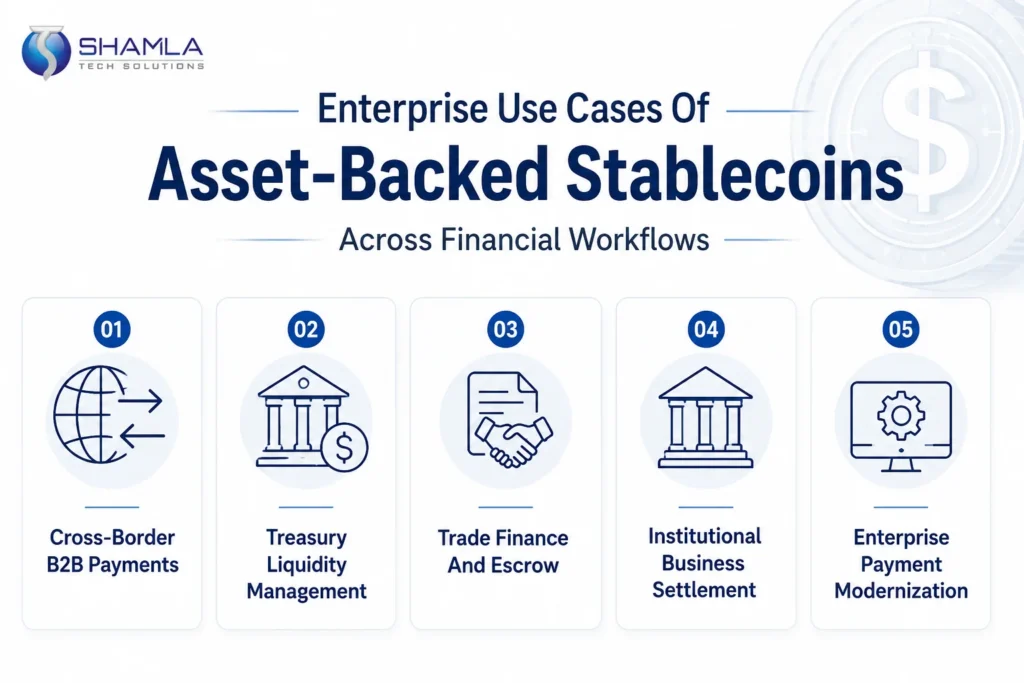
Enterprise Use Cases Of Asset-Backed Stablecoins Across Financial Workflows

Cross-Border B2B Payments With Predictable Settlement Value

Businesses making international supplier or partner payments need settlement instruments that preserve transaction value between initiation and completion. Asset-backed stablecoins provide reserve-backed price stability, making them suitable for high-value B2B cross-border payments where payment certainty, cost control, and treasury predictability directly affect commercial operations and vendor relationship management.

Corporate Treasury Liquidity Management

Treasury teams managing capital across multiple business entities require fast, predictable movement of funds without exposing working capital to digital asset volatility. Asset-backed stablecoins support treasury transfers, liquidity allocation, and short-term capital positioning through stable, reserve-backed digital settlement infrastructure aligned with enterprise financial control requirements.

Trade Finance And Escrow-Based Commercial Transactions

Commercial agreements involving milestone payments, escrow conditions, and cross-border settlement require trusted value transfer mechanisms. Asset-backed stablecoins provide businesses with a programmable, reserve-backed settlement instrument suitable for structured trade execution, reducing delays, payment uncertainty, and operational dependency across multi-party commercial transaction environments.

Institutional Settlement Between Business Counterparties

High-value enterprise settlements between financial institutions, corporate entities, or commercial counterparties require predictable transaction value and execution certainty. Asset-backed stablecoins provide a more reliable digital settlement layer for institutional financial workflows where speculative digital assets create unacceptable treasury and balance sheet exposu

Enterprise Payment Infrastructure Modernization

Businesses modernizing payment infrastructure need digital settlement systems compatible with automation, financial controls, and global transaction execution. Asset-backed stablecoins serve as stablecoin payment solutions, offering a practical reserve-backed settlement layer for enterprises seeking to improve payment efficiency while maintaining the predictability required for commercial financial operations.

How Businesses Can Prepare For Asset-Backed Stablecoin Adoption

Enterprise adoption of asset-backed stablecoins requires disciplined financial, technical, and compliance planning.

Businesses handling high-value payments, treasury operations, or institutional settlement workflows must evaluate infrastructure readiness, regulatory obligations, and operational execution requirements before introducing reserve-backed digital assets into core financial processes.

Identify The Exact Financial Workflow

Asset-backed stablecoins should solve a defined operational problem, not serve as experimental infrastructure. Businesses must determine whether adoption is intended for cross-border supplier payments, treasury fund transfers, trade settlement, escrow-based transactions, or institutional payment execution. Each use case carries different settlement requirements, liquidity implications, integration complexity, and governance expectations.

Evaluate Reserve Structure And Issuer Credibility

The financial reliability of an asset-backed stablecoin depends entirely on the quality and transparency of its backing mechanism. Businesses should assess reserve composition, redemption structure, audit frequency, custodian credibility, and issuer governance. Stablecoins backed by cash equivalents, short-term treasuries, or verifiable collateral provide stronger enterprise confidence for operational financial deployment.

Assess Regulatory And Compliance Exposure

Stablecoin transactions intersect with payment regulations, AML controls, KYC obligations, tax reporting requirements, and digital asset governance rules across jurisdictions. Businesses must determine whether their target markets permit digital settlement activity, whether internal compliance teams can monitor transaction obligations, and whether reporting infrastructure can support regulated financial asset movement.

Plan Financial Systems Integration

Adoption becomes operationally useful only when stablecoin infrastructure connects directly with enterprise finance systems. Businesses should evaluate integration requirements across ERP platforms, treasury management systems, payment gateways, banking APIs, reconciliation engines, and internal approval workflows. Disconnected implementation creates manual overhead, weak controls, and limited enterprise-scale usability.

Define Custody, Access Control, And Operational Governance

Enterprise stablecoin operations require institutional-grade control over asset custody, wallet access, transaction authorization, and approval governance. Businesses should establish treasury ownership models, multi-signature authorization policies, internal transaction controls, counterparty approval procedures, and operational accountability frameworks before introducing digital settlement infrastructure into production financial environments.

Final Thoughts

Enterprise finance infrastructure is being redefined by organizations seeking greater control over settlement speed, liquidity access, and transaction execution. Asset-backed stablecoins represent a credible financial instrument for businesses that require reserve-backed digital value movement without compromising operational predictability or treasury discipline.

The strategic advantage lies with businesses that implement digital settlement infrastructure before operational inefficiencies become competitive liabilities. Asset-backed stablecoin adoption is no longer a technical discussion alone; it is a financial infrastructure decision with direct implications for payment efficiency, capital control, and institutional scalability.

Launch Asset-Backed Stablecoins With Shamla Tech Solutions

Launching an asset-backed stablecoin requires regulatory precision, reserve-backed architecture, and infrastructure built for enterprise financial execution. Shamla Tech Solutions helps businesses design and deploy compliant stablecoin ecosystems tailored for cross-border payments, treasury modernization, institutional settlement, and private enterprise financial networks across global jurisdictions.

Whether your business requires fiat-backed stablecoin development, multi-chain deployment, smart contract engineering, wallet integration, compliance-ready architecture, or payment infrastructure connectivity, Shamla Tech Solutions delivers end-to-end execution. Speak with our stablecoin development specialists to build a secure, scalable digital asset infrastructure aligned with your commercial objectives.


Build Compliant Stablecoin Infrastructure For Global Business Operations

FAQs

1. What are asset-backed stablecoins in enterprise finance?

Asset-backed stablecoins are digital assets backed by reserve assets such as fiat currency, commodities, or short-term securities. Enterprises use them for predictable digital settlements, treasury operations, and cross-border financial transactions requiring stable transaction value.

2. What are the key benefits of asset-backed stablecoins for businesses?

The benefits of asset-backed stablecoins include faster settlement, lower cross-border payment costs, improved liquidity management, transaction transparency, reduced settlement risk, and programmable financial workflows that improve operational control across enterprise payment infrastructure.

3. How are asset-backed stablecoins used in business financial operations?

Businesses use asset-backed stablecoins for supplier payments, treasury fund transfers, trade settlements, institutional transactions, escrow arrangements, and payment infrastructure modernization where predictable digital value transfer improves financial execution efficiency and transaction reliability.

4. Are asset-backed stablecoins suitable for cross-border enterprise payments?

Yes. Asset-backed stablecoins support faster international settlements with more predictable transaction value compared to volatile digital assets. This makes them suitable for enterprise cross-border payments where speed, cost control, and settlement certainty are critical.

5. How long does it take to develop an asset-backed stablecoin?

Asset-backed stablecoin development timelines depend on project scope, compliance requirements, blockchain infrastructure, and integration complexity. With an experienced enterprise development partner like Shamla Tech Solutions, businesses can launch a secure, custom asset-backed stablecoin platform in as little as 4 weeks.

Talk to Our Experts

Recent Posts