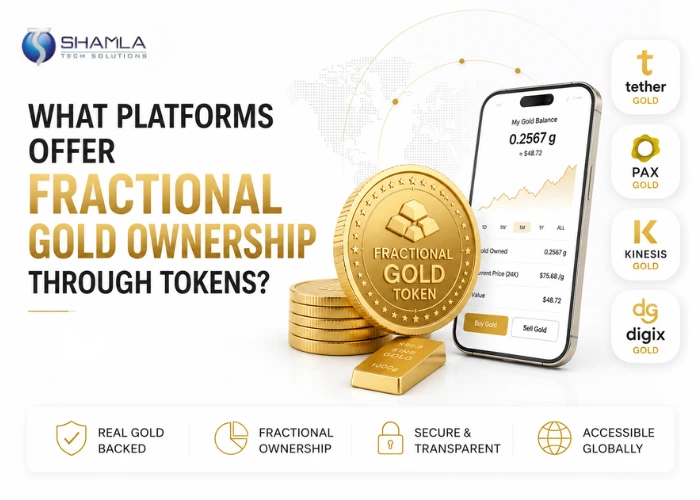

Gold is trusted, but owning it is not always simple. Buyers have to think about purity, storage, insurance, transport, resale value, and dealer charges. For businesses, it becomes harder when they want to offer gold investment products to many users through a digital platform. This is where fractional gold ownership through tokens is gaining value. It allows users to buy smaller digital units backed by physical gold stored safely by a custodian. Investors get easier access to gold, while businesses can build gold-backed wallets, apps, and RWA platforms. This guide explains how it works and where ShamlaTech fits.
What Is Fractional Gold Ownership Through Tokens?
Fractional gold ownership through tokens means turning physical gold into smaller digital units on the blockchain. Each token represents a fixed share of gold kept in secure custody. Users can buy, hold, transfer, or trade these tokens online without handling physical gold, making gold ownership easier, more flexible, and accessible.
What It Means:
- Physical gold is divided into smaller digital units.
- Each token represents a fixed gold share.
- Gold stays secured with a custodian.
- Users can buy and trade tokens online.
- Blockchain tracks ownership and transfers.
- It helps users avoid storage and handling issues.
How Does Gold Tokenisation Actually Work?
Gold tokenisation starts with real gold. A business sources gold, verifies it, and places it in secure custody. After that, the platform issues blockchain tokens that represent the stored gold. A basic gold tokenisation process includes:
- Gold sourcing and verification.
- Secure vault or custody arrangement.
- Token creation through smart contracts.
- User onboarding and KYC checks.
- Investor dashboard setup.
- Token purchase and wallet support.
- Proof-of-reserve or audit reporting.
- Redemption or sale process.
The most important part is trust. A gold token is only valuable if the gold behind it is real, properly stored, and legally connected to the token. This is why any blockchain gold investment should be reviewed carefully. Blockchain can track token ownership, but it cannot protect investors if the issuer has weak custody, poor audits, unclear redemption rules, or a bad legal structure.
A strong platform should clearly explain where the gold is stored, who audits it, how tokens are issued, how users can sell or redeem them, and what rights token holders have.
Top Platforms Offering Fractional Gold Ownership Through Tokens
Several platforms support fractional gold ownership through tokens in different ways. Some are direct investment platforms. Some issue their own gold-backed tokens. Others, like ShamlaTech, help businesses build custom gold tokenisation platforms.
1. ShamlaTech Custom Gold Tokenisation Platforms
ShamlaTech is listed first because it serves businesses that want to build their own gold tokenisation platforms, not only invest in existing tokens.
ShamlaTech helps gold dealers, fintech companies, investment firms, RWA startups, commodity businesses, and digital asset companies launch custom platforms for fractional gold ownership through tokens. This makes it useful for companies that want to create a complete gold-backed digital asset ecosystem.
A business may want to launch its own gold-backed token, investor portal, trading dashboard, custody-connected system, or white-label digital gold platform. ShamlaTech can support the technical side of that build. Its gold tokenisation development support can include:
- Smart contract development.
- Gold-backed token architecture.
- Investor dashboard development.
- Wallet integration.
- KYC and AML workflows.
- Custody integration.
- Proof-of-reserve features.
- Admin panel development.
- Redemption management.
- Exchange or marketplace integration.
- Multi-chain token support.
For businesses searching for ” Create Your Own Gold-Backed Token in 2026 or How to Build a Gold Tokenisation Platform in 2026, ShamlaTech is a strong development partner to consider.
ShamlaTech is not a gold token issuer like PAXG or XAUt. It does not simply sell users a gold-backed coin. Instead, it helps companies build the technology needed to operate their own gold tokenisation product.
This makes it a smart option for businesses that want to enter the tokenised gold market with their own brand, compliance model, custody partner, and platform workflow.
2. Pax Gold PAXG
Pax Gold, also known as PAXG, is one of the most recognised gold-backed tokens in the market. Each PAXG token represents one fine troy ounce of London Good Delivery gold.
PAXG is popular because it connects physical gold ownership with blockchain-based transferability. Users can hold the token in supported wallets, trade it on exchanges, or use it within digital asset platforms. For investors comparing the best gold-backed tokens, PAXG is often included because of its market presence, asset-backed structure, and broad recognition.
Still, users should review fees, redemption terms, supported jurisdictions, custody rules, and platform access before buying.
3. Tether Gold XAUt
Tether Gold, also called XAUt, is another major name in the tokenised gold market. It is designed to give users ownership exposure to physical gold through a blockchain-based token. XAUt is often considered by crypto users who want gold exposure without leaving the digital asset ecosystem. It can be useful for people who already use crypto wallets, exchanges, and blockchain-based financial tools.
For users searching for gold-backed cryptocurrency in 2026, XAUt is one of the common options they may find. Before investing, users should check reserve details, transparency reports, redemption rules, fees, exchange liquidity, and legal terms.
4. Kinesis Gold KAU
Kinesis Gold, or KAU, uses a gram-based gold model. One KAU is linked to one gram of physical gold. This makes it easier for users who want smaller gold ownership units instead of ounce-sized exposure. KAU also supports spending, sending, trading, and holding gold within the Kinesis ecosystem. This gives it more of a payment and utility angle compared to some gold tokens that focus mainly on investment holding.
For people who want to buy fractional gold online in smaller amounts, gram-based ownership may feel easier to start with. Users should still check fees, platform access, custody model, redemption process, and liquidity before buying.
5. Other Tokenised Gold Providers
There are also region-specific tokenised gold platforms. Some focus on institutional buyers. Some serve local markets. Some offer private gold-backed tokens for wealth platforms, fintech products, or commodity businesses.
These platforms may offer useful features, but buyers should be careful. A new token can look attractive, but weak custody or low liquidity can create serious risk. Before choosing any lesser-known gold token provider, users should check audits, reserve proof, legal ownership, redemption rules, exchange access, and platform reputation.
Comparison of Leading Gold Tokenisation Platforms
Platform | Type | Best For | Key Strength | What to Check |
ShamlaTech | Platform development partner | Businesses launching custom gold token platforms | Custom tokenisation platform development | Custody model, compliance scope, business requirements |
Pax Gold PAXG | Gold-backed token | Investors seeking ounce-based tokenised gold | Recognized gold-backed token | Fees, redemption, and supported regions |
Tether Gold XAUt | Gold-backed token | Crypto users seeking gold exposure | Strong crypto market visibility | Transparency, reserves, terms |
Kinesis Gold KAU | Gram-based gold token | Smaller buyers and payment-focused users | One-gram unit model | Platform fees, redemption, liquidity |
Private gold token platforms | Custom or regional products | Institutions and local markets | Flexible structure | Audits, custody, legal rights |
What to Look For Before Choosing a Gold Tokenisation Platform?
A gold token is not just a digital asset. It is linked to real gold, so the platform behind it matters.
- Gold Backing: The platform should clearly state how much gold backs each token. It should also explain how new tokens are issued and retired.
- Custody: A strong platform should use reliable vaults or custody partners. The user should know where the gold is stored and who controls it.
- Audits and Proof of Reserve: Regular audits or proof-of-reserve systems help users verify that tokens match stored gold.
- Redemption Rights: Some platforms allow physical redemption. Others may only support trading. Users should understand the minimum redemption amount, delivery rules, and fees.
- Liquidity: A token should be easy to sell when needed. Investors should check trading volume, exchange listings, spreads, and withdrawal options.
- Fees: Gold token platforms may charge buying fees, storage fees, transfer fees, withdrawal fees, or redemption fees. These costs affect returns.
- Legal Rights: The platform should explain what the token holder actually owns. This is one of the most important parts of any tokenised gold investment.
Risks of Fractional Gold Tokens: Do Not Skip This
Fractional gold ownership through tokens can make gold easier to access, but it still has risks.
- Custody Risk
The value of fractional gold ownership through tokens depends on how safely the physical gold is stored. If the custodian is weak, unverified, or poorly managed, users may lose trust in the token. - Reserve Transparency Risk
A platform must clearly show whether each token is backed by real gold. Without audits or proof of reserves, investors cannot confirm if the gold-backed cryptocurrency is fully supported. - Redemption Risk
Some users expect to redeem tokens for physical gold anytime. In reality, many tokenised gold platforms may have minimum limits, extra fees, location rules, or long processing times. - Liquidity Risk
A token may be backed by gold, but that does not mean it is easy to sell. Low trading activity can make it harder to exit a blockchain gold investment at the expected price. - Regulatory Risk
Rules for digital gold token blockchain products can change by country. Tax laws, commodity rules, securities regulations, and crypto policies may affect how users buy, hold, or sell tokens. - Platform Failure Risk
Even if the gold exists, investors may face problems if the issuer, exchange, custodian, or technology provider fails. This is why users should review every gold tokenisation platform carefully before investing.
Benefits of Investing in Fractional Gold Ownership Platforms
Despite the risks, tokenised gold has clear benefits when the platform is built well.
Lower Entry Barrier- Users can buy smaller gold units instead of purchasing a full bar or large coin.
Easier Trading- Gold tokens can be traded or transferred through supported blockchain networks and exchanges.
Better Divisibility- Physical gold is hard to divide. Tokens make fractional ownership easier.
No Personal Storage Burden- Users do not need to store gold at home or manage physical security.
Faster Access- Some tokenised gold platforms allow users to buy, sell, or transfer tokens outside traditional market hours.
Digital Portfolio Use- Gold tokens can fit into crypto wallets, investment apps, DeFi platforms, and RWA products.
Business Innovation- Companies can build digital gold apps, wealth platforms, lending products, or asset-backed marketplaces using gold tokenisation infrastructure.
Gold Token vs Gold ETF- Understanding The Difference
| Gold Token | Gold ETF |
| A gold ETF is a traditional financial product. It usually trades through a brokerage account during market hours. It may suit investors who prefer regulated securities markets and do not need blockchain features. | A gold token is blockchain-based. It can support digital wallet storage, faster transfers, smaller units, and integration with crypto platforms. It may suit users who want gold exposure inside the digital asset market. |
The better option depends on the user. A traditional investor may prefer a gold ETF. A crypto-native user may prefer tokenised gold. A business building an investment platform may prefer gold tokens because they are programmable and easier to integrate into digital products.
How to Invest in Tokenised Gold?
Anyone researching how to invest in tokenised gold should follow a careful process.
- Choose a trusted platform. Check custody, audits, fees, redemption, reputation, and supported regions.
- Complete onboarding. Most platforms require identity checks or KYC.
- Decide how much to buy. Gold prices can move, so users should invest based on their own goals and risk level.
- Choose a wallet or account. Some users keep tokens on a platform. Others move tokens to a supported wallet.
- Monitor the investment. Users should follow reserve updates, platform notices, liquidity, and fees.
- Understand tax rules. Gold-backed tokens may create reporting obligations depending on the user’s country.
This is not financial advice. Buyers should review legal, tax, and investment risks before purchasing any gold-backed cryptocurrency product in 2026.
How Businesses Can Launch Their Own Gold Tokenisation Platform
Businesses can also build their own gold-backed token platform. This is useful for gold dealers, bullion companies, fintech startups, investment firms, commodity exchanges, and RWA platforms. A strong platform needs more than a token. It needs a complete business and technical system.
Key requirements include:
- Gold sourcing and custody.
- Token design.
- Smart contract development.
- KYC and AML setup.
- Investor dashboard.
- Admin dashboard.
- Wallet integration.
- Payment gateway.
- Proof-of-reserve system.
- Redemption module.
- Reporting tools.
- Security controls.
- Compliance workflows.
The technical build should start only after the company understands custody, legal structure, token economics, investor rights, and redemption policy.
Future of Fractional Gold Ownership Through Tokens and Asset Tokenisation
The future of fractional gold ownership through tokens is connected to the growth of real-world asset tokenisation.
Gold is one of the easiest real-world assets for people to understand. It has a long history, global demand, and clear market value. This makes it a natural fit for tokenisation.
As the market grows, users will expect better custody, stronger audits, lower fees, clearer redemption rules, and more trusted platforms. Businesses will also look for new ways to use gold tokens in wallets, lending products, savings apps, payment systems, and investment platforms.
The winning platforms will be the ones that provide backing, protect users, maintain liquidity, follow compliance rules, and offer a simple experience.
For businesses, the opportunity is clear. Tokenised gold can open new revenue channels and serve users who want digital access to physical assets.
Final Thoughts
Fractional gold ownership through tokens gives users a modern way to access gold without managing physical storage. It also gives businesses a way to build new gold-backed financial products. For companies planning to launch a gold-backed token platform, this is the right time to build with a clear architecture. The market is growing, but trust will decide which platforms succeed.
At ShamlaTech, we help you build secure, scalable, and custom gold tokenisation platforms with smart contracts, custody integration, KYC workflows, investor dashboards, proof-of-reserve systems, and redemption modules. Our team helps you move from concept to launch with a platform designed for real users, real assets, and long-term growth.