


Zooming in on recent times, how to create a Stablecoin has silently migrated from the periphery to the heart of modern digital finance. Initially stablecoins were a solution to reduce volatility and now they are a dependable layer to move value across platforms, borders and payments. As the change happens, companies start to wonder if it is beneficial to establish their own stablecoin relevant to their own use case and goal, instead of using current stablecoins.
This is a handbook for company executives who want to know how to develop a stablecoin, especially in 2026. The blog talks about what exactly is a stablecoin, why firms are building them, types of stablecoins, things to consider, steps to develop and possible issues that can arise and how to tackle them. Let’s dive into the core.
Launch a Secure Stablecoin for Scalable Digital Payments
Understanding Stablecoins
A stablecoin is a cryptocurrency designed to have a stable value, similar to that of a traditional currency (USD) or a commodity (gold). How to create a Stablecoin not to be volatile like the Bitcoins and the Ethereums that have such huge price swings. And it’s because of that consistency that stablecoins are suitable for real-world use, particularly for enterprises. It functions as digital cash on a blockchain system.
They are transferable across borders, immediately, to anyone, at any time. This is why they are most often used for payments, settlements, treasury management, remittances, and as a bridge between traditional finance and blockchain-based finance. For enterprises, the appeal of stablecoins is mainly about efficient transactions on the blockchain. Stability and reliability of stablecoin makes it the backbone of current DeFi.
Why businesses Should Create their Own Stablecoins
Stablecoins are great for business but not knowing how to create a stablecoin may cause some issues on their platform. Here are some compelling reasons below,
- Full Ownership: Businesses that depend on external stablecoins for third parties are at risk of frozen wallets, missed compliance and refused access. This is why enterprises need to know how to create a stablecoin for ownership and management.
- Cost-effective: Another reason is the low costs of transactions, which are kept low by stablecoins, especially for intercontinental payments. On platforms that have large quantities of transactions, a small drop in transaction fees can add up to a lot of savings.
- New Income prospects: Other than operational efficiency, stablecoins open up other sources of income prospects. With your stablecoin, you can develop fee models, incorporate DeFi yield methods, enable payments, or build a partner ecosystem.
- Strong Faith in Brand: A well-designed transparent, compliant stablecoin builds user confidence and trust and produces a safe lock-in environment. And users stay on the platform where the value is stable and easily predicted.
Growth of Stablecoin in 2026
Stablecoins are no longer a payment mechanism of experiment and how to create a stablecoin. They are production infrastructure. The proof is in the M&A.
The business case is quantifiable. Real-economy on how to create a stablecoin payments grew 60% year-over-year to $350-550 billion in 2025, according to BCG and Allium Labs. B2B settlement is the largest segment at around 60 per cent of that volume. 41% of corporates already adopting stablecoins report saving at least 10% on cross-border B2B payments (EY-Parthenon, June 2025). That is $5 million plus recovered per year at $50 million annual payment volume.
The subject of conformity is settled. Three key jurisdictions for cross-border stablecoin movements now have extensive frameworks in place: the US (GENIUS Act, signed July 2025), the EU (MiCA) and Singapore (MAS Payment Services Act). This book offers what finance teams need to know to implement: how settlement works technically, its end to end costs, which use cases produce ROI the fastest and how to assess suppliers.
Step-by-Step Guide to Creating a Stablecoin
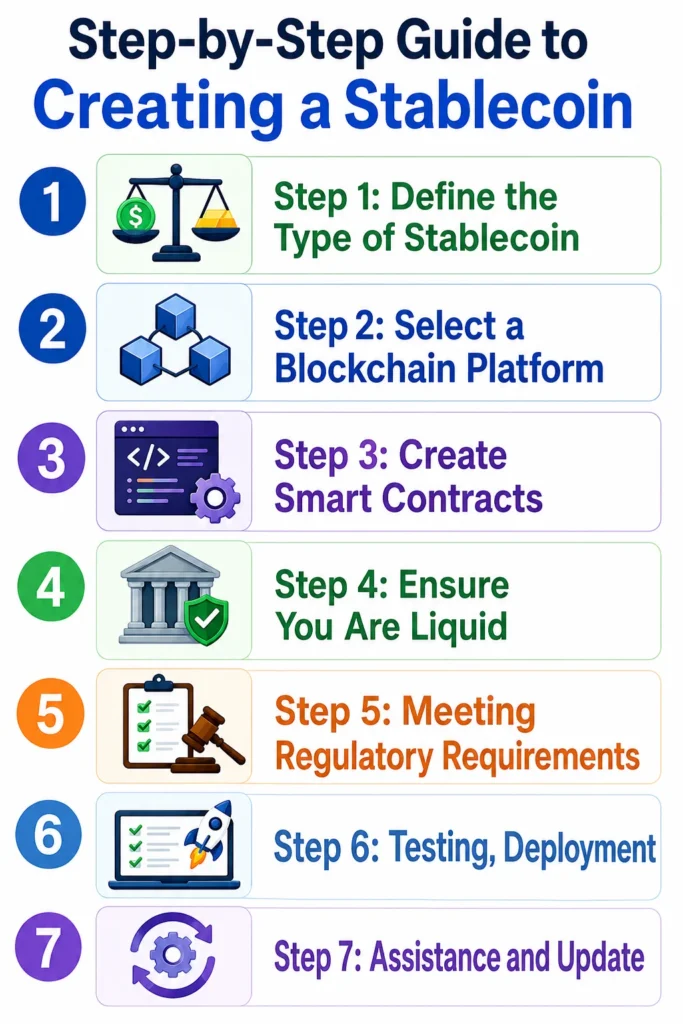
Step 1: Define the Type of Stablecoin
1. Stablecoins Backed by Fiat:
- Description: Backed by comparable reserves in custody accounts and pegged to fiat currencies like USD or EUR.
- Example: Tether (USDT), USD Coin (USDC)
- Pros: Simple structure. Fiat backed, therefore people trust it.
- Challenges: Trust needs to be based on transparency and regular audits.
2. Stablecoins backed by crypto:
- Backed by cryptocurrencies like ETH, generally over-collateralized to hedge against price volatility.
- Example: MakerDAO’s DAI.
- Advantages: Decentralized and trustless, stable due to smart contracts.
- Challenges: Vulnerable to volatility in the crypto market, need strong collateral management mechanisms.
3. Algorithmic Stable Coins
- Description: Keep prices stable with algorithms and smart contracts that change supply as needed.
- Example UST (Ecosystem of Terra)
- Advantages : No requirement for reserves , capital efficient .
- Challenges: Extremely complex and will collapse if demand goes off a cliff.
Step 2: Select a Blockchain Platform
1. Ethereum:
Pros: Extensive Ecosystem, Robust Developer Community, DeFi Protocol Friendly
Cons: High network fees on congestion.
2. Binance Chain(BSC):
Pros: How to create a Stablecoin benefits include lower transaction fees and faster processing.
Cons: Not as decentralized as ethereum.
3. Solana:
Pros: Fast throughput, cheap costs. Suitable for scalable stablecoin applications.
Cons: Ethereum ecosystem is less established.
Which one you choose depends on the technical and operational requirements of your stablecoin, such as scalability, cost of transactions, and compatibility with existing decentralized apps (dApps).
Step 3: Create Smart Contracts
Your stable coin architecture is driven by smart contracts that automatically manage essential procedures such as minting, burning and collateral management. Here are some important factors for stable coin smart contract development and d
- Automation: Create contracts that regulate stablecoin in the USA supply/demand and stabilize prices.
- Transparency: Use open source code and allow external audits to promote user trust.
- Security: Conduct security audits to combat vulnerabilities and hacks.
- Work with professional blockchain developers like IdeaSoft for reliable smart contract development tailored to your stablecoin requirements.
Step 4: Ensure You Are Liquid
Liquidity is essential for the fiat-based stablecoin development stability and usage of your stablecoin. Strategies for maintaining adequate liquidity include:
- Exchange Integration: Have your stablecoin listed on centralized (CEXs) and decentralized exchanges (DEXs) for trade.
- Market Makers: Work with market makers to deliver liquidity across trading pairs.
- Reserve Management: Hold algorithmic stable coin development sufficient reserves in secure custodian accounts for fiat-backed stablecoins.
Step 5: Meeting Regulatory Requirements
Regulatory compliance is non-negotiable when it comes to stablecoin development. The key steps are:
- Research the Jurisdictions Understand the legal landscape of stablecoins in the markets you want to enter.
- AML/KYC Policies: Enforce strong anti-money laundering (AML) and know-your-customer (KYC) policies.
- Licensing and Audits: Obtain required licenses and perform periodic audits to foster transparency and user confidence.
Step 6: Testing, Deployment
Prior to How to create a Stablecoin, you have to guarantee it functions and is trustworthy through thorough testing:
- Testnet Deployment: Deploy on a testnet to simulate real-world situations without endangering user payments.
- Security Audits: Full audits of smart contracts and the system as a whole.
- User Feedback: Get early adopters to provide you feedback on the product and improve it based on their feedback.
- Once testing is done, put the stablecoin on the mainnet with a solid launch plan.
Step 7: Assistance and UpdateHow to create a Stablecoins
Post-launch success of stable coin platform development is contingent on continued support and enhancement:
- Customer Support: Offer easy to use customer support channels to answer user questions and concerns on how to create a stablecoin
- Performance Monitoring: Use analytics tools to monitor adoption rates, transaction volumes, and system performance.
- Continuous Deployment: Roll out updates to smart contracts and the backend infrastructure to adapt to changing market conditions and regulatory requirements.
Regulatory Compliance: A Practical Checklist
For the first time, a business can run stablecoin payment rails across the US, EU and Asia under clear, codified rules. The GENIUS Act (US, July 2025), MiCA (EU), and frameworks across Asia all need full reserve backing, regular attestations, and AML/KYC compliance — but the details vary in ways that matter operationally.
What should finance teams implementing stablecoin payments worry about? The operational checklist:
Provider licensure (non-negotiable): Verify that your provider is licensed in your operating areas. If the provider cannot give you their license numbers for your target markets, move away.
Transaction monitoring (table stakes) : Stable coin integration solutions supplier should be able to monitor for suspicious behavior, do real-time AML/KYC screening and sanctions list checks. This should be part of the platform not an add-on. 90% of institutions assessed by Fireblocks are live, piloting or developing stablecoin programs — the compliance tooling has grown up to institutional norms.
Audit trail mapping: The transactions on a blockchain are auditable by nature on how to make a stablecoin. However, your supplier needs to map the on-chain records to your accounting system in a format your auditors can use. Ask if they’re ISO 20022 compatible and what standard export formats they support
Tax Treatment: Depending on the jurisdiction on how to create a stablecoin, transactions involving stablecoins may result in taxable events. In the EY-Parthenon study, 50% of U.S. respondents said accounting and tax clarity was a problem. Pilot before you meet with your tax expert, not after.
Multi-jurisdiction complexity: If you are running operations in the US, EU and Asia simultaneously, you have to deal with multi-chain stablecoin frameworks. The GENIUS Act has redemption windows of 72 hours but MiCA has a 24 hour requirement. 79% of financial institutions (EY-Parthenon) want to engage a third-party technology partner to manage this complexity, rather than build it in-house.
What infrastructure is needed to launch a stablecoin?
Stable coin token development needs a whole stack of technologies to maintain the coin stable, compliant and usable. The infrastructure ties the blockchain to banks, custodians, identity checks, wallets and payment networks.
Smart contracts
Many stablecoins begin with a smart contract design that facilitates the minting, burning, and transfers on how to create a stablecoin. If you are building on a big chain like Ethereum you should follow a standard token format so wallets and apps can use it right away.
If you are working on a crypto-backed or algorithmic design, you must use smart contracts. You may add collateral vaults, pricing oracles to bring offchain data onto the blockchain, liquidation logic and governance modules. These contracts should be examined, monitored and built for safe upgrades.
Reserve System Management
If the coin is backed by fiat or commodities, you need secure custody of the underlying assets. This means stablecoin banking integrations or trust relationships, automated reconciliation between onchain and offchain systems, and explicit processes for minting upon receipt of cash and burning upon token redemption.
Crypto backed projects replace banks with onchain collateral contracts, but still need fully integrated oracles and dashboards to provide reserve status in real time. Transparency is an integral part of the infrastructure in both models, not an afterthought.
Controls on compliance and identity
Stablecoin compliance stack is where crypto meets traditional finance. There is a compliance infrastructure, for things like Know Your Customer (KYC) and Anti-Money Laundering (AML). Issuers often need to do KYC, AML and sanctions screening on flows related to reserves and produce routine reports to authorities, to mint and redeem.
Such systems need to fit seamlessly into the technical stack, so that compliance doesn’t become a bottleneck.
Wallets, payments & integrations
The token is as vital as user access. Many stablecoins are built on existing wallets but some teams are working on creating unique apps or application programming interfaces (APIs) to make minting, redeeming and everyday use easier.
If your stablecoin is for payments or payouts, integrations matter. Businesses, payroll tools, exchanges, custodians and payment networks need a simple way to manage your token. Take Stripe, for example, which accepts stablecoin payment infrastructure in USD Coin (USDC), making it easy for issuers that follow common technological standards to plug in to global payment networks.
Controls and Security
How can organisations plan a stablecoin project?
A stablecoin project can succeed if it clearly aligns its economic model, technical architecture, regulatory strategy and user experience. Now that you have built your stablecoin, here’s what you’ll also need to do to get ready for launch:
Follow the regulatory breadcrumbs: Determine the jurisdictions you will be operating in, how your stablecoin could be categorized, and licenses/approvals you may require. By planning legally early you may avoid launch delays and establish compliance workflows before they become barriers.
Choose the technology stack: select the blockchain, token standard oracle providers, custody partners and any middleware (software that enables independent applications to communicate) required to integrate onchain activity with offchain services.
Design the architecture with risk in mind: What are the mechanics of minting, burning, reserves, governance and emergency controls? How will the system behave under stress?
Test and audit thoroughly: Simulate common and extreme situations; carry out internal testing and commission independent audits of smart contracts and processes.
Plan staggered rollout: Start with a tiny amount, watch the peg and user behaviour and increase supply slowly as confidence grows. The system achieves early equilibrium through close collaboration with custodians, market players and partners.
Commit to continuing governance and maintenance: Establish a regular cadence for reserve reporting, risk reviews, contract upgrades and user communication.
Strategic Planning for Stablecoin Issuers
Secure programming is only part of the puzzle for a successful stablecoin. Issuers shall develop a sustainable economic model that creates incentives for liquidity providers and preserves market confidence.
- Providing liquidity. Stablecoins require broad liquidity pools on decentralized exchanges to reduce slippage when being traded. Issuers often run initial capital or incentive programs to draw early liquidity.
- Revenue Models fiat-backed issuers make revenue by storing the fiat collateral in low risk yield bearing instruments like government bonds Crypto-backed protocols may collect fees for minting or interest on loans.
- Integration strategy: To encourage acceptance, issuers are eager to engage with DeFi protocols, payment processors and existing infrastructure suppliers.
How Stablecoins Address Volatility
Issue | Description | Impact |
Speculation-Driven Price Swings | Prices are influenced by investor behavior and market sentiment, often leading to dramatic fluctuations | Creates uncertainty and discourages long-term adoption |
Lack of Intrinsic Value | Many cryptocurrencies lack tangible value, making prices highly dependent on perceived demand | Amplifies volatility and reduces market stability |
Thin Liquidity | Limited market liquidity exacerbates price swings during high buying or selling pressure | Increases susceptibility to sudden and sharp price movements |
Regulatory Uncertainty | Inconsistent global stablecoin regulations lead to uncertainty and sudden market reactions | Discourages institutional participation and trust in the market |
Limited Real-World Use | Cryptocurrencies are not widely adopted for transactions or as a store of value | Limits demand stability and reliance as a practical financial tool |
Why Choose Shamlatech for Stablecoin?
Shamla Tech provides end-to-end stablecoin development and top cross-chain stablecoin solutions tailored for enterprises, fintech platforms, and financial institutions. From smart contract development and blockchain integration to compliance automation and liquidity management, Shamla Tech delivers secure, scalable, and regulation-ready stablecoin infrastructure.
The company supports multiple blockchain networks, enabling businesses to launch fiat-backed, crypto-backed, or custom stablecoins with seamless interoperability. With a strong focus on AML/KYC compliance, security audits, and enterprise-grade architecture, Shamla Tech helps organizations reduce transaction costs, improve cross-border payments, and accelerate digital finance adoption. Their expertise in tokenization and blockchain innovation makes them a reliable technology partner for launching stablecoins in 2026 and beyond.
Build a Powerful Stablecoin Ecosystem for Your Business
Conclusion
Stablecoins have changed the crypto world by fixing one of the biggest problems in the crypto world – volatility. These new digital assets serve as a bridge between the fast-paced, decentralized blockchain environment and the stability needed for mainstream adoption. Stablecoins have become vital instruments for businesses, investors and individuals, offering price consistency, faster and cheaper transactions, and more financial inclusion.
Creating a stablecoin is hard work but can be very rewarding. It takes a lot of preparation, technical knowledge, and a commitment to following the law. For your stablecoin project to succeed, every step counts, from identifying the type of stablecoin, selecting the correct blockchain platform, to guaranteeing robust smart contract development. Managing liquidity, rigorous testing, continual updates, all of these are equally important to ensure stability, security and long-term trust from users.
FAQ'S
1. What is the main purpose of creating a stablecoin?
2. Which blockchain is best for stablecoin development in 2026?
3. What are the different types of stablecoins?
Stablecoins are mainly divided into three categories:
- Fiat-backed stablecoins backed by currencies like USD or EUR
- Crypto-backed stablecoins supported by digital assets such as ETH
- Algorithmic stablecoins that maintain price stability through automated supply mechanisms
Each model has different advantages, risks, and infrastructure requirements.