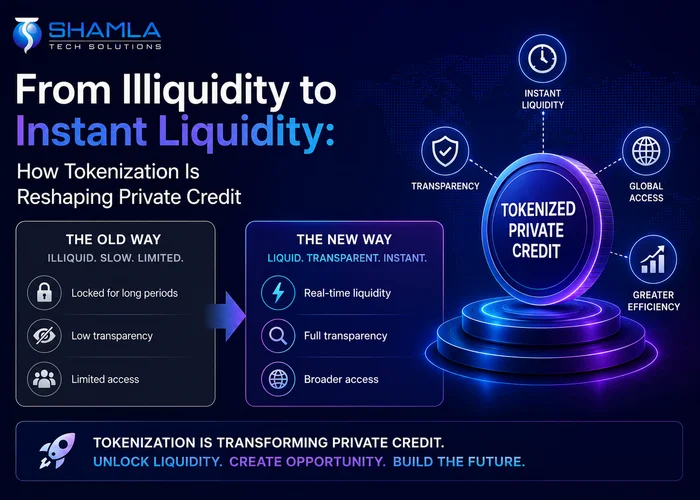

Private Credit Tokenization Is Reshaping Alternative Finance by transforming one of the most traditionally illiquid asset classes into a more accessible, transparent, and efficient investment ecosystem. For decades, private credit markets have been dominated by high entry barriers, lengthy lock-in periods, slow settlements, and limited secondary market opportunities. Institutional investors often faced operational inefficiencies and restricted liquidity despite the growing popularity of private debt as an alternative investment strategy.
Today, blockchain-powered tokenization is changing that landscape. By converting private credit assets into digital tokens, financial institutions can enable fractional ownership, faster settlements, automated compliance, and improved liquidity access through regulated digital marketplaces. Tokenization also enhances transparency by recording transactions and ownership data on immutable blockchain networks.
As institutional demand for alternative finance continues to grow, tokenized private credit is emerging as a major innovation bridging traditional finance and decentralized infrastructure. The result is a more scalable, flexible, and globally accessible private credit market for the next generation of investors.
A Private Credit Fund Enters the Tokenized Market
A mid-sized private credit tokenization is reshaping alternative finance fund managing a portfolio of secured company loans is seeking to broaden its investor base and improve liquidity without running afoul of regulations. The fund’s offering is generally restricted to protracted lock-in periods and manual interest disbursal with very few secondary market prospects.
Tokenization of Underlying Asset
TALM allows the fund to tokenize its loan agreements as digital securities, encoding attributes such as coupon rates, repayment schedules, and maturity dates. Each private credit tokenization is reshaping alternative finance and token reflects a partial ownership of the underlying credit exposure.
DyCIST to Enforce Compliance
DyCIST guarantees that only confirmed, jurisdictionally eligible investors can participate. KYC/AML checks, investor accreditation and transfer limitations are encoded at the token level and enforced in real time, removing the need for manual oversight.
Investor Access & Integration
Qualified Investors Thru DyCIST Built-In Whitelisting Process Incorporated All offerings are visible via an easy-to-use platform and tokens can be subscribed to or managed in a fully transparent way.
Automated Reporting & Service
TALM automates interest payments, tracks repayment progress and updates token metadata when the underlying loans change. This allows investors to get quick returns and accurate reporting without the delays of intermediaries.
Integrating the Secondary Market
The private credit tokenization is reshaping alternative finance and the fund chooses to list these tokenized credit products on a regulated digital asset marketplace that is integrated with DyCIST. This enables compliant peer-to-peer trading, allowing investors to abandon positions, which is rare in traditional private credit.
Regulatory Clarity is Taking Shape
The major U.S., European, UAE and Singapore authorities are engaging more actively with tokenized financial assets through pilot projects, digital asset standards and innovation sandboxes.
In the United States, activities by the SEC and FINRA are indications that there is a wider recognition of the role that blockchain plays in securities markets, notably in the area of transfer agent registration and custody.
MiCA law and DLT Pilot Regime of European Union provide a defined framework for issuance and trading of tokenized securities in regulated environments.
Singapore and the UAE are leading the way in advancing the rate of adoption and development by allowing financial institutions to explore tokenization use cases in a controlled environment through regulators.
These advances are in line with Shamlatech’s architecture and compliance first attitude. With integrated jurisdiction-specific rules, including full auditability and identity management, DyCIST and TALM provide a confidence route for institutions to participate in tokenized debt markets without sacrificing legal requirements.
What Are Institutional Investors Looking for in Private Credit?
Not all opportunities are created equal as more investors move into the private credit tokenization is reshaping alternative finance. What institutional investors care about:
- Security & Capital Preservation – The senior secured loan structure provides lenders with a preferential claim on a borrower’s assets, and greater downside protection than unsecured credit schemes
- Liquidity Considerations — Private lending has historically been illiquid and has required multi-year lockups. However, newer models like tokenized credit are offering better liquidity alternatives for faster cycles of redemption.
- Diversification & Non-Correlation — Private credit has demonstrated low correlation to public markets, making it a great portfolio diversifier, especially during times of economic instability.
- Inflation Hedge – Many private credit assets, such as floating-rate senior loans, can act as a hedge against inflation when they reprice with higher interest rates.
The Future of Private Credit
Private credit markets and private credit tokenization is reshaping alternative finance continue to evolve and there are certain significant trends that are defining the next wave of institutional adoption:
- Expanded Institutional Allocations — The specialized market is now a preferred investment route. Family offices, private banks, foundations and endowments are expected to increase allocations to the $1.7 trillion asset class during the next two years.
- New Liquidity Solutions — Structured secondary markets for private credit are emerging, offering more flexibility for investors.
- Tokenization & Digital Marketplaces – We expect tokenized private credit strategies to see greater usage as regulatory clarity increases and platforms provide institutional-grade access.
- Tokenized private credit and private credit tokenization is reshaping alternative finance and now makes up the biggest and fastest-growing share of all tokenized real-world assets (RWAs), expanding much faster than other asset classes like as U.S. Treasuries and corporate bonds.
Bringing Institutional-Grade Private Credit On-Chain
As private credit tokenization is reshaping alternative finance continues to grow in popularity with institutional investors, new financial structures are being explored to tackle conventional concerns such as liquidity limits, high entry barriers and inadequate transparency. Tokenization is one of the most promising developments in this sector.
Tokenization is the digitization of financial assets and their representation in the form of tokens on a blockchain. What this means for private credit is that investors can access typically illiquid credit methods in a more flexible, transparent, format.
Some of the main benefits are:
- Increased Liquidity — Tokenization offers additional liquidity possibilities, providing better access and redemption opportunities than traditional private credit structures. Most private credit funds have lockups of a few years, but the digital infrastructure of tokenized structures could provide more flexibility.
- Expanded Access — Institutional investors can access high-quality credit strategies at substantially lower minimums than traditional private credit funds.
- Enhanced transparency and efficiency – Transactions and holdings are stored on an unalterable blockchain ledger, enhancing efficiency and lowering settlement periods.
Why Choose Shamla Tech for Private Credit Tokenization?
As institutional investors increasingly move toward tokenized private credit solutions, choosing the private credit tokenization is reshaping alternative finance and right technology and compliance partner becomes critical. Shamla Tech provides a comprehensive infrastructure designed to help institutions tokenize private credit assets securely, compliantly, and efficiently.
Here’s why businesses and institutional investors choose Shamla Tech for private credit tokenization is reshaping alternative finance:
Compliance-First Architecture
Enhanced Liquidity for Traditionally Illiquid Assets
Institutional-Grade Security & Transparency
Automated Interest Payments & Reporting
Lower Entry Barriers for Investors
Global Regulatory Alignment
Faster Settlement & Operational Efficiency
Why Choose Shamlatech for Private Credit Tokenization?
Private Credit Tokenization Is Reshaping Alternative Finance by transforming one of the most traditionally illiquid asset classes into a more accessible, transparent, and efficient investment ecosystem. For decades, private credit markets have been dominated by high entry barriers, lengthy lock-in periods, slow settlements, and limited secondary market opportunities. Institutional investors often faced operational inefficiencies and restricted liquidity despite the growing popularity of private debt as an alternative investment strategy.
Today, blockchain-powered tokenization is changing that landscape. By converting private credit assets into digital tokens, financial institutions can enable fractional ownership, faster settlements, automated compliance, and improved liquidity access through regulated digital marketplaces. Tokenization also enhances transparency by recording transactions and ownership data on immutable blockchain networks.
Shamla Tech is helping accelerate this transformation with enterprise-grade tokenization infrastructure designed for institutional finance. From compliance automation and smart contract integration to investor onboarding and secondary market enablement, Shamla Tech delivers secure and scalable private credit tokenization solutions tailored for the evolving alternative finance ecosystem.
Conclusion
Private credit is no longer an alternative investment on the periphery, it’s a basic allocation for institutional portfolios. With the advancement of financial innovation, tokenization will revolutionize how investors access private credit, bringing liquidity, transparency and efficiency to an asset class that has traditionally been plagued with lock-ups and convoluted arrangements.
Capital preservation remains a key reason institutional investors continue to pursue private credit, especially senior secured loan schemes, for stable risk-adjusted returns. And with tokenization opening up new levels of access and liquidity, the future of private credit investing is only beginning.