


The digital asset market is quickly evolving past speculative experimentation and into enterprise-grade financial stablecoin infrastructure. Stablecoins are one of the most commercially feasible inventions among the different blockchain-based financial instruments for modern payment ecosystems, institutional stablecoin settlement frameworks and programmable finance applications. They are a building block of the future generation financial stablecoin infrastructure, capable of providing price stability and facilitating cross-border digital transactions.
Stablecoin development is no longer the domain of crypto-native startups in 2026. Banks, fintech companies, payment processors, asset tokenization platforms and international corporations are looking into stablecoin integration to streamline treasury, enable cross-border remittances, digital commerce and real-time settlement functions. However, the growing regulatory scrutiny and cybersecurity concerns have dramatically increased the technical and operational requirements for adoption.
Building a viable stablecoin ecosystem today requires a strategy plan that integrates blockchain engineering, reserve transparency, governance controls, compliance stablecoin infrastructure and corporate Stablecoin Security Risks architecture. New entrants to the space have to think about deployment of stablecoins as a regulated financial stablecoin infrastructure project, not a traditional token issuance project.
Explore Stablecoin Infrastructure For Digital Finance
The Expanding Role of Stablecoins in Enterprise Financial Systems
Stablecoin infrastructure is emerging as liquidity bridges between traditional finance and decentralized digital ecosystems. They are not just useful for crypto exchanges and decentralized finance platforms but also for more general enterprise applications such as payroll processing, merchant settlement, supply chain finance and tokenized asset marketplaces.
Increasing institutional interest in stablecoin infrastructure is mostly driven by operational efficiency. Conventional cross-border stablecoin settlement systems are characterized by a large number of intermediaries, long reconciliation cycles and high transaction costs. Blockchain enables real-time settlement processes, removing many of these inefficiencies through stablecoins.
Now many enterprise industries are actively building stablecoin infrastructure:
- Cross-border payment networks
- Digital banking ecosystems
- Tokenized real estate platforms
- Global B2B payment platforms
- Liquidity and Treasury Management Systems
- Interoperability layers for decentralized finance
But these benefits do not, by themselves, guarantee long-term viability. The ecosystem of stablecoin infrastructure needs to prove the integrity of the reserves, the openness of the stablecoin regulations and the systemic resilience to preserve the confidence of institutions. The demise of badly managed digital assets in prior market cycles has underscored the need for financial accountability and operational stablecoin risk management.
Businesses are therefore turning to stablecoin architectures that combine technology innovation with governance maturity and compliance readiness.
Stablecoin Regulatory Compliance
The stablecoin infrastructure environment is being profoundly changed by regulatory maturity. Governments and financial authorities in major worldwide economies are developing tighter control mechanisms for digital assets to address systemic financial risks, consumer protection issues and susceptibility to criminal transactions.
In 2026, the stablecoin compliance stack can no longer be a post-deployment modification layer. It must be built directly into the stablecoin architecture from the start of development.
Modern global stablecoin compliance systems usually encompass:
- AML & KYC Onboarding Solutions
- Blockchain forensic analytics & transaction monitoring
- Transparency and audit reporting of reserves
- Suspicious activities automated detection
- Workflows for jurisdictional licensing
- Dispute resolution and redemption mechanisms for consumers
The development of legal frameworks like the European Union’s Markets in Crypto-Assets Regulation (MiCA) has fueled global demand for uniform governance procedures. Today, institutional investors demand operational accountability from stablecoin issuers in the same way they do from any other financial institution.
Likewise increasingly tied to interoperability is compliance Multi-jurisdictional stablecoins will have to provide for different reporting requirements, tax regimes and financial transparency needs. Failure to manage these challenges may subject organizations to legal liabilities and reputational concerns.
As such, regulatory congruence is no longer seen as a constraint to innovation but as a critical enabler to institutional adoption and mainstream financial integration.
Quick comparison: Global stablecoin regulations (2026)
Jurisdiction | Framework | Status | Key Regulator |
United States | GENIUS Act | Signed into law in July 2025 | OCC, FinCEN, FDIC |
European Union | MiCA | Live since mid-2024 | ESMA + National Competent Authorities in each member state |
United Kingdom | The Financial Services and Markets Act 2000 (Cryptoassets) Regulations 2025 | In development | FCA, Bank of England |
Singapore | MAS Framework | Live since August 2023 | MAS |
Hong Kong | Stablecoin Ordinance | Live since August 2025 | HKMA |
UAE | Payment Token Regulation | Live since August 2024 | CBUAE |
Japan | Payment Services Act | Crypto changes enacted in 2025 | FSA |
Why are stablecoins being regulated in 2026?
If your board or executive team has been wondering if stablecoins belong in your payment stack, you are not alone. Stablecoins have become a serious instrument for global payments by 2025, from a niche crypto product.
You probably already see the use cases: moving money faster across borders, decreasing settlement risk, offering clients 24/7 in different currencies. Regulators have been pushed to act by that enterprise demand.
The pattern is the same all across the world – stablecoins can improve the efficiency of payments if they are allowed to function under the same regulations as traditional banking.
Now, worldwide regulators are establishing clear standards for organizations offering crypto services and for stablecoin issuers.
How Do Stablecoins Work?
Examples of Stable Coins
Types of Stablecoin, Reserve System and Regulation
Fiat-Backed Stablecoins: The Balance Sheet Model
How the peg is kept
The key mechanism is arbitrage via issuance and redemption and for Stablecoin Depeg
- If the token is trading above $1, the authorized participants will issue fresh tokens to sell, which will push the price down.
- For less than $1, participants purchase tokens at a discount and redeem them for $1, driving the price upward.
- This only works if redemption is dependable and rapid enough to be relevant in stress.
What reserves can mean in practice
What “fully backed” is not a single requirement; it depends on reserve composition and liquidity:
- The best kind of support is cash and deposits with the central bank.
- Short-dated government bills are liquid, but they have interest-rate and market-liquidity dynamics.
- The introduction of credit risk and crisis correlation through commercial paper, corporate bonds, or other credit instruments.
- Bank deposits concentrate risk into the banking partners they go into.
- Even if a stablecoin is ‘backed’, the backing can still be fragile if it is not liquid at the moment of panic.
Structural Weaknesses
Usually, risk with fiat-backed stablecoins is concentrated in three areas:
The model is conceptually simple and substitutes crypto-native risk for well-known financial risk – stablecoin liquidity management mismatches, governance opacity, and reliance on centralized institutions.
- Crypto-collateralized stablecoins: over-collateralization and liquidation
- Crypto-collateralized stablecoins aim to remove the need of traditional reserve custodians by employing on-chain collateral, usually volatile assets, locked in smart contracts. Collateral values can fluctuate a lot, hence these systems tend to be overcollateralized.
How the peg is kept
A combination of the following keeps the peg:
- This approach views the stablecoin as a collateralized debt instrument and not a redeemable claim on cash.
The hidden dependence: market liquidity
- You can’t liquidate without buyers. Liquidation auctions can be efficient in quiet markets. In stressed markets the system relies on sufficient liquidity to absorb collateral sales without forcing prices down in a spiral.
- The essential question is whether, as collateral falls rapidly, liquidation processes will be faster than the price decline.
Structural deficiencies
Crypto-collateralized systems focus risk on:
- Collateral volatility and correlation: multiple crypto assets suffer together in a crisis, hollowing down buffers precisely when they are required.
- Liquidation cascades : prices fall , triggering liquidations , which sell collateral , which causes prices to fall even more , which could increase instability.
- Oracle risk: pricing feeds might fail, lag or be manipulated and solvency math becomes guesswork at the worst moment.
- Smart contract risk: Exploits, governance attacks, or parameter mistakes can impact collateral safety.
These systems can be rather durable if they are over-collateralized and handled conservatively, but they are structurally vulnerable to market-wide liquidity shocks.
Deploy White Label Stablecoin Platforms For Global Payments
Crypto-Collateralized Stablecoins: Liquidation and Overcollateralization
How the peg is kept
A combination of the following keeps the peg:
This approach views the stablecoin as a collateralized debt instrument and not a redeemable claim on cash.
The hidden dependence: market liquidity
You can’t liquidate without buyers. Liquidation auctions can be efficient in quiet markets. In stressed markets the system relies on sufficient liquidity to absorb collateral sales without forcing prices down in a spiral.
The essential question is whether, as collateral falls rapidly, liquidation processes will be faster than the price decline.
Structural deficiencies
Crypto-collateralized systems focus risk on:
- Collateral volatility and correlation: multiple crypto assets suffer together in a crisis, hollowing down buffers precisely when they are required.
- Liquidation cascades : prices fall , triggering liquidations , which sell collateral , which causes prices to fall even more , which could increase instability .
- Oracle risk: pricing feeds might fail, lag or be manipulated and solvency math becomes guesswork at the worst moment.
- Smart contract risk: Collateral safety relies on no exploits, governance assaults or parameter errors.
These systems can be surprisingly durable when overcollateralized and managed conservatively, but they remain structurally sensitive to market-wide liquidity shocks.
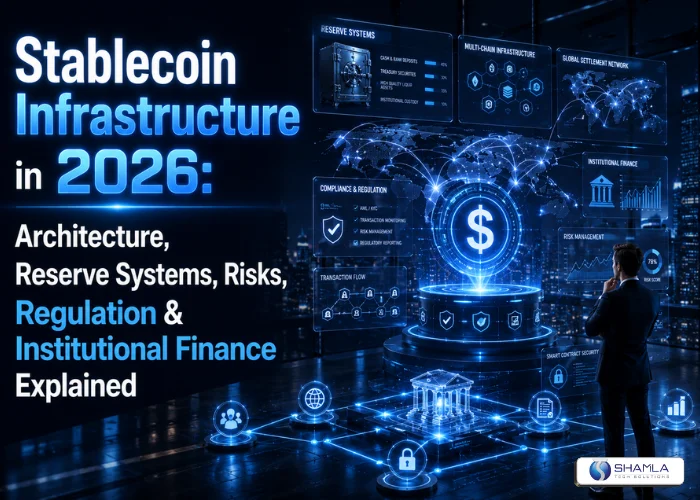
The Stablecoin Infrastructure Stack
As stablecoins mature, the ecosystem around them has blossomed into a whole financial technology stack.
At the bottom of this stack you have the blockchain settlement networks like Ethereum, Solana, Polygon, and other distributed ledger systems. These networks validate transactions and update the shared ledger that tracks stablecoin balances and ownership.
Stablecoin issuers reside above this foundation layer. Tokens issued by companies such as Circle, Tether, Paxos and Ripple are fiat-backed and backed by currency reserves held at authorized financial institutions. Corresponding reserves are put into custodial accounts when fresh stablecoins are produced. When tokens are redeemed, they are burned and reserves are returned.
Surrounding these essential elements is an infrastructure layer that is becoming more and more sophisticated. Custodial institutions including Fireblocks and BitGo are leveraging multi-party computation wallets and policy-controlled transaction platforms to maintain digital asset security. Compliance analytics companies analyze blockchain activities to assist with anti-money laundering enforcement. Stablecoins and traditional currencies are exchanged via liquidity providers and payment processors.
On top of this are payment orchestration platforms that route transactions across different blockchain networks, manage liquidity flows, and integrate stablecoins with current financial systems.
Finally, the ecosystem is connected to traditional financial railroads via on and off ramps, card networks and banking partners. These connections enable smooth transfers of stablecoins between traditional payment systems and blockchain environments.
The architecture goes beyond creating a new asset class. This is a new stack of financial infrastructure.