


The rise of blockchain adoption in capital markets has made tokenization more than a conceptual innovation, but a strategic infrastructural choice. Enterprises, asset managers and fintech companies are increasingly exploring tokenized securities, fractional ownership structures, and programmable financial instruments. But before jumping into construction, it’s important to ask a key question: what is the actual expense of creating a tokenization platform?
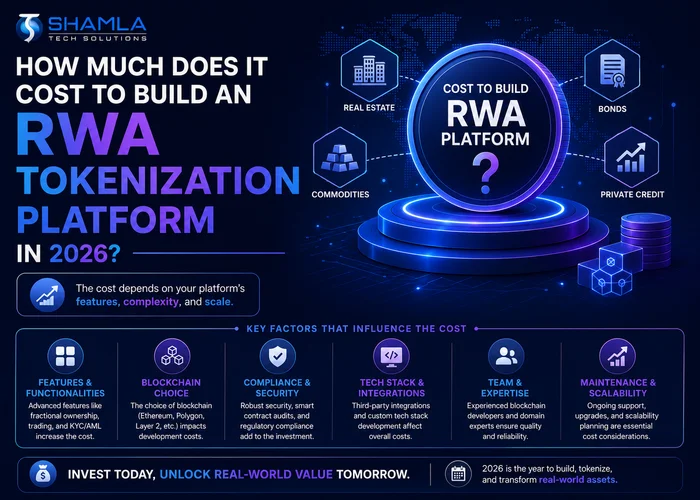
The RWA tokenization platform development cost 2026 goes well beyond the basic development time. The creation of a tokenization platform depends on several factors: the asset complexity, the required level of compliance, the security measures of the product, the number of integrations needed, and the scalability of the solutions for the future. Where the asset is a security or a tangible item in the real world, the real-world asset tokenization cost will also be inclusive of fees related to regulatory compliance, reporting requirements and custodial obligations.
In this blog we will discuss the many cost variables involved in tokenization and the different use cases of tokenization platforms across different types of assets and the timelines of executing a tokenization project. This article will provide a detailed follow up on how an organization may develop compliant digital asset ecosystems and includes several sample vendors and detailed RWA tokenization platform development cost 2026.
Key Factors That Influence Tokenization Software Development Pricing
1. Choosing the Blockchaina
The blockchain framework is responsible for the performance, scalability and RWA platform cost structure .
- Public chains may reduce the set up time but need gas optimization and scalability considerations.
- Enterprise blockchains need specific node setups and governance procedures.
- Cross-chain compatibility increases development complexity, but it enhances liquidity access.
- The choice of the right blockchain architecture can have a huge impact on the cost of developing a tokenization platform.
2. Complexity of smart contracts
Basic token contracts are rather straightforward. But security token standards with regulatory logic demand more engineering and testing.
Complex smart contracts usually have:
- Automating dividends
- Logic of revenue sharing
- Voting rights for investors
- Updates to the automated cap table
- Transfer gating based on compliance
The RWA tokenization platform development cost 2026 more because to extensive testing, formal verification and third-party audits, but these are necessary for institutional trust.
3. Regulatory Framework & Jurisdiction
Compliance requirements vary from country to country. Cross-border investor platforms need to integrate:
- Multi-jurisdictional Accreditation Standards
- Transfer Limits
- Frameworks for reporting
- Licensing and Certification Requirements
Legal structuring is often in conjunction with development, raising the real world asset tokenization cost. But if you ignore regulatory regulations, you may be in for costly changes later.
4. Security Architecture
Security is not only smart contracts. It contains:
- API encryption
- Firewalls on the network
- DDoS Protection
- Database security
- Monitoring tools, continuous
Third-party security audits are necessary for institutional-grade implementations. These solutions raise initial costs but reduce long-term operational risk.
5. Ecosystem of integrations
Tokenization development price of the platforms do not often function in a vacuum. They need to integrate with:
- Payment Gateway
- Banking APIs
- Providers of identity verification
- Alternative trading systems
- Reporting tools
The breadth of development also affects the RWA tokenization platform development cost 2026 and the total schedule for deployment; every integration adds to the scope.
How to Choose the Right RWA Tokenization Platform Development Company for Cost Efficiency ?
When you are evaluating the cost of building a tokenization platform and making sure it remains sustainable over time, it is crucial to select a qualified RWA tokenization platform development cost 2026 company. Tokenizations are taking place at several intersections — Blockchain Engineering, Financial Regulations, Cybersecurity, and Enterprise Architecture.
If you select a vendor that is not an expert on this, you will be exposed to compliance concerns, security issues, price overruns and eventually increased total cost to construct your RWA tokenization platform development cost 2026.
When evaluating for cost-effectiveness, don’t just look for the lowest dollar alternative and wind up selecting a Vendor that is not able to provide an infrastructure that is secure, compliant, scalable and all without unwanted rewriting/rework and/or hidden charges.
Evaluate demonstrated domain expertise
A qualified development partner should have experience with:
- Real World Asset Structuring (Real Estate, Private Equity, Debt Instruments, Funds)
- Regulatory mapping and securities token standards
- Implementation of smart contract security
- Institutional-grade custody integration
A vendor unfamiliar with regulated token issuance could underestimate the compliance layers, leading to scope revisions during the project. This directly raises the cost to establish a tokenization platform through lengthier development cycles and increased audit requirements.
Technical Architecture Capability Assessment
A good partner will have comprehensive documentation will help to build RWA platform:
- Selection of blockchain framework
- Node management architecture.
- Models of scalability
- Interoperability with exchanges and custodians
Cost efficiency is attained when the technical basis is built for long-term scalability. Poor architectural decisions often need costly redevelopment of components during later stages of the development of tokenization software.
Review Security and Audit Readiness
Institutional security norms must be satisfied by enterprise tokenization platforms. The development company should have a systematic methodology for:
- Smart contract audit
- Pen testing
- Structural strengthening
- Safe key management
If audit readiness is not included into development from the start, remediation expenses may be more than originally estimated, increasing the total real-world asset tokenization cost.
Think Post Launch Support & Upgradeability
Tokenization ecosystems need constant modifications because:
- Changes in Regulation
- Feature expansion
- Security improvements
- Diversify your holdings
A development partner providing structured maintenance models can reduce the long-term unpredictability of tokenization platform development cost and prevent unanticipated operational disruptions.
Look Into Pricing Structure Transparency
A professional RWA tokenization platform Development company will provide you:
- Clear documentation of scope
- Defined deliverables.
- Pricing milestones
- Separate distribution of audit and integration cost
A transparent price removes ambiguity and stabilizes the expected cost of the RWA tokenization platform development cost 2026 to ensure alignment of business goals with budget allocation.
Feature Map: What to Include on Your Platform (and What to Wait)
Core Must-Haves for Launch
Advanced Features to Add Later
Optional or Nice to have Features for scale
Realistic Cost Ranges Based on Current Data
Basic/MVP platform
Mid-Tier / Growth Stage Platform
Enterprise-Grade or Global Platforms
O&M Cost (Operations and Maintenance)
Conclusions
To construct a real estate tokenization platform in 2026, you need to plan well and budget. Discovery is the usual stage. Legal establishment is a popular term. Typical stages are platform and smart contract development. UI/UX design is a regular step. Jurisdiction compliance is a regular step. Auditing is a typical step. Security testing is a normal procedure. Market launch is a standard step. A typical step is scaling. A common phase is post-launch assistance. Every level effects prices and deadlines and is a trade off between features, security and investor experience. By understanding the drivers of overall cost, hidden expenses and lead time, businesses may build an effective, compliant and scalable tokenization platform. Blockchain App Factory’s Real Estate Tokenization Services offers a one-stop solution to establish a tokenized real estate project, from technical development to regulatory compliance and market launch.