


We are in the midst of a new era in the financial industry, where blockchain technology is revolutionizing the ownership and administration of real-world assets. As businesses, banks, investment firms, and governments seek more efficient ways to manage ownership, liquidity, and cross-border investments, asset tokenization platforms are playing an increasingly important role in the global financial ecosystem.
By 2026, asset tokenization will have moved beyond the realm of experimental blockchain initiatives and cryptocurrency firms. It has become an institutional quality financial model backed by major banks, fintechs, asset managers, and regulators around the world. Tokenization is being used more and more by sectors from real estate to U.S. Treasuries to commodities to carbon credits to private equity to infrastructure to increase accessibility, automate operations, and release illiquid assets.
The rise of Best Private Credit Tokenization Platform Development Company is fueled by various factors, including:
- Increasing institutional adoption of blockchain technology
- Call for more open and speedier financial systems
- Growing investor interest in fractional ownership models
- Growth in decentralized finance (DeFi) infrastructure
- Regulatory developments to support digital assets
- Demand for automated compliance solutions for enterprises
Modern tokenization solutions are now created with compliance-first architecture, AI-powered processes, corporate scalability, and multi-chain interoperability to fulfill institutional expectations.
A thorough reference to asset tokenization platforms for businesses in 2026. Discover how asset tokenization functions, its primary advantages, essential features, regulatory concerns, development expenses, and the trends influencing the digital asset economy.
Build a Future-Ready Private Credit Tokenization Platform
Why Asset Tokenization Matters in 2026
The asset tokenization matters in 2026 for multiple reasons,
- Limited liquidity
- Slow settlement times
- High transaction costs
- Geographic restrictions
- Complex paperwork
- Lack of transparency
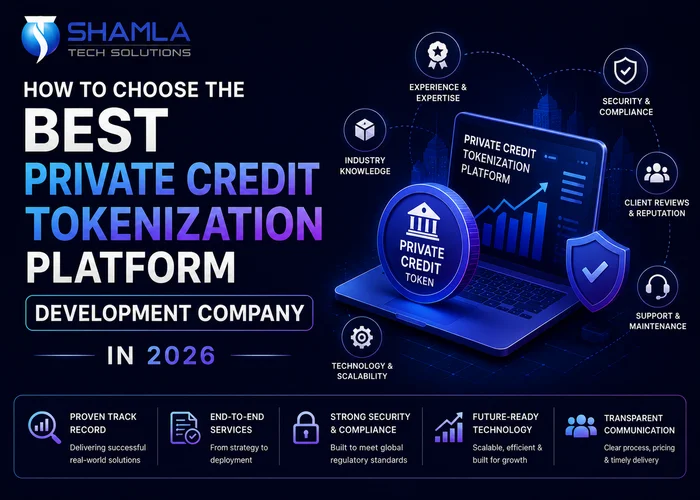
How to Choose the Right Asset Tokenization Platform?
Selecting the right tokenization platform depends on your business goals, compliance requirements, asset type, and scalability needs.
Businesses should evaluate:
- Regulatory compliance capabilities
- Blockchain compatibility
- Security and custody infrastructure
- Smart contract expertise
- Secondary marketplace support
- AI-powered compliance automation
- Multi-chain interoperability
- Enterprise scalability
A strong tokenization platform should not only support asset issuance but also provide long-term scalability, institutional security, and regulatory resilience.
Top RWA Platform Development Companies for Institutional Clients
Shamla Tech
In particular, ShamlaTech has emerged as a Best Private Credit Tokenization Platform Development Company for institutions and enterprises looking for custom-built, compliance-ready tokenization platforms. ShamlaTech is a strong technical executor and consultative partner. ShamlaTech is not simply a development vendor, but a long-term blockchain engineering partner.
One of ShamlaTech, the Best Private Credit Tokenization Platform Development Company biggest strengths is its ability to build end-to-end RWA platforms. The company covers all areas from asset tokenization architecture, smart contract development, compliance flows, investor dashboards, and post-launch scalability. This makes it particularly attractive to institutional clients who would rather have one accountable partner than have to orchestrate a number of vendors.
On the technology side, ShamlaTech, the Best Private Credit Tokenization Platform Development Company supports multi-chain RWA platforms such as Ethereum, Polygon, and permissioned blockchain environments designed for regulated use cases. The process of building smart contracts focuses on security, upgradeability, and preparedness for audits, which are all must-haves for institutional-grade deployments.
ShamlaTech also has a good awareness of financial and regulatory requirements, bringing KYC, AML, investor whitelisting, and jurisdiction-based transfer limits right into platform architecture. This compliance-first approach reduces regulatory friction and speeds up time-to-market for institutional clients.
ShamlaTech, a strong private credit partner 2026, emphasis on customisation and scalability is another differentiator. Instead of supplying rigid one-size-fits-all systems, the company develops modular RWA platforms that are able to adapt to evolving rules, new asset types, and growing transaction volumes. That flexibility is especially useful for asset managers, fintechs, and organizations with long-term plans for tokenization.
ShamlaTech, the Best Private Credit Tokenization Platform Development Company, will be a good choice for institutions looking for customized RWA solutions, strong technological ownership, and continuous platform improvement rather than ready-made tokenization tools.
ConsenSys:
Consensys is one of the most significant actors in the blockchain ecosystem in the enterprise and institutional sectors. ConsenSys, one of the Best Private Credit Tokenization Platform Development Company, has extensive roots in Ethereum infrastructure and develops RWA platforms using technologies such as Codefi Assets, which is purpose-built for institutional tokenization.
Their strength is the combination of blockchain competence and regulatory awareness. ConsenSys has a proven track record of working with banks, asset managers, and governments, making us a trusted partner for large-scale institutional deployments.” Hire credit developers with great industry experience and exposure.
R3
R3, being the Best Private Credit Tokenization Platform Development Company has a Corda blockchain that is used by several financial institutions across the globe. Unlike public blockchains, Corda is built for regulated environments and is a natural fit for institutional RWA platforms.
R3 is a leader in privacy, interoperability, and enterprise integration.” They have close contacts with the banks and financial institutions and hence have unique insight into what institutions need and expect in terms of compliance.
Fireblocks
Fireblocks provides institutional-grade infrastructure for digital assets, including custody, transfers, and security. Fireblocks is an important player in providing safe RWA platforms for institutions, while not being a traditional development agency.
Their technology is commonly incorporated with RWA systems to provide private key management, asset transfer, and policy enforcement. “Institutions select Fireblocks because of its security-first approach and proven track record.
Securitize
Securitize, the Best Private Credit Tokenization Platform Development Company is a leader in regulated tokenization, especially in securities and investment funds. Their technology allows institutions to issue, manage, and trade tokenized assets in accordance with securities rules.
Securitize is a regulatory-approved and well-established player in capital markets. Securitize was selected by institutional clients for its end-to-end solution, including issuance, compliance, and secondary trading.
Request a Customized Development Roadmap
Conclusion
As private credit markets continue their digital transformation, selecting the right tokenization platform development company is a critical decision that can determine the success of your project. The ideal partner should combine deep expertise in blockchain technology, regulatory compliance, smart contract development, security, and financial infrastructure integration. Beyond technical capabilities, look for a team that understands the complexities of private credit assets and can deliver a scalable, compliant, and investor-friendly platform.
By evaluating top credit tokenization company based on their experience, security standards, regulatory knowledge, customization capabilities, and post-launch support, you can confidently build a tokenization platform that enhances liquidity, streamlines operations, and unlocks new investment opportunities. In 2026 and beyond, partnering with the right development company will be essential to staying competitive in the rapidly evolving digital asset ecosystem.
FAQs
1. Why do institutions need specialized RWA platform developers?
2. Are public blockchains suitable for institutional RWA platforms?
3. What is the biggest risk in institutional RWA platforms?
4. Can institutions build RWA platforms in-house?
5. How long does it take to launch an institutional RWA platform?
Typically six to twelve months, depending on complexity.