

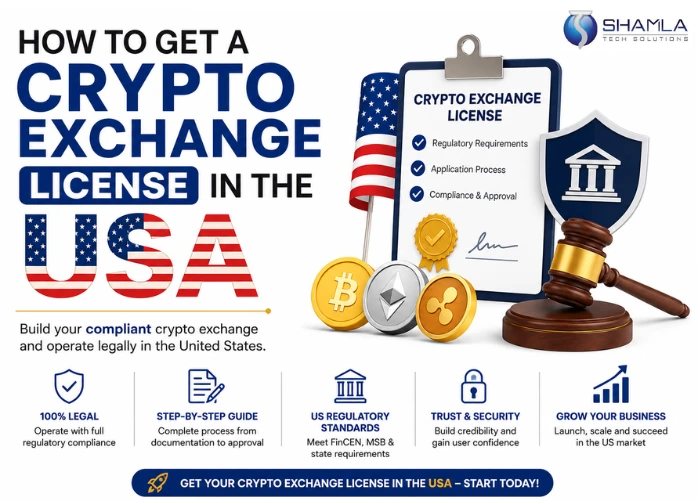

To launch a cryptocurrency exchange trading platform in the United States, businesses require identifying which federal registrations, state licenses, financial safeguards, cybersecurity controls, and compliance programs apply to their specific business model.
There is no universal Crypto Exchange License in the USA that covers every jurisdiction and activity. Most businesses need a combination of FinCEN Money Services Business registration, state-level authorization, and additional regulatory analysis based on the assets and products offered.
This article highlights the legal requirements to get a license in the USA from qualified regulatory counsel to launch a cryptocurrency exchange platform.
What Is a Crypto Exchange License?
A Crypto Exchange License is a general commercial term for the registrations, licenses, approvals, and compliance obligations that allow a business to offer cryptocurrency exchange services legally.
This may include federal MSB registration, one or more state Money Transmitter Licenses, New York’s BitLicense, California’s Digital Financial Assets Law license, or securities and derivatives registrations. FinCEN states that a business acting as an administrator or exchanger of convertible virtual currency may be treated as a money transmitter unless an exemption applies.
A licensing strategy can help your business:
- Operate in approved U.S. jurisdictions.
- Establish banking and fiat-payment partnerships.
- Demonstrate governance and financial responsibility.
- Build institutional and customer confidence.
- Reduce enforcement and launch-delay risks.
- Prepare the platform for audits and regulatory examinations.
- Expand into additional states through a structured roadmap.
Launching a digital assets trading platform without confirming its licensing obligations can result in blocked payments, banking rejection, customer restrictions, financial penalties, or a complete redesign of the platform.
Can platform development happen during licensing?
Yes. Cryptocurrency exchange development and licensing can run at the same time. However, both teams must work from the same approved product scope. Adding custody, margin trading, new token classes, or fiat-payment features during development may change the licensing analysis.
7 Steps to Get Crypto Exchange License
A successful Crypto Exchange License project should connect legal analysis, compliance design, financial readiness, and technology implementation.
Step 1: Define the exact business model
Document whether the platform will offer spot trading, fiat on-ramps, hosted wallets, custody, staking, token issuance, OTC services, margin, derivatives, institutional accounts, or peer-to-peer trading.
Do not begin cryptocurrency exchange development using an undefined product scope. Small functional changes can alter the licensing analysis.
Step 2: Map customer and asset flows
Prepare diagrams showing how fiat and virtual assets move between customers, wallets, banks, liquidity providers, custodians, and the exchange. Identify which entity possesses or controls customer assets at every stage.
Step 3: Complete federal and state regulatory analyses
Determine whether the company is an MSB, money transmitter, broker-dealer, securities exchange, alternative trading system, commodity intermediary, derivatives venue, custodian, or another regulated entity.
Create a state-by-state licensing matrix before deciding where the cryptocurrency exchange trading platform will accept customers.
Step 4: Establish the applicant entity and ownership structure
Regulators generally review direct and indirect owners, controlling persons, directors, senior officers, compliance leadership, related entities, and sources of funding. Resolve complex offshore, nominee, or multilayer structures before applying.
Step 5: Appoint qualified compliance leadership
Assign a compliance officer with appropriate authority, access to management, and the resources needed. The compliance function should participate in product design rather than being added after development.
Step 6: Build the AML, KYC, and sanctions program
Build an integrated compliance framework covering AML, KYC, beneficial ownership, risk scoring, enhanced due diligence, blockchain monitoring, sanctions screening, suspicious activity reporting, staff training, testing, and record retention.
Establish financial safeguards and submit accurate FinCEN, NMLS, BitLicense, DFAL, and state applications.
Step 7: Respond to regulator questions and prepare for launch
Regulators may request clarification, policy revisions, financial evidence, management interviews, demonstrations, or additional background information. The business should maintain an organized response team involving management, counsel, compliance, finance, security, and engineering.
A licensed cryptocurrency exchange trading platform must manage renewals, examinations, reporting, policy updates, complaint handling, cybersecurity testing, and material-change notifications.
Why does your business need licensing?
The cryptocurrency exchange license service gives your business more than regulatory permission. It can improve your ability to establish banking, custody, liquidity, payment-processing, insurance, and institutional partnerships. A clear licensing position may also help your company:
- Securing a Crypto Exchange License strengthens investor confidence through transparent governance, verified controls, regulatory readiness, and credible long-term growth planning.
- Reliable cryptocurrency exchange license service support simplifies banking reviews by organizing ownership records, fund flows, compliance evidence, and risk documentation.
- Entering regulated American markets becomes easier with a Crypto Exchange License roadmap covering federal filings, state approvals, and operating boundaries.
- Institutional clients value a compliant cryptocurrency exchange trading platform offering secure custody, dependable reporting, strong cybersecurity, and disciplined oversight practices.
- Professional crypto exchange license service guidance reduces enforcement exposure by identifying regulatory gaps, correcting weak controls, and strengthening application accuracy.
- Clear cryptocurrency exchange license service documentation improves acquisition readiness by demonstrating financial stability, compliance maturity, scalable controls, and expansion potential.
- Future state expansion becomes more manageable when a digital assets trading platform supports adaptable products, policies, controls, and jurisdictional requirements.
Which U.S. Regulators Oversee Crypto Exchanges?
Several federal and state authorities may oversee a cryptocurrency exchange trading platform. The applicable regulators depend on the platform’s products, customer flows, custody arrangements, token listings, and transaction structure.
Authority | Potential role in crypto exchange regulation |
FinCEN | Registers qualifying businesses as MSBs and administers Bank Secrecy Act requirements, including AML programs, recordkeeping, and suspicious-activity reporting. |
State financial regulators | Issue Money Transmitter Licenses and other state approvals. Many applications and renewals are processed through NMLS. |
New York DFS | Administers the BitLicense framework and limited-purpose trust company pathway for qualifying virtual-currency businesses serving New York. |
California DFPI | Administers the Digital Financial Assets Law licensing framework for covered activity involving California residents. |
SEC | Regulates securities markets. Registration analysis may be required when a platform offers, brokers, lists, or facilitates transactions involving crypto asset securities. |
CFTC | Regulates commodity derivatives, including futures, options, swaps, and certain leveraged or margined transactions. |
OFAC | Administers economic sanctions that apply to virtual-currency transactions as well as fiat transactions. |
How To Get A Federal License, State License, or Both?
Many exchange businesses require both federal registration and state authorization, but the exact combination depends on their activities.
Federal level
A qualifying exchange may need to register with FinCEN as a Money Services Business.
FinCEN requires an MSB owner or controlling person to file the registration within 180 days after the business becomes established as an MSB. Registration must generally be renewed every two years.
FinCEN registration is not a nationwide Crypto Exchange License. It does not automatically authorize the business to serve customers in every state. It also does not remove obligations relating to:
- Customer identification and verification.
- Risk-based AML controls.
- Transaction monitoring.
- Suspicious Activity Reports.
- Required transaction and transfer records.
- Independent AML-program reviews.
- Sanctions screening and blocked-property procedures.
State level
State licensing depends on where customers are located and what the exchange does with their money or digital assets.
A business that accepts fiat currency, controls customer wallets, transfers assets, settles trades, or holds customer value may face broader licensing requirements than a software-only provider.
The Nationwide Multistate Licensing System is the official licensing system for participating state agencies. Applicants must use state-specific checklists, as requirements can vary.
Product-specific registration
Additional federal registration may be required when the cryptocurrency exchange trading platform facilitates securities transactions, derivatives, leveraged products, tokenized securities, or regulated investment services.
Before development begins, businesses should classify:
- Every product offered
- Every supported asset
- Every customer type
- Every custody arrangement
- Every payment flow
- Every revenue stream
This regulatory perimeter analysis helps determine whether the company needs FinCEN registration, state licenses, securities approvals, commodities permissions, or a combination of these.
What Is a Money Transmitter License and Which States Require It?
A Money Transmitter License authorizes a nonbank business to conduct regulated money-transmission activities within a state.
Money transmission can include receiving money or monetary value from one person and transmitting it to another person or location.
Why MTL rules matter for crypto businesses?
State regulators may examine whether your digital assets trading platform:
- Receives customer fiat currency
- Holds digital assets for customers
- Controls private keys
- Operates hosted wallets
- Transfers cryptocurrency
- Settles customer trades
- Converts fiat into cryptocurrency
- Converts one cryptocurrency into another
The result is highly dependent on the platform structure. Calling a service “noncustodial,” “peer-to-peer,” or “decentralized” does not automatically remove licensing obligations.
Which states require a Money Transmitter License?
Most businesses planning a nationwide launch should conduct an individual licensing analysis for every target state and the District of Columbia.
NMLS provides state-specific licensing checklists, but it emphasizes that each applicant remains responsible for satisfying the requirements of every relevant state authority.
The practical categories include:
Jurisdiction category | Business consideration |
States using MTL frameworks | Determine whether fiat transfers, cryptocurrency custody, wallet control, or settlement activities fall within state money-transmission rules. |
New York | Covered virtual-currency activity may require a BitLicense or approved trust-company structure. |
California | Covered businesses generally require DFAL authorization from July 1, 2026, even when licensed in another state. |
Montana | Montana states that its banking division does not regulate money transmitters, although other licensing requirements may still apply. |
Other state-specific models | Some states apply special virtual-currency provisions, exemptions, interpretations, or additional requirements. |
Montana’s regulator specifically states that the division does not regulate money transmitters, while warning that other activities may still require licensing.
Build a state licensing matrix.
A professional crypto exchange license service should create a licensing matrix. This matrix gives decision-makers a realistic view of cost, timing, and market-entry priorities. It involves
- Target state
- Proposed business activity
- License required
- Application fee
- Surety bond
- Minimum net worth
- Financial statements
- Control-person documents
- Regulator contact
- Application status
- Renewal date
- Launch restriction
What Is New York’s BitLicense and Do You Need It?
New York’s BitLicense is a specialized license administered by the New York State Department of Financial Services. A business may need it when conducting covered virtual-currency business activity involving New York or a New York resident.
Covered activities can include:
- Receiving virtual currency for transmission.
- Transmitting virtual currency.
- Storing, holding, or maintaining custody of virtual currency for others.
- Buying and selling virtual currency as a customer business.
- Providing exchange services.
- Controlling, administering, or issuing a virtual currency.
How much is the BitLicense application fee?
The official New York BitLicense application fee is $5,000. The application fee does not include the broader costs of:
- Legal preparation
- Compliance staffing
- Cybersecurity implementation
- Financial audits
- Capital requirements
- Transaction-monitoring systems
- Application remediation
- Ongoing assessments
Businesses applying for a New York Crypto Exchange License should submit consistent information across their business plan, ownership records, financial statements, compliance policies, platform architecture, and customer documents.
What Documents Are Required for Crypto Exchange License?
Requirements vary by jurisdiction, but a complete Crypto Exchange License application generally includes these seven document groups:
Document Group | Key Documents Required |
Corporate and Ownership | Formation certificate, constitutional documents, organizational and ownership charts, shareholder agreements, management structure, affiliate details, registrations, and foreign qualifications. |
Management and Control Persons | Resumes, personal histories, identification, fingerprints, background checks, credit reports, financial disclosures, litigation records, criminal disclosures, and responsibility matrix. |
Financial Records | Historical or audited financial statements, opening balance sheet, three-year projections, capitalization table, source-of-funds evidence, bank statements, surety bonds, liquidity calculations, and permissible investments. |
AML, KYC, and Compliance Policies | AML/CTF policy, KYC procedures, sanctions screening, transaction monitoring, suspicious activity reporting, risk assessment, complaints handling, consumer protection, record retention, training, and independent testing. |
Technology and Cybersecurity | System architecture, asset-flow diagrams, wallet controls, private-key management, cybersecurity policy, penetration testing, incident response, vendor management, access controls, backups, and disaster recovery. |
Product and Customer Documents | Business plan, product descriptions, token listing and delisting rules, fee schedule, customer agreement, privacy notice, risk disclosures, custody terms, marketing materials, and geographic restrictions. |
Application and Submission Tracker | Maintain a tracker linking each FinCEN, NMLS, BitLicense, DFAL, or state requirement to its document owner, version, approval status, regulator, and submission deadline. |
Incomplete or inconsistent documents can significantly delay a crypto exchange license application. Every submission should accurately reflect the company’s ownership, finances, compliance controls, customer terms, and technical operations.
How Much Does It Cost to Get a Crypto Exchange License in the USA?
The cost depends on the states targeted, application complexity, ownership structure, business model, bonding requirements, capital commitments, and readiness of the compliance and technology systems.
Cost category | What to budget for |
FinCEN preparation | Regulatory analysis, MSB registration, AML documentation, compliance implementation, and reporting systems. |
NMLS charges | NMLS currently lists a $120 initial company setup fee per agency and license, in addition to state-specific charges. |
State application fees | Vary by state and license type. Background checks, investigations, renewals, and examinations may cost extra. |
New York BitLicense | $5,000 initial application fee, excluding preparation, capital, legal, cybersecurity, audit, and operational costs. |
Surety bonds | Bond amount and annual premium depend on the state, financial condition, and projected transmission volume. |
Capital and net worth | Regulatory capital is not simply a fee; funds may need to remain available within the licensed business. |
Legal and compliance | Regulatory opinions, application drafting, policy development, regulator responses, and ongoing compliance support. |
Technology and security | KYC, sanctions screening, blockchain analytics, monitoring, reporting, custody controls, audits, and penetration testing. |
Ongoing supervision | Renewals, state reporting, examinations, annual assessments, independent reviews, and policy updates. |
NMLS fees are separate from individual state fees, while New York imposes its own application charge and ongoing supervisory assessments. For business planning, companies may consider the following nonbinding ranges:
- One-state or limited launch: approximately $75,000 to $250,000, excluding required capital, customer reserves, and exchange engineering.
- Phased multistate launch: approximately $250,000 to $750,000 or more.
- Broad nationwide strategy: approximately $750,000 to $2 million or more over multiple phases.
These figures are commercial planning estimates, not government fee schedules. A complex digital assets trading platform offering custody, fiat payments, institutional services, numerous token listings, or leveraged products may require a larger budget.
Businesses should also separate licensing expenditure from cryptocurrency exchange development costs.
How Long Does the Licensing Process Take?
There is no universal statutory timeline for obtaining a Crypto Exchange License across the United States. Review time depends on the states selected, application completeness, ownership complexity, financial condition, management experience, and regulator workload.
The following ranges can be used for planning rather than as agency guarantees:
Project stage | Indicative planning time |
Regulatory scoping and state matrix | 2–6 weeks |
Business plan and policy preparation | 4–12 weeks |
Financial, bond, and background preparation | 4–12 weeks |
FinCEN registration preparation and filing | 1–3 weeks |
Individual state-license review | 3–12 months |
Coordinated multistate program | 9–18 months or longer |
Complex New York BitLicense review | 12–24 months or longer |
Full nationwide rollout | Commonly phased over 12–24 months or more |
The licensing timeline can run alongside cryptocurrency exchange development, but the two workstreams must remain synchronized.
Takeaway
Getting a crypto exchange license in the USA requires more than one approval. Businesses may need FinCEN registration, state money transmitter licenses, and additional permissions such as New York’s BitLicense or California’s DFAL license. Success depends on regulatory planning, strong AML and KYC controls, financial readiness, cybersecurity, and accurate documentation. A compliance-focused development partner can help align licensing requirements with platform architecture, reduce delays, and support a safer market launch.
Ready to Secure Your Crypto Exchange License Without Costly Compliance Gaps?
At Shamla Tech, we connect your crypto exchange licensing roadmap with the technology you plan to operate. We develop custom and white-label cryptocurrency exchanges, including CEX, DEX, P2P, and hybrid platforms, with high-performance matching engines, secure wallets, liquidity integrations, KYC/AML tools, and multilayer security controls. Our compliance-focused development process helps align your business model, platform architecture, customer workflows, and regulatory documentation. From initial planning and development to testing, deployment, and post-launch support, we help you build a secure, scalable, and regulation-ready cryptocurrency exchange.
FAQs
1. Is there one Crypto Exchange License for the entire USA?
No. The United States does not issue one universal Crypto Exchange License. Most operators need FinCEN MSB registration, state-level authorization, and activity-specific legal analysis. New York and California also have specialized frameworks. Your exact licensing route depends on custody, fiat transfers, customer location, token types, and trading products offered nationwide.
2. Is FinCEN registration a nationwide crypto exchange license?
FinCEN registration is a federal requirement for qualifying money services businesses, not a nationwide Crypto Exchange License service. It does not replace state licenses. Registration also creates ongoing Bank Secrecy Act responsibilities, including a written AML program, suspicious-activity reporting, recordkeeping, staff training, risk assessment, and independent compliance reviews for businesses.
3. How long does a cryptocurrency exchange license service take?
A Cryptocurrency exchange license service may take several months for a focused launch and considerably longer for a multistate rollout. Timing depends on application completeness, ownership complexity, financial readiness, regulator questions, background checks, bonds, and policy quality. Businesses should plan licensing and platform development together to prevent costly launch delays.
4. What is the total cost of a Crypto Exchange License?
The cost of a Crypto Exchange License includes more than filing fees. Budget for state applications, NMLS charges, surety bonds, minimum net worth, legal support, compliance staff, audits, cybersecurity, transaction monitoring, and renewals. New York’s BitLicense application fee is $5,000, but total implementation costs are usually significantly higher overall.
5. Does a decentralized crypto exchange need a license?
A decentralized model is not automatically exempt from licensing. Regulators examine who controls the interface, receives compensation, routes transactions, holds assets, or supports settlement. Before launching a Digital assets trading platform, obtain a written regulatory analysis covering federal money transmission, state licensing, securities, derivatives, sanctions, custody, and consumer-protection obligations carefully.
6. Can Shamla Tech help launch a licensed exchange?
Shamla Tech supports businesses with compliance-focused Cryptocurrency exchange development, including trading engines, wallets, KYC and AML integrations, transaction monitoring, reporting workflows, security controls, and scalable architecture. Its team can help align platform functionality with the licensing roadmap while qualified U.S. legal counsel handles legal opinions, applications, and regulatory representation.