


AI Overview
A crypto exchange succeeds or fails where money enters and leaves the platform. Traders may value liquidity and execution speed, but they will not remain loyal to an exchange that delays deposits, rejects familiar payment methods, or makes withdrawals difficult.
For business leaders, Integrating Exchanges with Crypto Wallets and Payments is the operating foundation connecting custody, blockchain activity, banking, compliance, treasury, accounting, and support.
The strongest approach is not to connect every provider. It is to build a controlled layer that can add, replace, or route between partners without disrupting the ledger or trading engine. This guide explains how to make those decisions and turn integration into a commercial advantage.
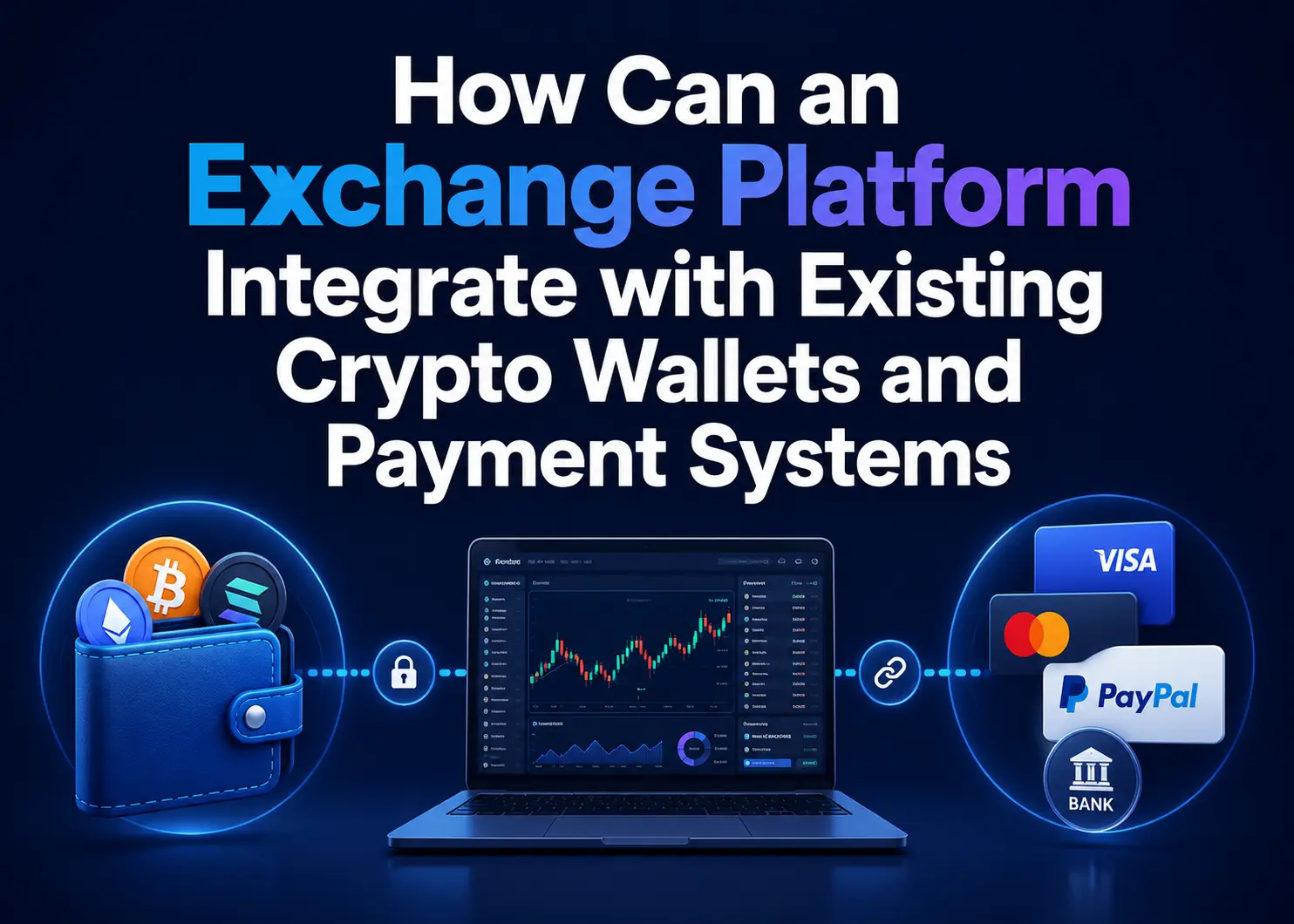
An exchange can integrate crypto wallets and payment systems using REST APIs, WebSocket feeds, wallet SDKs, multi-signature protocols, blockchain nodes, fiat on-ramp providers, bank APIs, card gateways, and stablecoin rails.
Reliable integration requires four connected layers:
- Wallet and blockchain connectivity
- Payment orchestration
- Compliance and risk controls
- A double-entry transaction ledger
This structure allows a digital assets trading platform to add or replace providers without affecting customer balances or trading operations.
Why Wallet and Payment Integration Matters for Exchanges?
Integrating Exchanges with Crypto Wallets and Payments increases conversion, lowers operating costs through automation, and reduces risk by separating payment approval from final settlement before funds become withdrawable.
Integrating Exchanges with Crypto Wallets and Payments should be planned at the beginning of cryptocurrency exchange development. A business should also avoid measuring success only by the number of available methods. The more useful metrics are:
- Registration-to-first-deposit conversion
- Payment approval rate by provider and country
- Average deposit and withdrawal completion time
- Cost per successful funding transaction
- Reconciliation exceptions per thousand transactions
- Chargeback and fraud loss rate
- Support contacts caused by payment uncertainty
- Percentage of volume dependent on one vendor
These indicators reveal whether integration improves growth or merely adds complexity.
Types of Crypto Wallets Exchanges Must Support
During Integrating Exchanges with Crypto Wallets and Payments, exchanges should support more than one wallet model. Retail traders, institutions, treasury teams, and market makers have different custody and transaction needs. This choice shapes secure cryptocurrency exchange development and platform operations.
Custodial Wallets
Custodial wallets let the exchange control private keys while customer balances remain on an internal ledger. In cryptocurrency wallet development, hot, warm, and cold wallets support liquidity, reserves, recovery, and withdrawals. Clear limits and approval rules reduce operational exposure effectively.
Non-Custodial Wallet Connections
Non-custodial wallets allow customers to keep their keys while the exchange requests signatures for transactions. For cryptocurrency exchange software development, teams still need address screening, session security, contract checks, and clear transaction details before users securely approve any transfer request.
Embedded Wallets
Embedded wallets create accounts using passkeys, recovery tools, or delegated signing. They improve onboarding for a white label crypto exchange and support cryptocurrency payment gateway development, but teams must define key ownership, recovery rights, signing locations, and vendor dependencies carefully.
Multi-Signature and Institutional Wallets
Multi-signature wallets support multiple approvers, whitelisted destinations, audit trails, and role-based controls. A cryptocurrency trading platform development company should define thresholds, recovery rights, and segregation of duties so its digital assets trading platform can manage institutional funds securely at scale.
Core Integration Methods: Crypto Exchange Platform Development
A strong exchange architecture uses different integration methods for different workflows.
APIs can manage balances and withdrawals, SDKs connect external wallets, blockchain nodes verify transactions, and multi-signature protocols protect treasury operations.
This modular approach supports scalable cryptocurrency exchange software development without forcing every process through one provider.
REST and WebSocket APIs
REST APIs are commonly used to create deposit addresses, retrieve balances, initiate withdrawals, request payment quotes, and check transaction status.
WebSocket connections support live events such as:
- Deposit confirmations
- Withdrawal broadcasts
- Wallet-session changes
- Payment-status updates
- Market-price movements
Production systems should also include signed webhooks, retry queues, duplicate detection, idempotency controls, and missed-event reconciliation.
Wallet SDKs: WalletConnect, Web3.js, and Ethers.js
WalletConnect, Web3.js, and Ethers.js simplify signatures, sessions, and network activity. Placing them behind an exchange-owned wallet service gives your business control over chains, contracts, fees, limits, and future upgrades during cryptocurrency wallet development and platform expansion without disrupting customer experiences.
Multi-Signature Wallet Protocols
Multi-signature wallets strengthen control over treasury transfers, cold storage, large withdrawals, and contract actions. A secure digital assets trading platform should use risk-based approvals, protected signers, tested recovery procedures, and escalation rules to prevent delays, fraud, and unauthorized fund movement.
Node-Based Blockchain Integration
Running blockchain nodes improves privacy, verification, and control, while third-party providers accelerate multi-chain launches. A hybrid cryptocurrency exchange development strategy gives your business reliable network access, independent fallbacks, accurate deposit crediting, and scalable infrastructure without depending on one external provider.
Integrating Payment Systems
Payment orchestration connects wallets, banks, cards, and on-ramps into one consistent customer journey. Effective integration of exchanges with Crypto Wallets and Payments helps businesses improve deposit conversion, simplify reconciliation, manage risk, and deliver faster movement between fiat and digital assets securely.
Fiat On-Ramp and Off-Ramp Providers
Providers such as MoonPay, Simplex, and Banxa can support fiat-to-crypto purchases through hosted checkout pages, widgets, SDKs, or APIs. Businesses should compare providers based on:
- Country coverage
- Supported currencies
- Local payment methods
- Approval rates
- Settlement speed
- Compliance ownership
- Chargeback responsibility
- Customer-support processes
Strong cryptocurrency payment gateway development should also allow transactions to be routed between providers based on region, availability, cost, and approval performance.
Bank Transfer, SWIFT, and SEPA Integration
Bank transfers remain important for institutional customers, market makers, professional traders, and high-value deposits. The exchange should create unique references or virtual accounts, automate statement matching, verify sender details, and route unmatched payments to an exception queue. SWIFT and SEPA integrations should remain connected to the customer timeline, compliance checks, and settlement ledger.
A cryptocurrency trading platform development company can connect banking workflows while protecting settlement accuracy and customer trust.
Card Payment Gateways
Card payments can increase first-deposit conversion, but they require strong fraud and chargeback controls. Tokenization, hosted fields, 3-D Secure, device checks, and delayed withdrawals help a white label crypto exchange accept cards safely while protecting revenue, customers, and platform reputation.
Stablecoin Settlement Rails
Stablecoins enable continuous settlement, cross-border liquidity, and faster treasury movement beyond banking hours. For Integrating Exchanges with Crypto Wallets and Payments, businesses must still address issuer exposure, contract validation, liquidity, reconciliation, and depegging risk, helping businesses scale payments without creating hidden operational or compliance problems.
8 Steps to Integrating Exchanges with Crypto Wallets and Payments
A successful integration connects wallets, payments, compliance, and operations through one reliable architecture. This step-by-step framework helps businesses reduce risk, accelerate launch, and create scalable infrastructure when integrating Exchanges with Crypto Wallets and Payments across markets, providers, and customer segments.
Step 1. Define the Commercial and Regulatory Scope
Start by defining target markets, customer types, supported assets, fiat currencies, transaction limits, payment methods, custody, and expected volumes. This foundation guides licensing, provider selection, treasury design, and compliance requirements throughout secure cryptocurrency exchange development and future international business expansion.
Step 2. Map Every Movement of Funds
Map every deposit, withdrawal, trade, refund, chargeback, bank return, failed transfer, network fee, and balance adjustment. Assign a system of record, responsible team, approval process, customer notification, and reconciliation evidence before Integrating Exchanges with Crypto Wallets and Payments officially begins.
Step 3. Build the Ledger First
Build a double-entry ledger before connecting wallets, banks, or gateways. Separate customer liabilities, treasury funds, fees, settlements, network costs, suspense accounts, and pending balances. Strong cryptocurrency exchange software development preserves transactions and protects balances from duplicate or conflicting provider updates.
Step 4. Create a Provider-Abstraction Layer
Build separate adapters for wallet providers, blockchain nodes, banks, card gateways, on-ramps, and stablecoin partners. Normalize provider responses into internal events such as:
- Deposit detected
- Payment authorized
- Funds settled
- Withdrawal broadcast
- Transaction completed
This makes provider replacement and intelligent transaction routing easier.
Step 5. Assign Compliance Ownership
Define exactly which compliance checks your business performs and which providers handle them. Document ownership for onboarding, transaction monitoring, Travel Rule data, sanctions screening, investigations, account freezes, and reporting. Clear responsibility strengthens cryptocurrency payment gateway development and prevents costly compliance gaps.
Step 6. Test Failure, Not Only Success
Do not test only successful transactions. Simulate:
- Duplicate webhooks
- Node outages
- Wrong blockchain networks
- Expired quotes
- Delayed bank confirmations
- Chargebacks
- Failed withdrawal broadcasts
- Provider downtime
- Unsupported token contracts
The platform should recover without corrupting customer balances.
Step 7. Release in Controlled Stages
Launch with limited assets, markets, payment methods, and transaction limits. Track approval rates, provider uptime, completion times, reconciliation exceptions, fraud losses, and support demand. A controlled white label crypto exchange rollout reduces risk and supports expansion based on real performance.
Step 8.Security and Compliance Considerations
Protect keys, APIs, customer data, and operational workflows with layered controls. Use hardware security, scoped credentials, withdrawal allowlists, monitoring, immutable logs, and daily reconciliation. An experienced cryptocurrency trading platform Development Company builds security into every process, not as an afterthought.
Choosing the Right Integration Partner and Technology Stack
To successfully integrate exchanges with Crypto Wallets and Payments, the right cryptocurrency trading platform Development Company must understand financial operations, not only blockchain code. Ask potential partners to demonstrate:
- A clear custody and key-control model
- A double-entry ledger architecture
- Provider-independent integration adapters
- Reconciliation and exception workflows
- Security testing and recovery procedures
- Compliance integration ownership
- Multi-region monitoring
- Data-export and vendor-exit plans
For a custom digital assets trading platform, the business gains greater control over workflows, data, user experience, and provider routing. It also accepts more development and operational responsibility.
A white label crypto exchange can reduce launch time when its architecture remains modular. Before selecting one, confirm whether you can:
- Change custody providers
- Add local payment methods
- Own and export customer data
- Connect independent liquidity
- Access complete ledger records
- Replace vendors later
- Customize compliance rules
The technology stack should support service separation, event queues, secure secrets management, transactional databases, centralized logs, monitoring, and controlled infrastructure deployment.
Partner with Shamla Tech for Exchange Wallet and Payment Integration
At Shamla Tech, we build exchange wallet and payment integrations around the way your business operates. Our cryptocurrency exchange development company connects multi-chain wallets, custody models, liquidity, fiat on-ramps, card payments, stablecoin rails, KYC/AML workflows, and transaction reconciliation within one scalable architecture. Our team manages everything from integration planning and provider selection to testing, deployment, and ongoing support. Whether you need custom cryptocurrency exchange development or a faster white label crypto exchange launch, we tailor the solution to your markets, users, and growth goals.
FAQs
1. How long does exchange wallet and payment integration take?
A focused integration may take weeks, while a multi-country, multi-chain platform can require months. Timing depends on custody, licensing, compliance, banking access, ledger readiness, testing, and whether the project uses custom cryptocurrency exchange development or a white-label foundation.
2. Can an existing exchange add new wallet and payment providers?
Yes. Add an abstraction layer between providers and the core exchange. It normalizes statuses, routes transactions, reconciles settlements, and allows vendor replacement without changing customer balances, trading logic, or the main digital assets trading platform.
3. Should an exchange use one payment provider or several?
One provider simplifies launch but increases concentration risk. Multiple partners improve coverage, approval rates, and resilience. Route by country, payment method, cost, risk, and uptime while maintaining one internal ledger and consistent customer status.
4. Is a white-label platform suitable for wallet and payment integration?
A white label crypto exchange is suitable when it supports modular APIs, independent custody, configurable compliance, local payment methods, data ownership, and provider replacement. Avoid platforms that lock banking, wallets, liquidity, and reconciliation into one vendor-controlled system.
5. What should a business prepare before contacting an integration partner?
Prepare target markets, customer segments, volumes, assets, fiat currencies, payment methods, custody, compliance responsibilities, and launch priorities. These inputs help a cryptocurrency trading platform Development Company propose a realistic architecture, provider strategy, and operating model.