

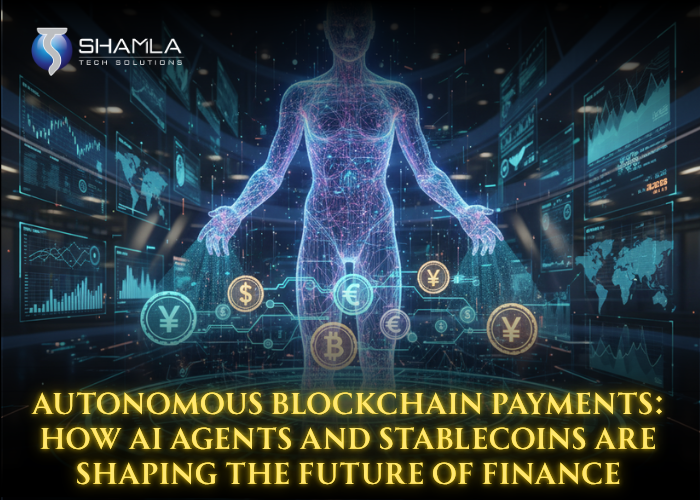

The world of finance is rapidly evolving — not just with blockchain, but with AI-powered automation redefining how transactions are executed, verified, and optimized. At the heart of this transformation lies the convergence of AI agents and stablecoins, enabling autonomous blockchain finance, where AI autonomous payments solutions can transact, analyze, and make financial decisions with little to no human intervention.
Whether you are a fintech startup, bank, or enterprise innovator, understanding this fusion is essential. And partnering with a leading AI Agent Development Company can help you unlock the full potential of AI agents stablecoin payments in the Web3 economy.
By integrating stablecoins for AI agents and stablecoin automation, organizations can achieve instant settlements, eliminate intermediaries, and ensure stable value transfers across borders. Whether for digital payments, DeFi operations, or smart contract execution, AI agent development services are empowering enterprises to transition toward self-operating financial ecosystems. Together, AI agents and stablecoins are transforming finance into a dynamic, data-driven infrastructure that runs autonomously — securely, efficiently, and intelligently.
The Rise of Stablecoins & the Shift to Agentic Payments
Stablecoins have evolved beyond being a bridge between traditional finance and cryptocurrencies. Today, they are becoming the preferred payment infrastructure for businesses, developers, and digital platforms seeking fast, low-cost, and programmable transactions. Unlike traditional banking systems that rely on intermediaries and limited operating hours, stablecoin payments enable near-instant settlements, lower transaction costs, and 24/7 global accessibility.
At the same time, AI is entering a new era with the rise of agentic systems—intelligent AI agents capable of reasoning, planning, and executing tasks autonomously. As these agents begin managing procurement, subscriptions, cloud resources, logistics, and digital services, they require a payment mechanism that can operate at the same speed and scale as their decision-making processes.
This convergence is driving the shift toward agentic payments, where AI agents can initiate, authorize, and complete transactions independently based on predefined rules, business objectives, or real-time conditions. Stablecoins provide the ideal financial layer for these autonomous transactions by offering predictable value, blockchain transparency, and seamless integration with smart contracts and decentralized applications.
As enterprises increasingly adopt AI-powered automation, stablecoin payments are expected to become the backbone of autonomous financial ecosystems, enabling machine-to-machine commerce, cross-border settlements, and intelligent business operations without the friction of traditional payment infrastructure.
What Are Autonomous Blockchain Payments?
Autonomous blockchain payments are digital transactions that are initiated, executed, and settled automatically by AI agents or smart software without requiring manual approval for every payment. Unlike traditional automated payments that simply follow fixed schedules or predefined rules, autonomous blockchain payments leverage artificial intelligence, blockchain technology, and smart contracts to analyze conditions, make decisions, and execute payments in real time.
These payments are typically conducted using stablecoins or other digital assets on blockchain networks, enabling fast, secure, and transparent transactions across borders. AI agents can evaluate factors such as budget limits, service completion, pricing, vendor reputation, and contractual obligations before authorizing a payment. Once the predefined conditions are met, the payment is automatically processed on the blockchain and permanently recorded for transparency and auditing.
Autonomous blockchain payments are becoming a foundational element of the agentic economy, where AI systems can independently purchase services, pay suppliers, manage subscriptions, allocate cloud resources, and facilitate machine-to-machine (M2M) commerce without constant human oversight.
How Do Autonomous Blockchain Payments Work?
1. Data Collection and Decision Intelligence (AI Layer)
At the core of the system lies the AI agent — an intelligent software entity capable of analyzing data, identifying patterns, and making autonomous decisions.
- It gathers inputs from multiple sources — such as market feeds, IoT devices, APIs, and user-defined rules.
- The agent processes this data using machine learning models or predictive analytics to determine when a payment or transaction should be triggered.
- For example, in a decentralized marketplace, an AI agent may detect inventory depletion and automatically initiate a restock payment in stablecoins.
2. Smart Contract Trigger and Validation (Blockchain Layer)
Once the AI agent decides to act, it communicates with a smart contract on the blockchain.
- Smart contracts are self-executing programs that define transaction logic and conditions (e.g., “If product delivered → release payment”).
- When the trigger condition is met, the smart contract executes autonomously.
- The blockchain validates this action, ensuring that all nodes agree the terms have been satisfied before recording the transaction.
This eliminates the need for intermediaries like payment gateways or banks — ensuring faster, tamper-proof settlements.
3. Stablecoin-Powered Transaction (Financial Layer)
The actual payment is processed using stablecoins, ensuring a stable and predictable value.
- Stablecoins are pegged to assets like USD, EUR, or gold, making them ideal for automation and long-term contracts.
- The AI agent instructs the smart contract to transfer the required stablecoin amount to the recipient’s wallet.
- The transaction is settled on-chain instantly, with complete transparency and traceability.
This integration of AI agents with stablecoin payments forms the foundation of autonomous blockchain finance, providing speed, security, and global accessibility.
4. Ledger Recording and Feedback Loop
After execution, the blockchain records the payment details immutably.
- Every transaction becomes part of a tamper-proof audit trail.
- The AI agent reviews transaction results, learning from outcomes to optimize future decisions — this forms a feedback loop that enhances system intelligence over time.
Through reinforcement learning, AI agents refine parameters such as transaction timing, cost optimization, and market response prediction.
5. Continuous Automation and Scalability
As more AI agents interact, the ecosystem evolves into a self-sustaining financial network.
- Devices, applications, and smart systems communicate and transact autonomously.
- Businesses gain real-time insights and reduced operational friction.
- The system scales globally without the limitations of legacy banking frameworks.
Flow of Autonomous Blockchain Payments
Step | Process | Technology Involved | Outcome |
1 | Data Collection | AI Agent, APIs, Sensors | Decision Context |
2 | Decision Making | Machine Learning Models | Trigger Signal |
3 | Smart Contract Execution | Blockchain | Automated Validation |
4 | Stablecoin Transfer | Crypto Ledger | Instant Settlement |
5 | Feedback & Optimization | Reinforcement Learning | Improved Future Accuracy |
This autonomous payment architecture allows AI agents to operate like intelligent digital bankers — analyzing data, executing contracts, and transferring value in stablecoins — creating a borderless, real-time, and self-optimizing financial ecosystem.By leveraging professional AI Agent Development Services, enterprises can implement this model to power everything from smart supply chains and IoT economies to autonomous DeFi protocols and digital payment systems.
How Do AI Agents Work in Finance?
AI agents in finance are intelligent, autonomous digital entities capable of analyzing data, making decisions, and executing financial actions without constant human input. They are the cornerstone of the new wave of autonomous blockchain finance, where automation, trust, and intelligence converge.
Unlike traditional bots or algorithms, AI agents possess contextual awareness and goal-oriented behavior. Built using advanced machine learning models and blockchain-integrated architectures, they can interpret market signals, assess risk, and act in real time — just like a digital financial advisor that never sleeps.
Core Working Mechanism of AI Agents in Finance
Data Collection and Analysis
Decision-Making and Prediction
Autonomous Execution
Compliance and Monitoring
Learning and Optimization
What Role Do Stablecoins Play in Autonomous Finance?
Enabling Predictable AI Agent Transactions
Autonomous AI systems depend on predictable financial outcomes to make accurate decisions. Unlike volatile cryptocurrencies, stablecoins maintain a consistent value by being pegged to fiat currencies or other reserve assets, giving AI agents a reliable medium for executing transactions.
With stablecoins, AI agents can:
- Execute payments that consistently meet predefined spending thresholds.
- Rebalance digital asset portfolios without being affected by market volatility.
- Complete cross-border settlements while preserving transaction value.
- Automate recurring business payments with greater financial certainty.
Facilitating Real-Time, Borderless Payments
Stablecoins enable AI agents to make fast, low-cost payments across global blockchain networks without relying on traditional banking infrastructure. This allows businesses to automate international transactions with greater speed and efficiency.
Key advantages include:
- Near-instant settlement, often within seconds or minutes.
- Lower transaction costs compared to conventional cross-border payment systems.
- 24/7 payment availability without banking hours or geographic restrictions.
- Seamless support for global, multi-currency business operations.
These capabilities make stablecoins ideal for AI-powered supply chains, decentralized marketplaces, IoT ecosystems, and enterprise treasury operations where speed and reliability are essential.
Reducing Risk in AI-Driven Financial Systems
Financial automation requires a payment asset that minimizes uncertainty. Stablecoins help reduce the risks associated with cryptocurrency price swings, allowing AI agents to execute transactions with confidence.
By using stablecoins, AI agents can:
- Automate payroll, vendor payments, and subscription renewals without unexpected value fluctuations.
- Execute sophisticated treasury and liquidity strategies more effectively.
- Maintain stable liquidity across decentralized finance (DeFi) protocols.
- Improve budgeting and cash flow forecasting for autonomous financial operations.
This stability enables AI agents to make consistent financial decisions while reducing operational and market risk.
Powering Smart Contract Automation
Stablecoins integrate seamlessly with smart contracts, allowing AI agents to automate payments based on predefined business rules and contractual conditions.
For example, AI agents can:
- Release payments automatically once delivery or service milestones are verified.
- Power AI-driven escrow systems that transfer funds only after agreed conditions are fulfilled.
- Execute recurring or conditional payments without manual approval.
- Support high-volume microtransactions between machines, applications, and decentralized services.
Together, AI agents, smart contracts, and stablecoins create a secure and programmable infrastructure for autonomous blockchain finance.
Supporting Machine-to-Machine (M2M) Payments
As connected devices become increasingly intelligent, they require a frictionless way to exchange value. Stablecoins enable AI agents embedded in machines to initiate and settle payments autonomously without human intervention.
Real-world examples include:
- Electric vehicles automatically paying charging stations.
- Autonomous drones purchasing energy credits or paying airspace usage fees.
- Industrial IoT devices paying for cloud storage, bandwidth, or maintenance services.
- Smart manufacturing equipment ordering replacement components when inventory reaches predefined thresholds.
By providing stable value and instant settlement, stablecoins make the machine-to-machine economy both practical and scalable.
Enhancing Compliance and Auditability
Blockchain-based stablecoin transactions offer a transparent and verifiable record of every payment, making compliance and financial reporting more efficient.
AI agents using stablecoins can:
- Maintain immutable on-chain transaction records for auditing.
- Simplify reconciliation through transparent payment histories.
- Improve accounting accuracy with predictable asset values.
- Support regulatory requirements such as KYC and AML when integrated with compliant financial platforms.
This combination of transparency, programmability, and value stability helps enterprises build secure, compliant, and highly automated financial ecosystems powered by AI.
Summary Table: How Stablecoins Support AI Agents in Finance
Stablecoin Function | Impact on AI Agents & Autonomous Finance |
Price Stability | Predictable, reliable automated payments |
Programmable Money | Integrated with smart contracts for autonomous execution |
Fast, Borderless Settlements | Supports real-time cross-border operations |
Risk Reduction | Minimizes volatility-related financial risk |
Microtransaction Capability | Enables M2M payments and IoT automation |
Compliance & Auditability | Simplifies accounting and regulatory reporting |
The Strategic Role of Stablecoins
How Do AI Agents and Stablecoins Work Together?
Stablecoins: The Currency Powering AI Automation
Stablecoins provide the financial foundation that enables AI agents to transact autonomously. Because they maintain a relatively stable value by being pegged to fiat currencies or other reserve assets, they eliminate the uncertainty associated with volatile cryptocurrencies. This gives AI agents the confidence to execute payments with predictable purchasing power and consistent financial outcomes.
With stablecoins, AI agents can:
- Execute payments without exposure to cryptocurrency price volatility.
- Perform high-frequency transactions with consistent value.
- Automate cross-border payments while minimizing settlement delays and costs.
- Manage recurring financial operations with greater accuracy and reliability.
Example: An AI agent responsible for corporate payroll can calculate employee salaries in a USD-pegged stablecoin, verify compliance requirements, and automatically distribute payments through smart contracts—without requiring manual approval.
How AI Agents Execute Autonomous Payments
AI agents act as intelligent financial decision-makers, continuously analyzing both on-chain and off-chain data to determine when and how payments should be made. They monitor variables such as liquidity, account balances, market conditions, contractual obligations, delivery confirmations, and business policies before initiating a transaction.
A typical autonomous payment workflow includes:
- Data Analysis: The AI agent gathers and evaluates financial, operational, and blockchain data in real time.
- Decision Making: Based on predefined rules and business objectives, the AI determines whether a payment should be approved, how much should be transferred, and which blockchain network offers the most efficient settlement.
- Smart Contract Execution: The AI instructs a smart contract to validate the required conditions, such as successful delivery, milestone completion, or invoice verification.
- Stablecoin Settlement: Once all conditions are satisfied, the smart contract automatically transfers stablecoins to the recipient and records the transaction on the blockchain.
By combining AI-driven decision-making with smart contract automation and stablecoin settlements, businesses can create a trustless, transparent, and fully automated payment infrastructure that operates around the clock without manual intervention.
Real-World Use Cases of AI Agents and Stablecoins
Use Case | How AI Agents and Stablecoins Work | Business Benefit |
Payroll Automation | AI agents calculate salaries, verify employee records, and trigger stablecoin payouts automatically. | Faster, accurate, and globally accessible payroll processing. |
Supply Chain Payments | AI monitors shipment milestones, delivery confirmations, and invoices before releasing stablecoin payments via smart contracts. | Real-time settlements, improved supplier relationships, and reduced administrative overhead. |
DeFi Lending & Borrowing | AI agents manage lending positions, automate repayments, rebalance collateral, and optimize yields using stablecoins. | Lower financial risk and efficient capital management. |
IoT & Machine-to-Machine Payments | Connected devices autonomously pay for electricity, bandwidth, cloud services, or shared infrastructure using stablecoins. | Enables scalable machine-to-machine (M2M) commerce with minimal human involvement. |
Treasury Management | AI agents continuously monitor liquidity, allocate stablecoin reserves, and optimize capital deployment across financial protocols. | Improved cash flow, liquidity optimization, and real-time financial management. |
Subscription & SaaS Billing | AI agents monitor software usage, renew subscriptions, or cancel unused services while settling payments with stablecoins. | Reduced operational costs and automated expense management. |
Real-World Use Cases of AI Agents + Stablecoin Payments
As AI agents become capable of making independent decisions, businesses are moving beyond simple workflow automation toward fully autonomous payments. By combining AI-driven decision-making with stablecoins and smart contracts, organizations can automate financial operations with greater speed, transparency, and efficiency.
From machine-to-machine commerce to enterprise treasury management, AI agent payment systems are enabling entirely new business models across industries.
Agent-to-Agent Commerce
AI agents can negotiate contracts, compare pricing, place orders, and settle payments directly with other AI agents without human involvement. Stablecoins provide a reliable payment medium that allows these autonomous transactions to be completed instantly while maintaining predictable value.
Example: An AI procurement agent automatically purchases cloud computing resources from another AI-powered vendor and completes payment using stablecoins once pricing and service terms are approved.
Machine-to-Machine (M2M) Payments
Connected devices increasingly need the ability to exchange value autonomously. AI agent payment systems allow machines to initiate and settle transactions in real time using stablecoins.
Examples include:
- Electric vehicles pay for charging stations automatically.
- Smart factories purchase replacement components when inventory runs low.
- IoT devices paying for cloud storage, bandwidth, or maintenance services.
- Autonomous drones purchasing energy credits or airspace access.
These autonomous payments eliminate manual intervention while supporting a scalable machine economy.
Autonomous Treasury Management
Enterprise treasury teams can use AI agents to continuously monitor liquidity, forecast cash flow, and optimize capital allocation across multiple financial platforms.
AI agents can automatically:
- Rebalance stablecoin reserves.
- Execute cross-chain transfers.
- Move idle funds into yield-generating opportunities.
- Pay suppliers based on real-time cash availability.
This enables faster financial decision-making while reducing operational costs.
Micropayments for Digital Services
Traditional payment systems are often too expensive for high-volume, low-value transactions. Stablecoins allow AI agents to process micropayments efficiently, unlocking new revenue models for digital services.
Common applications include:
- Paying per API request.
- Charging for AI inference or GPU usage.
- Streaming content payments based on actual consumption.
- Pay-per-use software and cloud computing services.
AI agents can automatically calculate usage and settle payments in real time.
Cross-Border Business Settlements
International payments often involve multiple intermediaries, high fees, and settlement delays. AI agents can automate global supplier payments using stablecoins, enabling faster and more cost-effective cross-border transactions.
For example, an AI finance agent can verify invoice approval, convert funds if necessary, and release stablecoin payments to international vendors within minutes instead of waiting several business days.
Decentralized Finance (DeFi) Operations
AI agents are increasingly managing decentralized financial activities without continuous human supervision. They can monitor lending markets, adjust collateral positions, optimize yield strategies, and execute repayments automatically using stablecoins.
This improves capital efficiency while minimizing exposure to market volatility.
What Industries Can Use AI Agents and Stablecoins?
AI agent payment systems can transform financial operations across virtually every sector where payments, settlements, or resource allocation require speed, automation, and accuracy.
Industry | How AI Agents and Stablecoins Are Used |
Banking & Financial Services | Automate payments, treasury operations, compliance checks, and cross-border settlements. |
Supply Chain & Logistics | Release payments automatically after shipment verification or delivery confirmation. |
Healthcare | Process insurance claims, supplier payments, and healthcare reimbursements securely. |
Manufacturing | Enable autonomous procurement, equipment maintenance payments, and machine-to-machine transactions. |
Retail & E-commerce | Automate supplier settlements, refunds, dynamic pricing, and inventory purchases. |
Cloud Computing & SaaS | Pay for computing resources, APIs, software subscriptions, and infrastructure on demand. |
Telecommunications | Automate billing, roaming settlements, bandwidth purchases, and network resource allocation. |
Energy & Utilities | Support autonomous EV charging, renewable energy trading, and smart grid payments. |
Travel & Mobility | Enable AI-driven booking, ticketing, toll collection, vehicle charging, and transportation payments. |
Web3 & DeFi | Automate lending, liquidity management, staking rewards, governance payouts, and decentralized treasury operations. |
What Are the Benefits of Autonomous Blockchain Payments?
Faster Transactions and Real-Time Settlements
One of the biggest advantages of autonomous blockchain payments is transaction speed. AI agents can initiate payments instantly, while blockchain networks validate and settle transactions within seconds or minutes.
Benefits include:
- Near-instant domestic and cross-border settlements.
- Reduced payment delays caused by intermediaries.
- Faster cash flow and improved working capital.
- Efficient support for high-volume and microtransactions.
For example, an AI agent can automatically release payment to a supplier immediately after confirming successful delivery through a smart contract.
Lower Costs Through Automation
Traditional payment systems often involve banks, payment processors, foreign exchange providers, and other intermediaries that increase transaction costs. Autonomous payments streamline this process by enabling direct blockchain-based transfers.
Organizations benefit from:
- Lower transaction and settlement fees.
- Reduced administrative and processing costs.
- Automated financial workflows with minimal manual effort.
- Cost-effective global payments and micropayments.
This makes autonomous payment systems particularly attractive for enterprises handling frequent international transactions.
24/7 Financial Operations
Unlike traditional banking infrastructure, blockchain networks never close. AI agents can execute payments at any time, ensuring continuous financial operations regardless of weekends, holidays, or time zones.
This enables businesses to:
- Automate payroll and supplier payments around the clock.
- Process subscription renewals without interruption.
- Support global customers across multiple regions.
- Maintain uninterrupted financial operations for decentralized applications.
Continuous availability is especially valuable for enterprises operating across international markets.
Greater Transparency and Auditability
Every autonomous payment is permanently recorded on the blockchain, creating a secure and immutable audit trail. This transparency improves financial reporting and simplifies regulatory compliance.
Key advantages include:
- Immutable transaction records.
- Simplified reconciliation and accounting.
- Real-time visibility into payment activity.
- Easier auditing and regulatory reporting.
Organizations gain greater confidence in the accuracy and traceability of every financial transaction.
Programmable Payments with Smart Contracts
Smart contracts allow payments to execute automatically once predefined business conditions are satisfied. AI agents continuously monitor these conditions and initiate transactions without requiring manual approval.
Programmable payments enable businesses to:
- Automate supplier settlements after delivery verification.
- Release escrow funds when contractual milestones are achieved.
- Schedule recurring subscription or payroll payments.
- Build intelligent workflows that combine AI decision-making with blockchain automation.
This programmability makes autonomous payments highly adaptable to complex enterprise processes.
Enhanced Security and Reduced Risk
Blockchain technology secures transactions using cryptographic verification, while AI agents monitor financial activity for anomalies, policy violations, and potential fraud.
Together, they help organizations:
- Reduce fraud and unauthorized transactions.
- Improve payment accuracy.
- Strengthen compliance with internal policies.
- Build trust through transparent and tamper-resistant financial records.
Scalable Global Payment Infrastructure
Autonomous blockchain payments can support thousands of simultaneous transactions across multiple countries and blockchain networks without increasing operational complexity.
Whether managing enterprise treasury operations, machine-to-machine payments, or global supplier settlements, AI agents can scale financial workflows efficiently while maintaining speed, security, and reliability.
As AI adoption accelerates, autonomous payments will become a critical component of intelligent financial infrastructure, enabling businesses to automate complex payment operations while reducing costs and improving operational efficiency.
Are AI Agent Stablecoin Payments Safe? Security, Custody & Compliance
AI-Powered Fraud Detection
Secure Digital Asset Custody
Smart Contract Security
Regulatory Compliance
Transparent Audit Trails
Every blockchain transaction is permanently recorded on a distributed ledger, creating a complete and tamper-resistant history of autonomous payments. Combined with AI-generated decision logs, organizations gain full visibility into why a payment was made, when it occurred, and which conditions triggered its execution. This improves governance, simplifies audits, and strengthens regulatory reporting.
By combining secure custody, intelligent monitoring, smart contract safeguards, and compliance automation, businesses can deploy AI agent stablecoin payment systems with greater confidence while maintaining security, transparency, and regulatory readiness.
AI Agents vs. Traditional Payment Systems
Traditional payment infrastructure was designed for human-operated financial processes involving banks, payment processors, and manual approvals. AI agent payment systems introduce a fundamentally different model, where intelligent software can analyze conditions, make decisions, and execute autonomous payments in real time using stablecoins and blockchain technology.
Feature | Traditional Payment Systems | AI Agent Payment Systems |
Transaction Speed | Hours to several business days | Seconds or minutes with blockchain settlement |
Availability | Limited by banking hours and holidays | Operates 24/7 without interruption |
Intermediaries | Multiple banks and payment processors | Direct blockchain and smart contract execution |
Transaction Costs | Higher processing and cross-border fees | Lower fees through blockchain networks |
Cross-Border Payments | Slower with foreign exchange and banking delays | Fast global settlements using stablecoins |
Decision Making | Manual approvals and workflows | AI-driven, rule-based autonomous execution |
Transparency | Records distributed across multiple systems | Immutable, on-chain transaction history |
Scalability | Additional operational overhead as volume grows | AI agents can manage thousands of concurrent transactions |
Programmability | Limited automation capabilities | Fully programmable through smart contracts and AI logic |
AI agent payment systems do more than automate payments—they create intelligent financial workflows. AI agents can monitor business events, evaluate contractual obligations, verify compliance requirements, and initiate payments automatically once predefined conditions are satisfied.
As enterprises increasingly adopt AI-driven operations, autonomous payment systems offer a compelling alternative to conventional financial infrastructure by delivering faster settlement, lower costs, greater transparency, and continuous availability. While traditional payment systems will continue to play an important role, AI agents combined with stablecoins are laying the foundation for the next generation of programmable digital finance.
How Shamla Tech Powers Autonomous Blockchain Payments with AI Agents and Stablecoins
The future of finance is autonomous, intelligent, and programmable. As businesses adopt AI-driven operations, they need more than standalone AI models or blockchain infrastructure—they need an integrated ecosystem that combines AI agents, stablecoins, smart contracts, and enterprise-grade security. Shamla Tech specializes in building end-to-end autonomous blockchain payment solutions that enable organizations to automate financial workflows, streamline cross-border transactions, and unlock new digital business models.
Whether you’re developing AI-powered treasury systems, decentralized finance (DeFi) platforms, machine-to-machine (M2M) payment networks, or enterprise payment automation, our experts help you transform complex financial operations into secure, scalable, and fully autonomous payment ecosystems.
Consultation & Strategy
Custom AI Agent Design
Stablecoin & Blockchain Integration
Security & Compliance
Deployment & Ongoing Support
From deployment to long-term optimization, Shamla Tech provides complete implementation and support services. We handle system integration, performance testing, infrastructure scaling, AI model optimization, smart contract maintenance, and continuous monitoring to ensure your autonomous blockchain payment solution operates reliably as your business grows.
Partner with Shamla Tech to build secure, scalable, and future-ready autonomous blockchain payment solutions powered by AI agents, stablecoins, and blockchain technology—helping your business accelerate financial automation and lead the next generation of digital commerce.