

Key Takeaways
- Regulators assess the design of systems, sanctions controls, governance, and monitoring infrastructure under crypto exchange compliance 2026.
- Banking partnerships, commercial liquidity, and speedier licensing approvals are automatically enhanced by the strategy of regulated crypto exchange development.
- Real-time sanctions screening, AML automation, and audit-ready logs are essential add-ons for governance controls that might clear huge risks as well as reducing penalties while improving operational efficiency.
- Enterprises that build a regulated crypto exchange featuring scalable and compliant architecture would be poised for long-term growth, expanding borders and regulatory stability beyond 2026.
Regulated Crypto Exchange Development
Global digital asset markets are accessing a more structured growth phase. Institutional participation is increasing, regulatory frameworks are tightening, and governments are moving toward clearly outlined licensing norms. Recent headlines considering Binance Iran sanctions business continue to notch greater awareness about sanctions risks in the industry, with U.S. lawmakers calling upon a federal enquiry because of the sanctions risk in the cryptocurrency sector. In this context, crypto exchange compliance 2026, seems to be the standard that shall define sustainability for the long haul.
In 2025, the market reached an all-time high of illicit cryptocurrency activities worth $154 billion, an increase of 162% compared to 2024, exposing alarming compliance risk to be addressed by regulated exchanges. Robust architecture and monitoring systems must be put in place to directly address risk. For enterprises looking to build a regulated crypto exchange, the opportunity extends beyond trading fees. Here, regulated crypto exchange development and the robust crypto exchange architecture have become strategic priorities.
Organizations that aim to launch compliant crypto exchanges puts compliance in the heart of infrastructure. This blog discusses how the standards for crypto exchanges are being redrawn by regulatory pressures and what it takes to develop a compliance-ready platform in 2026.
Build a Regulation-Ready Crypto Exchange
Why Are Traditional Crypto Exchange Models No Longer Sufficient in 2026?
The digital asset regulatory environment is maturing rapidly and is consequently causing traditional exchange models to keep pace. What worked during early growth cycles is no longer adequate in the era of crypto exchange compliance 2026. Regulators are not only reviewing policies but also assessing how exchanges are architected, monitored, and governed at a system level.
This architecture creates operational bottlenecks and increases regulatory exposure.
Fragmented Infrastructure Increases Risk
When KYC providers, AML engines, sanctions screening tools, and transaction monitoring systems operate in silos, visibility becomes limited. This leads to:
- Delayed detection of high-risk activity
- Inconsistent enforcement of sanctions rules
- Higher operational overhead due to manual intervention
- Increased audit complexity during regulatory reviews
When controversies like the Binance Iran sanctions probe surface, oversight shifts toward weaving systems together instead of just fixing problems after they happen.
Manual Compliance Drives Cost and Delays
Exchanges relying heavily on human review processes face scaling challenges. Manual case handling slows onboarding, increases the cost of compliance staff handling, and introduces inconsistencies. This impacts time-to-market and institutional confidence for companies seeking to build a regulated crypto exchange.
A compliance-first approach in the regulated crypto exchange development comprises automated screening, real-time risk scoring, and structured audit-trail construction within the crypto exchange architecture. This would significantly minimize reliance on manual controls with positive implications for regulatory transparency.
Institutional Expectations Are Higher
Institutional participants now require demonstrable infrastructure maturity. They assess:
- Real-time sanctions enforcement capabilities
- Audit-ready compliance logs
- Segregation of duties within governance systems
- Cross-jurisdiction regulatory adaptability
Exclusively those exchanges that do not demonstrate those traits shall experience difficulty accessing institutional liquidity and finding appropriate strategic partners.
To launch compliant crypto exchange platforms that can scale globally, companies now have to think of compliance as intrinsic to their infrastructure and not just something being dealt with once trading operations are set up. The jump from policy-driven compliance to architecture-driven compliance marks the next stage in sustainable growth for exchanges.
How Does Regulated Crypto Exchange Development Strengthen Compliance in 2026?
Regulated cryptocurrency exchange development is no longer a technical initiative for development teams, as it has become a strategic advantage for an exchange to attain licensing, institutional investors, and scale in multiple jurisdictions under the standards of crypto exchange compliance 2026.
Compliance Embedded in Crypto Exchange Architecture
A strong crypto exchange architecture integrates compliance across every operational layer:
- Onboarding systems that automatically screen against global sanctions lists
- Transaction engines that incorporate pre-trade risk scoring
- Wallet monitoring tools that detect exposure to high-risk counterparties
- Automated reporting systems aligned with multi-jurisdiction requirements
- Automated reporting systems being built in tandem with multi-jurisdiction requirements
When all the above elements operate as a unified system, compliance is truly proactive rather than merely after the fact.
Multi-Jurisdiction Readiness from Day One
While aiming to launch a compliant crypto exchange platform, companies must be prepared for compliance considerations for many jurisdictions. The different regions bring different license standards, reporting scenarios, and sanctions obligations. To scale, build, and provide the compliance right, decentralized compliance logic and configurable rule engines are therefore incredibly vital.
A compliance-first infrastructure supports:
- Dynamic regulatory rule updates
- Geo-restriction enforcement
- Region-specific KYC thresholds
- Automated suspicious activity reporting
This flexibility reduces expansion problems and quickens market entry.
Risk Mitigation as a Growth Strategy
Ensuring compliance maturity involves more than just staying clear of penalties. It directly influences growth potential. Institutional partners evaluate infrastructure before committing liquidity or custody integration. Banks assess risk frameworks before enabling fiat rails. Regulators review system documentation before granting operational approval.
Crypto exchange compliance 2026, shape how regulated crypto exchange development takes form today – turning rigid requirements into strategic advantages. Built right, these platforms stand steady when pressure hits, earn confidence from serious players, yet stay clear of the shaky ground tomorrow might bring. Instead of reacting, they lead through design.
What Core Capabilities Define a Modern Crypto Exchange Architecture?
Enterprise should now move from feature-based to structural capability development if they want to reach the standards of the crypto exchange compliance 2026. Basically, what defines a modern crypto exchange architecture is its alignment with and capability in the integration of security, compliance, scalability, and governance into one operational framework.
In addition, the key features that separate sustainable platforms from risky models are:
Real-Time Sanctions and AML Enforcement
Sanction exposure is no longer a periodic review exercise. Exchanges must deploy:
- Continuous sanctions list synchronization
- Automated wallet intelligence integration
- Dynamic AML rule engines
- Pre-trade and pre-withdrawal compliance validation
This ensures that enforcement occurs before settlement, not after risk materialize
Scalable and Modular Infrastructure
Businesses that are planning to build a regulated crypto exchange must venture towards constructing for scalability. A modular system that enables easy improvements in compliance without disrupting the trading activities.
Key infrastructure elements include:
- Microservices-based architecture
- High-throughput matching engines
- Horizontal scalability for traffic surges
- Cloud-native deployment environments
Scalability protects performance while compliance layers operate simultaneously.
Automated Governance and Access Controls
Regulators increasingly evaluate internal oversight mechanisms. Modern regulated crypto exchange development integrates:
- Role-based access control systems
- Segregation of operational and compliance authority
- Immutable audit logs
- Automated escalation workflows
All these can decrease insider risk and these are what enhances regulatory visibility.
Audit-Ready Data Infrastructure
Central to gaining approvals from regulators is transparent record-keeping. Exchanges must maintain:
- Structured compliance logs
- Timestamped transaction histories
- Case management tracking systems
- Export-ready regulatory reporting formats
Audit readiness shortens licensing cycles and reduces investigation exposure
Interoperability and Banking Integration
To successfully launch compliant crypto exchange platforms, enterprises must bridge traditional finance and digital assets.
This requires:
- API-first architecture
- Banking integration modules
- Custody provider connectivity
- Liquidity provider interfaces
Without interoperability, compliance alone does not translate into scalable growth.
In 2026, the difference between operational resilience and regulatory vulnerability lies in architecture depth. A compliance-first crypto exchange architecture is no longer a premium feature. It is the structural foundation required to compete in an increasingly institutional and regulated market.
Launch Your Compliant Crypto Exchange
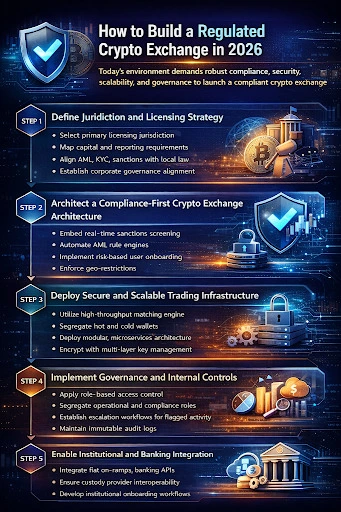
How to Build a Regulated Crypto Exchange in 2026
Today’s environment demands more than merely deploying a matching engine and wallet infrastructure in order to launch a compliant crypto exchange platform. Licensing readiness, sanctions controls, governance frameworks, and technical architecture are evaluated by regulators against the network of interconnected security and compliance controls that constitute the core of crypto exchange compliance 2026. Below is an outline for companies pursuing regulated crypto exchange development.
Step 1: Define Jurisdiction and Licensing Strategy
Before development begins, regulatory positioning must be clear.
- Select primary licensing jurisdiction
- Map capital adequacy and reporting requirements
- Pay attention to conformance matters with domestic laws concerning AML, KYC, and sanctions
- Call on corporate governance structure concerning regulatory expectations
The technical requirements and compliance scope are steered by licensing strategy.
Step 2: Architect a Compliance-First Crypto Exchange Architecture
A modern crypto exchange architecture must embed compliance directly into operational layers.
Core components include:
- Real-time sanctions screening integration
- Automated AML rule engines
- Risk-based user onboarding workflows
- Pre-trade transaction validation controls
- Geo-restriction enforcement modules
Given the fact that compliance is important for onboarding, trading, withdrawal, and any reporting.
Step 3: Deploy Secure and Scalable Trading Infrastructure
Scalability comes when performance and compliance are placed together.
Infrastructure priorities:
- High-throughput matching engine
- Segregated hot and cold wallet custody systems
- Multi-layer encryption and key management
- Microservices-based modular deployment
- Cloud-native scalability architecture
This ensures operational resilience while compliance monitoring runs continuously.
Step 4: Implement Governance and Internal Controls
The scrutiny of oversight structures by regulators is ever on the rise.
Key governance mechanisms:
- Role-based access control spanning all functions in administration
- Segregation between operational and compliance authority
- Escalation workflows for flagged activity
- Immutable audit logs and compliance documentation systems
Understanding licensing approvals and trust from the institution actually goes hand in hand with governance maturity.
Step 5: Integrate Monitoring, Reporting, and Audit Readiness
The requirement to successfully launch compliant crypto exchange would be insisting upon proactive transparency in the long run.
Critical systems include:
- Real-time transaction monitoring dashboards
- Automated suspicious activity reporting
- Structured audit export capabilities
- Continuous sanctions list synchronization
The preparedness for audit is equivalent to reducing the regulatory friction and enhancing the credibility.
Step 6: Enable Institutional and Banking Integration
A regulated exchange must connect seamlessly with traditional financial systems.
This requires:
- API-first architecture
- Fiat on-ramp and banking integration modules
- Custody provider interoperability
- Institutional onboarding workflows
Institutional adoption depends on infrastructure depth.
In 2026, building a regulated exchange is more about the systems engineering process concerning the coordination of compliance, security, scalability, and governance to create a comprehensive framework. Enterprises that approach regulated crypto exchange development strategically position themselves for sustainable growth, cross-border expansion, and long-term regulatory stability.
What Business Impact Can Enterprises Expect from Regulated Crypto Exchange Development?
Beyond being prudential to compliance, the serious cost of regulated crypto exchange development lies in accountability of measurable business results. In 2026, compliance-first infrastructure is outrightly linked on revenue, cost efficiency, institutional access, and large-term risk containment. For decision-makers who ask themselves if it deserves to put investment on the compliance architecture, it is no longer a question if it does make sense but how great that investment could translate into competitive advantage.
Reduced Regulatory and Enforcement Risk
A compliance-driven crypto exchange architecture significantly lowers exposure to:
- Sanctions violations
- AML enforcement actions
- License suspension or operational restrictions
- Cross-border compliance conflicts
Enterprises can keep themselves away from paying administrative fines and losing a good reputation by embedding real-time control and automatic monitoring at all levels.
Faster Licensing and Market Expansion
Exchanges designed around crypto exchange compliance 2026 standards are better positioned to:
- Accelerate regulatory approvals
- Expand into new jurisdictions with minimal reconfiguration
- Meet evolving reporting requirements
- Adapt quickly to policy updates
Regulatory readiness reduces time-to-market delays and supports cross-border scalability.
Aiding regulatory readiness minimizes delays in introducing the solution into the market and supports cross-border scalability.
Increased Institutional Capital Inflows
Institutions considering committing their capital flow strictly choose to evaluate infrastructure maturity.
Compliance-first exchanges benefit from:
- Stronger banking partnerships
- Institutional custody integrations
- Reduced counterparty risk perception
- Higher-quality liquidity providers
Optimally, the significance of any compliance maturity lies in guiding the availability of funds and trading volumes for various enterprises wishing to build a regulated crypto exchange.
Operational Efficiency and Cost Optimization
Automation decreases reliance on manual compliance processes.
Key efficiency gains include:
- Lower compliance staffing overhead
- Faster onboarding cycles
- Reduced false-positive case handling
- Improved reporting efficiency
These will lower operational expenses and concurrently increase monitoring accuracy.
Competitive Differentiation in a Regulated Market
Amid escalating efforts for global enforcement activities, signature differences are highlighted by mature governance and compliance. When enterprises launch compliant crypto exchange platforms with integrated controls and audit-ready systems, trading providers position themselves as trusted infrastructure rather than simply speculative.
And indeed, a regulated exchange will turn into a defensive barrier and growth accelerator in a market where things will be much more critical. The enterprises that align architecture with compliance today will define the institutional digital asset ecosystem of tomorrow.
Conclusion
The digital asset market is no longer operating in a regulatory gray zone. Under the standards emerging in crypto exchange compliance 2026, exchanges are evaluated on architecture, governance, monitoring systems, and institutional readiness.
When embarking on the path to build a regulated crypto exchange, enterprises should ensure that compliance is built through the platform from start to finish. It has become imperative that a robust crypto exchange architecture include sanctions screening, automated risk controls, audit-ready reporting, and multi-jurisdiction adaptability. This is no longer an option but a requisite for sustainable growth.
Companies that bring into existence a compliant crypto exchange platform following a compliance-first mentality will also realize other benefits aside from maintaining regulatory alignment. Among them, these entities will access institutional capital, expedite licensing approvals, reduce enforcement risk, and fashion long-term operational resilience.
In 2026 and beyond, regulated crypto exchange development is not simply a technical project. It is a strategic business decision that determines who leads and who lags in the institutional digital asset economy.
Build Your Regulated Crypto Exchange with Shamla Tech
At Shamla Tech, we specialize in regulated crypto exchange development built for the demands of crypto exchange compliance 2026. We design and deploy secure, scalable, and audit-ready platforms where compliance is embedded directly into the crypto exchange architecture. Our approach integrates real-time sanctions screening, automated AML monitoring, governance controls, and multi-jurisdiction regulatory frameworks from the ground up.
We understand that enterprises do not just want to launch a trading platform. They desire to build a regulated crypto exchange that is able to attract institutional capital; able to secure the necessary licensing approvals so as to scale across territories seamlessly without regulatory friction. Our developmental framework has been intentionally crafted to immerse technology, security, and governance so you can have a high level of confidence to launch compliant crypto exchange platforms.
With our expertise, you gain infrastructure designed for resilience, regulatory alignment, and long-term competitive advantage in an increasingly regulated digital asset ecosystem.