

Decentralized exchanges are becoming a major part of crypto trading because users want more control over their assets. Traders now prefer wallet-based trading, transparent smart contracts, faster swaps, and open access to digital assets. Decentralized Exchange development has become an important business opportunity for crypto startups and enterprises entering the Web3 market.
For businesses, launching a DEX can create new revenue from trading fees, token listings, liquidity services, staking, farming, and DeFi product expansion.
In this guide, we will discuss what Decentralized Exchange development is, how to launch a DEX in 2026.
What Is Decentralized Exchange Development?
Decentralized Exchange development is the process of building a blockchain-based trading platform where users can buy, sell, and swap crypto assets without giving custody of their funds to a central exchange.
In a centralized exchange, the platform holds user funds and manages orders internally. In a DEX, users connect their wallets and trade through smart contracts. The trade happens on-chain or through decentralized trading logic, depending on the platform model.
A DEX usually includes wallet connection, smart contracts, liquidity pools, token swap features, price calculation, transaction records, trading fees, admin dashboard, and security controls. This gives users a transparent and self-custody trading experience.
6 Steps to Launch DEX Exchange in 2026?
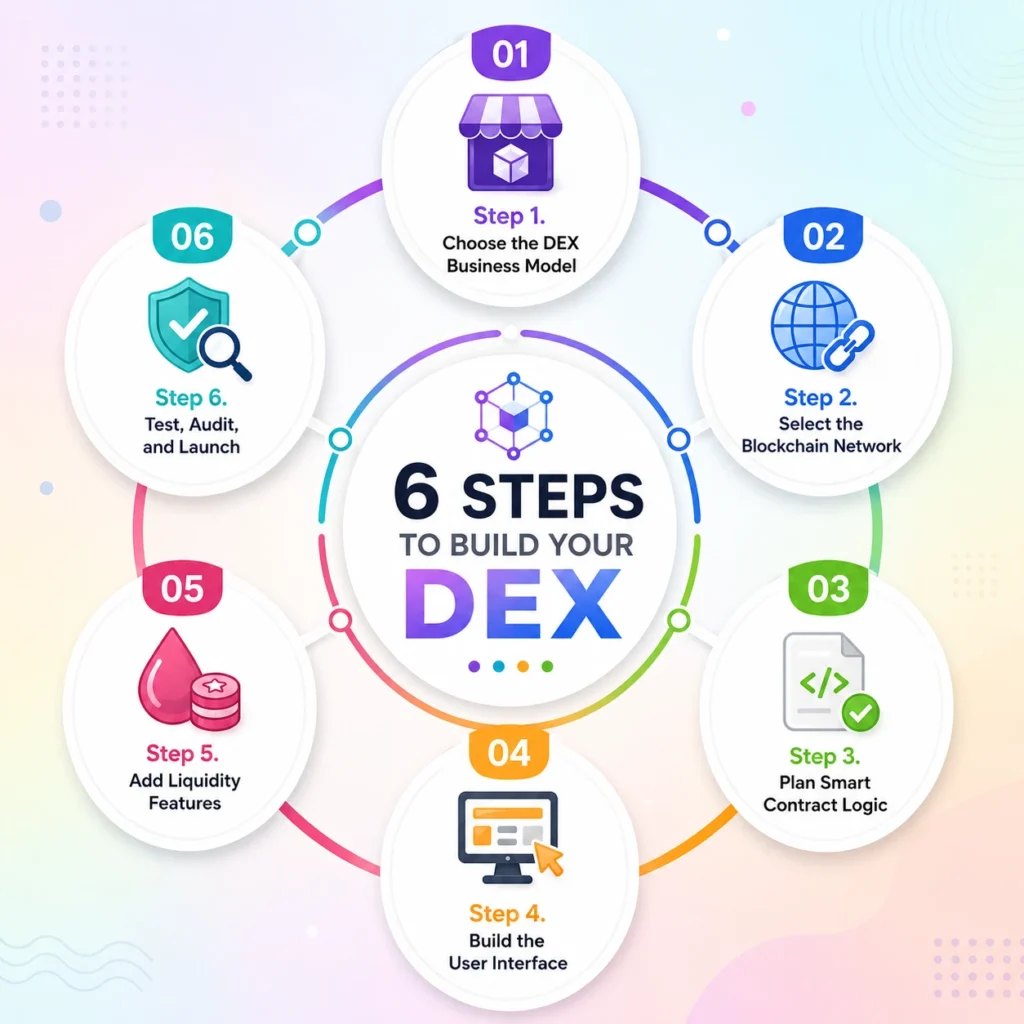
To Launch Decentralized Exchange development successfully in 2026, businesses need proper planning before development starts.
Step 1. Choose the DEX Business Model
The business must first decide what kind of DEX it wants to launch. It may be a token swap platform, multi-chain DEX, AMM exchange, order book DEX, hybrid exchange, or derivatives-based platform.
The revenue model should also be clear. A DEX can earn from swap fees, liquidity fees, listing fees, staking features, farming modules, governance tokens, and premium DeFi tools.
Step 2. Select the Blockchain Network
The blockchain network affects speed, gas fees, user base, liquidity, and development cost. Ethereum, BNB Chain, Polygon, Solana, Arbitrum, Avalanche, Base, and Optimism are common choices for DEX platforms.
The best network depends on the business goal. A retail-focused DEX may need low fees. A DeFi-heavy platform may need strong liquidity. A gaming token DEX may need faster transactions.
Step 3. Plan Smart Contract Logic
Smart contracts are the core of Decentralized Exchange development. They manage swaps, liquidity pools, token pairs, fees, rewards, staking, farming, slippage, and ownership rules.
Smart contract planning should be very careful because even a small bug can create financial loss. Security must come before launch speed.
Step 4. Build the User Interface
A DEX should look simple even if the backend is complex. Users should be able to connect wallets, select tokens, check price impact, set slippage, review gas fees, and confirm trades easily.
A clean interface builds user confidence. Confusing screens can push traders away even if the platform works technically
Step 5. Add Liquidity Features
Liquidity is one of the most important parts of a DEX. Without enough liquidity, users may face high slippage, poor pricing, and failed trades.
Businesses should plan liquidity pools, liquidity provider rewards, farming programs, token pair selection, and early market-making support before launch.
Step 6. Test, Audit, and Launch
Before launch, the DEX must go through smart contract testing, wallet testing, swap testing, admin testing, load testing, and security audits.
After launch, the team should monitor liquidity, transactions, errors, user activity, gas usage, and platform performance. A DEX launch is not the end of development. It is the start of continuous improvement.
5 Types of Decentralized Exchanges You Can Build in 2026
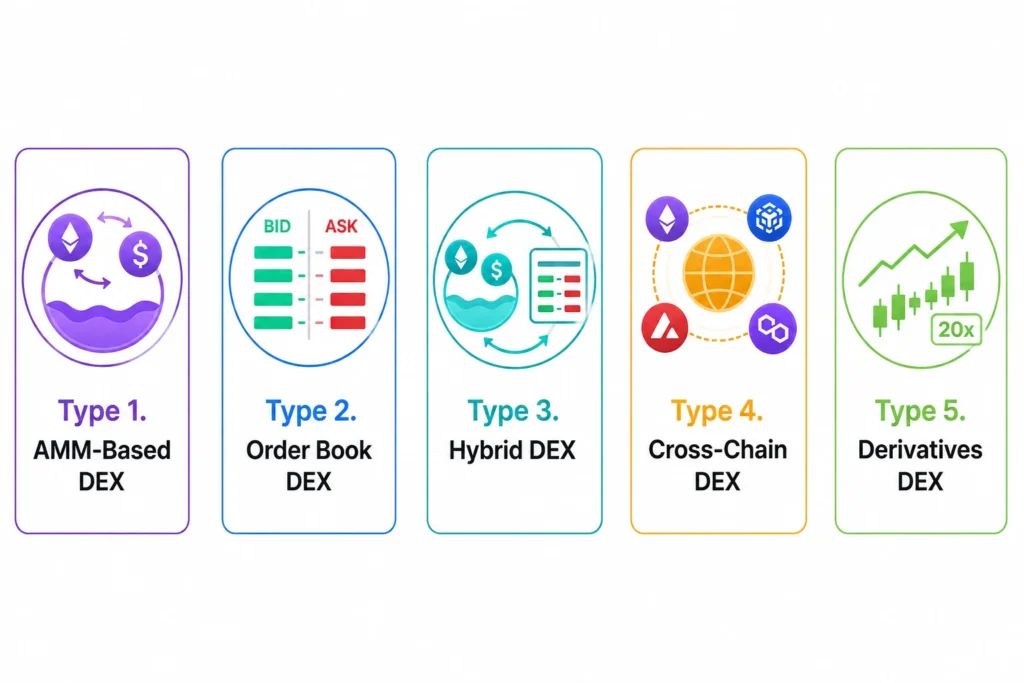
A business can build different types of DEX platforms depending on its users and trading goals.
Type 1. AMM-Based DEX
An AMM-based DEX uses liquidity pools instead of traditional order books. Users trade against pooled assets, and smart contracts calculate prices automatically.
This type is useful for token swaps, DeFi projects, community tokens, and new crypto ecosystems.
Type 2. Order Book DEX
An order book DEX works closer to a traditional exchange. Buyers and sellers place orders, and the system matches them.
This model is suitable for advanced traders who want limit orders, price control, and deeper trading features.
Type 3. Hybrid DEX
A hybrid DEX combines decentralized custody with selected centralized features. It can offer better speed, smoother matching, and advanced trading tools while keeping user control strong.
This model works well for businesses that want both usability and decentralization.
Type 4. Cross-Chain DEX
A cross-chain DEX allows users to trade assets across different blockchains. It can attract a wider market, but it needs secure bridge logic, routing systems, and liquidity management.
This type is useful for businesses targeting multi-chain crypto users.
Type 5. Derivatives DEX
A derivatives DEX supports margin trading, perpetual contracts, or synthetic assets. This model can attract active traders, but it needs strong risk management, oracle integration, liquidation logic, and deep liquidity.
Common DEX Exchange Challenges and How to Solve Them
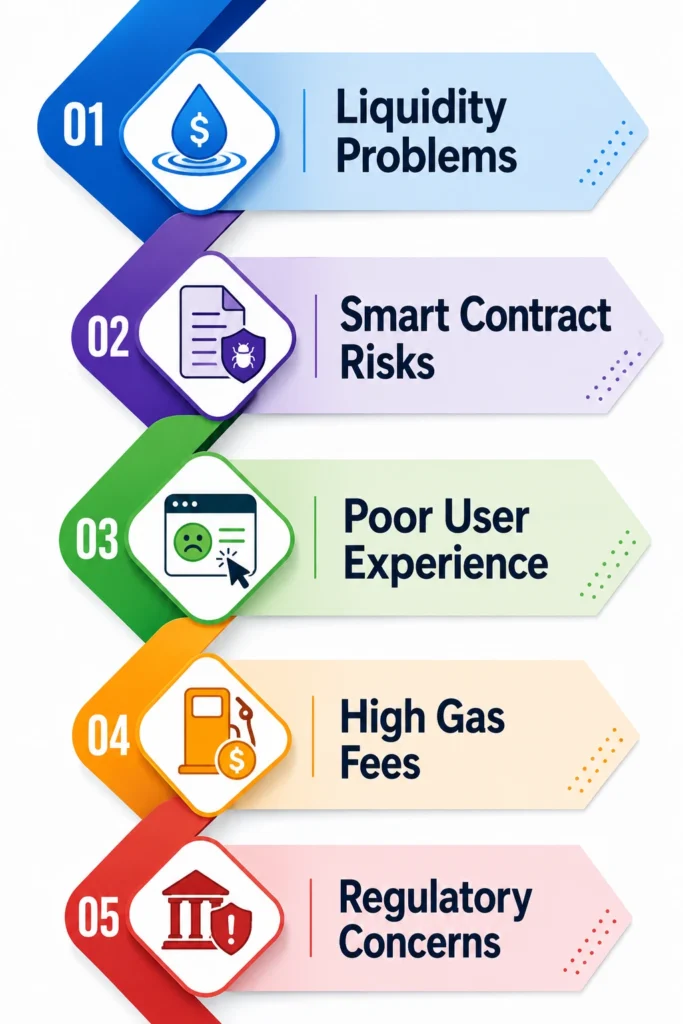
A DEX can become a profitable business model, but it also comes with serious challenges. These issues should be solved before launch, not after users start trading.
Liquidity Problems
A DEX without liquidity cannot provide smooth trading. Users may leave if they face high slippage or poor price execution.
The solution is to start with selected trading pairs, create liquidity incentives, partner with token projects, and design LP rewards carefully
Smart Contract Risks
Smart contracts control funds and trading rules. If the contracts have bugs, the platform can face financial and reputation damage.
The solution is secure coding, repeated testing, third-party audits, gas optimization, and post-launch monitoring.
Poor User Experience
Many DEX platforms fail because users find them difficult to use. Wallet errors, unclear fees, slow swaps, and confusing screens can reduce adoption.
The solution is a simple interface, clear trade details, visible slippage, easy wallet connection, and helpful transaction messages.
High Gas Fees
High gas fees can stop small traders from using the platform, especially on congested networks.
The solution is choosing the right blockchain, supporting Layer 2 networks, optimizing smart contracts, or offering multi-chain trading.
Regulatory Concerns
Crypto regulations continue to change. Businesses must understand risk before launching a DEX in any target market.
The solution is legal review, region-based planning, risk controls, transparent policies, and proper platform governance.
What is the Cost to Develop a Decentralized Exchange?
The cost of Decentralized Exchange development depends on platform type, blockchain network, features, UI complexity, smart contract logic, security audits, and post-launch support.
- A basic AMM DEX with wallet connection, token swaps, liquidity pools, an admin panel, and a simple dashboard will cost less than a cross-chain or derivatives DEX.
- A mid-level DEX may include staking, farming, analytics, a token listing module, multi-wallet support, and improved admin controls.
- An advanced DEX may include cross-chain swaps, governance tokens, launchpad features, liquidity routing, advanced charts, derivatives trading, oracle integration, and custom trading logic.
Businesses should not estimate cost only by feature count. Security, scalability, liquidity planning, and compliance support also affect the final budget.
Cryptocurrency exchange Development Company can help reviewing the business idea, required features, blockchain network, security needs, and launch plan before giving a proper cost estimate.
What are the Benefits of Launching Decentralized Exchange Development?
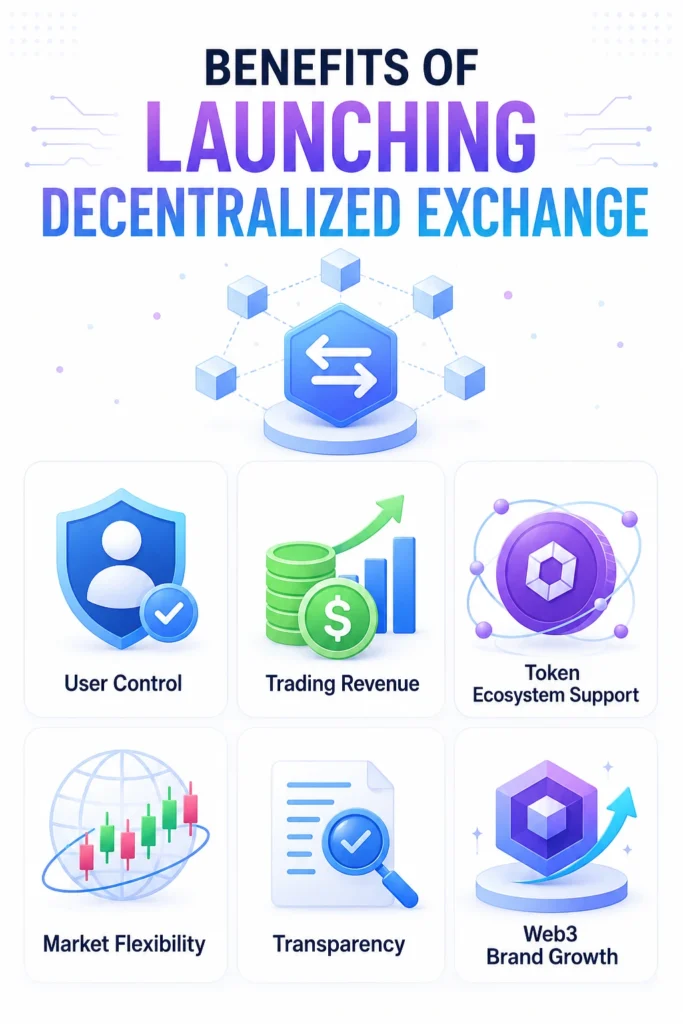
Launching a DEX gives businesses more than a trading platform. It creates a DeFi product that can support users, token projects, and long-term crypto growth.
User Control
Users can trade directly from their own wallets without giving custody of funds to a central platform. This builds more trust among DeFi traders.
Trading Revenue
The DEX owner can earn revenue from swap fees, liquidity pool fees, token listings, staking, farming, and premium trading features.
Token Ecosystem Support
A DEX can help token projects create liquidity, support community trading, and reduce dependence on centralized exchange listings.
Market Flexibility
Businesses can add new token pairs, liquidity pools, and DeFi features faster when the platform has a strong smart contract structure.
Transparency
Blockchain records allow users to view transactions, liquidity movement, token swaps, and platform activity more openly.
Web3 Brand Growth
A DEX helps startups, fintech companies, and enterprises build a stronger position in decentralized finance.
Takeaway
A decentralized exchange can become a strong business opportunity in 2026, but it needs proper planning and technical care. Users want fast swaps, transparent trading, secure smart contracts, wallet-based access, and enough liquidity.
For businesses, Decentralized Exchange development can open revenue through trading fees, token listings, liquidity programs, staking, farming, and DeFi ecosystem growth. However, a successful DEX needs the right blockchain, strong contracts, a clean user experience, liquidity planning, testing, security, and post-launch support.
Built Customized Dex Exchange Platform With ShamlaTech
ShamlaTech helps businesses plan, build, test, and launch decentralized exchange platforms based on real business needs. Whether a company wants to Create your own Decentralized Exchange development project or upgrade an existing crypto platform, ShamlaTech can support the full process.
As a leading Cryptocurrency exchange Development Company, we work with startups, enterprises, fintech firms, and crypto businesses to develop secure and scalable DEX platforms. Our eam supports DEX business model planning, blockchain selection, smart contract development, wallet integration, liquidity pool setup, token swap features, admin dashboard development, UI/UX design, testing, deployment, and post-launch maintenance. We also help with integration of advanced features such as staking, farming, governance tokens, cross-chain swaps, liquidity rewards, analytics dashboards, token listing modules, and DeFi integrations.
FAQs
What is decentralized exchange development?
Decentralized Exchange development is the process of building a blockchain-based trading platform where users can swap crypto assets directly through wallets and smart contracts.
How can I launch a DEX exchange in 2026?
You can launch a DEX by choosing a business model, selecting a blockchain, developing smart contracts, adding liquidity, testing security, and deploying the platform.
How much does decentralized exchange development cost?
The cost depends on features, blockchain network, smart contract complexity, security audits, design, integrations, and whether the DEX is basic, mid-level, or advanced.
What types of DEX platforms can businesses build?
Businesses can build AMM-based DEXs, order book DEXs, hybrid DEXs, cross-chain DEXs, and derivatives DEX platforms.
Why choose ShamlaTech as a Cryptocurrency exchange Development Company?
ShamlaTech helps businesses plan, develop, test, and launch secure DEX platforms with smart contracts, wallet integration, liquidity pools, admin panels, and support.