

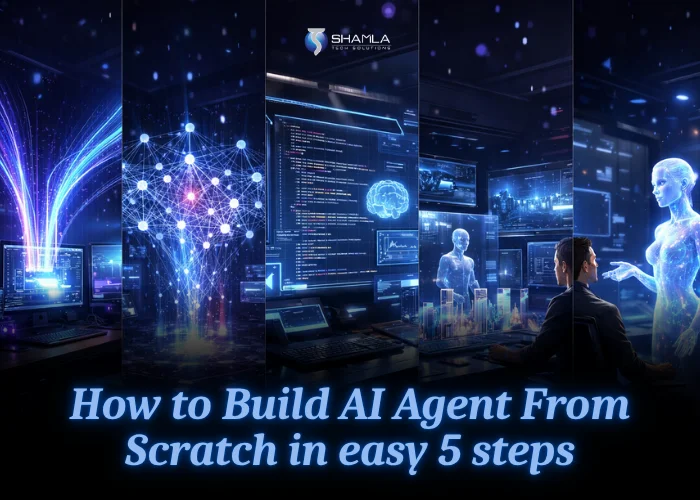

AI agents are autonomous systems that perceive their environment, plan actions and execute multi-step tasks and How to build ai agent from scratch are transforming business workflows. Advances in large language models and integration tools make it easier than ever to create agents that can handle tasks like scheduling, data entry or complex decision-making. Organizations are rushing to harness this technology: a Gartner report predicts that by 2026, 40% of enterprise applications will include dedicated AI agents (up from <5% in 2025).
A McKinsey survey likewise found 62% of companies experimenting with agentic AI by 2025. This guide explains why AI agents are surging in popularity, and then lays out five clear steps to build your own agent from scratch.
Why the Surge in AI Agents?
The rise of AI agents is driven by technical and business factors. Modern foundation models (like GPT-4 and Gemini) now support multi-turn reasoning and can connect to external data. Easy integration platforms and open-source toolkits (e.g. LangChain, LlamaIndex, ReAct frameworks) allow developers to plug in AI models, APIs and knowledge bases with minimal effort.
At the same time, businesses see real value: agents can automate, like AI automation agent, repetitive work and make processes faster. Surveys confirm this trend: nearly nine in ten organisations now use some form of AI, and most are moving beyond chatbots into agentic AI by understanding How to build ai agent from scratch.
Gartner’s 2025 forecast warns that companies who don’t adopt agent strategies risk falling behind because AI agents are entering commerce In short, easier technology and clear ROI have created a wave of interest in AI agents. In this blog we will see How to build ai agent from scratch.
How to Build An AI Agent from the Scratch?
1. Define the agent’s task clearly:
- Decide exactly what you want the agent to accomplish or Build an ai agent with Shamlatech.
- Write a precise description of its role, inputs and expected outcomes.
- Simple agents should focus on a single task with a clear endpoint; complex agents may handle multi-step workflows but should still have a defined scope.
- Being explicit about the goal guides all later design choices. As Lindy puts it: “Give each agent a clear job.
2. Choose your platform or framework:
In this How to build ai agents step by step guide, this is second important step that you can’t miss out
- You have two main routes on learning how to create an AI agent: no-code agent builders or code-based frameworks. No-code/low-code tools (like Lindy, Zapier AI, or Microsoft Power Automate) let you assemble agents visually and are fast for non-technical users.
- They include built-in integrations and are ideal for simple workflows. For maximum flexibility, use code-based frameworks like LangChain, Retrieval-Augmented Generation (RAG) libraries or custom code.
- These require programming (typically Python) but allow deep customization of logic, memory and integrations. Code frameworks are better when you need complex reasoning, custom data handling, custom ai agent development or integration with proprietary systems.
3. Set up data, triggers and integrations.
- Next step on how to build ai agent from scratch is to configure how your agent will start and where it will get information.
- Define a trigger (the event that launches the agent): for example, an incoming email, a new database entry, or a scheduled time.
- This might include user profile info, task history or business rules. Also connect any external systems it needs via APIs or services. For instance, link the agent to your CRM, Google Sheets, Slack, or email system.
4. Develop and test the agent
- Now learn how to build AI agent and the agent’s logic and intelligence.
- If using a code framework, write the code that calls the AI model (e.g. an LLM), processes its response, and enforces any business rules. If using a no-code tool, configure the workflow steps and prompts.
5. Deploy and monitor the agent in production.
Regulatory and Compliance Frameworks for AI Agents
Autonomous AI agents developments are up to important compliance issues. AI regulations and standards are coalescing globally. n the US, agencies like the FTC have clarified that existing consumer protection laws already apply to AI systems.
At the same time, international frameworks provide guidance for building trusted agents. The NIST AI Risk Management Framework and ISO/IEC 42001 are best-practice standards for AI governance, and the EU’s Artificial Intelligence Act (effective 2024) sets mandatory requirements for “high-risk” AI, including many enterprise agents.
However, traditional frameworks weren’t specifically designed to build an AI agent and fully autonomous agents. Recognising this gap, Singapore released in Jan 2026 the first Model AI Governance Framework for Agentic AI, addressing unique risks of autonomous agents (unauthorized actions, data leaks, etc.) and emphasising human oversight and technical safeguards.
Compliance on How to build ai agent from scratch now effectively means adopting these standards: for instance, encrypting sensitive data, documenting your training data provenance, and proving that your agent’s actions are explainable and monitored. In short, use recognized frameworks (NIST, ISO, EU Act) as a baseline, and layer on agent-specific controls like those in Singapore’s framework to stay safe and compliant.
How ShamlaTech Can Help You?
ShamlaTech, an AI agent development company, offers end-to-end AI development services to bring your custom agent to life. We understand How to build AI agent from scratch and our team can handle everything from scratch: defining the AI model and workflow, coding the integration logic, and deploying a secure system.
We build both modular and full-stack solutions – for example, creating add-on AI modules that integrate with your existing software without disruption, or crafting complete platforms from the ground up.
ShamlaTech’s experts use industry-standard frameworks and large language models to implement complex agent logic.
We also ensure robust compliance: all our solutions meet global security standards (GDPR, ISO 27001, HIPAA etc.) and include privacy-by-design measures. From the initial consultation and strategy to LLM fine-tuning, deployment and monitoring, ShamlaTech can guide you through the five-step process.
Our experience with diverse AI applications means we can suggest the right platform (no-code vs custom code) and test cases, saving you time. By partnering with ShamlaTech, you get a scalable, secure AI agent tailored to your needs – without reinventing the wheel.