


Gold has been one of the most stable stores of value for ages. However, there are hurdles to owning actual gold, including the requirement to keep it securely and the necessity to find purchasers down the road (liquidity). That has given rise to gold tokenization, an innovative approach that is altering the way individuals acquire and sell gold.
Data from CoinGecko shows that gold tokenization market capitalization is now at $1 billion. This shows a growing acceptance and popularity of tokenize gold assets.
Tokenization is the digital representation of gold through the blockchain technology. The blockchain technology is a more efficient way to invest and possess gold.
This essay will describe what gold tokenization is and how it works, how to convert physical gold to digital gold tokenization platform, the benefits, and obstacles. We will also discuss the future of tokenized gold.
What is Gold Tokenization
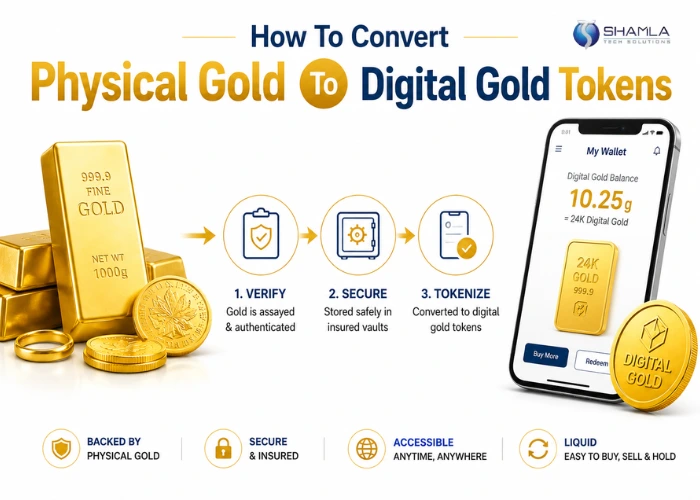
Gold tokenization, how to convert physical gold to digital gold tokens, is transforming actual gold into digital tokens on the blockchain. In these systems, each token represents a certain amount of gold housed in insured vaults, and is often backed 1:1 in physically allocated bullion. This token can then be traded, purchased or sold in a similar fashion to other crypto currencies. At the same time, the real gold is still in safe storage.
It confirms transactions and verifies ownership through a public ledger on the blockchain. This does not require any intermediaries and so gives a much simpler and direct way to make the gold trading more effective on digital platforms.
Why Convert Physical Gold Into Digital Tokens?
The ability to directly issue gold as a token hinges on regulators allowing the representation of commodities on distributed ledger technology. How to convert physical gold to digital gold tokens, in certain jurisdictions, tokenization can be done directly, while others still require middlemen like central securities depositories or licensed custodians
Where direct tokenization is not possible, the indirect tokenization technique is preferred:
- Physical gold is held within an intermediary legal framework, generally a Special Purpose Vehicle or regulated fund.
- The ownership interest of the entity is then represented on-chain as tokens.
- The custodial structure ensures the gold is segregated, audited and redeemed, shielding investors from counterparty risk.
This way of doing things allows fractional ownership, facilitates trading and encourages the circulation of tokens in regulated digital asset markets. The level of investor protection, the tax treatment and marketability are determined by the legislative architecture of these intermediate entities.
How Gold Tokenization Works?
The method of tokenizing gold or how to convert physical gold to digital gold tokens follows a straightforward path:
- Acquisition of Gold
A firm or organization buys actual gold and stores it in a safe vault.
- Issue of Tokens
The organization then creates digital coins on a blockchain network. Each token is equal to a certain quantity of gold, typically one gram or one ounce.
- Verify Ownership
The blockchain technology allows for the verification of ownership of the tokens and accordingly the gold in real time. Tokens can be traded or sold, and the ownership is transferred.
These tokens can be stored in digital wallets, such as Bitcoin or Ethereum. Rather than buying whole bars or coins, investors can purchase fractions of an ounce of gold
What are the Key Technologies behind Gold Tokenization?
The future of gold tokenization and convert gold to digital assets will probably be innovation in the way blockchain and smart contract technology interacts with traditional assets like gold. How to convert physical gold to digital gold tokens and tokenization platforms evolve, capabilities like automated rebalancing, real-time audits, and interaction with other financial services will become standard. Also, improved interoperability between different blockchains would make it easy to transfer gold token development between different networks, making them easier to access and use.
Another potential is the emergence of hybrid models that allow real gold and tokenized gold to coexist and enable investors to move between the two forms with ease. This might mean that token holders could redeem their digital gold for physical bullion on demand, or physical gold holders could redeem their holdings for tokens to access liquidity without selling their gold outright.
What are the Regulatory & Legal Considerations for Gold Tokenization?
Jurisdiction is the single most critical aspect in determining if a gold-backed cryptocurrency will take hold with institutional investors and stay compliant across various markets. It determines physical gold to crypto tokens not just whether tokenization is legally conceivable, but also the licensing requirements, custody arrangements and the breadth of investor access.
Switzerland
Historically, Switzerland has been a world leader in gold trading and safekeeping. “Asset tokens” are specifically permitted by FINMA, allowing for the issuance of gold-backed tokens in a clear legal framework. The country’s reputation and solid regulatory structure means that investors trust it a lot. Prices are steeper but Switzerland remains a favorite destination for institutional projects due to its crypto-friendly banks and stable environment.
European Union – MiCA framework
MiCA establishes a harmonized framework for asset linked tokens across the EU. Gold-backed tokens will be covered by this framework, with licensing, prospectus filings for public offers and strict AML/CTF compliance required. Supervision at EU level creates a high level of trust, but in practice execution varies among member states, and support from banks may not be uniform.
Liechtenstein (Liechtenstein)
Liechtenstein boasts one of the most complete systems for tokenisation. EU passportability, good regulatory legitimacy and access to institutional investors all benefit projects. But compliance fees are high and a local compliance officer is needed. That flexibility makes it attractive to issuers of gold-backed tokens.
UAE (ADGM & DIFC)
The UAE is becoming a hotspot for digital assets, with ADGM and VARA offering clear foundations for tokenization. Gold-backed structures are enabled via DLT Foundations and adaptable SPVs. Retail distribution is limited, but private placements are easy. UAE is favorable for growing enterprises regionally for its fast licensing and crypto-friendly banking.
Physical Gold vs Digital Gold (Tokenized Gold) - Comparison Table
Shamlatech, Leading companies offering gold tokenization services is crucial for gold tokenization.
Feature | Physical Gold | Digital Gold (Tokenized Gold) |
Ownership Form | Tangible asset (coins, bars, jewelry) | Blockchain-based tokens representing gold |
Storage | Requires personal storage or bank lockers | Stored in secure vaults by custodians |
Security Risk | Theft, loss, damage | Smart contract risk, platform security risks |
Liquidity | Moderate (depends on location & buyer availability) | High (can be traded instantly on platforms) |
Fractional Ownership | Limited (must buy whole units) | Easy (can buy small fractions like 0.1g) |
Transaction Speed | Slow (physical verification needed) | Fast (near-instant blockchain transactions) |
Transparency | Low to moderate | High (blockchain records + audits) |
Verification | Requires manual purity testing | Digitally verified and audited regularly |
Accessibility | Limited to local markets | Global access via internet |
Costs | Making charges, storage fees, transport | Platform fees, gas fees, custody fees |
Regulation | Well-established globally | Still evolving, varies by country |
Redemption | Immediate physical possession | Requires token redemption process |
Use Case | Investment, jewelry, cultural value | Investment, trading, DeFi integration |
Portability | Difficult to transport in large amounts | Easily transferable digitally |
Divisibility | Not easily divisible | Highly divisible into micro-units |
What are the Benefits of Converting Gold into Digital Tokens?
- Fractional Ownership
Tokenization gives users the ability to hold smaller amounts of gold. Instead of buying an ounce or a bar of gold, investors can acquire tokens that represent fractions of gold, so making gold accessible to more people.
- Improved Liquidity
For smaller investors especially, traditional gold markets are slow and cumbersome. Tokenization offers rapid and easy trading on worldwide markets, with the possibility to exchange tokens 24/7.
- Worldwide Accessibility
Gold tokenization is a gateway to admission. And where in the world you are, if you have access to the internet, you can invest in gold.
- Transparency.
Blockchain creates a visible, immutable ledger of ownership. This allows gold token mining process holders to readily verify the underlying assets and keep track of their investments.
- Cost Effective & Less Storage Worries
Gold tokenization also eliminates one of the biggest problems with traditional gold ownership: the price and logistics of storing physical gold.
- Gold in physical form has to be stored securely. This is an expensive business because of insurance, vaulting costs and the necessity for strong security.
- Tokenized gold, on the other hand, is housed in insured vaults by recognized custodians, which removes logistical issues from ordinary investors. Investors can buy and trade gold without the need to own the asset physically, which is significantly more convenient and cost-effective.
- Tokenized gold also means you don’t have to move real gold to complete a transaction. This decreases the cost of transportation and increases safety, as there is no possibility of loss or theft in transit.
- For organizations and businesses that own big amounts of gold, tokenization provides a streamlined way to track and transfer their assets around the world without the typical difficulties of moving real gold.
Challenges & Risks in Gold Tokenization
- Regulatory Uncertainty
Tokenization uses gold and blockchain technology, therefore the regulatory environment is still being formed. Different jurisdictions have different standards for dealing with real world assets and precious metals, which makes compliance complicated.
- Reliance on Custodians
A custodian holds the physical gold backing these tokens. Token holders need to believe the gold is secure and that the custodian is acting with complete transparency and integrity.
- Crypto Currency Fluctuations
Gold tokens themselves are not volatile, but they are exchanged on exchanges that also trade extremely volatile cryptocurrencies. This could indirectly impact the price and liquidity of tokenized gold.
- Blockchain risk
Like any system that uses blockchain technology, there is a danger of technical failure, hacking, or network weaknesses. The blockchain is safe, but not immune from these hazards.
Real-World Examples of Gold Tokenization Platforms
1. WGB
The Gold mining RWA tokenization platform development for WGB Metals Corp was built to bring gold mining output into a structured Real-World Asset (RWA) tokenization framework. The objective was to convert gold produced from mining operations into verifiable blockchain-based digital assets that can be issued, tracked, and used within a compliant financial system.
This was designed as a production-grade infrastructure system centered on gold-backed RWA tokenization. It needed to ensure direct linkage between mined reserves and digital tokens while maintaining regulatory compliance, auditability, and investor-grade transparency across the entire lifecycle from extraction to on-chain representation.
2. Tether Gold (XAUt)
The issuer of the USDT stablecoin, Tether, has launched a gold-backed cryptocurrency called XAUt. One XAUt token = one fine troy ounce of gold, vaulted in secure vaults in Switzerland. These tokens are listed on a number of cryptocurrency exchanges, giving investors liquidity and security. How to build gold tokenization platform, reporting procedure is transparent so that the gold underlying the tokens can be checked at any time and the users will trust the process.
3. Paxos Gold (PAXG)
PAXG tokens are Paxos’ trustworthy, highly regulated tokenization solution. Each PAXG token represents one fine troy ounce of gold, kept in London vaults as London Good Delivery bars. Paxos is regulated by the New York State Department of Financial Services (NYDFS) which adds another layer of trust and protection for investors. This regulation increases the attractiveness of PAXG, especially for institutional investors searching for compliant and transparent ways to invest in gold.
How much Cost to Convert Physical Gold into Digital Tokens?
The cost of converting physical gold into digital tokens (gold tokenization) varies significantly depending on scale, regulatory requirements, and the technology stack you choose. Typically, the total cost can range from $25,000 to $150,000+ for a basic to enterprise-grade setup.
Key cost components include:
- Gold Custody & Auditing
You need secure vaulting services and periodic third-party audits to verify that the physical gold backing the tokens exists. Costs depend on volume and location but are essential for trust and compliance. - Token Development & Smart Contracts
Developing secure smart contracts to represent gold ownership on blockchain can cost anywhere between $10,000 and $50,000, depending on complexity, features (fractional ownership, compliance rules), and blockchain choice. - Legal & Compliance Costs
Since gold tokenization development often falls under securities or commodity regulations, legal structuring, licensing, and compliance can cost $5,000 to $30,000+, especially in regulated jurisdictions. - Blockchain Infrastructure & Integration
Costs include selecting and integrating blockchain platforms, wallets, APIs, and custody systems. This may range from $5,000 to $25,000.
How to Launch Your Own Gold Tokenization Platform
Launching a gold tokenization platform involves combining blockchain technology with real-world asset management. Here’s a step-by-step approach:
- Define Your Business Model
Decide whether your platform will focus on retail investors, institutional clients, or both. Determine whether tokens represent ownership, claims, or derivatives. - Secure Physical Gold Supply
Partner with certified gold suppliers and vault providers to ensure physical backing. Transparency is critical for user trust. - Choose the Right Blockchain
Select a blockchain based on scalability, security, transaction fees, and ecosystem. Popular options include Ethereum, BNB Chain, and Polygon. - Develop Smart Contracts
Create secure and audited smart contracts that define token issuance, transfers, and redemption mechanisms. - Ensure Legal Compliance
Work with legal experts to comply with regulations in your target markets. This includes KYC (Know Your Customer) and AML (Anti-Money Laundering) requirements. - Build the Platform (Frontend + Backend)
Develop a dashboard where users can buy, sell, and manage their gold tokens. Integrate wallets and payment gateways. - Implement Security Measures
Use encryption, multi-signature wallets, and regular smart contract audits to protect user assets. - Launch & Market Your Platform
Create awareness through digital marketing, partnerships, and investor outreach. - Provide Liquidity Options
Enable secondary trading or integrate with exchanges to allow users to trade tokens easily.
FAQs About How To Convert Physical Gold To Digital Gold Tokens
How is physical gold backed in digital tokens?
Physical gold is stored in secure vaults managed by trusted custodians. Each Gold backed tokens represents a specific quantity of gold (e.g., 1 token = 1 gram of gold). Regular third-party audits ensure that the gold reserves match the number of tokens issued.
Is gold tokenization legal?
Yes, gold tokenization is legal in many jurisdictions, but it depends on local regulations. Some countries classify these tokens as securities, while others treat them as commodities. Compliance with financial laws, KYC, and AML regulations is mandatory.
Can I redeem digital gold for physical gold?
In most gold tokenization platforms, yes. Users can redeem their tokens for physical gold, subject to minimum thresholds and delivery fees. Some Best platform to invest in digital gold also allow conversion into fiat currency instead.
What blockchain is best for gold tokenization?
There is no single “best” blockchain, it depends on your needs of platforms offer fractional gold ownership through tokens
- Ethereum – High security and widespread adoption
- Polygon – Lower transaction fees and faster processing
- BNB Chain – Cost-efficient and scalable
- Private/Consortium Blockchains – Better for enterprise control and compliance
Conclusion: Is Gold Tokenization the Future of Asset Ownership?
Gold tokenization represents a powerful shift in how physical assets are owned, traded, and managed. By combining the stability of gold with the efficiency of blockchain, it unlocks new levels of liquidity, transparency, and accessibility.
Investors can own fractional gold, trade globally, and verify asset backing in real time—something traditional systems struggle to provide. However, challenges such as regulatory uncertainty, custody risks, and technological complexity still exist.
Despite these hurdles, the momentum behind real-world asset (RWA) tokenization is growing rapidly. As infrastructure matures and regulations become clearer, gold tokenization is poised to become a key pillar in the future of digital finance and asset ownership.