


The tokenization of real-world assets is redefining capital formation and distribution. Assets such as real estate, private credit, and commodities are now issued as programmable digital instruments, enabling fractional ownership, structured liquidity, and transparent transaction frameworks.
By 2026, tokenized real-world assets have crossed $19 billion in on-chain value, with the market expanding over 250% within fifteen months and institutional adoption extending across credit and treasury instruments. This scale is increasing demand for white label RWA tokenization platforms with compliant, production-ready infrastructure.
This article explains the features every RWA investment platform must have in 2026, with a focus on capabilities required for institutional deployment, regulatory alignment, and efficient lifecycle management of tokenized assets.
Why Enterprise-Grade RWA Platforms Need a New Standard in 2026
Institutional adoption has moved RWA tokenization into core financial infrastructure. Platforms are now expected to support regulated issuance, asset servicing, and liquidity under a single system, aligning with operational, legal, and capital market requirements at scale.
Key Market Drivers and Structural Demands
- Institutional capital is treating tokenization as an extension of existing asset frameworks, requiring platforms to integrate with custody, reporting, and compliance systems already in place
- Tokenized RWA markets are projected to surpass $400 billion in 2026, driven by demand for efficient settlement, collateral mobility, and new distribution channels
- Leading financial institutions are building internal infrastructure for tokenized assets, signaling a shift toward proprietary platforms and controlled ecosystems
- Liquidity expectations now include secondary trading, continuous pricing, and integration with both traditional and on-chain venues
- Regulatory alignment is becoming embedded at the infrastructure level, where compliance, transfer restrictions, and reporting are enforced through platform architecture rather than external processes
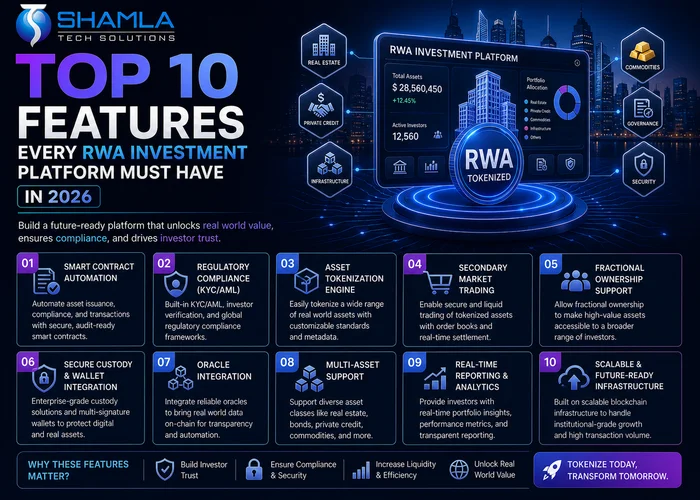
10 Features Every RWA Investment Platform Must Have in 2026
Feature | Core Function | Business Impact |
Asset Tokenization Engine | Converts assets into digital tokens | Enables scalable product structuring |
KYC / AML & Compliant Onboarding | Verifies identity and enforces compliance | Improves onboarding efficiency and reduces risk |
Smart Contract Token Issuance | Automates secure token creation | Ensures standardization and system integration |
Custody, Asset Safeguarding & Token Security | Secures tokens and underlying assets | Builds trust and mitigates operational risk |
Secondary Market Trading | Enables trading and liquidity access | Increases participation and capital flow |
Real-Time Valuation & Oracle Integration | Provides accurate pricing data | Supports transparency and reporting |
Automated Income Distribution | Automates yield and dividend payouts | Reduces errors and operational overhead |
Multi-Chain Interoperability | Enables cross-chain asset movement | Expands distribution and market access |
AI Portfolio Rebalancing & Allocation | Optimizes portfolio allocation | Enhances capital efficiency |
Regulatory Compliance by Jurisdiction | Enforces region-specific compliance | Enables global scalability |
- Asset Tokenization Engine
An asset tokenization engine is fundamental for converting physical and financial assets into structured digital instruments. Institutions require scalability and customization to support diverse asset classes such as real estate, private credit, and funds. Without this capability, platforms cannot support complex deal structures, limiting product flexibility, slowing issuance cycles, and restricting the ability to meet institutional investment requirements at scale.
- KYC / AML & Compliant Onboarding
KYC and AML systems must deliver seamless identity verification within a regulatory-first onboarding experience. Inefficient onboarding directly impacts investor conversion and delays capital deployment. Platforms must enforce investor eligibility, maintain audit trails, and ensure compliance across jurisdictions, enabling institutions to onboard investors efficiently while meeting regulatory obligations without introducing operational bottlenecks.
- Smart Contract Token Issuance
Smart contract token issuance enables automated, secure minting of tokens using standardized frameworks such as ERC-3643. Institutions require reliable, auditable, and governable issuance mechanisms to manage ownership, compliance rules, and lifecycle events. Weak issuance frameworks increase operational risk, complicate integrations, and reduce confidence among investors and counterparties.
- Custody, Asset Safeguarding & Token Security
Custody and asset safeguarding are central to institutional participation in tokenized markets. Platforms must provide institutional-grade custody solutions, secure key management, and protection against hacks and mismanagement. Ensuring a verifiable link between tokens and underlying assets is critical, as any failure in safeguarding exposes institutions to financial loss, legal disputes, and reputational damage.
- Secondary Market Trading
Secondary market trading is essential to unlock liquidity for tokenized assets. Platforms must offer built-in liquidity mechanisms, along with peer-to-peer and exchange integrations, to enable continuous trading. Without accessible secondary markets, assets remain illiquid, reducing investor interest and limiting capital inflows, which directly impacts the viability of tokenized investment products.
- Real-Time Valuation & Oracle Integration
Real-time valuation and oracle integration provide accurate pricing and continuous asset performance tracking. Institutions depend on reliable data for pricing, reporting, and risk assessment. Without trusted valuation mechanisms, platforms cannot support transparent trading, accurate NAV calculations, or institutional reporting standards, undermining confidence in tokenized assets.
- Automated Income Distribution
Automated income distribution enables smart contract-based payouts for dividends, yields, and rental income. Institutions managing large investor bases require precise and timely distribution mechanisms. Manual processes introduce delays, reconciliation issues, and compliance risks, while automation ensures operational efficiency, transparency, and scalability across multiple asset classes.
- Multi-Chain Interoperability
Multi-chain interoperability enables cross-chain asset movement and expands investor access across blockchain ecosystems. Institutions require flexibility to operate across networks based on liquidity, cost, and regulatory considerations. Platforms restricted to a single chain limit distribution potential and reduce competitiveness in a multi-network investment environment.
- AI Portfolio Rebalancing & Allocation
AI-driven portfolio rebalancing and allocation support data-driven investment optimization and personalized strategies. Institutions require dynamic portfolio management that adapts to market conditions, risk profiles, and performance targets. Static allocation models reduce efficiency, while AI-driven systems improve capital deployment and enhance portfolio performance.
- Regulatory Compliance by Jurisdiction
Regulatory compliance by jurisdiction ensures platforms can operate across multiple regions while adhering to local legal frameworks. Institutions require systems that enforce geo-specific rules, investor restrictions, and reporting obligations aligned with authorities such as the SEC, MiCA, VARA, and more. Without embedded compliance, platforms face legal exposure, restricted market access, and challenges in scaling tokenized offerings globally.
What Differentiates a Winning RWA Platform
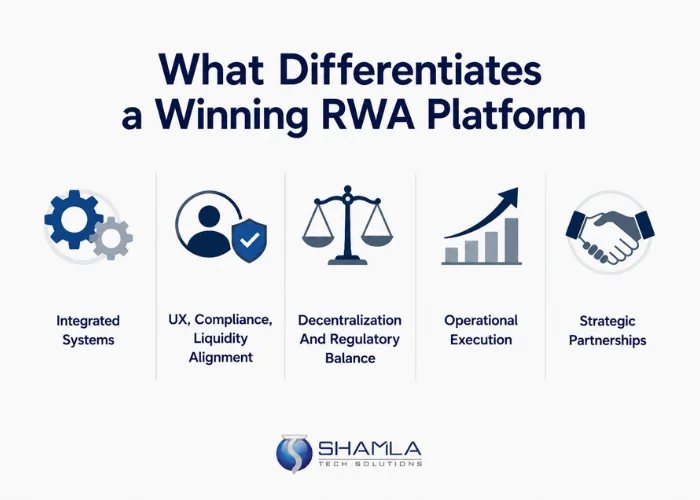
Integrated Systems Drive Real Adoption
User Experience, Compliance, And Liquidity Must Align
Balance Between Decentralization And Regulatory Control
Operational Execution Determines Platform Viability
Strategic Partnerships Strengthen Market Positioning
Bottom Line
RWA investment platforms are becoming foundational infrastructure for institutions structuring and distributing tokenized assets. Decisions made at the platform level influence compliance, liquidity, and operational control. Selecting the right capabilities ensures alignment with regulatory expectations, investor requirements, and long-term scalability across asset classes and jurisdictions.
As adoption expands, competitive advantage will depend on execution quality, system integration, and institutional readiness. Platforms that deliver secure infrastructure, embedded compliance, and efficient asset lifecycle management position businesses to capture capital, enter new markets, and operate with confidence in increasingly regulated tokenized environments.
Build & Launch RWA Platforms with Shamla Tech Solutions
Shamla Tech Solutions is an RWA tokenization platform development company. We deliver end-to-end infrastructure for asset tokenization, smart contract issuance, and compliant onboarding. Our solutions support institutional requirements, enabling secure asset structuring, efficient deployment, and seamless integration across custody, trading, and reporting systems.
We build scalable RWA platforms with embedded compliance, multi-chain interoperability, and automated asset lifecycle management. Our expertise ensures faster deployment, reduced operational complexity, and consistent system performance, helping businesses launch and manage tokenized investment platforms across global markets with confidence.