

Home » Real Estate Tokenization » Top 7 Benefits of Real Estate Tokenization in the USA for Institutional Investors in 2026

Top 7 Benefits of Real Estate Tokenization in the USA for Institutional Investors in 2026

Share this article:
benefits of real estate tokenization
Table of Contents
About the Author
Balaji
CEO of Shamla Tech, specializes in crypto exchange development, RWA tokenization, blockchain infrastructure, AI solutions, and compliance-ready platforms. He helps enterprises address regulatory, security, and scalability challenges while driving real-world adoption of emerging technologies across industries.
Connect On:

Institutional real estate investment has always favored scale, exclusivity, and structured capital access. Tokenization introduces a new ownership and distribution framework, enabling institutions to package, manage, and commercialize real estate assets with greater precision across investor networks.

The U.S. real estate market is experiencing a high-value, inventory-constrained environment, with total market valuation projected to approach $131 trillion in 2026. This market structure is increasing institutional interest in real estate tokenization platforms that support fractional access, liquidity strategies, and efficient capital distribution.

In this article, we examine the benefits of real estate tokenization for institutional investors in the USA, how tokenized ownership aligns with 2026 portfolio strategies, and why building a dedicated real estate tokenization platform creates measurable commercial opportunities.

Build Your Custom Real Estate Tokenization Platform Now

How Real Estate Tokenization In The USA Is Reshaping Institutional Real Estate Investment

Institutional real estate investment in the USA is shifting from static ownership structures toward programmable asset infrastructure. Tokenization enables institutions to redesign capital formation, investor participation, asset servicing, and transaction execution with stronger control over efficiency, scalability, and monetization.

Key Strategic Shifts Driving Institutional Adoption

  • Institutional real estate is moving from closed capital ecosystems toward digitally structured investment distribution, enabling firms to broaden accredited investor participation without redesigning underlying asset ownership frameworks.

  • Asset managers are treating tokenization as infrastructure for balance sheet optimization, using programmable ownership models to improve capital recycling, reduce idle asset lock-in, and support more flexible fundraising strategies.

  • U.S. commercial real estate investment volume reached $499 billion in 2025, reflecting the scale of institutional capital in the market. Real estate tokenization creates the infrastructure to structure, distribute, and manage this capital with greater efficiency.

  • U.S. institutional firms are increasingly prioritizing operational automation, where smart contract-enabled workflows reduce friction across dividend distribution, investor onboarding, compliance administration, reporting, and transaction reconciliation.

  • Real estate tokenization is reshaping competitive positioning, allowing institutions to launch proprietary investment ecosystems instead of depending solely on conventional REIT structures, private placements, or intermediary-heavy fundraising channels.

7 Benefits Of Real Estate Tokenization In The USA For Institutional Investors

1. Institutional-Grade Liquidity For Commercial Real Estate Holdings

Institutional capital tied to office towers, multifamily portfolios, logistics parks, and hospitality assets often remains locked for years, limiting strategic flexibility. Real estate tokenization enables fractional exits, structured secondary participation, and partial asset monetization, allowing institutions to unlock trapped equity without pursuing full disposals or disrupting broader portfolio ownership strategies.

2. Access To A Broader Accredited And Qualified Investor Base

Institutional fundraising in U.S. real estate often depends on private networks, family offices, pension relationships, and negotiated capital commitments. Tokenization platforms allow firms to structure compliant digital offerings that expand access to accredited investors, qualified purchasers, and cross-border institutional participants, increasing fundraising capacity without relying exclusively on conventional capital sourcing channels.

3. Reduced Fund Administration And Investor Servicing Costs

Institutional real estate operations carry significant administrative burdens across onboarding, KYC/AML verification, subscription management, distribution processing, reporting, and investor communications. Tokenization platforms centralize these workflows within a single infrastructure layer, reducing manual operational overhead, improving administrative accuracy, and lowering the servicing cost associated with managing large investor ecosystems.

4. Faster Capital Formation For Time-Sensitive Acquisition Opportunities

Institutional acquisitions often move at a pace where fundraising delays create execution risk. Tokenized real estate platforms accelerate investor onboarding, allocation processing, tokenized real estate ownership issuance, and capital commitment workflows, enabling firms to mobilize capital faster for acquisitions, recapitalizations, bridge financing strategies, and opportunistic deployment within competitive U.S. commercial real estate transactions.

5. Flexible Structuring Of Institutional Investment Products

Traditional real estate investment structures can limit product innovation around ownership classes, access thresholds, and distribution rights. Tokenization allows institutions to create highly structured investment products tied to specific commercial assets, geographic portfolios, or sector allocations, offering greater flexibility in how capital products are packaged, priced, and commercialized for institutional audiences.

6. Stronger Auditability, Ownership Transparency, And Governance Control

Institutional investors require precise ownership visibility, transparent allocation records, and reliable governance oversight. Real estate tokenization platforms create structured digital ownership records, transaction traceability, automated distribution logs, and stronger audit readiness. This improves internal governance controls while supporting due diligence expectations from institutional stakeholders, regulators, auditors, and investment committees.

7. New Fee-Based Revenue Through Platform Ownership

Owning a real estate tokenization platform creates business value beyond asset monetization. Institutions can generate recurring commercial revenue through issuance fees, investor onboarding charges, transaction processing, platform participation models, white-label offerings, and managed digital investment infrastructure, transforming tokenization from an operational capability into a scalable institutional business vertical.

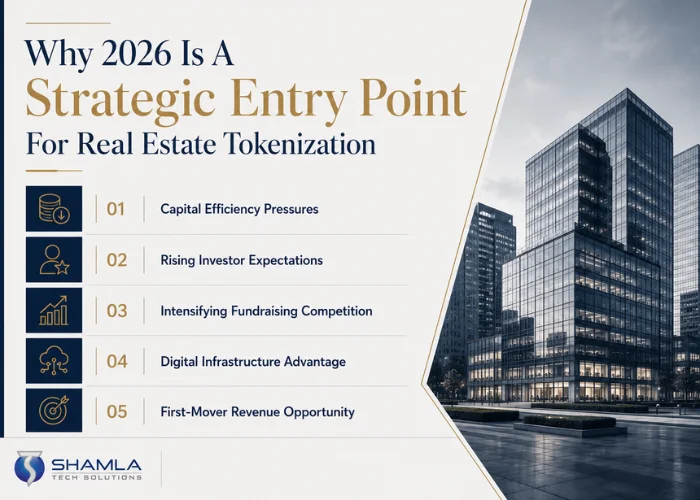
Why 2026 Is A Strategic Entry Point For Real Estate Tokenization
Why 2026 Is A Strategic Entry Point For Real Estate Tokenization

Rising Pressure To Improve Capital Efficiency

Institutional real estate portfolios continue to face capital lock-in across long holding periods, refinancing obligations, and delayed exits. In 2026, improving capital efficiency is a board-level priority. Real estate tokenization enables more flexible ownership structures, partial monetization strategies, and stronger capital redeployment across active investment pipelines.

Investor Expectations Are Becoming More Sophisticated

Institutional investors increasingly expect greater flexibility in how they access, structure, and participate in alternative assets. Static investment vehicles are becoming less commercially attractive. Tokenization of real estate using blockchain technology allows firms to offer more tailored ownership exposure, structured participation models, and digitally managed investment experiences aligned with modern institutional expectations.

Fundraising Competition Is Intensifying Across Alternative Assets

Institutional capital is being aggressively pursued by private equity, infrastructure funds, private credit platforms, and specialized alternative investment vehicles. Competing effectively requires stronger product differentiation. Real estate tokenization enables institutions to present more flexible, accessible, and operationally efficient investment structures that strengthen fundraising competitiveness in increasingly crowded capital markets.

Digital Investment Infrastructure Is Becoming A Commercial Necessity

Institutional firms are moving beyond viewing digital asset infrastructure as experimental capability. In 2026, platform ownership represents strategic commercial infrastructure for capital distribution, investor servicing, and transaction execution. Real estate tokenization platforms provide institutions with the operational framework required to modernize investment delivery while strengthening long-term infrastructure ownership advantages.

Early Platform Ownership Creates Long-Term Revenue Advantage

Institutions entering commercial real estate tokenization early gain more than operational efficiency. They establish direct control over investor ecosystems, platform economics, transaction flows, and digital investment distribution channels. This creates durable commercial advantage, positioning firms to generate recurring revenue while strengthening competitive control over future institutional real estate participation models.

Turn Real Estate Assets Into Scalable Digital Revenue

How Real Estate Tokenization Platforms Create New Institutional Revenue Streams

Institutional firms should not be framed only as tokenization adopters. The stronger commercial case is infrastructure ownership. A real estate tokenization platform creates recurring fee economics, distribution control, and monetizable digital investment infrastructure beyond traditional asset management income.

Revenue Stream

Example Pricing Model

Revenue Scenario

Token Issuance Fees

1%–3% of asset raise

$50M asset raise = $500K–$1.5M

Investor Onboarding / Compliance Fees

$250–$2,000 per investor

500 investors = $125K–$1M

Secondary Transaction Fees

0.5%–2% per trade

$20M annual volume = $100K–$400K

Platform Subscription / Access Fees

$5K–$50K monthly enterprise

$60K–$600K annually

White-Label Licensing

$100K–$500K+ per deployment

New institutional client revenue

Asset Listing Fees

Fixed listing charges

$25K–$150K per asset

Token Issuance Revenue

Every tokenized commercial real estate offering creates a direct monetization opportunity through issuance and structuring fees. Institutional platforms commonly position this within the 1% to 3% range of total capital raised. A $100 million tokenized asset offering can generate $1 million to $3 million in platform-driven issuance revenue.

Secondary Transaction Fee Economics

Institutional real estate platforms can create recurring revenue from secondary marketplace trading, where transaction fees are applied each time tokenized ownership changes hands. Even a modest 1% transaction fee on $50 million in annual secondary trading volume creates $500,000 in recurring revenue without requiring new asset origination.

Investor Access Monetization

Investor onboarding is a monetizable operational layer, not merely an administrative requirement. Platforms can generate revenue through KYC verification, AML compliance processing, accreditation validation, onboarding fees, and premium access structures. With 1,000 institutional and accredited participants, even conservative per-user fee models create meaningful annual revenue streams.

White-Label Infrastructure Revenue

Institutions owning mature tokenization infrastructure can commercialize the platform itself through white-label deployments for developers, private funds, asset managers, and investment firms. Enterprise infrastructure licensing can command six-figure commercial contracts depending on platform capability, customization requirements, compliance architecture, and deployment scale, creating high-margin technology-led institutional revenue.

Recurring Platform Revenue

Long-term platform economics are built on recurring institutional service revenue. Subscription access, asset administration, investor reporting, compliance servicing, distribution management, custody coordination, and transaction infrastructure create predictable commercial income. This transforms a tokenization platform from a project-based investment into a scalable digital revenue business with recurring monetization mechanics.

Wrapping Up

Institutional real estate is entering a phase where infrastructure ownership will shape competitive advantage as much as asset ownership. Firms that establish tokenization capabilities early gain stronger control over capital distribution, investor relationships, monetization models, and the digital architecture supporting future investment products.In the U.S. real estate market, tokenization represents a commercial infrastructure decision with long-term revenue implications. Institutions evaluating platform ownership today are positioning themselves to capture capital, operational efficiency, and market relevance in the next generation of real estate investment.

Why Build Real Estate Tokenization Platforms With Shamla Tech Solutions

Shamla Tech Solutions specializes in building custom real estate tokenization platforms for institutions, asset managers, and investment businesses looking to digitize real-world real estate assets. Our experience spans global market requirements, helping clients launch secure, scalable platforms aligned with regulatory, operational, and commercial objectives.

From token issuance architecture and smart contract engineering to investor onboarding, compliance workflows, asset administration, and secondary trading infrastructure, we deliver end-to-end platform development for institutional use cases. Shamla Tech Solutions helps businesses transform real estate tokenization from concept into commercially viable digital investment infrastructure.


Launch Institutional-Grade Real Estate Tokenization Platforms

FAQs

1. What Are The Main Benefits Of Real Estate Tokenization For Institutional Investor

Real estate tokenization helps institutional investors improve liquidity, expand access to qualified capital, reduce administrative overhead, accelerate fundraising, strengthen ownership transparency, and create more flexible investment structures for commercial real estate participation.

2. Why Is 2026 Considered A Strategic Time For Real Estate Tokenization In The USA?

In 2026, institutional real estate firms face capital efficiency pressures, fundraising competition, and rising investor expectations for digital investment access, making tokenization a commercially relevant infrastructure decision rather than an experimental technology initiative.

3. Can Real Estate Tokenization Platforms Generate Revenue For Institutions?

Yes, institutions can generate revenue through token issuance fees, investor onboarding services, transaction commissions, subscription-based platform access, white-label licensing, and recurring administrative service models tied to digital real estate investment operations.

4. Is Real Estate Tokenization Suitable For Commercial Real Estate Assets?

Yes, commercial real estate assets such as office properties, multifamily developments, hospitality projects, logistics facilities, and mixed-use portfolios are well-suited for tokenization due to their capital-intensive ownership and investment structures.

5. Why Should Businesses Partner With A Real Estate Tokenization Platform Development Company?

A specialized development partner helps businesses build secure, compliant, and scalable tokenization infrastructure with expertise across blockchain architecture, smart contracts, investor workflows, compliance integration, and enterprise-grade real estate investment platform deployment.

Talk to Our Experts

Recent Posts