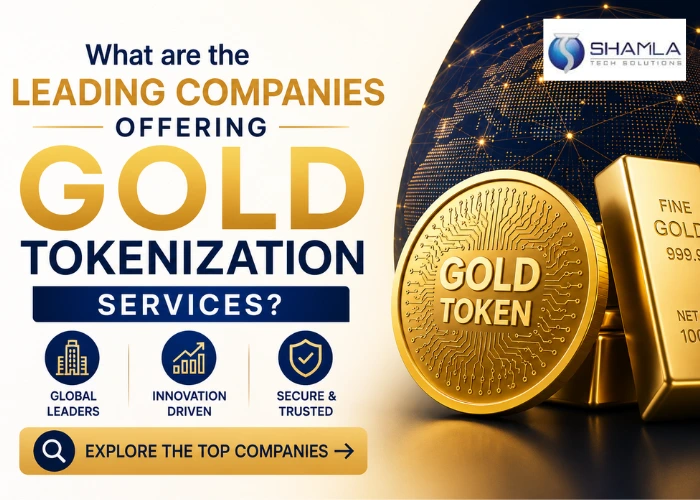

Top 10 Gold Tokenization Companies Offering Gold Tokenization Services 2026
- ShamlaTech: Secure and Compliant Gold Tokenization
- Paxos: Regulated Digital Gold Infrastructure
- Tether Gold: High-Visibility Gold-Backed Crypto
- Kinesis Money: Spendable Digital Gold
- Matrixdock: Institutional Gold on Chain
- VNX Gold: European Gold-Backed Token
- ComTech Gold: Shariah-Compliant Digital Gold
- Meld Gold: Supply-Chain-Linked Gold and Silver Tokenization
- Blockchain App Factory: Gold Tokenization Development Services
- SoluLab: Custom Platform
1. ShamlaTech: Secure and Compliant Gold Tokenization
ShamlaTech takes the first position among gold tokenization platform development companies because it serves the most important audience in this space: businesses that want to launch their own gold tokenization ecosystem. Many companies issue gold-backed tokens, but ShamlaTech helps enterprises build the complete platform behind those tokens.
For a founder, bullion dealer, fintech brand, or investment company, this difference matters. ShamlaTech offers gold RWA tokenization development, smart contract architecture, custody integration, compliance workflows, liquidity features, and platform dashboards. Its gold tokenization services focus on turning physical gold into secure digital assets with transparency and institutional-grade reliability.
2. Paxos: Regulated Digital Gold Infrastructure
Paxos is one of the most recognized names in tokenized gold through PAX Gold, also known as PAXG. Each PAXG token represents one fine troy ounce of a London Good Delivery gold bar stored in professional vault facilities. Paxos also states that PAXG holders have ownership rights to the underlying gold held by Paxos Trust Company.
Paxos is important because it shows how regulated infrastructure can support digital gold. It appeals to investors who want a direct link between a token and physical bullion. It also sets a benchmark for transparency, custody, and redemption structure.
For businesses studying tokenized gold investment platforms, Paxos offers a useful model. It shows why legal clarity, reserve backing, and user trust must come before marketing.
3. Tether Gold: High-Visibility Gold-Backed Crypto
Tether Gold, or XAUt, is another major name in the digital gold market. Tether says XAUt gives ownership of real physical gold by putting gold on the blockchain. Reuters has also reported that Tether’s XAUt is one of the largest gold-backed tokens by market presence.
Tether Gold attracts users who already understand crypto markets. It benefits from the wider Tether brand and strong exchange familiarity. This gives it visibility among users searching for companies offering gold-backed cryptocurrency.
Still, investors must review custody, redemption rules, regulatory risks, fees, and market liquidity before choosing any gold-backed token. A large brand does not remove the need for due diligence.
4. Kinesis Money: Spendable Digital Gold
Kinesis Money offers KAU, a gold-backed digital currency. Kinesis says KAU lets users own, spend, trade, send, and earn with gold. It also says every gram of physical gold is stored in insured, independently audited vaults.
Kinesis has built its product around utility. Instead of treating gold only as a passive asset, it tries to make gold usable in daily digital finance. That makes it attractive for users who want more than storage.
For digital gold token providers, Kinesis is useful because it shows how tokenized gold can move beyond investment and become part of payments, savings, and transfers.
5. Matrixdock: Institutional Gold on Chain
Matrixdock offers XAUm, a token backed by 99.99% purity LBMA gold. Each token represents one troy ounce stored in reputable vaults in Asia, with physical redemption options.
Matrixdock focuses on institutional-grade tokenized gold. Its model fits users who want on-chain gold exposure with vault backing, regional relevance, and clear asset representation. It is one of the real-world asset (RWA) gold tokenization firms that shows how gold can become part of broader RWA finance. This is important because tokenized gold is no longer only a crypto product. It is becoming financial infrastructure.
6. VNX Gold: European Gold-Backed Token
VNX Gold, or VNXAU, is a multichain token that represents direct ownership of physical gold certified by the London Bullion Market Association. VNX says each bar is stamped with its own serial number and linked to VNX Gold tokens.
VNX Gold attracts users who want European exposure, direct ownership language, and multichain flexibility. It also shows how regional regulation and asset location can influence trust.
For users researching top gold-backed token platforms, VNX Gold is worth watching because it connects physical gold ownership with blockchain access in a clear way.
7. ComTech Gold: Shariah-Compliant Digital Gold
ComTech Gold, also known as CGO, is a gold-backed digital asset designed for users who want compliant exposure to physical gold. Every CGO token is backed by one gram of physical gold with 999.9 or 999.5 purity stored in regulated and insured vaults, according to ComTech Gold’s reserve page. The project also gained attention through DMCC’s announcement about tokenized gold bullion backed by DMCC Tradeflow warrants.
For a business studying gold tokenization, ComTech Gold is a good example of how compliance, purity, vault storage, and token design can work together.
8. Meld Gold: Supply-Chain-Linked Gold and Silver Tokenization
Meld Gold focuses on tokenizing physical gold and silver. Its tokens are backed by one gram of the corresponding precious metal and are fully redeemable for the underlying metal. Meld Gold also presents itself as a platform that supports the broader precious metals supply chain, from miners and refiners to retailers.
Meld Gold fits well under digital gold token providers because it not only focuses on investors. It also connects tokenized metals with real-world supply-chain movement. This makes it useful for businesses that want traceability, digital ownership, and easier metal transfer.
9. Blockchain App Factory: Gold Tokenization Development Services
Blockchain App Factory provides gold tokenization development services for businesses that want to create gold-backed tokens and platforms. Its gold tokenization page says it helps store physical gold through real-world vault providers and develops gold-backed tokens that represent ownership in shares of physical gold stored in secured vaults.
10. SoluLab: Custom Platform
SoluLab offers gold tokenization development services for businesses that want to digitize and fractionalize physical gold. Its service page lists custom gold token development, blockchain integration, white-label gold tokenization services, crypto trading integration, platform dashboards, smart contract development, token issuance, redemption, and post-launch support.
Comparison Table: Leading Gold Tokenization Companies and Platforms
Company / Platform | Main offering | Backing model | Best fit |
ShamlaTech | Custom Gold Tokenization platform development | Builds custody-linked, compliance-ready tokenization platforms | Businesses planning to launch a regulated, secure, and compliant gold platform |
Paxos – PAX Gold (PAXG) | Regulated gold-backed token | One token represents one fine troy ounce of London Good Delivery gold held in professional vaults | Investors who want regulated, bar-linked exposure |
Tether Gold (XAUt) | Large gold-backed token | Each XAUt represents one fine troy ounce of physical gold | Users seeking liquidity and broad crypto-market access |
Kinesis Money (KAU) | Spendable digital gold | KAU is backed by physical gold stored in insured, audited vaults | Users who want to send, spend, trade, and hold gold |
Matrixdock Gold (XAUm) | Institutional tokenized gold | Each token represents one troy ounce of 99.99% LBMA gold stored in Asian vaults | Asia-focused institutions and on-chain investors |
VNX Gold (VNXAU) | European gold token | Token represents direct ownership of LBMA-certified physical gold in Liechtenstein | European users who value a regulated custody location |
ComTech Gold (CGO) | Shariah-compliant digital gold | One CGO represents one gram of 999.9 purity gold; DMCC announced tokenization through Tradeflow warrants | Users seeking Shariah-compliant gold exposure |
Meld Gold | Gold and silver tokenization | Tokens are backed by one gram of metal and are redeemable | Supply-chain-linked precious metals tokenization |
Blockchain App Factory | Gold tokenization development company | Builds gold-backed tokens and platform infrastructure | Enterprises creating a gold-backed token project |
Solulabs | Gold tokenization development company | Builds custom and white-label tokenized gold platforms | Businesses launching Gold Tokenization Platform |
What are the Top Gold-Backed Token Platforms?
The top gold-backed token platforms are judged by proof of reserve, redemption, custody, liquidity, and legal clarity. PAXG and XAUt lead by market recognition. KAU stands out for utility. Matrixdock, VNX Gold, ComTech Gold, and Meld Gold serve more specific regional or compliance needs.
For investors, the best platform is not always the biggest one. A token may trade well but offer limited ownership clarity. Another may have a stronger legal structure but lower liquidity. This is why serious buyers compare tokenized gold investment platforms with a checklist, not hype.
Which Platform is the Best to Invest in Digital Gold, and How?
There is no single answer to which platform is the best to invest in digital gold, and how. A safer answer is: choose the platform that matches the investor’s risk, jurisdiction, liquidity needs, and redemption plan.
Investor need | Better-fit option | Why it may fit |
Strong regulatory structure | PAXG | Paxos links PAXG to allocated London Good Delivery gold and publishes transparency reports |
Large crypto liquidity | XAUt | Tether Gold has broad market visibility and significant token scale |
Small unit ownership and utility | KAU, CGO, VNXAU | Gram-based models can make digital gold easier to buy in small portions |
Asia-based institutional use | XAUm | Matrixdock focuses on LBMA gold stored in reputable Asian vaults |
Shariah-sensitive users | CGO | ComTech Gold has promoted Shariah-compliant tokenized gold through the DMCC ecosystem |
Investors should check the whitepaper, reserve reports, redemption rules, exchanges, fees, and local tax treatment before buying. This is not financial advice, but it is basic due diligence.
How To Build a Gold Tokenization Platform: Step-By-Step
Businesses ask how to build a gold tokenization platform because they want more than a token. They want a revenue-ready product. Here is the practical route:
- Choose the legal structure first. The company must decide whether the token is a commodity token, security token, e-money-like product, or asset-referenced token in its target market.
- Secure the gold supply and vault partner. The gold must be allocated, insured, and auditable. Without this, the token has no trust.
- Design the token model. The business must define whether one token equals one gram, one ounce, or a smaller claim.
- Build smart contracts with mint-and-burn controls. Tokens should be minted only after verified gold deposits and burned when gold gets redeemed.
- Add KYC, AML, and wallet controls. Regulated investors expect screening and jurisdiction rules.
- Build the user platform. The product needs wallets, order flow, dashboards, audit reports, admin tools, and support workflows.
- Plan liquidity and redemption before launch. A platform without depth, market makers, or redemption partners loses trust quickly.
This is the cleanest answer to How to launch a tokenization platform without waste. Launch legal, custody, technology, and liquidity together. Do not launch the website first and build trust later.
How Real-World Asset (RWA) Gold Tokenization Firms Create Business Value
The best real-world asset (RWA) gold tokenization firms treat gold as financial infrastructure, not a marketing trick. They connect physical reserves with programmable ownership. That helps bullion dealers sell digitally, fintech apps add gold savings, exchanges list asset-backed products, and institutions settle faster.
Good gold asset tokenization solutions also create revenue. Platforms can earn through issuance, redemption, custody, trading spreads, API access, white-label licensing, and integrations. This attracts founders who want durable financial products, not short-lived crypto launches.
What Makes the Best Digital Gold Token Providers Different?
The best digital gold token providers show proof. They do not hide behind broad words like “backed” or “secure.” They publish reserve details, explain custody, define redemption, and keep token supply aligned with gold reserves. Serious companies offering gold-backed cryptocurrency explain risks because trust grows when users see both upside and limits.
For platform builders, the choice is different. They must compare gold tokenization companies based on blockchain engineering, custody integration, compliance design, smart contract security, and post-launch support. Cheap development becomes expensive if the platform fails an audit, loses liquidity, or disappoints regulators.
Top Gold Tokenization Companies Offering Digital Gold Services in 2026
The demand for Gold tokenization is surging with each passing day. While some gold tokenization companies sell or issue digital gold. Others are blockchain companies for gold tokenization that build token logic, dashboards, compliance, and custody links. The best gold tokenization companies connect secure vault custody, smart contracts, compliance, audits, and digital trading in one system. That is why investors, fintech founders, bullion dealers, and institutions study gold tokenization service providers before buying or building digital gold products.
Reuters reported that nearly 20 gold-backed tokens had reached close to $6 billion in market value by early 2026. This guide highlights the Top 10 Gold Tokenization Platform Development Companies.
Why Businesses and Investors Are Choosing Gold Tokenization in 2026
Gold is trusted, but it is hard to move, divide, store, or trade across borders. Tokenized gold removes that friction. It lets users buy smaller units, transfer value faster, and verify supply on-chain. This is why platforms offer fractional gold ownership through tokens for retail users while institutions use tokenized reserves for settlement, treasury, and RWA strategies.
Strong gold tokenization companies do more than mint a token. They prove where the gold sits, who audits it, who owns it, how redemption works, and what happens if the issuer fails. That separates a serious digital gold product from a weak crypto wrapper.
Takeaway
The leading gold tokenization companies are shaping a new gold market where ownership can be smaller, faster, and more programmable. PAXG and XAUt lead the public conversation, while KAU, XAUm, VNXAU, CGO, and Meld Gold show how regional, utility, and compliance-led models can grow.
For investors, the winning move is careful comparison. For businesses, trusted gold tokenization companies turn the bigger opportunity into infrastructure. The next strong digital gold brand will not win only because it has a token. It will win because it proves custody, liquidity, compliance, and user value better than other gold tokenization companies.
Build Your Gold Tokenization Platform With ShamlaTech
If you want to enter this market, ShamlaTech helps you move from idea to launch with secure, compliance-ready infrastructure. You get custody-linked smart contracts, KYC/AML workflows, investor dashboards, reserve-tracking systems, and scalable gold asset tokenization solutions built around your business model. You can launch faster, reduce risk, and give users a platform they can trust.