

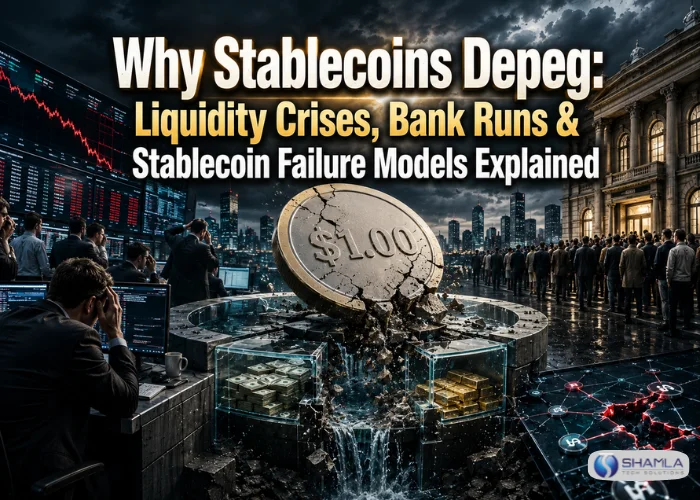

What is Stablecoin Depegging?
- This happens when the value of a stablecoin drifts away from its peg (e.g., trades at $0.95 instead of $1.00).
- Why It’s Important: Stablecoins are essential for crypto transactions, transacting $2.6 trillion in the first half of 2024 alone. “They are a safe haven in volatile times.”
Reasons for stablecoin depegging:
- Market volatility and liquidity challenges
- Stablecoin reserver collapse
- Poor algorithmic stablecoin failure designs
- Regulatory/technical risk.
TerraUSD, for instance, failed in 2022, losing $60 billion, while USDC fell as low as $0.88 in March 2023 over concerns over its reserves.
How to Protect Yourself: Diversify your holdings, monitor the peg stability in real time, choose regulated stablecoins and prioritize those with transparent reserves.
De-pegging is real for algorithmic stablecoin, and can create abrupt losses. Learning about its origins and taking actions to prevent it can make the stablecoin market a safer place to travel.
Stablecoins are designed to maintain a steady value, often pegged to $1.00. But there are many things that can upset this balance and a stablecoin can lose its peg. Grasping these elements helps explain why a well-designed stablecoin can nevertheless stumble during periods of stress.
Liquidity Problems and Market Volatility
Liquidity and active trading are very important for stablecoins to keep their value. During periods of low stablecoin market liquidity and trading activity, stablecoin prices can deviate from the peg. Arbitrageurs-traders who buy underpriced coins then redeem them for $1.00-are important in stabilizing prices. But when the redemption mechanisms slow down or stop, it’s hard to hold the peg. Such disruptions can also affect Stablecoin Settlement Systems, which depend on reliable liquidity and efficient redemption processes to function smoothly.
For instance, Tether (USDT) briefly stablecoin depegged to $0.977 in June 2023 due to a liquidity mismatch in the 3 pool of Curve, one of the largest decentralized liquidity pools. Due to large trader swaps, the pool composition became imbalanced with USDT accounting for more than 70% of the pool. Tether also imposes a minimum redemption of $100,000, thus smaller investors had no choice but to use these secondary markets. These markets were already tight, extending the stablecoin depeg.
The market is volatile, which makes these problems much worse. In March 2023, amid the financial crisis, decentralized exchanges recorded trade volumes of more than $20 billion on March 11 alone, significantly higher than the usual $1 billion to $3 billion each day. When centralized exchanges stopped offering conversions, users moved to decentralized venues and other Stablecoin Liquidity Hubs to access alternative trading routes. When these liquidity pools were thin, the influx of sell orders created large amounts of slippage in price, which increased the danger of stablecoin depegging due to liquidity and collateral difficulties.
Lack of enough collateral backing
The strength of a stablecoin’s reserves is critical to maintaining its peg. Stablecoins are supposed to be worth $1.00, but whether they are depends on the quality and availability of the reserves behind them. Dollar-backed stablecoins are pegged to cash and Treasury bills, while crypto-backed stablecoins employ other digital assets as collateral. Problems emerge when these reserves are mishandled, degraded or inaccessible.
A notable example occurred in March 2023, when USDC stablecoin depegged following reserve challenges linked to disruptions at Silicon Valley Bank. This event also affected DAI, a prominent stablecoin relying partly on USDC as collateral.
Crypto-backed stablecoins are not immune, either. In October 2023, USDT (Real USD) stablecoin depegged after $10 million in redemption requests overwhelmed its treasury. The liquid DAI reserves were quickly depleted, leaving only illiquid tokenized real estate as collateral. This lack of liquidity made it impossible for the issuer to meet redemptions promptly.
Choose Regulated Stablecoin Providers
For instance, regulated stablecoin issuers are subject to tight requirements, such as regular audits and transparent reporting, which might mitigate the risk of bank runs. For example, PayPal’s PYUSD, issued in August 2023, is issued through Paxos Trust Co., a service regulated by the New York State Department of Financial Services (NYDFS). PYUSD is supported by U.S. dollar deposits and short-term Treasurys, and hence may be redeemed for U.S. dollars. When looking at providers, look for those that are licensed by respected regulators or following frameworks like the EU’s Markets in Crypto-Assets (MiCA) law.
The rules provide that stablecoins shall be backed by high quality liquid assets matching the circulating supply. A case in point is USDC from Circle, which briefly stablecoin depegged in March 2023 after $3.3bn of its reserves were stored at the collapsed Silicon Valley Bank. The FDIC’s systemic risk exception allowed Circle to begin redemptions 1:1 and re-establish the peg. “Regulatory uncertainty is a huge obstacle to investor confidence and thus the wider adoption of stablecoins.” Moody’s Investors Service
Before investing, check the issuer’s redemption procedures. Who may redeem coins directly? Are there minimums that would cause you to have to depend on secondary market liquidity in a crisis? It’s also a good idea to look for stablecoins that are widely accepted on regulated exchanges and have significant liquidity. These characteristics serve to provide stability during periods of market stress and are part of what makes the system as a whole resilient.
Conclusion
Stablecoins can lose their peg and the possibility of that happening is real. It can lead to instant monetary losses, forced liquidations, and market-wide upheaval. Understanding the reason for the system issues ( liquidity issues or design issues ) is critical to protecting your investments .
Recent developments make it clear that tighter oversight in the stablecoin settlement system and ecosystem is needed. For example, the collapse of TerraUSD (UST) in May 2022 wiped off an estimated $60 billion in market value, while USDC briefly fell below $0.88 in March 2023 after Silicon Valley Bank failed. These cases underscore the need for risk management techniques such as diversification, continuous assessment, and the selection of stablecoins with transparent reserves and dependable redemption processes.
Transparency and regulation matter for reliability in the stablecoin insurance protocols market, too. Users are safer with issuers who are subject to frequent, independent audits of their reserves and that operate under recognized financial authorities. Platforms such as Kryptonim, a licensed service in the EU, with an emphasis on security and transparent pricing, can assist reduce counterparty risks during market turbulence.
Why Choose ShamalTech to Build a Legally Regulated Stablecoin?
Shamal Tech is a leading blockchain development company specializing in compliant stablecoin development and digital asset stablecoin infrastructure for businesses worldwide. As regulatory frameworks for stablecoins continue to evolve across regions such as the UAE, Europe, Singapore, and North America, building a legally compliant stablecoin requires more than technical expertise—it demands a deep understanding of regulatory requirements, reserve management, security standards, and Global Stablecoin Compliance compliance.
Our team helps enterprises, fintech companies, payment providers, and financial institutions launch fully customized stablecoin ecosystems backed by transparent reserve mechanisms and robust governance frameworks. From smart contract development and reserve management integration to KYC/AML implementation, compliance workflows, wallet infrastructure, and exchange connectivity, we provide end-to-end stablecoin security risk and development services.
With extensive experience in blockchain technology, enterprise-grade security, and regulatory-focused digital asset solutions, ShamalTech enables businesses to launch stablecoins that are secure, scalable, transparent, and designed for long-term sustainability. Whether you’re developing fiat-backed stablecoin risks, commodity-backed, or institutionally regulated stablecoin, we provide the technical foundation and strategic guidance needed for success.