

What is Perpetual DEX
Perpetual trading is becoming a strong growth opportunity for businesses entering the crypto exchange market. Traders want leverage, deep liquidity, transparent settlement, and wallet-based control, while businesses want recurring revenue, wider market reach, and scalable infrastructure. This is why many companies now choose to build a perpetual DEX before investing in full exchange development.
A perpetual DEX lets users trade contracts without owning the underlying asset. It supports long and short positions, leverage, margin management, oracle pricing, and smart contract execution. Businesses planning to launch a decentralised exchange or launch a cryptocurrency can use it to increase trading activity, token utility, and user retention. This guide explores how to build a perpetual DEX following simple steps.
7 Steps to Build a Perpetual Dex
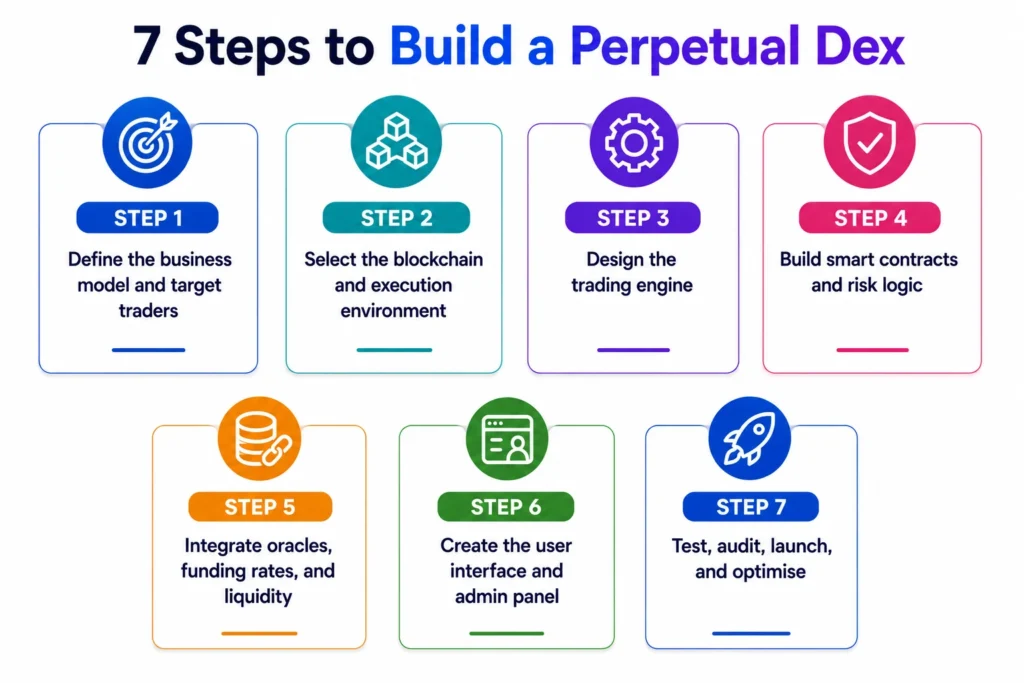
A perpetual DEX needs more planning than a swap platform because it manages leverage, margin, liquidation, price feeds, and real-time trading risk. The following stages help businesses move from idea to live market.
Step 1. Define the business model and target traders
The first step is commercial clarity. A company must decide whether it wants to serve retail traders, professional traders, institutions, market makers, regional crypto users, or an existing token community. Each group needs different leverage limits, collateral assets, fee tiers, compliance flows, UI depth, and liquidity support.
The business must also choose its exchange model. It can build an AMM-based perpetual DEX, an order book DEX, a hybrid architecture, or a custom derivatives venue. Companies exploring Hybrid crypto exchange development often combine centralised speed with decentralised custody to improve execution while preserving user asset control.
Step 2. Select the blockchain and execution environment
The chosen blockchain affects transaction speed, gas cost, settlement finality, liquidity access, and user experience. Ethereum offers a strong DeFi network, while Layer 2 networks improve cost efficiency and throughput. Solana, BNB Chain, Polygon, Avalanche, Arbitrum, Optimism, and Cosmos-based chains can also support perpetual exchange models depending on the product plan.
A team should not build perpetual Dex without testing latency, oracle availability, wallet support, cross-chain needs, and smart contract deployment costs.
Step 3. Design the trading engine
The trading engine manages orders, positions, leverage, collateral, margin, and settlement. In an order book model, the platform needs fast matching, real-time order updates, market maker access, and stable trade confirmation. In an AMM or virtual AMM model, the protocol needs pricing curves, liquidity vaults, slippage controls, and exposure limits.
This layer must handle peak volatility. Crypto derivatives markets can shift quickly, so the system must process trades without stale prices, frozen positions, or unfair liquidations.
Step 4. Build smart contracts and risk logic
Smart contracts enforce trading rules. They manage collateral deposits, position opening, position closing, margin checks, liquidation triggers, funding payments, fee collection, and protocol accounting. The development team must write upgrade-aware contracts, keep critical logic auditable, and reduce attack surfaces.
Risk logic deserves early attention. Leverage can magnify user losses and protocol exposure. Therefore, the platform needs maintenance margin, initial margin, partial liquidation, insurance fund rules, auto-deleveraging logic, open interest caps, and circuit breakers.
Step 5. Integrate oracles, funding rates, and liquidity
A perpetual DEX depends on accurate reference prices. Oracles feed external market prices into smart contracts and help the protocol calculate mark prices, liquidation levels, and funding rates. Reliable oracle providers, fallback sources, deviation checks, and time-weighted average price logic reduce manipulation risk.
Liquidity decides whether traders stay. Thin liquidity causes high slippage, wide spreads, failed orders, and poor retention. Businesses should plan market maker partnerships, liquidity vaults, incentive programs, fee rebates, and early liquidity seeding before launch. More liquidity usually improves execution. Better execution can attract higher volume. Higher volume increases fee revenue.
Step 6. Create the user interface and admin panel
The interface must help traders act fast without confusion. A perpetual trading UI should include charts, order forms, leverage controls, margin display, funding countdowns, liquidation price, open positions, order history, PnL, and risk warnings.
The admin panel should show user activity, markets, liquidity depth, open interest, revenue, suspicious activity, wallet flows, system alerts, and compliance reports. A business cannot manage a derivatives venue with a thin dashboard.
Step 7. Test, audit, launch, and optimise
Before launch, the platform needs smart contract audits, penetration testing, load testing, oracle failure simulations, liquidation scenario checks, and market maker testing. The team should start with limited markets, controlled leverage, and monitored liquidity. After launch, the business can add more pairs, collateral options, referral systems, analytics, and institutional APIs.
Build a Perpetual DEX
What Are the Benefits of Building a Perpetual DEX?
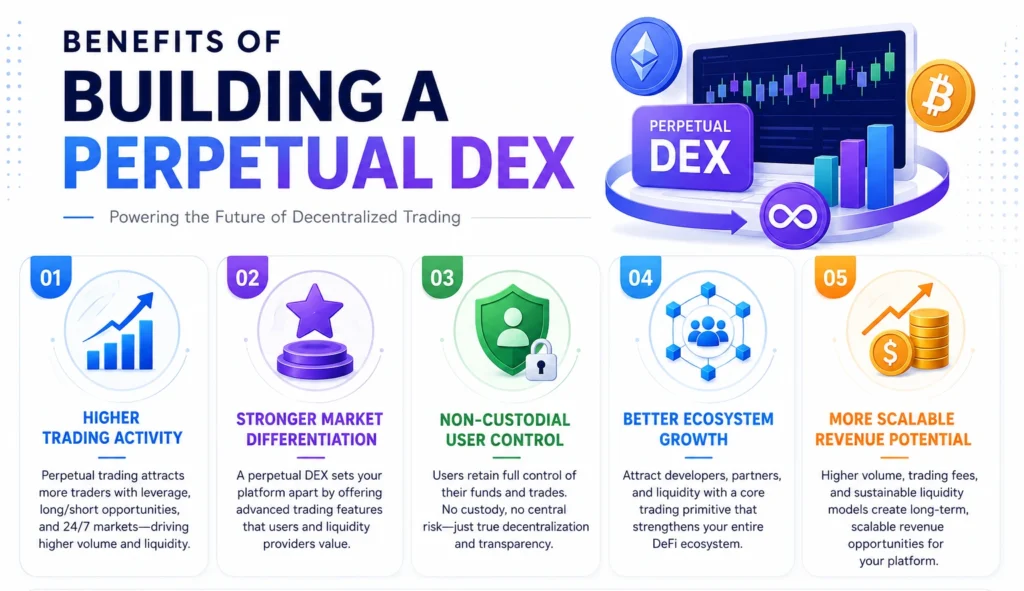
When businesses build perpetual DEX platforms, they move beyond basic swaps and enter a more active trading market with stronger revenue, retention, and ecosystem growth opportunities.
- Higher Trading Activity
Perpetual traders open, adjust, hedge, and close positions more often than spot traders. This frequent activity can increase transaction volume and create more recurring revenue opportunities for businesses. - Stronger Market Differentiation
A perpetual DEX helps businesses stand apart from regular swap platforms by offering leverage, advanced order types, risk controls, liquidity depth, and professional trading tools for serious users. - Non-Custodial User Control
Users can trade through connected wallets while smart contracts manage settlement. This gives traders more control over funds and helps businesses build trust with security-conscious crypto users. - Better Ecosystem Growth
Businesses can connect perpetual trading with native tokens, staking, governance, rebates, referral rewards, and liquidity incentives. These features improve community participation and long-term platform value. - More Scalable Revenue Potential
A company planning to launch a decentralised exchange or build a cryptocurrency exchange platform can use perpetual trading to earn from fees, premium tools, institutional access, and market expansion.
How Does a Perpetual DEX Work?
To build a perpetual Dex, a company must understand the trading cycle. First, the trader connects a wallet and deposits collateral. Then the trader selects a market, chooses long or short, sets leverage, and opens a position. The protocol records the position and monitors the margin in real time.
The oracle sends reference prices. The trading engine calculates mark price, unrealised profit or loss, maintenance margin, and liquidation level. If the position loses too much value, the liquidation engine closes part or all of it to protect the protocol and liquidity providers.
Funding payments run at defined intervals. Depending on the price gap between the perpetual contract and the index price, one side of the market pays the other. This mechanism discourages extreme divergence from spot prices.
Behind the interface, the platform coordinates smart contracts, liquidity pools, order books, market makers, risk modules, fee engines, data indexing, wallet integrations, and admin controls. The user sees a trading screen. The business operates a real-time financial system.
Difference Between Spot DEX and Perpetual DEX
Factor | Spot DEX | Perpetual DEX |
Main function | Users swap or trade actual crypto assets | Users trade contracts based on asset prices |
Expiry | Trades settle directly | Perpetual contracts have no expiry |
Leverage | Usually unavailable or limited | Core feature for long and short positions |
Revenue depth | Swap fees and liquidity fees | Trading fees, liquidation fees, premium tools, API revenue |
Risk level | Lower product complexity | Higher due to leverage, margins, oracles, and liquidations |
Liquidity need | Token-pair pools | Deep liquidity, market makers, collateral pools, open interest controls |
Best suited for | Simple asset exchange | Active traders, hedgers, and derivatives-focused markets |
A company that wants to create a cryptocurrency exchange for simple buying and selling may start with spot trading. A company that wants advanced trading volume and differentiated revenue may choose perpetual DEX development.
What Technology Stack Is Required for Perpetual DEX Development?
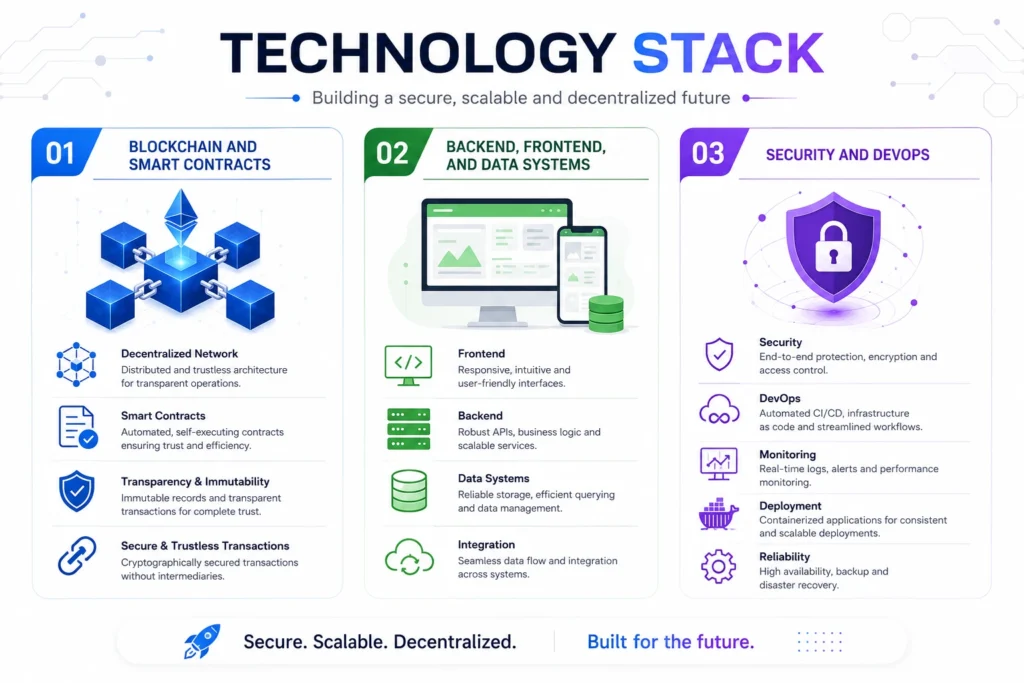
Any plan to build a perpetual Dex needs a reliable technology stack across blockchain, backend, frontend, data, infrastructure, and security.
Blockchain and smart contracts
The blockchain layer includes smart contracts, settlement logic, token standards, wallet connectivity, oracle feeds, and cross-chain bridges where needed. Solidity, Rust, Move, CosmWasm, or chain-specific frameworks may apply depending on the network.
Core contracts usually cover collateral vaults, margin accounts, position management, funding payments, liquidation logic, fee distribution, insurance funds, governance, and rewards. Developers must build with auditability, modularity, and emergency controls in mind.
Backend, frontend, and data systems
The backend supports order processing, indexing, API services, risk monitoring, notifications, referral systems, analytics, and admin tools. Node.js, Go, Rust, Python, Kafka, Redis, PostgreSQL, and event-driven services often fit high-volume exchange systems.
The frontend should use fast, responsive frameworks such as React, Next.js, or Vue. It should connect to charting tools, wallet providers, order forms, mobile views, trading history, and portfolio dashboards.
Security and DevOps
Security systems include Web Application Firewalls, key management, rate limiting, DDoS protection, audit logs, monitoring, bug bounty programs, penetration testing, and smart contract audits. DevOps teams should use CI/CD pipelines, containerization, cloud infrastructure, automated alerts, and disaster recovery.
A strong Cryptocurrency exchange development company aligns these layers into one stable platform instead of treating them as separate modules.
Revenue Models To Unlock With Perpetual DEX
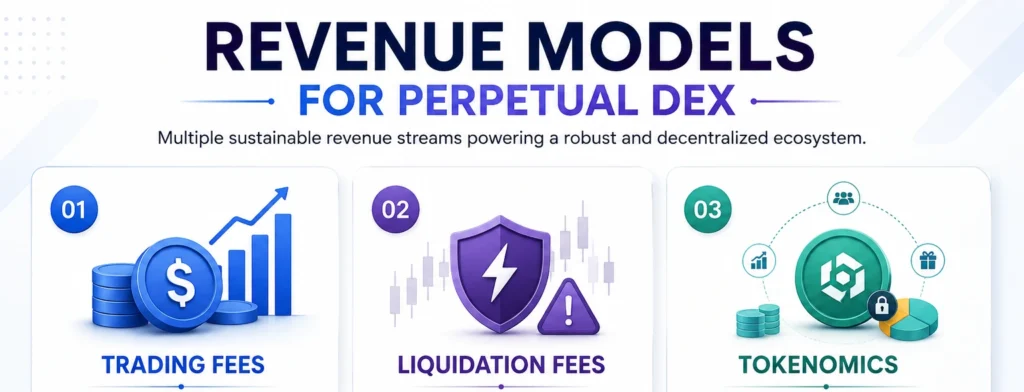
A perpetual DEX can generate income through several channels.
Trading fees
The platform can charge maker fees, taker fees, or tiered fees based on trading volume. It can also offer premium accounts, advanced analytics, API access, institutional dashboards, priority support, and professional trading tools.
Liquidation fees
This creates another income stream, although businesses must design them carefully to avoid unfair trader outcomes. Listing fees can apply when projects want new perpetual markets. Liquidity programs can support revenue through spreads, vault performance fees, or market maker agreements.
Tokenomics
The platform may use a native token for governance, fee discounts, staking rewards, liquidity incentives, or revenue sharing where regulations allow. Referral programs and affiliate partnerships can also lower acquisition costs and expand trader reach.
How Perpetual DEX Development Helps Businesses Generate ROI
Perpetual DEX development helps businesses create recurring revenue through active trading, liquidity depth, trader retention, and scalable product expansion while reducing rebuild costs through smarter planning and execution roadmaps.
- Higher trading frequency: Businesses that build perpetual Dex platforms can earn from active traders who open, adjust, and close positions regularly. Unlike spot exchanges, perpetual futures trading creates more revenue touchpoints.
- Multiple fee channels: A perpetual DEX can generate income through trading fees, liquidation fees, premium analytics, API access, advanced order tools, market listings, and institutional trading features.
- Stronger trader retention: Traders stay longer when the platform offers fast execution, low slippage, leverage trading, real-time charts, risk controls, and a smooth decentralised exchange experience.
- Better liquidity growth: Strong liquidity pools reduce slippage and improve order execution. This attracts serious traders, market makers, token projects, affiliates, and institutional participants.
- Scalable market expansion: After launching the first trading pairs, businesses can add new crypto markets, collateral options, mobile trading, copy trading, staking, governance, and institutional APIs.
- Higher average revenue per user: Perpetual DEX users often trade more frequently than spot traders. This gives the platform more chances to earn from every active wallet.
- Stronger ecosystem value: A perpetual DEX can support native tokens, referral programs, liquidity rewards, governance models, and community-led growth, which improves long-term platform participation.
- Lower rebuild costs: ROI improves when businesses plan target markets, licensing needs, liquidity budgets, fee structures, launch regions, and operating costs before cryptocurrency exchange development begins.
- Clearer performance tracking: A well-planned crypto derivatives platform helps leadership measure trading volume, revenue per user, liquidity depth, retention rate, and market growth from launch.
- Long-term business advantage: When security, compliance, liquidity, and user experience are built correctly, a perpetual DEX becomes more than a trading product. It becomes a scalable revenue engine.
Why Choose ShamlaTech for Building Your Own Perpetual DEX
Shamlatech helps clients build perpetual Dex with engineering-led development, security-first architecture, liquidity planning, compliance-aware workflows, and scalable exchange infrastructure. We are a leading Cryptocurrency exchange development company that builds centralised, decentralised, hybrid, P2P, derivatives, futures, margin, and AI-enabled exchange models for startups, enterprises, fintech firms, and digital asset businesses. Our team builds modular architectures, trading engines, wallet systems, liquidity layers, KYC/AML integrations, risk dashboards, liquidation logic, insurance fund mechanisms, and post-launch scalability systems. Partner with our team to shape the product around the target market, regulatory environment, budget, liquidity model, and growth plan.
Takeaway
Building a perpetual DEX is a strategic business decision. As demand for decentralised derivatives continues to rise, companies that offer secure, liquidity-rich, and user-friendly trading experiences are better positioned to capture long-term market share.
Success depends on choosing the right architecture, implementing strong risk controls, ensuring reliable liquidity, and creating an experience that traders trust. Businesses that plan these elements carefully can transform a perpetual DEX from a trading platform into a sustainable revenue-generating ecosystem.
Whether you’re launching a new crypto venture or expanding an existing exchange, investing in the right development strategy today can create a strong foundation for future growth.
FAQs
1. How much does perpetual DEX development cost?
Cost depends on the exchange model, blockchain network, number of trading pairs, leverage features, smart contract complexity, liquidity integrations, compliance modules, UI depth, audits, and post-launch support. A white-label route can reduce cost and launch time, while custom development gives stronger control and differentiation.
2. How long does it take to launch a perpetual DEX?
A basic MVP may take a few months when the scope stays focused. A custom, audited, multi-market derivatives platform can take longer because it needs trading logic, risk systems, smart contracts, liquidity testing, oracle integration, and security validation.
3. What features should a perpetual DEX include?
Core features include wallet login, collateral deposits, long and short positions, leverage controls, funding rates, oracle-based pricing, liquidation engine, order management, charts, trading history, admin dashboard, analytics, security monitoring, and liquidity tools.
4. Is a perpetual DEX better than a spot DEX?
A perpetual DEX suits businesses that want advanced trading volume, leverage-based products, and diversified revenue. A spot DEX suits businesses that want simple token swaps and lower product complexity. The right choice depends on the company’s market, risk appetite, and revenue plan.
5. Why does a perpetual DEX need an insurance fund?
An insurance fund helps cover losses when liquidations cannot close positions at a safe price during volatile markets. It protects the protocol, supports liquidity confidence, and reduces the chance of socialised losses.
6. Can Shamlatech build custom perpetual DEX features?
Yes. Shamlatech can design custom trading engines, smart contracts, admin dashboards, liquidity systems, wallet integrations, compliance workflows, tokenomics, AI-driven monitoring, and post-launch scaling features based on each business model.