

Switzerland entered 2026 as one of the most established jurisdictions for digital assets, supported by a mature regulatory framework and strong institutional participation. For businesses planning to launch real-world asset (RWA) platforms, understanding the legal requirements surrounding tokenized real estate has become a fundamental part of market entry and long-term operations.
At the start of 2026, the combined valuation of leading blockchain and cryptocurrency companies in Switzerland and Liechtenstein exceeded CHF 465 billion, reflecting the country’s growing role in digital asset innovation and tokenized investments. This momentum has increased demand for compliant real estate tokenization platforms capable of supporting asset issuance, investor management, and regulated ownership transfers.
Understanding real estate tokenization regulations in Switzerland is essential before launching an RWA platform. Regulatory obligations influence token structures, securities classification, investor protection requirements, and operational compliance standards. In this article, we explain Switzerland’s legal framework for real estate tokenization, FINMA requirements, token classifications, and the key regulatory considerations businesses must address before entering the market.
Build Secure Tokenized Property Investment Solutions in Switzerland
Switzerland's Legal Framework for Real Estate Tokenization and RWAs
Key Elements of Switzerland's RWA Tokenization Framework:
- Switzerland’s DLT Act introduced legally recognized ledger-based securities, enabling ownership rights and investment interests to be issued, transferred, and recorded on blockchain infrastructure with legal validity under Swiss law. This creates a stronger foundation for real estate tokenization platforms seeking enforceable investor rights.
- The legal framework integrates tokenized assets into existing financial market regulations rather than creating a separate regime. For platform operators, this reduces regulatory ambiguity and allows tokenized real estate offerings to be structured using established securities and financial services principles.
- Switzerland has expanded regulated market infrastructure for digital assets through the DLT trading facility framework. In March 2025, FINMA licensed the country’s first DLT trading facility, creating a regulated environment for the trading and settlement of tokenized securities.
- The framework supports end-to-end tokenization ecosystems covering issuance, custody, trading, settlement, and investor access. This allows businesses to design real estate tokenization platforms that address the full asset lifecycle instead of operating as standalone issuance portals.
- Switzerland’s regulatory certainty continues to attract institutional capital and blockchain innovation. At the start of 2026, the leading blockchain and digital asset companies in Switzerland and Liechtenstein collectively represented more than CHF 465 billion in value, reinforcing the country’s position as a preferred jurisdiction for tokenized asset initiatives.
FINMA Compliance Requirements for Real Estate Tokenization Platforms
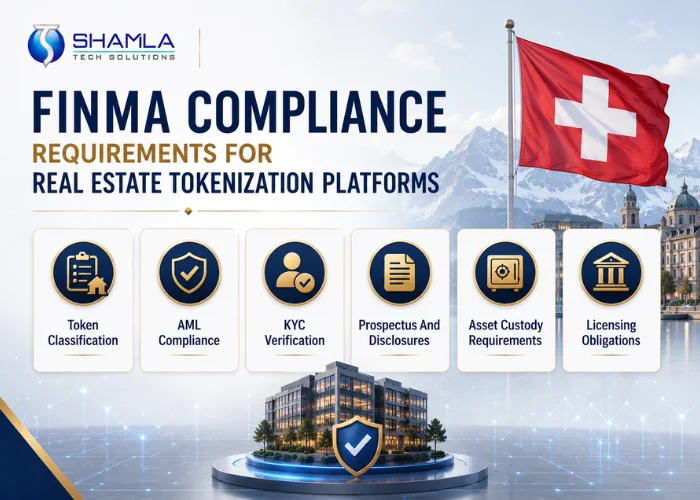
1. Token Classification and Regulatory Assessment
2. Anti-Money Laundering Compliance
3. Know Your Customer Verification
4. Securities Prospectus And Disclosure Obligations
5. Custody And Asset Safeguarding Requirements
6. Licensing And Financial Services Obligations
Token Classification, Securities Laws, and Investor Protection Rules in Switzerland
Switzerland’s regulatory framework evaluates tokenized real estate offerings through multiple compliance considerations, including token classification, securities treatment, investor eligibility requirements, and investor protection measures. For businesses launching RWA platforms, understanding these regulatory areas is essential for creating legally compliant token structures, attracting investors, and supporting long-term platform growth.
Regulatory Focus | Regulatory Scope | Business Impact |
Asset Token Classification | FINMA token categorization and regulatory treatment | Determines applicable compliance obligations |
Ledger-Based Securities | Recognition of blockchain-based ownership records | Establishes legal validity of digital ownership |
Prospectus Requirements | Disclosure and offering documentation obligations | Impacts fundraising and investor communications |
Investor Eligibility | Investor onboarding and access controls | Defines target investor groups |
Ownership Rights | Legal rights attached to tokenized assets | Protects investor claims and entitlements |
Secondary Trading Compliance | Trading, transfer, and marketplace requirements | Enables compliant liquidity mechanisms |
Asset Token Classification
Ledger-Based Securities
Prospectus Requirements
Investor Eligibility
Ownership Rights
Secondary Trading Compliance
Develop Swiss-Compliant Real Estate Tokenization Platforms
AML, KYC, and Licensing Obligations for Swiss Real Estate Tokenization Businesses
AMLA Compliance Requirements
FINMA-Compliant Investor Verification
Ultimate Beneficial Owner (UBO) Identification
Recordkeeping And Audit Trail Management
Licensing Assessments Under Swiss Financial Market Laws
Cross-Border Investor Compliance Controls
Key Regulatory Considerations Before Launching a Real Estate Tokenization Platform in Switzerland
Essential Swiss Compliance Requirements Before RWA Platform Launch:
- Determine whether the tokenized asset qualifies as an asset token, ledger-based security, or another regulated financial instrument under Swiss law.
- Establish a legally enforceable ownership structure that clearly defines investor rights, revenue entitlements, governance mechanisms, and asset-backed claims.
- Evaluate whether the proposed offering triggers prospectus requirements, disclosure obligations, or additional securities-related compliance requirements.
- Design AML and KYC workflows that align with Swiss AMLA requirements and FINMA expectations for investor verification and due diligence.
- Assess whether platform activities such as custody, trading, brokerage, or payment processing require regulatory approvals or licensing.
- Implement compliant token standards and smart contract controls that support investor whitelisting, transfer restrictions, and regulatory enforcement mechanisms.
- Develop transaction monitoring, recordkeeping, and audit trail capabilities that support ongoing compliance and regulatory reporting obligations.
- Build cross-border compliance controls for international investors, including jurisdiction-specific restrictions, sanctions screening, and disclosure management requirements.
Partnering with an experienced real estate tokenization platform development company can help businesses address these regulatory requirements from the outset. By aligning legal structures, compliance workflows, token standards, and platform architecture with Swiss regulations, organizations can reduce compliance risks, streamline implementation, and establish a strong foundation for regulated real estate tokenization initiatives.
Key Takeaway
Switzerland offers one of the most established regulatory environments for real estate tokenization, supported by legal recognition of ledger-based securities and clear guidance from FINMA. This regulatory foundation provides businesses with greater certainty when structuring tokenized real estate offerings and developing institutional-grade RWA platforms.
Organizations planning to enter the Swiss market should approach compliance, platform architecture, investor onboarding, and token design as interconnected requirements. Working with an experienced real estate tokenization platform development company helps ensure alignment with FINMA expectations, Swiss financial market regulations, and the operational requirements needed to support long-term growth.
Launch FINMA-Compliant Real Estate Tokenization Platforms with Shamla Tech Solutions
Shamla Tech Solutions helps businesses build FINMA-compliant real estate tokenization platforms designed for the Swiss market. Our development services cover asset tokenization, investor onboarding, smart contract development, compliance workflows, digital asset management, and platform infrastructure required to support regulated real estate investment opportunities.
With extensive expertise in real-world asset tokenization and security token development, we help organizations align platform architecture with Swiss regulatory requirements from the outset. From ERC-3643 token implementation and investor whitelisting to compliance automation, custody integrations, and secondary trading capabilities, we deliver scalable real estate tokenization platforms built for institutional participation and long-term market growth.