
Real estate is one of the largest asset classes in the world, yet it remains structurally illiquid. This is where secondary market liquidity for real estate tokenization becomes a defining factor. While Real World Asset Tokenization enables fractional ownership and global participation, the real transformation happens when these assets can be actively traded through efficient RWA Secondary Market Trading mechanisms. Without strong Real Estate Tokenization Liquidity, even well-tokenized assets fail to deliver true investor value.
A prime industry stat illustrates the global scale of the shift. By 2035, the emerging real estate tokenization market is anticipated to permit tokenizing up to over US$4 trillion in real estate assets, thereby an increase from less than US$0.3 trillion tokenization in 2024 with a CAGR of 27%. The 2026 report states that tokenized assets enable 24/7 trading and are transforming traditional finance mechanisms, with major platforms already surpassing billions in trading volume.
In this blog, we will cover how secondary market liquidity for real estate tokenization works, compare different liquidity models, and explore which approach truly enables scalable RWA secondary market trading.
Build High-Liquidity Tokenized Real Estate Platforms
What is Secondary Market Liquidity for Real Estate Tokenization?
Secondary market liquidity for real estate tokenization is described as the capability of buying and selling tokenized real estate assets with ease, post initial distribution. It is a function that affects how quickly an investor can disengage or reposition their positions.
- Enables faster investor exits and capital rotation
- Improves price discovery through active trading
- Builds trust and participation in RWA secondary market trading
- Transforms illiquid real estate into tradable digital assets
- Attracts both retail and institutional investors
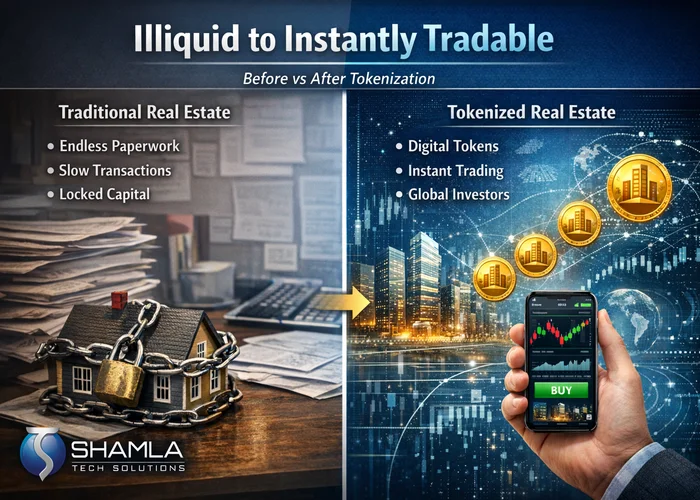
In traditional real estate, liquidity takes months. In tokenized ecosystems, the expectation is near-instant trading.
What Is the Core Liquidity Problem in Real Estate and How Does Tokenization Solve It?
The Core Problem in Traditional Real Estate
- Illiquidity by Design
- Selling property involves lengthy legal, financial, and administrative processes
- No instant exit options for investors
- High Capital Barriers
- Investors need significant upfront capital
- Limited participation from retail investors
- Slow Transaction Cycles
- Deals can take weeks or months to close
- Delays reduce market efficiency
- Limited Market Access
- Investments are often restricted to local or regional buyers
- Cross-border participation is complex
- Lack of Price Transparency
- Property valuations are not updated in real time
- Pricing depends on infrequent transactions
- Inactive Secondary Markets
- No structured environment for continuous trading
- Assets remain locked after purchase
How Tokenization Solves These Challenges
In order to overcome the above-mentioned disadvantages, secondary market liquidity for real estate tokenization provides an innovative approach by altering the nature of ownership and the mode of trading.
- Fractional Ownership Enables Accessibility
- Properties are divided into smaller units
- Investors can enter with lower capital
- Faster and Continuous Trading
- Tokens can be traded instantly on digital platforms
- Enables real-time secondary market liquidity for real estate tokenization
- Global Investor Participation
- Blockchain enables borderless access
- Expands liquidity pools beyond local markets
- Improved Price Discovery
- Continuous trading reflects real-time demand and supply
- Prices become more transparent and market-driven
- Reduced Transaction Friction
- Smart contracts automate execution and settlement
- Eliminates intermediaries and delays
- Creation of Active Secondary Markets
- Structured trading environments enable ongoing liquidity
- Transforms real estate into a dynamic financial asset class
The traditional real estate market was never designed for liquidity. Tokenization fixes this at the structural level. But the real impact is only realized when secondary market liquidity for real estate tokenization is implemented effectively.
How Does Liquidity Work in a Tokenized Real Estate Marketplace?
Liquidity is what makes it possible to both buy and sell fractional property tokens via blockchain-based trading infrastructure. Secondary market liquidity for real estate tokenization, thus, ensures that investors will be able to position themselves any-time to enter and exit of their choice, without any delay or price impact.
Step-by-Step: How Secondary Market Liquidity for Real Estate Tokenization Works
- Asset Selection and Tokenization (Primary Issuance) – The digitization of real estate assets into fractional tokens through real world asset tokenization frameworks. These tokens represent ownership shares and are initially sold to investors.
- Listing on a Tokenized Real Estate Marketplace – Once issued, tokens are listed on a tokenized real estate marketplace or tokenized property trading platform, making them available for secondary trading.
- Activation of Secondary Market Liquidity – This is where secondary market liquidity for real estate tokenization begins. Investors can now:
- Buy additional tokens
- Sell existing holdings
- Trade fractions of property ownership
- Trading Mechanism Execution – Transactions are executed through:
- Order books
- AMMs
- Hybrid exchange models
These systems determine how efficiently real estate tokenization liquidity is maintained.
- Smart Contract Settlement – Blockchain-based smart contracts automate:
- Ownership transfer
- Payment settlement
- Compliance checks
This ensures faster and transparent RWA secondary market trading.
- Continuous Price Discovery – Prices are dynamically adjusted based on:
- Supply and demand
- Market participation
- Liquidity depth
This is essential for sustainable secondary market liquidity for real estate tokenization.
Primary Issuance vs Secondary Trading
- Primary Issuance
- One-time distribution of tokens
- Fixed pricing or structured offering
- Limited liquidity
- Investor entry point
- Secondary Trading
- Continuous buying and selling
- Market-driven pricing
- Active liquidity environment
- Enables exits and portfolio adjustments
The shift from primary issuance to secondary trading is where secondary market liquidity for real estate tokenization truly defines the platform’s success.
A tokenized real estate marketplace is only as strong as its liquidity layer. Secondary market liquidity for real estate tokenization is what transforms static property investments into dynamic, tradable assets.
What Are the Core Models for Secondary Market Liquidity for Real Estate Tokenization?
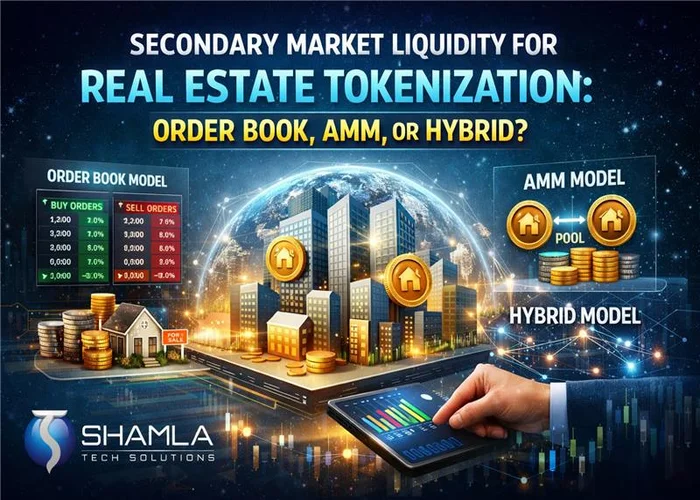
There are three primary models used to enable liquidity: order book systems, automated market makers, and hybrid models. Each has distinct strengths and limitations.
- Order Book Model
- AMM Model
- Hybrid Model
Choosing between them is not just a technical decision. It defines how your tokenized real estate marketplace behaves under real market conditions. This aligns perfectly with long-term scalability and investor experience.
What is an Order Book Model in Tokenized Real Estate Trading?
An order book model matches buyers and sellers based on bid and ask prices, similar to traditional stock exchanges.
- Buyers place bids, sellers place asks
- Trades execute when prices match
- Real-time price discovery through market activity
Advantages:
- Transparent pricing mechanism
- Familiar to institutional investors
- High control over trade execution
Limitations:
- Requires active participation
- Liquidity dries up in low-volume markets
- Not ideal for niche or early-stage RWAs
For real estate security token liquidity, order books work well when trading volume is high. Otherwise, they expose liquidity gaps quickly.
How Do AMMs Work for Real Estate Tokens?
AMMs utilize liquidity pools in place of direct buyers and sellers, thereby ensuring that transactions movement happens unconstrained and continuously without depending on counterparty.
- Liquidity providers deposit tokens into pools
- Prices are determined algorithmically
- Trades happen instantly against the pool
Advantages:
- Always-on liquidity
- No dependency on matching orders
- Supports decentralized access
Limitations:
- Impermanent loss for liquidity providers
- Pricing inefficiencies for illiquid assets
- Not optimized for high-value, low-frequency trades
For AMM for real estate tokens, the challenge lies in adapting DeFi models to assets that do not trade frequently. This is why decentralized exchanges for RWAs often struggle with accurate pricing.
What is a Hybrid Exchange Model in Blockchain for RWA Liquidity?
A hybrid exchange model combines order book precision with AMM liquidity to create a more balanced trading environment.
- Routes trades between order books and liquidity pools
- Uses smart algorithms for optimal execution
- Enables both institutional and DeFi participation
Advantages:
- Improved liquidity depth
- Better price efficiency
- Reduced slippage
Limitations:
- Higher technical complexity
- Requires advanced infrastructure
For scaling a tokenized property trading platform, hybrid models offer the most practical path forward. This aligns perfectly with real-world adoption requirements.
Turn Tokenized Assets into Actively Traded Markets
Order Book vs AMM Crypto: Which Model Works Best for Real Estate Tokenization?
No single model is universally ideal for real estate. However, when it comes to building strong secondary market liquidity for real estate tokenization, hybrid systems consistently outperform standalone approaches by combining the strengths of both order books and AMMs.
Comparison of Liquidity Models
Feature | Order Book | AMM | Hybrid |
Liquidity Source | Traders | Liquidity Pools | Both |
Price Discovery | High (market-driven) | Algorithmic | Optimized (market + algorithm) |
Suitability for RWAs | Medium | Low-Medium | High |
Capital Efficiency | Moderate | High | High |
Complexity | Low | Medium | High |
Trade Execution Speed | Depends on matching orders | Instant | Optimized routing |
Liquidity Availability | Inconsistent (volume dependent) | Continuous | Continuous + demand-driven |
Slippage | Low in high-volume markets | Can be high | Reduced through routing |
Institutional Compatibility | High | Low | High |
Retail Accessibility | Moderate | High | High |
Pricing Accuracy | High with volume | Can deviate from real value | Balanced and more accurate |
Key Insight
- Order books need volume – Without active traders, liquidity drops and execution becomes inefficient
- AMMs need capital – High liquidity pools will be essential for stability and to help in the reduction of slippage
- Hybrid models balance both – They combine real market pricing with continuous liquidity, improving overall efficiency
What This Means for Real Estate Tokenization
Real estate assets are:
- High-value
- Low-frequency traded
- Sensitive to pricing accuracy
Thus, there are certain limitations in relying on simply one model. Hybrid systems, however, solved this issue by enabling the provision of liquidity and functioning of an efficient price discovery mechanism.
When it comes to secondary market liquidity for real estate tokenization that is scalable and sustainable, hybrid architecture appears to be the best long-term strategy.
How to Improve Secondary Market Liquidity for Real Estate Tokenization?
Technology, compliance and market design strategies are required simultaneously to improve liquidity.
- Implement hybrid liquidity engines
- Aggregate liquidity across multiple platforms
- Introduce incentives for liquidity providers
- Enable cross-border compliant trading
- Integrate RWA Legal Consulting Services early
Additionally:
- Use dynamic pricing models
- Enable institutional participation
- Build trust through transparency
This aligns perfectly with creating sustainable real estate tokenization liquidity rather than short-term activity spikes.
What Role Does Compliance Play in RWA Secondary Market Trading?
Compliance is a foundational layer in RWA secondary market trading. It determines who can participate, how assets can be traded, and whether secondary market liquidity for real estate tokenization can scale across jurisdictions.
Why Compliance Is Critical for Secondary Market Liquidity for Real Estate Tokenization
- Defines Market Accessibility – Compliance rules determine:
- Who can invest (retail vs accredited investors)
- Which geographies can participate
This directly impacts the depth of secondary market liquidity for real estate tokenization.
- Enables Cross-Border Trading – Real estate tokenization is inherently global, but regulations are local. Compliance frameworks help bridge this gap and unlock global liquidity pools.
- Builds Investor Trust – Institutional investors require regulated environments. Without compliance, participation remains limited, reducing liquidity.
Key Compliance Components in RWA Secondary Market Trading
- KYC (Know Your Customer)
- Verifies investor identity
- Prevents fraudulent participation
- AML (Anti-Money Laundering)
- Monitors transactions for suspicious activity
- Ensures financial integrity of the platform
- Security Token Regulations
- Determines how tokenized real estate assets are classified
- Impacts how they can be issued and traded
- Jurisdiction-Based Restrictions
- Controls cross-border participation
- Ensures legal enforceability of ownership
How Compliance Directly Impacts Liquidity
- Expands or restricts investor base
- Affects trading volume and frequency
- Influences platform credibility
- Determines institutional involvement
- Shapes the scalability of secondary market liquidity for real estate tokenization
The Role of Compliance in Scaling Liquidity
To build sustainable secondary market liquidity for real estate tokenization, compliance must be integrated into the platform architecture, not added later.
- Embed compliance into smart contracts
- Automate investor eligibility checks
- Enable compliant peer-to-peer transfers
- Align with multiple regulatory jurisdictions
This is where RWA legal consulting services become essential, ensuring that platforms are designed for both regulatory approval and liquidity scalability.
For any platform aiming to build strong secondary market liquidity for real estate tokenization, compliance is the bridge between innovation and real-world adoption.
Why Hybrid Models Are the Future of Tokenized Real Estate Marketplace Liquidity?
Hybrid models solve the fundamental mismatch between real estate assets and crypto-native liquidity mechanisms.
- Combine institutional trading structures with DeFi flexibility
- Enable continuous liquidity without sacrificing price accuracy
- Support both high-value and fractional trades
- Reduce dependency on a single liquidity source
This aligns perfectly with scalable RWA liquidity solutions and evolving investor expectations.
Conclusion
Liquidity is not just a feature. It is the backbone of any successful tokenized ecosystem. Without it, even the most well-structured real estate offerings struggle to gain traction.
Order books bring familiarity. AMMs bring accessibility. But hybrid models bring balance.
For secondary market liquidity for real estate tokenization, the future clearly leans toward integrated, hybrid systems that combine efficiency, compliance, and scalability.
This aligns perfectly with building the next generation of global, investor-ready real estate platforms.
How Shamla Tech Builds High-Liquidity Tokenized Property Trading Platforms
Shamla Tech approaches liquidity as a core architectural layer, not an afterthought.
- Expertise in Real Estate Tokenization Platform Development
- Implementation of hybrid exchange infrastructure
- Compliance-first platform design
- Integration with institutional and decentralized liquidity sources
- End-to-end Tokenized Real Estate Marketplace development services
The focus is on:
- Sustainable liquidity models
- Regulatory alignment
- Scalable trading ecosystems
This aligns perfectly with building production-ready platforms that go beyond tokenization into real market functionality.