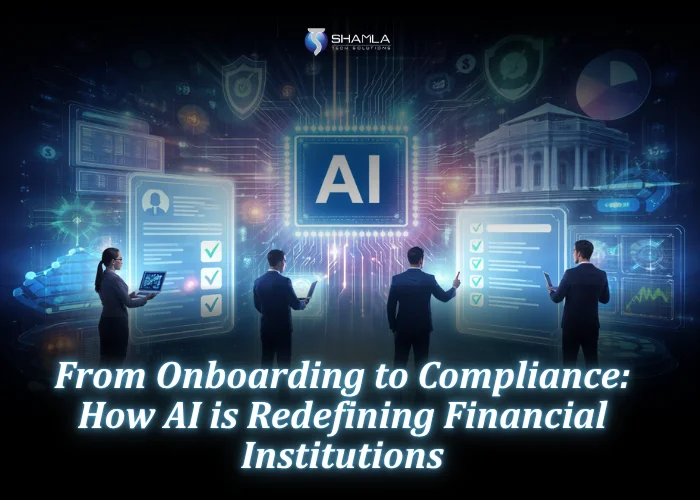

The gold rush for AI is now sweeping through banking and finance. There is a deep discussion among industry leaders on How AI is Redefining Financial Institutions. Leading firms like Goldman Sachs have begun embedding autonomous AI agents in core operations. In one recent announcement, Goldman’s CIO Marco Argenti revealed that after six months of in-house development the bank is deploying agentic AI (Anthropic’s Claude Opus 4.6) to handle trade accounting, compliance checks, and client onboarding.
This isn’t just a pilot project, it marks a structural shift. By turning “back-office” tasks over to AI “digital co-workers,” Goldman can cut costs and boost speed while freeing human experts to focus on strategy. As one report notes, Goldman’s AI agents already “collapse the amount of time” required for onboarding and compliance work. If successful, this move could usher in a new era where machine reasoning handles routine financial workflows across the industry.Major banks are now turning to AI across operations. Goldman Sachs, for example, reports a 30% reduction in client onboarding time by using agentic AI to run KYC/AML checks and compliance reviews.
Other banks follow suit: Bank of America, with some 18,000 developers, has used AI tools to streamline processes (even cutting software testing times by 90%). Let’s discuss in detail How AI is Redefining Financial Institutions.
AI-Powered Onboarding and KYC
Client onboarding – especially Know-Your-Customer (KYC) and Anti-Money-Laundering (AML) checks – has long been labor-intensive. New AI tools are fundamentally changing this. By using generative models to read and interpret documents, banks can extract customer data, verify identities, and cross-check watchlists far faster than before. Goldman reports that its AI agents can handle “dense rulebooks” and multi-step KYC tasks automatically. this shows How AI is Redefining Financial Institutions In trials, AI lowered onboarding times by about 30% by navigating KYC/AML protocols end-to-end.
In one case study, FTI Consulting helped a global bank deploy an AI-driven KYC platform. The outcome: KYC case turnaround times dropped by around 60% and operational capacity jumped 30–35%. Automating data extraction and regulatory checks also slashed the average KYC case completion time by 48%, cutting compliance costs and accelerating account openings.
The business outcome is clear on How AI is Redefining Financial Institutions: faster onboarding translates into earlier revenue. Goldman’s COO notes that quicker account openings give the firm a strategic edge in winning institutional mandates. Clients enjoy a smoother experience (no more “endless paperwork”), and banks avoid bottlenecks that could risk losing high-value customers.
Automating Trade Accounting and Reconciliation
On the other side of the ledger, banks are also applying AI to accounting and trade reconciliation and AI crypto trading bot Development. Investment banks process millions of trades and transactions daily across global markets, and even small mismatches can delay settlements or trigger regulatory fines. Traditionally, this required armies of operations staff. Now, firms are teaching AI agents to do that work.
Goldman Sachs describes its new agents as “autonomous systems” that read transaction data, cross-check internal books against exchange and counterparty records, and flag anomalies, this is a sign that AI agents are entering commerce. These AI “digital coworkers” follow multi-step logic: if an exception arises, they automatically route it to compliance or risk teams. Early trials showed that the AI could interpret policy language and conditionally update records – tasks once thought too complex for software.
Beyond Goldman, other banks are exploring similar paths. Citigroup, for example, has launched “Stylus Workspaces,” an internal agentic AI platform that stitches together data and workflows across applications, consolidating tasks that used to require multiple tools. These initiatives point to a broader trend: banks are increasingly building in-house AI layers for core finance tasks. This lets them retain tight control over sensitive data and compliance logic while boosting efficiency. The goal is on How AI is Redefining Financial Institutions is leaner back office where AI handles the routine, and people handle the exceptions and relationships.
AI-Driven Compliance and Risk Management
On the compliance front, AI is being used not just in day-to-day operations but also in monitoring and oversight this is How AI is Redefining Financial Institutions. Regulatory compliance traditionally meant manual checks of logs, reports, and communications – ripe for automation. Advanced AI systems can now read contracts, audit records, and large volumes of transactions to flag risky behavior or compliance breaches in real time.
For example, LLMs can ingest regulatory updates and internal policy manuals, then apply that knowledge to new data. IBM notes that financial firms are “automating regulatory reporting, improving fraud detection” and other compliance tasks with AI.
Regulators, however, are watching closely. Agencies like the UK’s Financial Conduct Authority (FCA) have launched reviews into AI’s impact, emphasizing that existing regulations and human oversight remain paramount. The FCA has explicitly leveraged rules like the Consumer Duty and operational-resilience standards to govern AI use, rather than writing new AI-specific laws.
Business Impact: Cost Savings and Growth
All these AI initiatives share common outcomes: greater efficiency, lower costs, and faster time-to-revenue. In numerical terms, the improvements are striking. We’ve already mentioned Goldman’s 30% faster onboarding and FTI’s 48–60% reductions in KYC processing time. McKinsey and others project that agentic AI could make compliance teams up to 20× more productive – even supervising “2,000%” higher throughput. Those gains free up headcount and capital for banks to invest in new products or lower prices.
In B2B terms, the return on investment (ROI) is clear: banks redeploy capital saved on manual work into strategic initiatives. The accelerated onboarding alone means earning fees on new accounts weeks sooner. And as Goldman emphasizes, these AI projects are framed as “capacity-adding” rather than pure cost-cuts. By integrating AI into core processes, banks aim to grow revenues faster (e.g. by enabling bankers to serve more clients) while holding headcount steady. Early market reactions to Goldman’s move even note pressure on enterprise SaaS vendors – suggesting banks expect to internalize tasks that had been outsourced to third parties.
Many companies automate the AI agents and offer services like Crypto trading bot development services. Shamlatech is one of the pioneers in AI agent development that helps the business to scale faster than usual with recent technological advancement.
Key takeaways for How AI is Redefining Financial Institutions:
- Cut processing time: Automate KYC/AML and reconciliation to shorten cycle times (often 30–60% faster in pilots).
- Reduce costs: Move hundreds of compliance FTEs to higher-value roles. AI-guided processes lower error and penalty risk while lowering labor spend.
- Boost productivity: Human specialists can supervise many AI “workers.” McKinsey finds 200–2,000% throughput gains when each person manages multiple AI agents.
- Enhance compliance: Use LLMs and agentic AI to continuously monitor transactions and documents, improving detection of anomalies and regulatory breaches.
- Faster revenue: Quicker client onboarding and service lets banks capitalize on opportunities sooner, a strategic edge in winning business