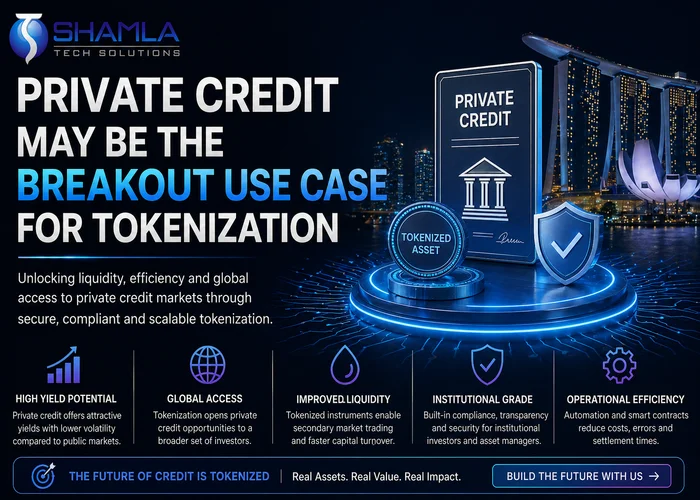

Tokenized treasuries only provide you access to already liquid instruments on the blockchain. Private credit, on the other hand, has structural problems that blockchain technology can fix. There is no real-time pricing, standardized reporting, or efficient secondary trading in traditional private credit markets. This makes things harder for both lenders and borrowers.
The reasoning says that private credit tokenization has a bigger effect than treasury tokenization, even though treasuries make up most of the current RWA TVL numbers. According to industry data, Maple, Centrifuge, and Goldfinch are three tokenized private credit protocols that together handle more than $12 billion in on-chain credit exposure.
Unlock the potential of private credit tokenization and see how it’s reshaping modern finance.
Why Blockchain is Necessary for Private Credit
Powell found three structural flaws with traditional private credit that on-chain alternatives fix:
- Limited Liquidity: Private credit situations usually keep money tied up for years with no way to sell it. Tokenization makes it possible to possess a small part of something and trade it later.
- Weak Price Discovery: Traditional private credit doesn’t have real-time mark-to-market. Oracle integrations can let on-chain loans provide clear, verifiable prices.
- Unclear Reporting: Traditional private credit reporting happens infrequently and isn’t standardized. Blockchain lets you see real-time, auditable data on how loans are doing.
Recent Protocol Developments
Maple Finance debuted syrupUSDC on Coinbase’s Base network on January 22, 2026. This stablecoin earns interest and is meant to be listed on Aave V3. The solution is part of Maple’s plan to make private credit yields available through DeFi interfaces that most people are already familiar with.
On January 14, 2026, Centrifuge made it possible for tokenized Treasury and CLO yields on BNB Chain through Lista DAO. The yields were between 3.65% and 4.71% APY. The protocol’s Whitelabel service lets organizations turn things like private finance and energy infrastructure into tokens.
What This Means for Investors
Maple and Centrifuge goods give 8 to 15 percent APY, which is more than the 4 to 5 percent APY offered by treasury products. This means that private credit tokenization has a better yield potential.
Investors can see how loans are doing in real time because to on-chain credit transparency. This is not possible in traditional private credit markets.
There is always a chance of default in private credit, even if it is tokenized. Before allocating, investors should look at the quality of the borrowers, the standards for underwriting, and the track records of the protocols.
Real-World Use Cases of Tokenized Private Credit
SME Lending in Emerging Markets
One product is the Mikro Kapital ALTERNATIVE eNote™.
This is a tokenized fixed-income tool that is set up to send money to microfinance and small business loans in Eastern Europe, the Middle East and North Africa, and Central Asia. The eNote gives investors access to a variety of private credit portfolios through digital distribution, while the loans themselves are made and handled off-chain. The structure aims for yields of up to 9.5% every year, and tokenization is employed to make access and servicing easier.
Short-Term Trade Finance:
Example product: TradeFlow Tokenized Trade Finance Bond
This tool turns short-term, guaranteed commodity trade finance deals into tokens. It is set up to give you a taste of real-world trade flows, with maximum tenors of 90 days. The tokenized format is used to make preserving records easier and more open, while the underlying credit is still handled through traditional financial and insurance channels. The target yield is about 8.5% every year.
Why You Should Trust Shamlatech for Private Credit Tokenization Platform Development?
Shamlatech stands out as a trusted partner for private credit tokenization platform development by combining deep expertise in real-world asset (RWA) tokenization with advanced blockchain infrastructure, making it highly relevant for anyone looking to build a prediction market platform with integrated financial products. Traditional private credit markets suffer from limited liquidity, lack of real-time pricing, and opaque reporting, but blockchain-based solutions—enhanced with robust oracle systems—enable fractional ownership, transparent data, and efficient secondary trading .
Shamlatech addresses these gaps by offering secure smart contract architectures, reliable oracle integration for accurate data feeds, cross-chain compatibility, and compliance-ready frameworks, ensuring your prediction market platform development or tokenized credit system is scalable, transparent, and investor-friendly. With the ability to design high-yield financial ecosystems, seamless Web3 integrations, and regulatory-aligned solutions, Shamlatech provides end-to-end support to create a prediction market platform that leverages both decentralized prediction markets and tokenized private credit opportunities in 2026.
Conclusion
Tokenized private credit is a new way for the world’s debt markets to work. The sector is freeing up trillions of dollars in assets by replacing old-fashioned paper processes with smart contracts that are clear and can be programmed.
Shamlatech is a key part of this change because it is the industry-standard oracle platform. Shamlatech gives institutions the confidence to use tokenized credit by giving them reliable market data through the Data Standard, safe cross-chain transactions through the Interoperability Standard, and proof of reserve to check collateral. These technologies are making tokenized private credit the standard way for people throughout the world to lend money.
Learn how your business can benefit from tokenized private credit solutions tailored to your needs.