




Home » Stable Coin » How to Build a Secure Stablecoin Platform for Cross-Border Payments in USA

How to Build a Secure Stablecoin Platform for Cross-Border Payments in USA

Share this article:
stablecoin platform for cross-border payments
Table of Contents
About the Author
Balaji
CEO of Shamla Tech, specializes in crypto exchange development, RWA tokenization, blockchain infrastructure, AI solutions, and compliance-ready platforms. He helps enterprises address regulatory, security, and scalability challenges while driving real-world adoption of emerging technologies across industries.
Connect On:

Cross-border payments continue to impose settlement delays, intermediary costs, fragmented compliance workflows, and limited transaction transparency for global businesses. Stablecoin payment infrastructure offers a practical framework for enterprises seeking programmable settlement, liquidity control, and efficient international value transfer.

By 2026, the global stablecoin market is projected to surpass $400 billion in circulating value, reflecting stronger institutional participation in digital payment infrastructure. This growth highlights the increasing need for stablecoin payment solutions that support faster settlement, cost efficiency, and scalable cross-border transactions.

In this article, we explain how to build a secure stablecoin platform for cross-border payments in the USA, covering platform architecture, essential security controls, regulatory compliance requirements, blockchain infrastructure choices, development stages, and strategic considerations for enterprise-grade payment deployment.

Launch Secure Cross-Border Stablecoin Payment Solutions In USA

Why Are Businesses Building Stablecoin Platforms for Cross-Border Payments in 2026?

Global payment infrastructure continues to create operational inefficiencies for enterprises managing international settlements, treasury transfers, supplier payouts, and cross-border disbursements. Stablecoin payment platforms are increasingly being viewed as strategic infrastructure for improving payment control, execution efficiency, and financial scalability.

Key Business Drivers Behind Enterprise Stablecoin Payment Adoption:

  • Cross-border payment delays directly impact enterprise working capital efficiency. Stablecoin platforms enable faster settlement execution, helping businesses reduce idle capital exposure, improve liquidity allocation, and maintain stronger financial predictability across international payment operations.

  • Visa’s 2024 annual report says that the company processed $16 trillion in total payments volume, highlighting the scale of global transaction demand. Enterprises are building stablecoin payment infrastructure to capture greater efficiency, automation, and operational control within high-volume payment ecosystems.

  • Correspondent banking models create operational complexity through intermediary dependencies, fragmented fee structures, reconciliation delays, and limited transaction visibility. Stablecoin payment platforms provide enterprises with transparent payment execution, auditable transaction records, and stronger governance across international financial operations.

  • Modern enterprises require payment infrastructure that supports automated settlements, programmable payout workflows, embedded financial services, and API-driven transaction execution. Stablecoin platforms align with these infrastructure requirements while enabling scalable payment architecture for global business expansion initiatives.

  • Enterprises increasingly view payment infrastructure ownership as a strategic commercial advantage. Building proprietary stablecoin platforms enables stronger control over transaction economics, ecosystem participation, customer payment experiences, and long-term monetization opportunities across cross-border financial service operations.

The Growing Need for Faster and Secure Cross-Border Payment Infrastructure

Cross-border payment infrastructure remains commercially inefficient for enterprises managing international settlements, treasury movement, and high-volume disbursements. Stablecoins for cross-border payments address persistent operational friction caused by payment execution delays, fragmented banking dependencies, and limited transaction visibility across global financial workflows.

According to the World Bank, the global average cost of sending $200 internationally remained 6.4%, significantly above the UN Sustainable Development Goal target of 3%, reinforcing the commercial need for more efficient digital payment infrastructure.

Why Existing Cross-Border Payment Infrastructure Falls Short:

  • Multi-day settlement cycles restrict working capital efficiency, delaying access to capital that enterprises could otherwise deploy toward supplier payments, treasury optimization, or revenue-generating financial operations.
  • Intermediary-led payment routing creates fragmented fee structures, making transaction cost forecasting difficult for enterprises managing recurring international payment volumes across multiple jurisdictions.
  • Limited end-to-end transaction visibility creates reconciliation inefficiencies, increasing operational workload for finance teams responsible for payment verification, audit readiness, and exception management.
  • Cross-border compliance execution remains operationally intensive, particularly for enterprises navigating AML screening, jurisdiction-specific reporting obligations, and transaction monitoring across stablecoin banking integrations.

Enterprises increasingly require payment infrastructure designed for execution speed, transaction transparency, and stronger operational control at scale.

Core Features of a Stablecoin Platform for Cross-Border Payments

Building a stablecoin platform for cross-border payments requires stablecoin infrastructure that meets enterprise expectations for security, compliance, settlement efficiency, and financial interoperability. The following core features define the technical foundation of a commercially viable stablecoin platform for cross-border payments.

Feature

Key Components

Business Impact

Multi-Stablecoin Support

USDC, USDT, PYUSD, Fiat-backed enterprise stablecoins

Settlement flexibility across payment corridors

Enterprise Wallet Infrastructure

MPC custody, Multi-signature approvals, Role-based access, HSM security

Secure treasury control and governed fund movement

Compliance Engine

KYC verification, AML screening, OFAC checks, SAR monitoring

Regulatory compliance and lower operational risk

Fiat Integration Layer

ACH, SWIFT, SEPA, Wire transfers, Banking APIs

Seamless fiat on/off-ramp execution

Settlement Engine

Ethereum, Stellar, Solana, Polygon, Private blockchain rails

Faster international payment execution

Risk Monitoring System

Fraud analytics, Transaction monitoring, Audit logs, Anomaly detection

Real-time payment oversight and fraud prevention

Enterprise API Integration

SAP, Oracle NetSuite, Salesforce, Payroll APIs, Treasury systems

Automated reconciliation and payment orchestration

1. Multi-Stablecoin Settlement Support

Cross-border payment infrastructure built around a single settlement asset creates operational rigidity. Enterprises require support for stablecoins such as USDC, USDT, PYUSD, and enterprise-issued fiat-backed tokens to align settlement execution with corridor liquidity, counterparty preferences, and treasury strategy. Multi-stablecoin support reduces conversion dependency and improves payment flexibility across global commercial transactions.

2. Institutional Wallet and Treasury Management

Enterprise payment operations require wallet infrastructure designed for financial governance, not retail asset storage. Core capabilities should include multi-signature approvals, MPC custody, role-based access controls, treasury wallet segregation, approval workflows, and hardware security module integration. This protects payment execution while giving finance teams operational control over institutional stablecoin movement.

3. Embedded KYC, AML, and Sanctions Compliance

Cross-border payment execution without automated compliance infrastructure creates regulatory risk and operational inefficiency. Platforms should integrate KYC identity verification, AML transaction screening, OFAC sanctions checks, suspicious activity monitoring, and jurisdiction-based stablecoin compliance stack rule engines. Embedded compliance infrastructure enables scalable international payment operations without forcing finance teams into fragmented manual review processes.

4. Fiat Banking and Liquidity Integration

Stablecoin payments must connect directly with traditional banking infrastructure to support real enterprise settlement workflows. Essential integrations include ACH rails, SWIFT connectivity, wire transfer support, SEPA access, banking APIs, and institutional liquidity providers. This ensures seamless fiat-to-stablecoin conversion, supplier payout flexibility, and treasury interoperability across conventional and blockchain payment environments.

5. Real-Time Cross-Border Settlement Engine

Delayed settlement creates measurable working capital inefficiencies for enterprises handling international payment obligations. The platform should support real-time settlement execution across Ethereum, Stellar, Solana, Polygon, or permissioned enterprise blockchain infrastructure, highlighting stablecoin payments vs traditional payments depending on throughput and compliance requirements. Faster transaction finality improves treasury forecasting, supplier settlement reliability, and operational responsiveness.

6. Transaction Monitoring, Audit Trails, and Risk Intelligence

Enterprise payment infrastructure requires full transaction oversight across payment lifecycles. Core monitoring capabilities should include real-time transaction analytics, wallet behavior monitoring, anomaly detection, fraud rule engines, immutable audit logs, and payment traceability dashboards. This strengthens internal governance while reducing exposure to financial fraud, operational blind spots, and audit reconciliation inefficiencies.

7. API and Enterprise System Integration

Stablecoin platforms must integrate directly with enterprise financial infrastructure to eliminate manual payment workflows. Critical integrations include ERP platforms like SAP and Oracle NetSuite, treasury management systems, CRM platforms, payroll infrastructure, and payment orchestration APIs. This enables programmable payouts, automated reconciliation, embedded financial workflows, and scalable cross-border transaction execution.

Step-by-Step Process to Build a Stablecoin Platform for Cross-Border Payments in the USA
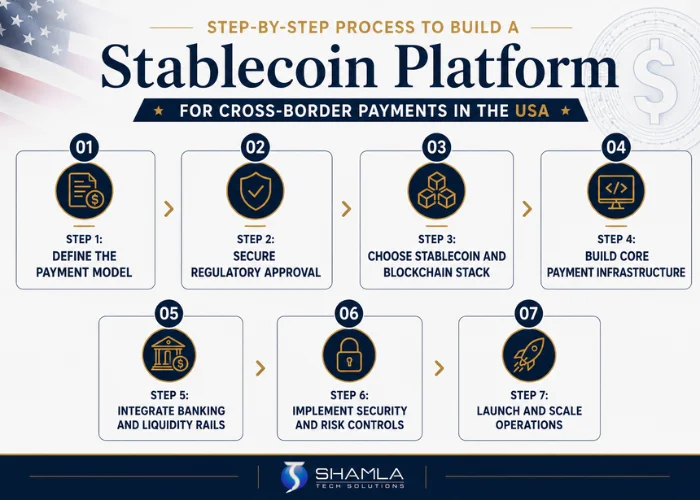
Step-by-Step Process to Build a Stablecoin Platform for Cross-Border Payments in the USA
Building a stablecoin platform for cross-border payments in the USA requires more than blockchain deployment and payment integrations. Commercial success depends on regulatory readiness, secure payment infrastructure, banking interoperability, and a technical architecture built for scalable enterprise-grade international payment operations.

Step 1: Define the Commercial Payment Use Case

Platform architecture should begin with commercial clarity. Cross-border payment infrastructure built for B2B supplier settlements differs significantly from platforms designed for payroll disbursements, marketplace payouts, remittances, or treasury transfers. Defining transaction volume, settlement corridors, user roles, compliance exposure, and payment workflows early prevents infrastructure misalignment, costly redevelopment, and operational limitations during commercial deployment.

Step 2: Establish U.S. Regulatory and Compliance Requirements

Payment infrastructure operating in the United States must align with financial regulatory obligations from the outset. Depending on the business model, this may involve FinCEN registration, money transmitter licensing, AML compliance programs, OFAC sanctions screening, KYC verification, SEC considerations, and state-level financial regulations. Delayed compliance planning creates licensing bottlenecks, banking partnership challenges, regulatory exposure, and barriers to enterprise-scale market entry.

Step 3: Select the Stablecoin and Blockchain Infrastructure

Stablecoin and blockchain decisions directly influence settlement efficiency, transaction economics, scalability, and interoperability. Businesses may integrate USDC, USDT, PYUSD, or proprietary fiat-backed stablecoins depending on operational requirements. Blockchain infrastructure across Ethereum, Stellar, Solana, Polygon, or permissioned enterprise networks should be selected based on transaction throughput, settlement speed, cost efficiency, institutional adoption, and compliance alignment.

Step 4: Build the Core Payment Infrastructure

The technical foundation must support secure, enterprise-grade payment execution across jurisdictions. Core infrastructure includes wallet architecture, MPC custody systems, settlement engines, payment routing logic, compliance modules, transaction monitoring tools, treasury management controls, and API orchestration layers. Weak infrastructure decisions create operational inefficiencies, payment bottlenecks, governance risks, and scalability constraints that limit long-term commercial performance.

Step 5: Integrate Banking Rails and Liquidity Infrastructure

Stablecoin platforms must operate seamlessly with traditional financial infrastructure to support enterprise settlement workflows. Essential integrations include ACH processing, SWIFT connectivity, wire transfer systems, SEPA rails, banking APIs, fiat conversion providers, and institutional liquidity partners. Without financial interoperability, payment execution becomes fragmented, treasury operations lose efficiency, and supplier settlement flexibility becomes commercially restrictive.

Step 6: Implement Security and Risk Governance Controls

Cross-border payment infrastructure handling enterprise financial flows requires institutional-grade protection. Security architecture should include multi-signature approvals, MPC custody, encryption frameworks, access governance, fraud detection systems, smart contract audits, anomaly monitoring, and penetration testing. Governance weaknesses expose businesses to transaction fraud, operational disruption, regulatory non-compliance, and reputational risk within high-value international payment ecosystems.

Step 7: Launch, Optimize, and Scale Payment Operations

Commercial deployment requires continuous operational refinement beyond technical launch. Growth priorities include payment corridor expansion, liquidity optimization, enterprise onboarding workflows, compliance process refinement, performance analytics, and infrastructure scaling. Stablecoin payment platforms built for long-term commercial success must support increasing transaction demand, evolving enterprise requirements, and broader participation across international payment ecosystems.

Build Enterprise-Grade Stablecoin Payment Infrastructure For Global Growth

Security and Compliance Requirements for Stablecoin Payment Platforms in USA

FinCEN, SEC, and Licensing Compliance

Stablecoin payment platforms operating in the United States must evaluate regulatory exposure across multiple agencies. Depending on platform structure, obligations may include FinCEN registration, Money Services Business classification, SEC oversight considerations, CFTC implications, and state money transmitter licensing. Regulatory ambiguity creates deployment delays, banking friction, enforcement exposure, and commercial uncertainty.

KYC, AML, and Sanctions Enforcement

Cross-border payment infrastructure without embedded compliance controls creates unacceptable regulatory and operational risk. Platforms must implement customer identity verification, AML transaction monitoring, OFAC sanctions screening, suspicious activity reporting workflows, and risk-based compliance governance. Enterprise clients and financial partners expect payment infrastructure aligned with established compliance and financial crime prevention standards.

Institutional Security Architecture

Enterprise payment infrastructure handling stablecoin settlement for tokenized assets requires institutional-grade asset protection and transaction governance. Essential controls include MPC custody, multi-signature approvals, encryption frameworks, role-based access controls, hardware security modules, and fraud monitoring systems. Security weaknesses create direct exposure to fund compromise, financial disruption, regulatory scrutiny, and reputational damage.

Smart Contract and Operational Risk Management

Stablecoin payment platforms depend on technical infrastructure that must maintain reliability under financial transaction pressure. Core controls include smart contract audits, penetration testing, vulnerability assessments, transaction monitoring, infrastructure redundancy, and disaster recovery planning. Weak operational governance increases the risk of settlement failures, exploit exposure, service disruption, and enterprise trust erosion.

Best Blockchain Networks for Cross-Border Stablecoin Payment Development

Blockchain infrastructure determines how efficiently a stablecoin payment platform handles settlement execution, transaction costs, interoperability, and scalability. Selecting the right network requires balancing enterprise payment requirements, compliance expectations, and commercial performance across international transaction corridors.

Blockchain Network
Best Fit for Cross-Border Payments
Key Strengths
Enterprise Consideration

Ethereum

High-value institutional settlements

Deep USDC ecosystem, institutional adoption, strong smart contract infrastructure

Higher gas fees during congestion

Stellar

Remittances, payment corridors, settlement networks

Fast settlement, low transaction costs, payment-focused architecture

Limited smart contract flexibility compared to broader ecosystems

Solana

High-volume transaction processing

Extremely fast settlement, low fees, strong scalability

Enterprise adoption still maturing

Polygon

Cost-efficient enterprise payment infrastructure

Ethereum compatibility, low transaction fees, scalable execution

Dependency on Ethereum ecosystem assumptions

XRP Ledger

Cross-border liquidity and financial settlement

Banking-focused design, efficient international settlement, strong transaction throughput

Regulatory perception considerations in certain markets

Hyperledger Besu (Permissioned)

Regulated enterprise financial infrastructure

Controlled governance, privacy, compliance flexibility, institutional architecture

Lower interoperability with public blockchain ecosystems

The most suitable blockchain depends on settlement volume, transaction economics, regulatory expectations, and interoperability requirements. Enterprise stablecoin payment platforms perform best when blockchain infrastructure aligns with commercial payment execution priorities, rather than relying solely on transaction speed or network popularity.

Business Benefits of Stablecoin-Based Cross-Border Payment Platforms

Faster Settlement and Treasury Liquidity Optimization

Traditional cross-border payments moving through correspondent banking networks, SWIFT messaging, and intermediary settlement layers can delay fund availability for one to five business days. Stablecoin platforms using networks such as Stellar, Solana, or Polygon enable near-instant settlement, allowing treasury teams to optimize liquidity allocation, supplier payouts, and capital deployment with greater precision.

Reduced Payment Processing and FX Cost Exposure

International payment execution often involves correspondent banking fees, intermediary deductions, FX spreads, and settlement handling charges that materially impact transaction economics. Stablecoin platforms using assets such as USDC or USDT reduce reliance on multi-bank routing, lowering payment processing costs and creating more predictable settlement economics for high-volume enterprise cross-border transactions.

Stronger Payment Traceability and Audit Governance

Enterprise finance teams often struggle with fragmented transaction visibility across banks, intermediaries, payment processors, and regional financial institutions. Stablecoin payment platforms provide on-chain transaction records, immutable settlement logs, wallet-level traceability, and real-time payment verification, reducing reconciliation overhead while strengthening audit readiness, financial governance, and internal transaction oversight.

Automated Global Payment Operations

Manual execution across payroll disbursements, supplier settlements, partner payouts, and treasury transfers creates operational inefficiency at scale. Stablecoin platforms integrated with SAP, Oracle NetSuite, treasury management systems, and payment APIs enable automated payment workflows, approval orchestration, scheduled settlements, and programmable transaction execution that reduces operational dependency on fragmented financial teams.

Scalable International Payment Infrastructure Ownership

Enterprises dependent on external payment processors remain constrained by third-party pricing, settlement rules, infrastructure limitations, and limited customization. Building proprietary stablecoin payment infrastructure enables direct control over payment corridors, settlement logic, liquidity management, fee economics, and embedded financial services, creating stronger commercial flexibility for international expansion and payment-led revenue models.

Challenges in Stablecoin Platform Development for Cross-Border Payments

Regulatory Complexity Across Jurisdictions

Stablecoin payment platforms operating across borders must navigate FinCEN obligations, money transmitter licensing, OFAC compliance, SEC considerations, and state-level regulatory requirements. Regulatory architecture mistakes can delay market entry and banking approvals, which is why many enterprises deliberately partner with experienced stablecoin development companies to reduce implementation and compliance execution risk.

Banking and Liquidity Integration Challenges

Cross-border stablecoin payments depend on interoperability between ACH, SWIFT, wire infrastructure, banking APIs, fiat conversion systems, and institutional liquidity providers. Weak integration design creates fragmented settlement execution, treasury inefficiencies, and payout constraints, making specialized payment infrastructure expertise a significant implementation advantage.

Security and Operational Risk Exposure

Enterprise payment platforms handling stablecoin settlement face direct exposure to wallet compromise, smart contract vulnerabilities, fraud attempts, and operational downtime. Implementing MPC custody, multi-signature governance, transaction monitoring, audit controls, and resilience planning is essential to protecting transaction integrity and maintaining enterprise trust.

Scalability and Enterprise Infrastructure Complexity

Platforms that function during early deployment often struggle under enterprise transaction volumes, corridor expansion, compliance growth, and integration demands. Supporting ERP connectivity, treasury automation, payment orchestration, and multi-jurisdiction settlement workflows requires infrastructure engineered for long-term operational scale rather than short-term technical deployment.

Wrapping Up

Cross-border payments are becoming a strategic infrastructure decision rather than a back-office financial function. Enterprises that invest in stablecoin payment capabilities today position themselves for stronger settlement control, improved treasury efficiency, and greater ownership over how international value moves.

Building this infrastructure requires disciplined execution across compliance, security, banking interoperability, and payment architecture. Businesses entering this space with a long-term commercial mindset will be better positioned to establish differentiated payment capabilities in an increasingly competitive global financial environment.

Build Stablecoin Platform for Cross-Border Payments with Shamla Tech Solutions

Shamla Tech Solutions is a stablecoin development company delivering enterprise-grade platforms for cross-border payments in the USA. Our expertise spans stablecoin architecture, wallet infrastructure, compliance-ready payment systems, banking integrations, and secure blockchain development tailored for regulated international payment operations.

From USDC and USDT payment platforms to custom stablecoin ecosystems, Shamla Tech Solutions helps businesses build scalable cross-border payment infrastructure aligned with U.S. compliance expectations. We develop secure, interoperable solutions engineered for treasury efficiency, transaction transparency, and enterprise financial performance.

Transform International Payments With Custom Stablecoin Platform Development

FAQs

1. What is a stablecoin platform for cross-border payments?

A stablecoin platform for cross-border payments is a digital payment infrastructure that enables businesses to transfer value internationally using fiat-backed stablecoins such as USDC or USDT, enabling faster settlement, improved transparency, and lower transaction dependency.

2. How much does it cost to build a stablecoin platform for cross-border payments?

Development costs depend on platform complexity, compliance requirements, banking integrations, blockchain infrastructure, wallet architecture, and security implementation. Enterprise-grade stablecoin payment platform development in the USA typically requires a tailored investment based on operational scope.

3. Which blockchain is best for cross-border stablecoin payment development?

The ideal blockchain depends on transaction volume, settlement speed, cost sensitivity, and compliance requirements. Ethereum, Stellar, Solana, Polygon, and permissioned enterprise blockchain networks are commonly evaluated for stablecoin-based cross-border payment infrastructure.

4. Are stablecoin payment platforms legal in the United States?

Stablecoin payment platforms can operate legally in the United States when aligned with applicable regulations, including FinCEN registration, AML compliance, KYC requirements, OFAC sanctions screening, and relevant state-level financial licensing obligations.

5. Why should businesses partner with a stablecoin development company?

Building enterprise-grade stablecoin payment infrastructure requires expertise in blockchain engineering, compliance architecture, banking integrations, wallet security, and transaction governance. Specialized development partners help businesses reduce implementation risk and accelerate commercial deployment timelines.

Talk to Our Experts

Recent Posts