
Tokenized value systems now operate as programmable financial infrastructure where assets move across networks through automated execution layers designed for scale, precision, and continuous settlement across global markets without friction or dependency on legacy intermediaries.
By 2026, more than $10 trillion in real world assets are expected to exist in tokenized form across blockchain based systems, spanning institutional funds, real estate portfolios, credit instruments, and structured financial products at global scale.
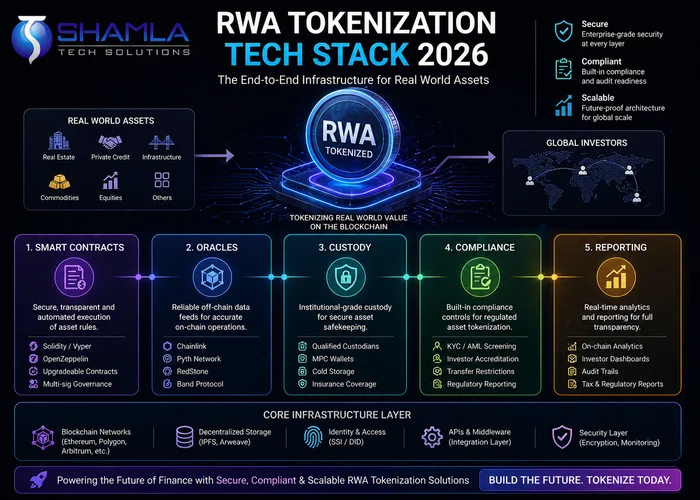
In this article we will break down the RWA tokenization tech stack 2026, covering smart contracts, oracle infrastructure, custody models, compliance architecture, and reporting systems that collectively enable end to end digital asset lifecycle management.
How Has the RWA Tokenization Tech Stack Evolved by 2026?
The RWA tokenization tech stack in 2026 has evolved into a modular, institutional-grade infrastructure where execution, data, custody, compliance, and reporting systems operate as tightly integrated layers enabling programmable real-world asset markets at global scale.
Evolution of the RWA Tokenization Stack
- Smart contracts now function as automated asset engines managing issuance, settlement, yield distribution, and lifecycle events of tokenized real world assets with deterministic execution logic across blockchain networks.
- Oracle networks have become critical infrastructure, delivering verified off-chain data such as asset valuations, interest rates, and NAV updates into on-chain systems to ensure accurate pricing and financial integrity.
- Institutional custody has matured into regulated multi-layer security systems using MPC wallets, cold storage frameworks, and compliance-linked access controls designed for large scale capital deployment.
- Compliance and identity layers are now embedded directly into the stack, enabling automated enforcement of KYC, AML, and jurisdiction-specific rules at transaction level within tokenized asset flows.
- The tokenized RWA market reached $27.7 billion in on-chain value by April 2026, reflecting rapid institutional adoption across asset classes like Treasuries and private credit.
Why Do Smart Contracts, Oracles, Custody, and Compliance Form the Core of RWA Tokenization Systems?
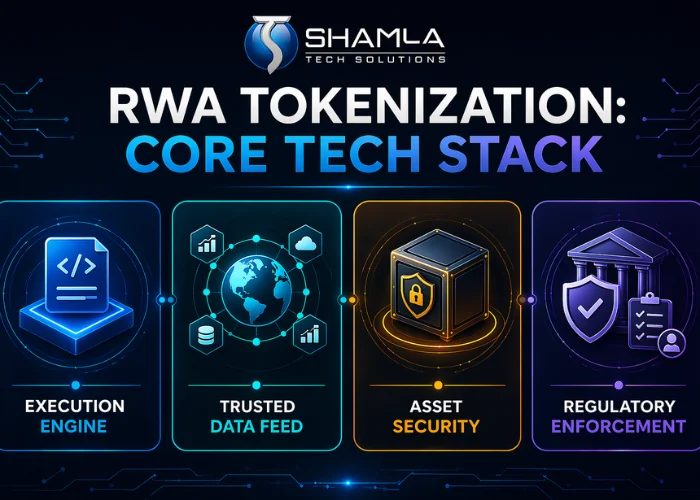
1. Smart Contracts as the Execution Layer
2. Oracles as the Data Integrity Layer
3. Custody as the Ownership Security Layer
4. Compliance as the Regulatory Enforcement Layer
System Integration: How the Core Layers Work Together
How Does a Modern RWA Tokenization Tech Stack Actually Work End-to-End?
End-to-End Workflow of the RWA Tokenization Tech Stack
Stage | What Happens | Core Layer Involved | Outcome |
Asset Onboarding | Real-world asset is identified, structured, and prepared for tokenization | Compliance + Custody | Asset becomes eligible for digital representation |
Token Creation | Smart contracts define ownership, supply, and transfer logic | Smart Contracts | Digital tokens representing asset ownership are issued |
Data Integration | External data such as pricing and yield is connected to the system | Oracles | Accurate and real-time asset valuation |
Custody Setup | Underlying asset is secured and linked to token ownership | Custody | Ownership integrity and asset backing ensured |
Investor Access | Regulatory checks are applied to participants | Compliance | Controlled and compliant participation |
Reporting & Lifecycle | Performance tracking and asset updates are executed | Reporting + Smart Contracts | Continuous monitoring and transparency |
- Asset Onboarding and Structuring
The process begins with identifying a real-world asset and structuring it within a legally enforceable framework that supports tokenization. This includes defining ownership rights, jurisdictional alignment, and financial characteristics such as yield or cash flow. Proper structuring ensures the asset can be represented digitally while maintaining regulatory validity and investor confidence across markets.
- Token Creation via Smart Contracts
Smart contracts are deployed to encode the asset’s economic and governance logic into programmable rules. These include ownership distribution, transfer conditions, compliance restrictions, and lifecycle events such as payouts or maturity. By embedding these rules directly on-chain, smart contracts ensure consistent execution, eliminate ambiguity, and enable automated asset management without reliance on manual processes.
- Data Integration Through Oracles
Oracle infrastructure enables seamless integration of external data into blockchain environments, ensuring tokenized assets reflect real-world financial conditions accurately. This includes inputs such as market valuations, benchmark rates, and performance metrics. Reliable data feeds are critical for maintaining pricing integrity, triggering contract events, and supporting informed decision-making across tokenized asset ecosystems.
- Custody and Asset Backing
Custody frameworks are responsible for securing the underlying real-world asset and maintaining a verifiable link between the asset and its digital representation. Institutional-grade custody solutions incorporate multi-layer security models, controlled access mechanisms, and regulatory oversight. This ensures that token holders have confidence in the legitimacy, safety, and enforceability of their ownership claims.
- Compliance and Investor Access
Compliance systems are integrated directly into the tokenization infrastructure to enforce regulatory requirements at every transaction level. This includes identity verification, anti-money laundering checks, and jurisdiction-specific participation rules. By embedding compliance into the system, tokenized markets can operate efficiently while ensuring that only eligible investors can access, trade, or hold regulated assets.
- Reporting and Lifecycle Management
Reporting systems provide continuous visibility into asset performance, ownership distribution, and financial outcomes throughout the lifecycle of the tokenized asset. This includes audit trails, real-time dashboards, and automated distribution of returns such as interest or dividends. Effective reporting ensures transparency, supports regulatory obligations, and enables informed decision-making for all stakeholders involved.
What Makes Scaling RWA Tokenization Platforms Complex in 2026?
Regulatory Logic Encoding Within the Tech Stack
Cross-Layer Integration Across Smart Contracts, Oracles, and Compliance Systems
Custody Infrastructure and On-Chain Ownership Synchronization
Oracle Architecture and High-Frequency Data Dependencies
System Performance Across Hybrid On-Chain and Off-Chain Architecture
Bottom Line
RWA tokenization in 2026 operates as a deeply integrated infrastructure layer where execution, data, custody, and compliance systems must function in precise coordination. Platform architecture, interoperability, and system design define how effectively tokenized assets can scale across institutional environments and global markets.
Organizations building in this space are focusing on unified tech stacks that align financial logic, regulatory requirements, and operational workflows within a single framework. This level of integration supports reliable deployment, consistent performance, and the ability to manage complex asset structures across tokenized ecosystems.
Build RWA Tokenization Platforms with an End-to-End Tech Stack with Shamla Tech
Shamla Tech Solutions is an RWA tokenization platform development company, we have deep expertise in building end-to-end tech stacks that integrate smart contracts, oracle infrastructure, custody frameworks, compliance engines, and reporting systems into a unified, scalable architecture designed for institutional-grade performance.
Our approach focuses on designing modular, interoperable systems that align with regulatory requirements while enabling seamless asset onboarding, execution, and lifecycle management. From architecture design to deployment, we deliver robust tokenization platforms built to support diverse asset classes and evolving market demands.