
Home » Real Estate Tokenization » Real Estate Tokenization Platform Development Cost for Enterprises in 2026

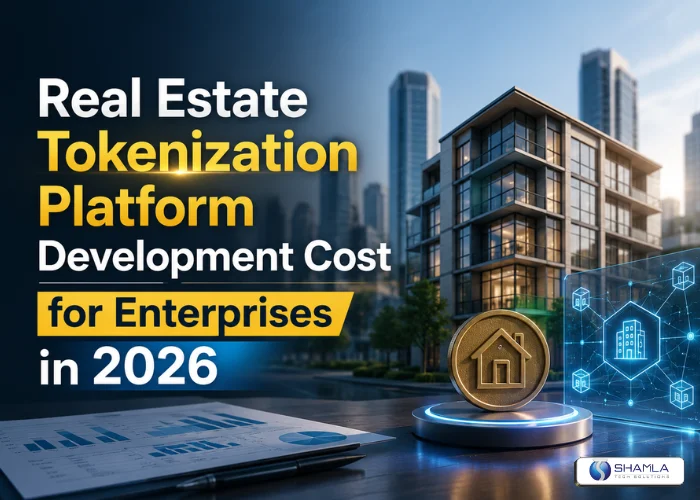
Real Estate Tokenization Platform Development Cost for Enterprises in 2026

Share this article:
real estate tokenization platform development cost
Table of Contents
About the Author
Balaji
CEO of Shamla Tech, specializes in crypto exchange development, RWA tokenization, blockchain infrastructure, AI solutions, and compliance-ready platforms. He helps enterprises address regulatory, security, and scalability challenges while driving real-world adoption of emerging technologies across industries.
Connect On:

Real estate ownership is entering a structurally different distribution model. Enterprises are assessing tokenized asset infrastructure to improve capital accessibility, investor participation, and transaction efficiency while retaining operational control over issuance, governance, and compliance frameworks.

The global real estate tokenization market is projected to reach $19.4 billion by 2033, reflecting growing institutional interest in digital asset-backed property investment models. Enterprises evaluating platform ownership must assess real estate tokenization platform development cost, compliance infrastructure, and deployment economics.

This article examines real estate tokenization platform development cost for enterprises in 2026, including major cost drivers, expected return on investment, deployment considerations, and the strategic value of partnering with an experienced real estate tokenization development company.

Turn Real Estate Assets Into Digital Investment Infrastructure

Why Build a Real Estate Tokenization Platform in 2026

Enterprises evaluating tokenization in 2026 are making infrastructure decisions tied to capital formation, investor distribution, and transaction monetization. Building a proprietary real estate tokenization platform creates operational ownership over compliance execution, issuance workflows, and long-term commercial scalability.

Strategic Business Drivers Behind Enterprise Adoption:

  • McKinsey estimates tokenized financial assets could reach approximately $2 trillion by 2030 in a base-case scenario. This signals growing institutional allocation toward tokenized infrastructure, making early platform ownership a commercially relevant strategic investment.
  • Proprietary platforms allow enterprises to retain control over issuance economics, investor onboarding, transaction fee structures, and secondary participation models, transforming tokenization infrastructure into a revenue-generating business asset rather than a technology procurement expense.
  • Institutional real estate tokenization requires infrastructure aligned with jurisdictional compliance obligations, investor accreditation controls, custody architecture, and governance policies. Third-party platform dependency can restrict customization, delay execution decisions, and create unnecessary operational constraints.
  • Cross-border fundraising requires integrated KYC orchestration, permissioned investor segmentation, programmable ownership controls, and transparent audit trails. Platform ownership reduces operational fragmentation and improves execution consistency across regulated investment workflows and institutional capital participation.
  • Enterprises entering tokenized markets early build execution maturity, compliance familiarity, and operational credibility ahead of competitors. Institutional buyers increasingly evaluate infrastructure capability as part of strategic partnership readiness, fundraising efficiency, and long-term digital asset positioning.

Real Estate Tokenization Platform Development Cost for Enterprises in 2026

Real estate tokenization platform development cost depends on infrastructure scope, regulatory requirements, transaction architecture, and deployment complexity. Enterprise buyers are not purchasing software alone. They are investing in regulated digital asset infrastructure designed for capital formation, investor operations, and long-term revenue ownership.

Cost Component

Estimated Cost Range (USD)

Platform Architecture & Core Development

$6,000 – $8,500

Compliance Infrastructure Integration

$3,000 – $5,000

Smart Contract & Tokenization Engine Development

$5,000 – $6,500

Wallet, Custody & Payment Integrations

$3,500 – $5,500

Security Testing & Audit Implementation

$2,500 – $4,000

Secondary Marketplace Features

$5,000 – $7,500

Maintenance & Ongoing Support

$750 – $1,500/month

Estimated Total Development Cost

$25,000 – $35,000+

1. Platform Architecture and Core Development

Platform architecture forms the operational foundation of the tokenization business. This includes investor dashboards, issuer management panels, administrative controls, transaction workflows, and reporting systems. Development costs in this category depend on workflow complexity, role-based access requirements, interface customization, and the degree of business process automation required.

2. Compliance Infrastructure Integration

Compliance infrastructure is essential for enterprises operating within regulated investment environments. This includes KYC verification, AML screening, sanctions monitoring, investor accreditation workflows, and audit-ready reporting systems. Development costs vary based on target jurisdictions, compliance provider integrations, and the level of automation required to streamline investor onboarding while maintaining regulatory accountability.

3. Smart Contract and Tokenization Engine Development

The tokenization engine governs digital asset issuance, ownership allocation, transfer permissions, investor rights, and redemption conditions. This component determines how real estate ownership is represented and managed on-chain. Costs increase when enterprises require custom ownership structures, automated entitlement distribution, programmable compliance rules, or blockchain interoperability capabilities.

4. Wallet, Custody, and Payment Integrations

Investor participation depends on seamless asset movement and payment infrastructure. This includes wallet connectivity, custodial architecture, fiat payment gateway integrations, stablecoin settlement support, and transaction reconciliation systems. Development costs are influenced by investor experience expectations, payment complexity, and whether the platform prioritizes institutional custody models or simplified retail accessibility.

5. Security Testing and Audit Implementation

Security investment protects platform credibility, investor confidence, and transaction integrity. This includes application security testing, smart contract audits, infrastructure hardening, access control validation, and vulnerability remediation. Since tokenized real estate platforms manage financial transactions and ownership records, security implementation should be treated as a foundational requirement rather than an optional enhancement.

6. Secondary Marketplace Features

Enterprises planning investor transferability or token trading require secondary marketplace infrastructure. This includes transaction matching workflows, compliance validation layers, settlement mechanisms, investor eligibility enforcement, and transaction reporting systems. Adding these capabilities increases development cost, while also creating broader monetization opportunities through platform participation fees and liquidity-focused investment models.

7. Maintenance and Ongoing Support

Platform ownership extends beyond launch. Ongoing costs include cloud hosting, third-party API subscriptions, security patching, compliance rule updates, performance monitoring, technical support, and feature improvements. Enterprises should budget for continuous operational maintenance to ensure platform stability, regulatory alignment, and a reliable investor experience as transaction activity increases.

Build Secure Tokenization Infrastructure For Global Investors

How Enterprises Generate ROI from Real Estate Tokenization Platforms
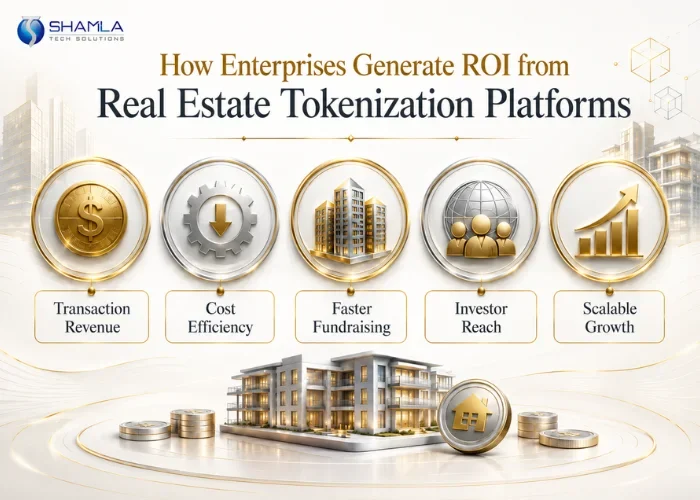
How Enterprises Generate ROI from Real Estate Tokenization Platforms

1. Revenue Monetization Across Transaction Layers

Enterprises owning tokenization infrastructure can monetize multiple transaction layers instead of relying solely on asset appreciation. Revenue can be generated through token issuance fees, investor onboarding charges, transaction processing, platform subscriptions, and secondary transfer participation. This creates a recurring commercial model where infrastructure ownership directly contributes to long-term revenue generation beyond individual fundraising cycles.

2. Lower Operational Costs Through Process Automation

Traditional real estate fundraising involves fragmented manual workflows across compliance verification, investor documentation, ownership record management, reporting, and transaction reconciliation. Tokenization platforms consolidate these operational functions into structured digital workflows, reducing administrative dependency, improving execution consistency, and lowering the recurring operational costs associated with investor management and asset servicing.

3. Faster Capital Formation and Investor Conversion

Capital deployment delays often result from inefficient onboarding, documentation bottlenecks, fragmented investor communication, and restricted participation infrastructure. A dedicated tokenization platform streamlines investor access, accelerates qualification workflows, and simplifies ownership allocation. For enterprises raising capital repeatedly, shorter fundraising cycles directly improve deployment efficiency, project timelines, and revenue realization opportunities.

4. Expanded Investor Market Access

Many real estate investment opportunities remain constrained by geographic access limitations, participation thresholds, and operational onboarding friction. Tokenization infrastructure enables structured participation models that support broader qualified investor access across jurisdictions. For enterprises, this improves fundraising optionality, reduces concentration risk, and creates stronger capital distribution capabilities across multiple investor segments.

5. Reusable Infrastructure for Multi-Asset Growth

Building tokenization infrastructure creates a reusable digital asset issuance framework rather than a one-time project expense. Enterprises can extend the same operational foundation across residential portfolios, commercial assets, private investment structures, or future tokenized offerings. This significantly improves long-term return on investment by spreading infrastructure costs across multiple monetizable asset programs

Partnering with a Real Estate Tokenization Development Company for Enterprise Deployment

Enterprise tokenization deployment is a business infrastructure decision with regulatory, operational, and commercial implications. The right development partner influences implementation speed, execution quality, compliance readiness, and long-term scalability, making vendor selection a strategic decision rather than a standard software procurement exercise.

Key Factors to Evaluate Before Choosing a Development Partner:

Proven Tokenization Delivery Experience

Building tokenized real estate infrastructure requires specialized execution capability beyond conventional software development. Enterprises should evaluate whether the partner has delivered token issuance systems, digital asset ownership frameworks, investor transaction workflows, and blockchain-integrated financial platforms. Practical delivery experience reduces architectural missteps, shortens implementation cycles, and improves confidence in production-grade deployment outcomes.

Compliance and Security Readiness

A tokenization platform without compliance execution capability creates operational and regulatory exposure. Enterprises should assess whether the development partner can implement KYC workflows, AML integrations, investor verification controls, audit-ready reporting, access governance, and smart contract security validation. Compliance and security should be embedded into platform architecture from the initial development phase.

Customization for Enterprise Business Models

Enterprise tokenization strategies vary significantly based on asset structure, investor participation models, ownership logic, jurisdictional requirements, and monetization objectives. Development partners offering rigid frameworks often create operational limitations. Enterprises benefit from partners capable of aligning platform architecture with specific business requirements instead of forcing commercial models into predefined technical constraints.

Integration and Deployment Capability

Tokenization platforms must operate within broader enterprise ecosystems rather than as isolated applications. Successful deployment requires integration with payment infrastructure, wallet systems, CRM environments, compliance providers, reporting tools, and administrative workflows. Enterprises should prioritize development partners with proven integration capability to reduce implementation friction and accelerate operational readiness.

Long-Term Product Support and Scalability

Platform deployment marks the beginning of operational ownership, not the completion of the investment. Regulatory updates, infrastructure scaling, security maintenance, feature expansion, and technical support require continuous execution capability. Enterprises should select development partners positioned to support long-term product evolution as tokenization initiatives expand across broader digital asset strategies.

Wrapping Up

Enterprises entering tokenized real estate markets are making infrastructure decisions that shape capital access, investor participation, and long-term revenue ownership. The question is no longer whether tokenization has commercial relevance, but whether the underlying platform strategy aligns with business objectives.

Organizations that approach tokenization with execution discipline, regulatory clarity, and scalable infrastructure planning position themselves to build durable digital asset capabilities. In a market where platform ownership influences commercial control, implementation quality will determine which enterprises create measurable long-term enterprise value.

Build Real Estate Tokenization Platform with Shamla Tech Solutions

Shamla Tech Solutions is a real estate tokenization platform development company delivering enterprise-grade digital asset infrastructure for global clients. We have built tokenization platforms across multiple jurisdictions, supporting asset issuance, investor onboarding, compliance integration, smart contract deployment, wallet infrastructure, and scalable ownership management systems.

Our development expertise covers custom real estate tokenization platforms aligned with enterprise fundraising models, regulatory requirements, and long-term commercialization objectives. From architecture design and security implementation to compliance workflows and post-launch support, Shamla Tech Solutions enables organizations to launch with execution confidence.

Launch Your Enterprise Real Estate Tokenization Platform

FAQs

1. How much does real estate tokenization platform development cost?

Real estate tokenization platform development cost typically starts from approximately $25,000, depending on platform scope, compliance integrations, blockchain infrastructure, security requirements, wallet connectivity, and feature customization required to support enterprise-specific operational and commercial objectives.

2. How long does it take to build a real estate tokenization platform?

Development timelines typically range from 4 to 8 weeks depending on platform scope, compliance integrations, smart contract complexity, and infrastructure requirements. With experienced delivery capabilities, companies like Shamla Tech Solutions can accelerate enterprise real estate tokenization platform deployment through structured development and streamlined implementation workflows.

3. What features should a real estate tokenization platform include?

A robust platform should include asset tokenization infrastructure, investor onboarding, compliance workflows, smart contract ownership management, wallet integrations, payment processing capabilities, administrative dashboards, reporting systems, and transaction management tools supporting secure enterprise operations.

4. Can a real estate tokenization platform support regulatory compliance?

Yes, enterprise tokenization platforms can integrate KYC verification, AML screening, investor accreditation workflows, sanctions monitoring, access governance, and audit-ready reporting infrastructure to support regulated fundraising operations and compliant digital ownership management across applicable jurisdictions.

5. Why choose custom real estate tokenization platform development over white-label solutions?

Custom development provides enterprises with greater control over monetization models, platform architecture, compliance workflows, integrations, and scalability. This flexibility supports long-term infrastructure ownership without the operational restrictions often associated with standardized white-label deployment frameworks.

Talk to Our Experts

Recent Posts