


Home » Real Estate Tokenization » Property Tokenization Platform Development for the Next Generation of Real Estate Investment

Property Tokenization Platform Development for the Next Generation of Real Estate Investment

Share this article:
property tokenization platform development
Table of Contents
About the Author
Balaji
CEO of Shamla Tech, specializes in crypto exchange development, RWA tokenization, blockchain infrastructure, AI solutions, and compliance-ready platforms. He helps enterprises address regulatory, security, and scalability challenges while driving real-world adoption of emerging technologies across industries.
Connect On:

Enterprises are identifying new pathways to unlock capital efficiency, expand investor access, and structure real estate participation with greater precision. Property tokenization introduces a commercially viable framework for transforming traditionally illiquid assets into digitally accessible investment instruments.

The global real estate tokenization market is projected to reach $19.4 billion by 2033, signaling substantial institutional interest in asset digitization. For businesses in the United States, a dedicated property tokenization platform supports compliant issuance, investor onboarding, and transaction governance.

In this article, we explain the fundamentals of property tokenization platform development, the essential capabilities enterprises should prioritize, the business advantages these platforms deliver, and why specialized development services are becoming a strategic requirement for real estate organizations.

Build Compliant Tokenization Infrastructure For Real Estate Investment Markets

What Is Property Tokenization Platform Development and How Does It Work?

Property tokenization platform development involves building the operational and transactional infrastructure required to transform real estate assets into investable digital instruments. For enterprises, this creates a structured framework for capital access, investor management, ownership governance, and monetization models that conventional property investment systems cannot efficiently support.

Core functions that define enterprise property tokenization platforms:

  • Real estate tokenization is projected to represent a $4 trillion market by 2035, reflecting strong institutional momentum toward digitized asset ownership models and creating a clear infrastructure demand for firms entering tokenized real estate markets.

  • Asset structuring frameworks convert real estate ownership into legally aligned digital units, enabling fractional participation, controlled issuance, transparent ownership records, automated revenue distribution, and governance mechanisms that reduce administrative friction across asset lifecycles.

  • Compliance architecture establishes market readiness through identity verification, accreditation workflows, jurisdictional access rules, document management, and audit trails, ensuring the platform supports regulated capital participation without introducing operational exposure.

  • Transaction infrastructure determines commercial viability by enabling managed secondary transfers, settlement workflows, ownership synchronization, and controlled liquidity pathways that improve asset accessibility while preserving issuer governance standards.

  • Business system integration connects tokenization workflows with CRM platforms, investor reporting environments, payment infrastructure, fund administration processes, and custody systems, allowing tokenized real estate operations to function as a scalable enterprise business model.

Core Features Every Property Tokenization Platform Development Project Needs

Property tokenization platforms succeed when they are engineered as business infrastructure rather than blockchain showcases. Enterprise buyers require systems that protect compliance, simplify investor operations, preserve governance control, and create commercially usable digital asset frameworks that support measurable business outcomes.

Feature

Core Capability

Business Advantage

Investor Compliance Infrastructure

KYC, AML, accreditation controls

Faster onboarding, lower compliance risk

Asset Tokenization Engine

Ownership structuring and issuance

New monetization and fractional access

Smart Contract Automation

Automated transactions and governance

Reduced manual workload, higher accuracy

Secondary Marketplace Framework

Controlled asset transfers

Improved liquidity and investor retention

Payment and Distribution Infrastructure

Capital collection and payout management

Stronger cash flow control and transparency

Enterprise System Integrations

CRM, reporting, custody connectivity

Seamless operational scale

Investor Onboarding and Compliance Infrastructure

Institutional participation depends on trust, control, and regulatory readiness. A robust compliance infrastructure ensures every investor passes structured verification, eligibility screening, and jurisdiction-specific access checks before participation. For leadership teams, this reduces compliance exposure, accelerates onboarding efficiency, and creates a governance framework capable of supporting growth without introducing operational or legal uncertainty.

Asset Tokenization and Ownership Structuring

Commercial success begins with how ownership is structured. A well-designed tokenization engine converts real estate assets into clearly defined digital ownership units with transparent rights, distribution entitlements, and governance rules. This gives enterprises a practical framework to introduce fractional ownership models, expand capital access, and package real estate assets into scalable investment products.

Smart Contract Automation

Manual execution creates delays, administrative overhead, and operational inconsistency. Smart contract automation embeds business logic directly into transaction workflows, enabling distributions, ownership transfers, approvals, and governance actions to execute with precision. For executive teams, this translates into lower operating costs, stronger control over execution quality, and greater confidence in transaction integrity at scale.

Secondary Marketplace Framework

Liquidity remains a decisive factor in investor decision-making. A controlled secondary marketplace allows approved participants to trade ownership stakes within predefined governance parameters, creating structured exit opportunities without compromising issuer oversight. This strengthens investor confidence, improves product marketability, and positions tokenized real estate offerings as commercially competitive alternatives within modern investment portfolios.

Payment and Distribution Infrastructure

Investor confidence is directly tied to financial transparency and operational consistency. Integrated payment infrastructure centralizes capital inflows, distribution payouts, reconciliation workflows, and transaction reporting within a single controlled environment. This improves financial oversight, reduces administrative inefficiencies, and ensures recurring financial operations are executed with the consistency expected in enterprise-grade investment platforms.

Enterprise System Integrations

Technology adoption fails when new infrastructure operates in isolation. Property tokenization platforms must integrate with CRM systems, investor reporting tools, accounting environments, payment infrastructure, and custody frameworks already supporting business operations. For leadership teams, this protects operational continuity, accelerates implementation value, and ensures tokenization strengthens existing business capabilities rather than creating parallel inefficiencies. 

Turn Real Estate Assets Into Scalable Digital Investment Products

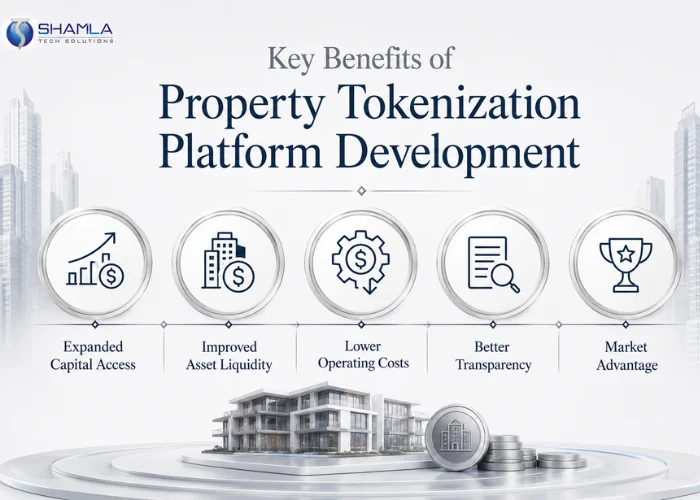
Benefits of Property Tokenization Platform Development for Next-Generation Real Estate Investment
Benefits of Property Tokenization Platform Development for Next-Generation Real Estate Investment

1. Expanded Capital Access

Traditional real estate fundraising often limits participation to a narrow pool of high-value investors due to substantial capital entry requirements. Property tokenization enables fractional ownership structures that significantly lower participation thresholds, opening access to a broader investor base. For enterprises, this creates stronger fundraising flexibility, faster capital deployment, and more diversified investment participation across targeted markets.

2. Improved Asset Liquidity

Commercial real estate transactions can take weeks or months to complete, creating friction for investors seeking capital flexibility. Property tokenization introduces controlled secondary transfer mechanisms that improve ownership mobility within governed frameworks. For enterprises, this enhances investor appeal, strengthens retention, and positions real estate offerings as commercially more attractive in markets where liquidity expectations increasingly influence investment decisions.

3. Lower Operating Costs

Manual investor onboarding, compliance administration, transaction coordination, and reporting create significant operational overhead. Tokenized infrastructure automates core investment workflows, reducing administrative dependency and execution delays. For executive teams managing growth, this translates into leaner operating models, improved process consistency, and stronger cost control without proportionally increasing headcount or operational management complexity.

4. Stronger Governance and Investor Transparency

Institutional investors expect accountability, visibility, and disciplined governance. Property tokenization platforms create immutable ownership records, transparent transaction histories, automated distribution tracking, and structured governance controls across the investment lifecycle. This reduces reporting friction, improves investor confidence, and strengthens the governance standards required to support larger pools of sophisticated capital participation.

5. Competitive Market Positioning

The tokenized real-world asset market is expected to reach multi-trillion-dollar scale over the next decade, signaling a clear commercial shift in how assets are structured and distributed. Enterprises entering early gain an opportunity to differentiate offerings, modernize capital products, and position themselves ahead of firms still dependent on conventional real estate investment operating models.

Why Enterprises Need Property Tokenization Platform Development Expertise

Regulatory and Structural Complexity

Property tokenization is not a standard software deployment. It sits at the intersection of securities compliance, ownership structuring, investor governance, and transaction infrastructure. Execution mistakes can create legal exposure, operational disruption, and investor risk. Specialized development expertise ensures the platform is architected around commercial realities, regulatory obligations, and asset ownership structures that support long-term business viability.

Enterprise-Grade Integration Requirements

Tokenization platforms deliver limited business value when disconnected from core enterprise systems. Leadership teams need infrastructure that integrates with CRM platforms, payment environments, investor reporting systems, accounting workflows, and custody frameworks. Specialized development expertise ensures implementation, strengthens operational continuity, reduces infrastructure duplication, and allows tokenization capabilities to function as an embedded part of broader business operations.

Commercial Scalability and Performance

A platform that supports one asset launch may fail under broader commercial demand. Investor onboarding volumes, transaction activity, reporting obligations, and governance workflows create infrastructure pressure as participation grows. Specialized development teams design for scale from the outset, ensuring performance stability, operational consistency, and commercial readiness as tokenization initiatives expand across multiple properties, investor groups, and markets.

Strategic Time-to-Market Advantage

Building internal capability for a specialized asset tokenization platform requires significant time, experimentation, and execution risk. Market opportunities reward firms that move with operational confidence and commercial clarity. Specialized development expertise shortens deployment timelines, reduces costly implementation missteps, and helps enterprises bring market-ready tokenization offerings to investors with greater speed, precision, and strategic control.

Final Thoughts

Real estate firms are entering a phase where digital ownership infrastructure will increasingly influence capital strategy, investor engagement, and product design. Property tokenization is becoming a strategic business capability for enterprises seeking greater control over how real estate investment opportunities are structured and delivered.

The greater advantage will belong to organizations that approach tokenization with commercial discipline, regulatory precision, and enterprise-grade execution. Building the right platform is not simply a technology decision; it is a strategic move that shapes long-term competitiveness in investment markets.

Build Property Tokenization Platforms with Shamla Tech Solutions

At Shamla Tech Solutions, we build enterprise-grade property tokenization platforms engineered for commercial execution, investor governance, and regulatory alignment. We support global compliance considerations across frameworks such as SEC, FINMA, FCA, VARA, and MAS, helping enterprises structure tokenized real estate platforms with stronger market readiness.

We work with enterprises to transform tokenization strategies into fully operational digital investment infrastructure. Our capabilities span ownership structuring, smart contract architecture, compliance workflows, enterprise integrations, and scalable platform development, enabling clients to launch secure, market-ready property tokenization solutions with confidence across global investment ecosystems.
Launch Enterprise-Grade Property Tokenization Platforms

FAQs

1. What is property tokenization platform development?
Property tokenization platform development involves building digital infrastructure that converts real estate assets into tokenized investment products, enabling ownership management, investor onboarding, compliance workflows, transaction processing, and structured investment operations within a secure platform.
2. How does a property tokenization platform benefit real estate businesses?
A property tokenization platform helps real estate businesses expand capital access, improve asset liquidity, reduce operational inefficiencies, strengthen investor transparency, and create digitally enabled investment products aligned with modern market participation expectations.
3. Is property tokenization legally compliant in the United States?
Yes, property tokenization can operate legally in the United States when platforms are structured to align with applicable securities regulations, investor eligibility requirements, compliance checks, ownership governance standards, and transaction reporting obligations.
4. What features should an enterprise property tokenization platform include?
An enterprise-grade platform should include compliance infrastructure, investor onboarding, asset tokenization engines, smart contract automation, payment and distribution systems, secondary transaction capabilities, and integrations with existing business and reporting infrastructure.
5. Why should businesses work with a specialized property tokenization development company?
Specialized development partners bring expertise in regulatory structuring, smart contract architecture, enterprise integrations, and scalable platform execution, reducing implementation risk while helping businesses launch commercially viable tokenization platforms with greater confidence.

Talk to Our Experts

Recent Posts