


Home » Coin Development » Green Energy Crypto Coins: Sustainable Blockchain Technology for a Carbon-Neutral Future

Green Energy Crypto Coins: Sustainable Blockchain Technology for a Carbon-Neutral Future

Share this article:
Green Energy Crypto Coins
Table of Contents
About the Author
Balaji
CEO of Shamla Tech, specializes in crypto exchange development, RWA tokenization, blockchain infrastructure, AI solutions, and compliance-ready platforms. He helps enterprises address regulatory, security, and scalability challenges while driving real-world adoption of emerging technologies across industries.
Connect On:

The crypto industry is largely shifting from high intensity energy consumption Proof of Work to low energy consuming Proof of Stake (POS) mechanism. Green Energy Crypto Coins, sustainable blockchain technology, needs to be energy-efficient, have a small carbon footprint, and keep the blockchain safe. As climate change becomes a bigger and bigger problem around the world, digital currencies are under more and more pressure to deal with their effects on the environment.

Learn all different types of cryptocurrency to understand green energy crypto coin – Read this Types of Crypto Coins in 2026: Categories, Features, and Use Cases

Proof of Work and Proof of Stake – What’s the difference?

Proof-of-Work (PoW)

Imagine a huge digital world where thousands of miners are trying to solve hard arithmetic problems. The first person to figure out the riddle gets to add a new block to the blockchain and gets a cryptocurrency reward. This method makes networks like Bitcoin safe, but it takes a lot of computing power, which uses a lot of energy and leaves a big carbon imprint.

Proof-of-Stake (PoS)

The Proof-of-Stake methodology picks validator nodes depending on how much cryptocurrency they put up as collateral, or “stake.” You might think of it as a digital lottery: the more coins you stake, the better your chances of being chosen to validate the next block. This process cuts down on the need for energy-intensive calculations by a large amount, making it a more environmentally friendly and sustainable option than PoW.

The advantages of Green Cryptocurrencies

A smaller carbon footprint
The digital currency industry will have a smaller carbon footprint if more people use Green Cryptocurrencies. Mining and transactions use less electricity and produce less carbon emissions because their algorithms are more energy-efficient. This helps fight climate change.
Incentivising renewables
Some Green Cryptocurrencies encourage miners and validators to use renewable energy sources like solar, wind, or hydroelectric power to mine and validate transactions. Miners and validators who do this will get rewards. This is another technique to lower the carbon footprint that comes with mining cryptocurrencies.
Faster transactions
Green Cryptocurrencies can handle transactions faster because they use consensus processes that make blocks faster. This makes it easier for people to send money to each other and makes the user experience better.
Environmental awareness
Green cryptocurrencies have brought attention to how regular cryptocurrencies like Bitcoin hurt the environment. More use of digital assets with a less carbon footprint could bring about more good developments in the industry as a whole.
Corporate social responsibility
Companies may show that they care about the ecology and sustainability by using green blockchain solutions in their business. This will make their corporate social responsibility profile better and also make them more appealing to customers that care about ethics.
Reducing E-Waste
When traditional mining equipment breaks down, it quickly becomes useless and creates a lot of electrical waste. Green coins that use more environmentally friendly consensus techniques assist solve this problem and support bigger initiatives to protect the environment.

Why Green Blockchain Matters for Enterprises
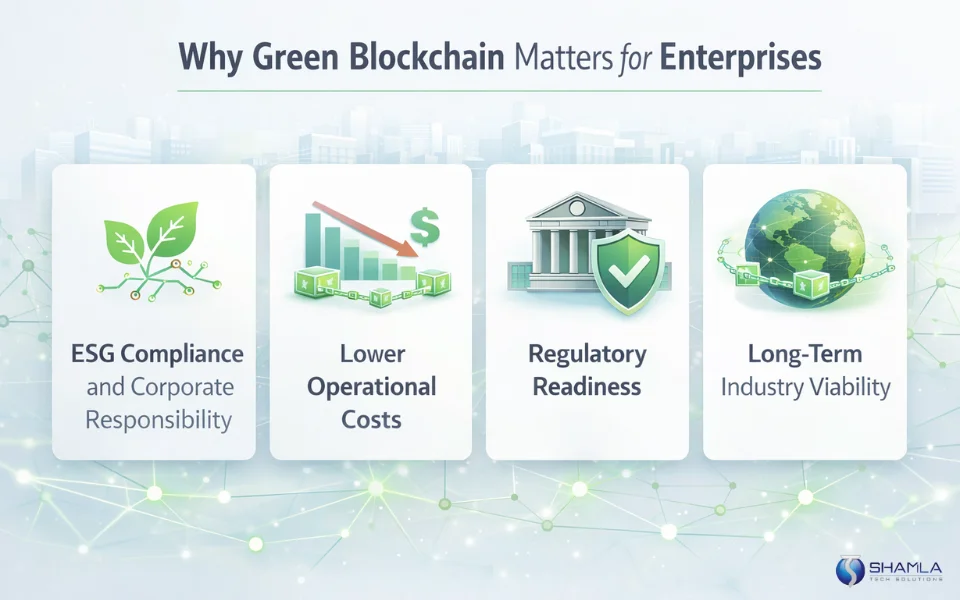
Why Green Blockchain Matters for Enterprises
For B2B organizations exploring blockchain integration, sustainability is becoming a key factor in technology selection. Green crypto networks provide several advantages:

1. ESG Compliance and Corporate Responsibility

Organizations across industries are under pressure to meet ESG commitments. Adopting sustainable blockchain solutions allows companies to align digital transformation with environmental responsibility.

Businesses that leverage green blockchain technology can demonstrate commitment to sustainability, improving their corporate reputation and investor appeal.

2. Lower Operational Costs

Energy-efficient blockchain networks consume far less electricity than traditional mining-based systems. Reduced energy demand translates to lower infrastructure costs and improved scalability for enterprise applications.

3. Regulatory Readiness

Governments and regulatory bodies are increasingly evaluating the environmental impact of digital technologies. Sustainable blockchain networks position businesses ahead of future compliance requirements.

4. Long-Term Industry Viability

The future of blockchain depends on its ability to scale sustainably. Green crypto networks are designed to support long-term adoption without excessive environmental impact.
Read More About – Future of Crypto Coin Development – Top 5 Crypto Predictions in 2026

Technologies Driving Sustainable Blockchain

Several technological innovations are powering the rise of green energy crypto coins.
Proof-of-Stake (PoS)
Proof-of-Stake is the most widely adopted energy-efficient consensus mechanism. Instead of mining, validators lock tokens as collateral to secure the network. This process reduces energy consumption dramatically while maintaining security.
Renewable Energy Mining
Some blockchain networks integrate renewable energy sources like solar, wind, and hydroelectric power into their infrastructure. This approach ensures that blockchain operations are powered by clean energy.
Alternative Consensus Models

Innovative consensus models such as Proof-of-Space, DAG-based networks, and hybrid validation mechanisms further reduce the environmental footprint of blockchain ecosystems.

These technologies are enabling blockchain networks that are both scalable and environmentally responsible.

Examples of Green Energy Crypto Coins

Several cryptocurrency projects are leading the shift toward sustainable blockchain infrastructure.
Cardano (ADA)
Cardano (ADA)
Cardano, energy-efficient crypto coins, uses the Ouroboros Proof-of-Stake protocol, one of the first peer-reviewed blockchain consensus systems designed for energy efficiency. This design significantly reduces power consumption while maintaining strong security.
Algorand (ALGO)
Algorand has positioned itself as a carbon-negative blockchain, meaning it offsets more carbon than it emits. Its Pure Proof-of-Stake mechanism consumes extremely low energy per transaction.
Tezos (XTZ)
Tezos is known for its self-amending blockchain architecture and energy-efficient PoS system. Its ability to upgrade without hard forks helps maintain network efficiency and sustainability.
Stellar (XLM)
Stellar (XLM)
Stellar focuses on fast and efficient transactions using minimal energy. The network is widely used for cross-border payments and financial infrastructure.
IOTA
IOTA

IOTA utilizes a Directed Acyclic Graph (DAG) structure rather than traditional blocks, enabling near-zero transaction fees and significantly low-energy cryptocurrency mining.

These projects demonstrate how blockchain innovation can support sustainability without sacrificing performance.

Learn About – The Role of a Cryptocurrency Coin in DeFi and Web3 Ecosystems

Real-World Applications of Green Blockchain
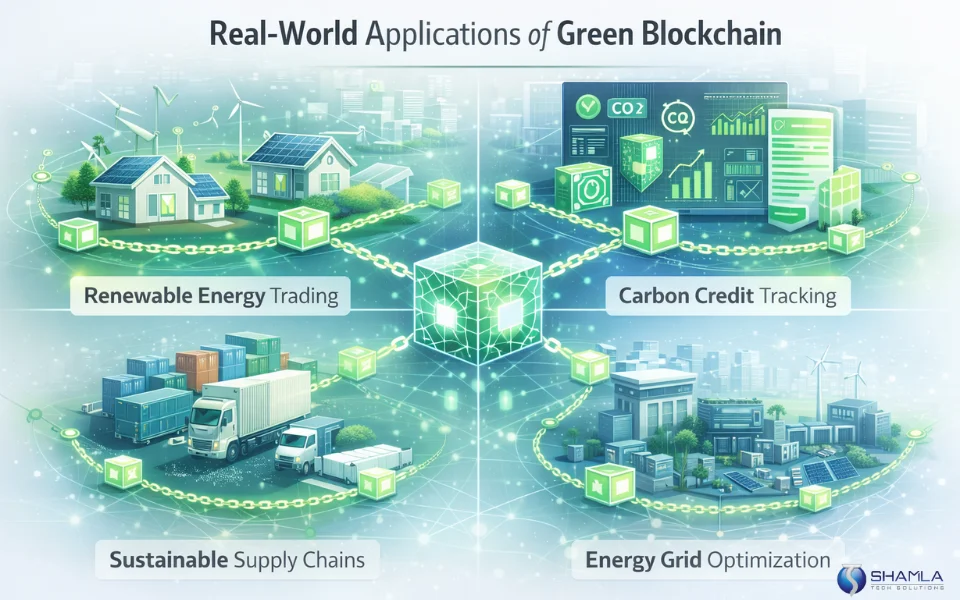
Green blockchain technology is already being applied in several industries.
Renewable Energy Trading
Blockchain enables peer-to-peer energy trading where households can sell excess solar energy directly to others. Smart contracts automate these transactions securely.
Carbon Credit Tracking
Blockchain platforms are being used to verify and track carbon credits, ensuring transparency in carbon offset markets.
Sustainable Supply Chains
Enterprises are using blockchain to verify environmentally responsible sourcing and production processes.
Energy Grid Optimization

Blockchain can help manage energy distribution by improving coordination between renewable energy producers and consumers.

Research shows blockchain can facilitate transparent peer-to-peer energy trading and efficient supply-demand management within energy markets.

Investment Trends in Green Crypto

Sustainable cryptocurrencies are gaining attention from institutional investors and ESG-focused funds. As climate awareness increases, investors are seeking digital assets that align with sustainability goals.

Many green blockchain projects also support decentralized finance (DeFi), NFT ecosystems, and Web3 infrastructure, expanding their eco-friendly cryptocurrency potential.

Green crypto assets also help diversify investment portfolios while aligning with responsible investment strategies.

For B2B investors and venture funds, sustainable blockchain projects represent an emerging growth sector.

Challenges Facing Green Cryptocurrencies

Despite the benefits, green crypto networks still face several challenges:

Security concerns: Some critics argue that Proof-of-Stake networks may be less secure than Proof-of-Work systems.

Centralization risks: Large token holders could potentially influence network validation.

Market education: Many businesses still associate cryptocurrency with high energy consumption, even though new technologies have improved efficiency.

Addressing these challenges will be crucial for broader enterprise adoption. Read the, Trusted Crypto Coin Development Services to Transform Your Blockchain Vision to know about the importance of choosing the crypto coin launch service provider.

The Future of Sustainable Blockchain

The next phase of blockchain development will likely focus on energy efficiency, scalability, and environmental sustainability.

Experts expect several key trends:

  • Increased adoption of PoS and alternative consensus mechanisms
  • Integration of renewable energy with blockchain infrastructure
  • Expansion of tokenized energy markets
  • Carbon-neutral blockchain ecosystems

Some nations are already exploring green cryptocurrency mining using renewable energy sources such as hydropower to support sustainable digital economies.

As these innovations continue, green blockchain could become the standard rather than the exception.

Why Businesses Should Explore Green Crypto Now

For enterprises evaluating blockchain adoption, sustainability is becoming a competitive differentiator.

Green blockchain technologies offer:

  • Lower energy costs
  • ESG-aligned innovation
  • Regulatory readiness
  • Scalable Web3 infrastructure

Organizations that integrate sustainable blockchain solutions today will be better positioned for the digital economy of tomorrow.

Why Choose Shamlatech for Green Energy Crypto Coin Development?

Building a green energy cryptocurrency requires more than just blockchain expertise—it requires a deep understanding of sustainability, energy-efficient consensus mechanisms, and scalable digital infrastructure. Shamlatech has established itself as a trusted blockchain development company that helps businesses create eco-friendly crypto solutions aligned with modern sustainability goals.

1. Expertise in Energy-Efficient Blockchain Protocols

Shamlatech, a leading cryptocurrency coin development company, specializes in developing cryptocurrencies using energy-efficient consensus mechanisms such as Proof-of-Stake (PoS), Delegated Proof-of-Stake, and other low-energy blockchain models. These technologies significantly reduce the environmental impact compared to traditional mining-based systems.

2. Customized Green Crypto Solutions

Every business has unique goals when launching a cryptocurrency. Shamlatech offers custom crypto coin development services tailored for green energy projects, carbon credit ecosystems, renewable energy trading platforms, and sustainable finance initiatives.

3. Advanced Blockchain Development Team

Shamlatech’s team of blockchain architects, smart contract developers, and security experts ensures that green crypto projects are built with secure, scalable, and future-ready infrastructure. Their development approach focuses on performance, reliability, and compliance with global blockchain standards.</spa

4. Integration with Renewable Energy Ecosystems

Shamlatech supports blockchain solutions that integrate with renewable energy platforms, enabling businesses to build decentralized systems for energy trading, carbon tracking, and sustainable asset tokenization.

5. End-to-End Crypto Development Services

From ideation and token design to smart contract deployment, wallet integration, and exchange listing support, Shamlatech provides complete crypto coin development services. This end-to-end support helps businesses launch eco-friendly crypto projects efficiently.

Final Thoughts

Green energy crypto coins represent a major shift in the evolution of blockchain technology. By combining energy-efficient protocols, renewable energy integration, and sustainable digital infrastructure, these projects are redefining how cryptocurrency interacts with the environment.

For B2B organizations, sustainable blockchain is more than an environmental initiative—it is a strategic investment in the future of digital infrastructure.

As enterprises continue to explore Web3 technologies, green crypto will likely play a critical role in building a carbon-neutral digital economy.


FAQs

1. What are green energy crypto coins?
Green energy crypto coins are cryptocurrencies built on energy-efficient blockchain networks that reduce electricity consumption and environmental impact. They often use consensus mechanisms like Proof-of-Stake instead of energy-intensive mining.
2. How do green cryptocurrencies support sustainability?
Green cryptocurrencies minimize energy usage, support renewable energy initiatives, and enable transparent carbon credit tracking through blockchain technology.
3. Which industries can benefit from green crypto coin development?
Industries such as renewable energy, carbon credit trading, sustainable finance, supply chain management, and decentralized energy markets can benefit from green crypto solutions.
4. What technologies are used in green crypto coin development?
Green crypto projects often use technologies like Proof-of-Stake consensus, smart contracts, decentralized identity systems, and renewable energy integrations to maintain sustainability.

Talk to Our Experts

Recent Posts