

Invoice settlement remains one of the least questioned inefficiencies in corporate finance, despite its direct impact on liquidity, supplier relationships, and working capital planning. Stablecoin invoicing is beginning to attract CFO attention as a practical instrument for settlement precision.
By 2026, B2B cross-border payment volumes are projected to surpass $56 trillion, reinforcing the need for invoicing infrastructure that reduces settlement delays, correspondent banking friction, and reconciliation complexity, which is driving enterprise interest in stablecoin-based invoicing frameworks.
In this article, we present the strategic case for stablecoin invoicing for businesses, examining how it supports payment infrastructure modernization, treasury efficiency, cross-border settlement execution, reconciliation accuracy, and the institutional governance frameworks required for secure enterprise deployment.
Modernize Cross-Border Invoicing With Stablecoin Infrastructure
Why Stablecoin Invoicing for Businesses Is Gaining CFO Attention in 2026
Why Stablecoin Invoicing for Businesses Is Entering CFO Strategic Discussions:
- Stablecoin invoicing introduces settlement continuity beyond banking windows, enabling treasury teams to execute invoice payments across jurisdictions without dependency on intermediary cut-off schedules, improving liquidity planning where supplier obligations and receivable timing directly influence working capital decisions.
- Visa’s own on-chain analytics indicate adjusted stablecoin transaction volume exceeded $10 trillion over the last twelve months, signaling meaningful institutional payment utility and validating why finance leaders are evaluating stablecoin-based settlement frameworks for enterprise invoicing infrastructure.
- Enterprise finance teams managing multinational vendor ecosystems benefit from deterministic settlement records, where invoice execution, transfer confirmation, and payment traceability exist within a single programmable ledger environment, reducing reconciliation workload across fragmented banking channels and disconnected payment reporting systems.
- Stablecoin invoicing creates optionality in treasury architecture by enabling businesses to separate invoice settlement execution from legacy correspondent banking dependencies, which becomes strategically relevant for firms operating in regions where payment routing inefficiencies introduce measurable operational and financial friction.
- CFO decision-making increasingly prioritizes infrastructure that improves financial control rather than simply lowering transaction costs, making stablecoin invoicing relevant because it supports programmable payment rules, settlement transparency, and stronger oversight across enterprise accounts payable and cross-border disbursement operations.
The Hidden Costs of Traditional Cross-Border Business Invoicing
Cross-border invoicing inefficiencies rarely appear as a single line-item expense, yet they materially affect enterprise cash positioning, payment predictability, and operational throughput. For CFOs managing international payment flows, hidden settlement friction creates measurable financial drag across treasury and accounts payable functions.
Cost Factor | Typical Business Impact |
Cross-Border Transaction Fees | 3% to 7% per transaction depending on payment corridors and intermediaries |
FX Conversion Markups | 1% to 3% above mid-market exchange rates |
Settlement Delays | 2 to 5 business days, extending working capital lockup |
Payment Investigation / Exception Handling | $25 to $100+ per payment inquiry depending on banking counterparties |
Manual Reconciliation Overhead | Finance teams spend 30% to 50% more time resolving fragmented payment records |
Failed / Returned Payments | Reprocessing costs, supplier disruption, and delayed revenue recognition |
Cross-Border Transaction Fees
FX Conversion Markups
Settlement Delays
Payment Investigation and Exception Handling
Manual Reconciliation Overhead
Failed or Returned Payments
How Stablecoin Invoicing for Businesses Improves Speed, Settlement, and Cash Flow Visibility
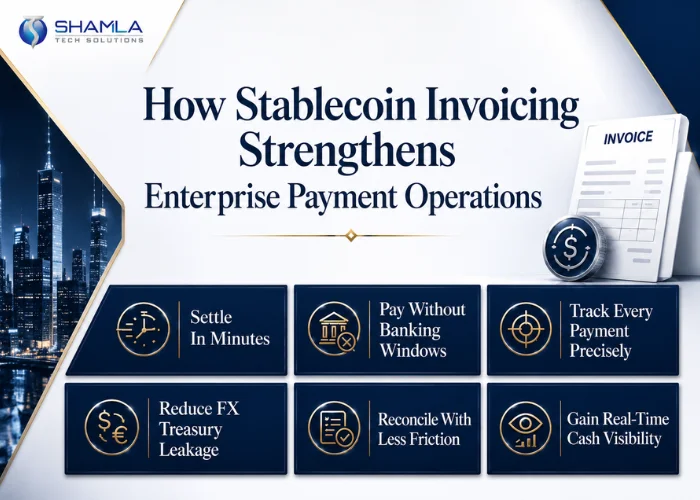
1. Near-Instant Settlement Execution
2. Continuous Payment Infrastructure Availability
3. Deterministic Payment Traceability
4. Improved Multi-Currency Treasury Efficiency
5. Streamlined Reconciliation and Financial Reporting
6. Stronger Cash Flow Visibility and Forecasting Control
Strengthen Global Invoice Payments With Stablecoin Infrastructure
Key Risks CFOs Must Evaluate Before Adopting Stablecoin Invoicing
1. Regulatory Exposure Across Jurisdictions
2. Stablecoin Counterparty and Reserve Risk
3. ERP and Treasury Integration Complexity
4. Operational Control and Internal Governance
5. Liquidity Conversion and Treasury Exit Planning
Final Thoughts
Payment infrastructure decisions increasingly sit within the CFO’s strategic mandate, particularly where settlement inefficiencies directly affect liquidity control, treasury precision, and supplier economics. Stablecoin invoicing deserves evaluation as a financial operations decision shaped by execution discipline, governance readiness, and enterprise infrastructure fit.
For businesses seeking greater control over cross-border invoice execution, the conversation is shifting toward infrastructure that delivers measurable financial utility. Enterprises that operationalize stablecoin invoicing with institutional safeguards may position treasury functions with stronger settlement agility, visibility, and commercial responsiveness.
Build Stablecoin Invoicing Solutions for Businesses with Shamla Tech Solutions
Shamla Tech Solutions helps businesses build stablecoin invoicing solutions that strengthen cross-border payment execution, treasury visibility, and settlement efficiency. We design platforms with multi-currency payment workflows, automation capabilities, reconciliation alignment, and institutional-grade controls tailored for enterprise finance operations.
With deep expertise in blockchain payment infrastructure, we deliver stablecoin invoicing platforms built for global jurisdiction readiness, compliance-aware architecture, secure wallet infrastructure, ERP integration, and treasury governance. We help businesses deploy scalable payment systems aligned with international financial operations and enterprise control requirements.