



Small and medium-sized enterprises are expanding beyond conventional funding channels to unlock capital from business-owned assets. Commercial property tokenization enables SMEs to transform real estate holdings into digital investment opportunities, creating new pathways for fundraising, liquidity management, and long-term business growth.
Industry forecasts suggest tokenized real estate could represent a market worth up to $1.5 trillion by 2030, highlighting growing institutional and investor interest in digitally managed property ownership structures. This momentum is increasing demand for secure, compliant, and scalable real estate tokenization platforms.
This article explains commercial property tokenization, its role in SME financing strategies, the advantages it offers over conventional capital-raising methods, and the practical use cases driving adoption across commercial real estate markets.
Transform Property Holdings Into Investment Opportunities
What Is Commercial Property Tokenization and How Does It Work?
How Commercial Property Tokenization Works:
- Real estate accounts for approximately 30% of the global asset tokenization market, making it one of the most actively tokenized asset classes. This level of adoption reflects growing confidence in blockchain-based ownership structures and digital investment models.
- The process begins by placing a commercial property within a legally compliant ownership framework that defines investor rights, revenue-sharing arrangements, governance mechanisms, and transfer conditions before digital tokens are issued to qualified participants.
- Once the legal structure is established, digital tokens are created on a blockchain network, with each token representing a fractional ownership interest or economic stake tied directly to the underlying commercial real estate asset.
- Smart contracts automate critical administrative functions, including investor onboarding, compliance verification, dividend distributions, ownership transfers, and reporting requirements, reducing operational complexity while supporting efficient management throughout the investment lifecycle.
- Investors can acquire tokenized ownership interests through approved investment channels, enabling commercial property owners to attract capital from a broader investor base while maintaining transparent ownership records and streamlined stakeholder engagement processes.
Why SMEs Are Exploring Alternatives to Traditional Commercial Property Financing
For many SMEs, commercial real estate represents a significant portion of enterprise value, yet accessing capital from these assets often involves lengthy financing processes and restrictive funding structures. Business leaders are increasingly evaluating capital models that improve liquidity, expand investor access, and support strategic growth objectives.
Financing Factor | Traditional Commercial Property Financing | Commercial Property Tokenization |
Capital Access | Dependent on banks and institutional lenders | Access to a broader pool of qualified investors |
Funding Structure | Debt-based financing with repayment obligations | Equity-based capital raising through fractional ownership |
Liquidity | Property value remains largely locked until refinancing or sale | Partial ownership interests can be offered to investors |
Investor Reach | Primarily local or institutional funding sources | Global investor participation within regulatory frameworks |
Administrative Efficiency | Multiple intermediaries and manual processes | Smart contract-driven operations and digital recordkeeping |
Expanding Access to Capital
Reducing Dependence on Debt Financing
Unlocking Liquidity From Existing Assets
Reaching a Wider Investor Base
Improving Operational Efficiency
Key Benefits of Commercial Property Tokenization for Small and Medium-Sized Enterprises
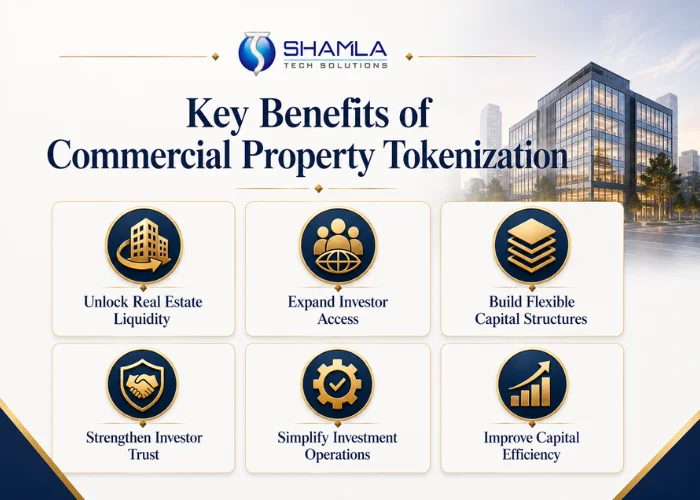
1. Transforming Illiquid Assets Into Strategic Capital
2. Accessing a Broader Investor Network
3. Strengthening Capital Structure Flexibility
4. Enhancing Transparency and Investor Confidence
5. Streamlining Administrative Operations
6. Creating Long-Term Competitive Advantage
Unlock Capital From Commercial Real Estate Assets
High-Value Commercial Real Estate Tokenization Use Cases
1. Office Buildings and Business Parks
2. Retail and Mixed-Use Developments
3. Warehousing and Logistics Facilities
4. Hospitality and Hotel Propertie
5. Healthcare and Medical Facilities
6. Industrial and Manufacturing Properties
The Future of Commercial Property Tokenization for SME Growth and Capital Access
Real Estate as a Strategic Capital Asset
Greater Flexibility in Capital Formation
Stronger Alignment Between Assets and Growth Objectives
Success Depends on Execution and Governance
Key Takeaway
Commercial property ownership is increasingly becoming a source of strategic capital rather than simply a long-term asset on the balance sheet. For SMEs seeking greater financial flexibility, tokenization introduces new opportunities to unlock value, engage investors, and support business growth objectives.
As commercial real estate financing continues to expand beyond conventional lending models, organizations must evaluate how effectively their assets contribute to broader capital strategies. Commercial property tokenization provides a framework for aligning real estate holdings with funding, liquidity, and long-term enterprise value creation goals.
Launch Commercial Property Tokenization Platforms with Shamla Tech Solutions
Shamla Tech Solutions has extensive experience developing secure, scalable, and compliance-focused commercial property tokenization platforms for businesses worldwide. We help organizations transform real estate assets into digital investment opportunities through robust blockchain infrastructure, smart contract development, and investor management capabilities.
Our team delivers end-to-end commercial property tokenization solutions customized to your business and regulatory requirements. From asset tokenization architecture and ownership management to compliance workflows and investor onboarding, we build platforms designed to support capital formation, operational efficiency, and long-term growth objectives.