



Home » Others » Real Estate Tokenization Regulations in Switzerland: What Businesses Need to Know Before Launching RWA Platforms

Real Estate Tokenization Regulations in Switzerland: What Businesses Need to Know Before Launching RWA Platforms

Share this article:
real estate tokenization regulations in Switzerland
Table of Contents
About the Author
Balaji
CEO of Shamla Tech, specializes in crypto exchange development, RWA tokenization, blockchain infrastructure, AI solutions, and compliance-ready platforms. He helps enterprises address regulatory, security, and scalability challenges while driving real-world adoption of emerging technologies across industries.
Connect On:

Switzerland entered 2026 as one of the most established jurisdictions for digital assets, supported by a mature regulatory framework and strong institutional participation. For businesses planning to launch real-world asset (RWA) platforms, understanding the legal requirements surrounding tokenized real estate has become a fundamental part of market entry and long-term operations.

At the start of 2026, the combined valuation of leading blockchain and cryptocurrency companies in Switzerland and Liechtenstein exceeded CHF 465 billion, reflecting the country’s growing role in digital asset innovation and tokenized investments. This momentum has increased demand for compliant real estate tokenization platforms capable of supporting asset issuance, investor management, and regulated ownership transfers.

Understanding real estate tokenization regulations in Switzerland is essential before launching an RWA platform. Regulatory obligations influence token structures, securities classification, investor protection requirements, and operational compliance standards. In this article, we explain Switzerland’s legal framework for real estate tokenization, FINMA requirements, token classifications, and the key regulatory considerations businesses must address before entering the market.

Build Secure Tokenized Property Investment Solutions in Switzerland

Switzerland's Legal Framework for Real Estate Tokenization and RWAs

Switzerland’s approach to tokenization is built on legal recognition rather than regulatory experimentation. For businesses launching real estate RWA platforms, the country’s framework provides defined pathways for issuing, trading, and managing tokenized assets within existing financial market laws. The result is a structure that supports institutional participation, legal enforceability, and long-term market confidence.

Key Elements of Switzerland's RWA Tokenization Framework:

  • Switzerland’s DLT Act introduced legally recognized ledger-based securities, enabling ownership rights and investment interests to be issued, transferred, and recorded on blockchain infrastructure with legal validity under Swiss law. This creates a stronger foundation for real estate tokenization platforms seeking enforceable investor rights.

  • The legal framework integrates tokenized assets into existing financial market regulations rather than creating a separate regime. For platform operators, this reduces regulatory ambiguity and allows tokenized real estate offerings to be structured using established securities and financial services principles.

  • Switzerland has expanded regulated market infrastructure for digital assets through the DLT trading facility framework. In March 2025, FINMA licensed the country’s first DLT trading facility, creating a regulated environment for the trading and settlement of tokenized securities.

  • The framework supports end-to-end tokenization ecosystems covering issuance, custody, trading, settlement, and investor access. This allows businesses to design real estate tokenization platforms that address the full asset lifecycle instead of operating as standalone issuance portals.

  • Switzerland’s regulatory certainty continues to attract institutional capital and blockchain innovation. At the start of 2026, the leading blockchain and digital asset companies in Switzerland and Liechtenstein collectively represented more than CHF 465 billion in value, reinforcing the country’s position as a preferred jurisdiction for tokenized asset initiatives.

FINMA Compliance Requirements for Real Estate Tokenization Platforms
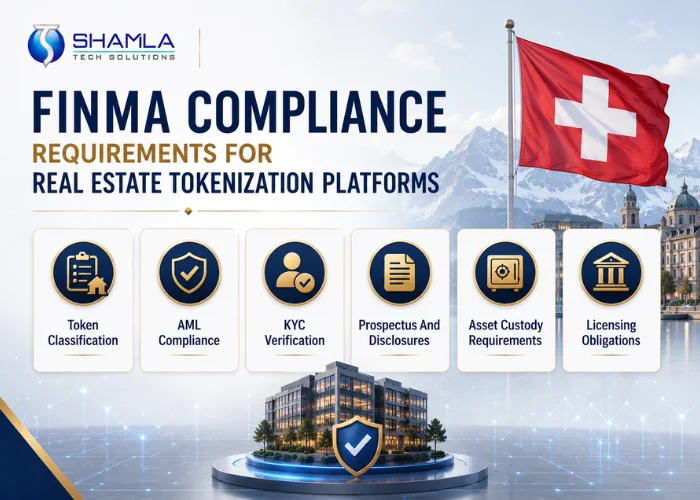
FINMA Compliance Requirements for Real Estate Tokenization Platforms

1. Token Classification and Regulatory Assessment

FINMA requires businesses to determine how their real estate tokens will be classified before launch. Most tokenized real estate offerings fall within the asset token category because they represent ownership rights, revenue participation, or economic interests in underlying properties. This classification influences the applicable securities regulations, disclosure requirements, investor onboarding processes, and compliance obligations throughout the platform lifecycle.

2. Anti-Money Laundering Compliance

Real estate tokenization platforms must implement robust anti-money laundering controls in accordance with Swiss AML regulations. This includes verifying investor identities, monitoring transactions, maintaining audit trails, and reporting suspicious activities when required. Businesses facilitating token purchases, transfers, or custody services must establish compliance procedures that align with FINMA expectations and ongoing financial crime prevention requirements.

3. Know Your Customer Verification

Investor onboarding processes must include comprehensive Know Your Customer (KYC) verification measures. FINMA expects platforms to collect and validate investor identification data before granting access to tokenized real estate investments. Effective KYC frameworks help establish investor eligibility, reduce fraud risks, support regulatory reporting requirements, and strengthen overall platform credibility among institutional and retail participants.

4. Securities Prospectus And Disclosure Obligations

Tokenized real estate offerings may trigger prospectus and disclosure requirements depending on the structure, investor base, and fundraising model. Businesses must evaluate whether offering documentation is required under applicable Swiss regulations. Transparent disclosures regarding property ownership structures, investor rights, risks, governance mechanisms, and revenue distribution models are essential for regulatory compliance and investor confidence.

5. Custody And Asset Safeguarding Requirements

Platforms offering custody services for tokenized assets must ensure secure storage, access controls, and operational safeguards. FINMA places significant emphasis on protecting investor assets from unauthorized access, operational failures, and cybersecurity threats. Businesses should establish custody frameworks that support asset security, transaction integrity, recovery procedures, and compliance with applicable financial market regulations.

6. Licensing And Financial Services Obligations

The activities performed by a real estate tokenization platform determine whether licensing requirements apply. Businesses involved in brokerage, trading, custody, payment processing, or other regulated financial services must assess their obligations under Swiss law. Early regulatory assessments help organizations identify licensing needs, structure operations appropriately, and avoid compliance challenges after platform deployment.

Token Classification, Securities Laws, and Investor Protection Rules in Switzerland

Switzerland’s regulatory framework evaluates tokenized real estate offerings through multiple compliance considerations, including token classification, securities treatment, investor eligibility requirements, and investor protection measures. For businesses launching RWA platforms, understanding these regulatory areas is essential for creating legally compliant token structures, attracting investors, and supporting long-term platform growth.

Regulatory Focus

Regulatory Scope

Business Impact

Asset Token Classification

FINMA token categorization and regulatory treatment

Determines applicable compliance obligations

Ledger-Based Securities

Recognition of blockchain-based ownership records

Establishes legal validity of digital ownership

Prospectus Requirements

Disclosure and offering documentation obligations

Impacts fundraising and investor communications

Investor Eligibility

Investor onboarding and access controls

Defines target investor groups

Ownership Rights

Legal rights attached to tokenized assets

Protects investor claims and entitlements

Secondary Trading Compliance

Trading, transfer, and marketplace requirements

Enables compliant liquidity mechanisms

Asset Token Classification

FINMA’s token classification framework determines how a real estate token is regulated throughout its lifecycle. Since most tokenized real estate offerings represent ownership interests or economic claims, they typically fall under the asset token category. This classification influences securities treatment, disclosure obligations, investor protections, and platform compliance requirements from issuance through secondary market activities.

Ledger-Based Securities

Swiss law recognizes ledger-based securities, allowing ownership rights to exist directly on distributed ledger infrastructure. This legal recognition enables tokenized real estate assets to maintain enforceable ownership records without relying on traditional certificate-based systems. For platform operators, ledger-based securities create a legally recognized framework for issuance, transfer, and ownership management.

Prospectus Requirements

Real estate token offerings may require formal prospectus documentation depending on the structure of the offering and the investors being targeted. Regulatory assessments typically evaluate fundraising activities, investor access, and the rights attached to the token. Comprehensive disclosures help investors understand ownership structures, associated risks, governance frameworks, and economic participation mechanisms.

Investor Eligibility

Investor eligibility requirements determine who can participate in a tokenized real estate offering. Platform operators must establish onboarding procedures capable of verifying investor classifications and maintaining compliance throughout the investment lifecycle. These controls influence distribution strategies, onboarding workflows, access permissions, and the overall design of the investment platform.

Ownership Rights

Investor confidence depends heavily on the legal rights attached to a tokenized asset. Businesses must clearly define ownership structures, entitlement rights, governance participation, profit distribution mechanisms, and asset-backed claims. Strong legal structuring ensures that token holders understand exactly what they own and how those rights can be exercised.

Secondary Trading Compliance

Secondary trading compliance governs how tokenized real estate assets can be transferred after issuance. Platform operators must consider investor verification requirements, transfer restrictions, transaction monitoring obligations, and marketplace controls. A compliant secondary market framework supports liquidity objectives while ensuring that asset transfers remain aligned with Swiss financial market regulations.

Develop Swiss-Compliant Real Estate Tokenization Platforms

AML, KYC, and Licensing Obligations for Swiss Real Estate Tokenization Businesses

Swiss real estate tokenization platforms must align their operational architecture with the country’s financial market regulations. AML obligations, investor verification requirements, and licensing assessments influence how investors are onboarded, how token transactions are managed, and how platform services are structured under the supervision of Swiss regulatory authorities.

AMLA Compliance Requirements

The Swiss Anti-Money Laundering Act (AMLA) forms the foundation of compliance obligations for many tokenization businesses. Platforms facilitating investor subscriptions, payment processing, asset transfers, or custody-related activities must assess whether they qualify as financial intermediaries. This assessment determines the AML controls, reporting procedures, and compliance infrastructure required before commercial operations begin.

FINMA-Compliant Investor Verification

FINMA expects regulated businesses to establish robust investor identification procedures before granting access to investment products. Real estate tokenization platforms should incorporate identity verification, sanctions screening, politically exposed person (PEP) checks, and ongoing customer due diligence measures. These controls help ensure that investor onboarding processes align with Swiss regulatory expectations and financial crime prevention standards.

Ultimate Beneficial Owner (UBO) Identification

Swiss compliance requirements extend beyond verifying the direct investor. Where investments are made through companies, foundations, trusts, or nominee structures, platforms must identify the ultimate beneficial owner controlling the investment. Capturing and maintaining UBO information strengthens transparency, supports AML compliance obligations, and reduces risks associated with complex ownership structures.

Recordkeeping And Audit Trail Management

Swiss financial regulations require businesses to maintain accurate records relating to investor onboarding, transaction activity, compliance checks, and ownership changes. Real estate tokenization platforms should implement systems capable of preserving immutable transaction histories, investor documentation, and compliance records. Strong audit trails simplify regulatory reviews and support long-term operational governance.

Licensing Assessments Under Swiss Financial Market Laws

Licensing obligations depend on the specific services offered by the platform. Activities involving securities trading, digital asset custody, brokerage functions, collective investment structures, or payment services may fall within existing Swiss financial market regulations. A comprehensive legal assessment helps businesses determine whether regulatory approvals or specific authorizations are required before launch.

Cross-Border Investor Compliance Controls

Many Swiss RWA tokenization platforms target investors across Europe, the Middle East, and Asia. As a result, onboarding frameworks should account for jurisdiction-specific investor restrictions, sanctions requirements, disclosure obligations, and marketing rules. Building these controls into the platform architecture supports international fundraising efforts while maintaining compliance with Swiss regulatory standards.

Key Regulatory Considerations Before Launching a Real Estate Tokenization Platform in Switzerland

Launching a real estate tokenization platform in Switzerland requires careful alignment between legal structuring, platform architecture, investor onboarding, and regulatory compliance. Businesses should evaluate regulatory requirements early in the development process to reduce operational risks, support investor confidence, and establish a scalable foundation for long-term growth.

Essential Swiss Compliance Requirements Before RWA Platform Launch:

  • Determine whether the tokenized asset qualifies as an asset token, ledger-based security, or another regulated financial instrument under Swiss law.


  • Establish a legally enforceable ownership structure that clearly defines investor rights, revenue entitlements, governance mechanisms, and asset-backed claims.


  • Evaluate whether the proposed offering triggers prospectus requirements, disclosure obligations, or additional securities-related compliance requirements.


  • Design AML and KYC workflows that align with Swiss AMLA requirements and FINMA expectations for investor verification and due diligence.


  • Assess whether platform activities such as custody, trading, brokerage, or payment processing require regulatory approvals or licensing.


  • Implement compliant token standards and smart contract controls that support investor whitelisting, transfer restrictions, and regulatory enforcement mechanisms.


  • Develop transaction monitoring, recordkeeping, and audit trail capabilities that support ongoing compliance and regulatory reporting obligations.


  • Build cross-border compliance controls for international investors, including jurisdiction-specific restrictions, sanctions screening, and disclosure management requirements.

Partnering with an experienced real estate tokenization platform development company can help businesses address these regulatory requirements from the outset. By aligning legal structures, compliance workflows, token standards, and platform architecture with Swiss regulations, organizations can reduce compliance risks, streamline implementation, and establish a strong foundation for regulated real estate tokenization initiatives.

Key Takeaway

Switzerland offers one of the most established regulatory environments for real estate tokenization, supported by legal recognition of ledger-based securities and clear guidance from FINMA. This regulatory foundation provides businesses with greater certainty when structuring tokenized real estate offerings and developing institutional-grade RWA platforms.

Organizations planning to enter the Swiss market should approach compliance, platform architecture, investor onboarding, and token design as interconnected requirements. Working with an experienced real estate tokenization platform development company helps ensure alignment with FINMA expectations, Swiss financial market regulations, and the operational requirements needed to support long-term growth.

Launch FINMA-Compliant Real Estate Tokenization Platforms with Shamla Tech Solutions

Shamla Tech Solutions helps businesses build FINMA-compliant real estate tokenization platforms designed for the Swiss market. Our development services cover asset tokenization, investor onboarding, smart contract development, compliance workflows, digital asset management, and platform infrastructure required to support regulated real estate investment opportunities.

With extensive expertise in real-world asset tokenization and security token development, we help organizations align platform architecture with Swiss regulatory requirements from the outset. From ERC-3643 token implementation and investor whitelisting to compliance automation, custody integrations, and secondary trading capabilities, we deliver scalable real estate tokenization platforms built for institutional participation and long-term market growth.
Launch FINMA-Compliant Real Estate Investment Platforms

FAQs

What are real estate tokenization regulations in Switzerland?

Real estate tokenization regulations in Switzerland are governed by existing financial market laws, FINMA guidance, and the DLT framework. These regulations influence token classification, investor protection requirements, securities compliance, ownership structures, and platform operations.

Does FINMA regulate real estate tokenization platforms?

FINMA oversees regulated financial activities associated with real estate tokenization platforms. Depending on the platform’s services, businesses may need to address requirements related to securities offerings, AML compliance, custody services, trading activities, and investor onboarding.

What token standard is commonly used for real estate tokenization?

ERC-3643 is widely used for regulated real estate tokenization because it supports investor whitelisting, identity verification, transfer restrictions, and compliance automation. These features help platform operators maintain regulatory controls throughout the asset lifecycle.

Do Swiss real estate tokenization platforms require KYC and AML compliance?

Yes. Swiss real estate tokenization platforms must implement KYC and AML procedures when regulatory requirements apply. These measures typically include investor identity verification, sanctions screening, beneficial ownership checks, transaction monitoring, and recordkeeping obligations.

Why choose Switzerland for real estate tokenization platform development?

Switzerland offers legal recognition of ledger-based securities, regulatory clarity, and a mature digital asset ecosystem. These advantages make it an attractive jurisdiction for businesses seeking to launch compliant real estate tokenization platforms and attract institutional investors.

Talk to Our Experts

Recent Posts