


Home » Artificial Intelligence » What is an AI Intelligent Agent and How Do These Agents Work Autonomously?

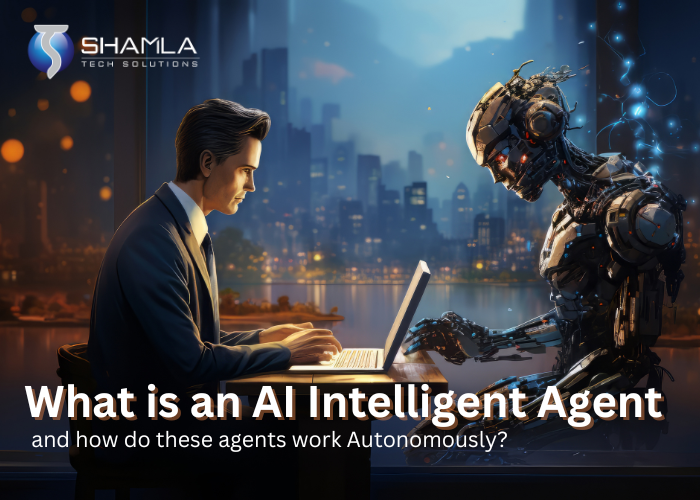
What is an AI Intelligent Agent and How Do These Agents Work Autonomously?

Share this article:
AI Intelligent Agent
Table of Contents
About the Author
Balaji
CEO of Shamla Tech, specializes in crypto exchange development, RWA tokenization, blockchain infrastructure, AI solutions, and compliance-ready platforms. He helps enterprises address regulatory, security, and scalability challenges while driving real-world adoption of emerging technologies across industries.
Connect On:

Usually shortened to AI, artificial intelligence is a remarkable area of information technology that permeates many spheres of modern life. Though it may appear complicated, and indeed, it is, by separating its elements, we can become more accustomed and comfortable with artificial intelligence. Understanding and using the components better depends on knowing how they fit together.

Today we are therefore addressing the intelligent Agent in artificial intelligence. Intelligent agents in artificial intelligence, AI agent functions and structure, and the quantity and varieties of agents in AI are defined in this paper.

Let us define in AI an intelligent agent as follows.

What Is an AI Agent?

This exactly matches the primary search intent while allowing you to naturally include the secondary keyword, “intelligent agents in AI,” within the content.

Here’s an optimized introduction:

An AI agent is an intelligent software system that can perceive information, reason, make decisions, and take actions autonomously to achieve specific goals. Unlike traditional software that simply follows predefined instructions, intelligent agents in AI analyze data, adapt to changing conditions, learn from interactions, and use technologies such as large language models (LLMs), machine learning, memory, and external tools to solve complex tasks with minimal human intervention.

AI agents can interact with users, access enterprise systems, retrieve information, execute workflows, and continuously improve their performance based on feedback. These capabilities make them valuable across industries, where they automate repetitive tasks, support decision-making, enhance customer experiences, and increase operational efficiency.

How Do AI Agents Work?

AI agents work by following a continuous cycle of perceiving, reasoning, planning, acting, and learning. They gather information from users, databases, APIs, sensors, or enterprise systems, analyze that data using artificial intelligence models, determine the best course of action, and execute tasks autonomously. As they receive feedback or encounter new information, AI agents refine their decisions and improve future performance.

The autonomous workflow of an AI agent typically includes:

  • Perception: Collects data from user inputs, documents, applications, APIs, sensors, or external environments.
  • Reasoning: Processes the information using large language models (LLMs), machine learning algorithms, or predefined business rules to understand context and evaluate options.
  • Planning: Breaks complex objectives into smaller tasks, prioritizes actions, and determines the most efficient execution path.
  • Action: Performs tasks by interacting with software applications, databases, enterprise systems, APIs, or other AI agents without constant human intervention.
  • Learning and Optimization: Evaluates outcomes, incorporates feedback, updates memory, and continuously improves decision-making and task execution over time.

This autonomous decision-making cycle enables AI agents to handle customer support, automate workflows, analyze data, generate content, monitor systems, and solve complex business problems with minimal human supervision.

Key Components of an AI Agent Architecture

An AI agent is built on a modular architecture that enables it to perceive information, reason through problems, make decisions, and execute tasks autonomously. While the architecture may vary depending on the use case, most AI agents share five essential components that work together to deliver intelligent automation.

1. Foundation Model (AI Brain)

The foundation model serves as the core intelligence of an AI agent. Typically powered by large language models (LLMs), machine learning models, or multimodal AI, it interprets inputs, understands context, generates responses, and performs reasoning. This component allows the agent to process natural language, analyze data, and make informed decisions instead of simply following predefined rules.

2. Planning and Reasoning Module

The planning module enables AI agents to break down complex goals into smaller, manageable tasks. It evaluates multiple approaches, prioritizes actions, creates execution plans, and adjusts strategies when conditions change. Advanced AI agents can reason through multi-step problems, making them suitable for business process automation, software development, financial analysis, and customer service.

3. Memory Module

Memory allows an AI agent to retain relevant information across interactions. Short-term memory helps maintain context during a conversation or workflow, while long-term memory stores historical data, user preferences, previous decisions, and organizational knowledge. This enables AI agents to deliver more personalized, consistent, and context-aware responses over time.

4. Tool Integration Layer

AI agents become significantly more capable when they can interact with external tools and systems. Through APIs, databases, enterprise applications, cloud platforms, CRM systems, ERP software, search engines, and third-party services, they can retrieve real-time information, execute workflows, generate reports, update records, and automate business operations without manual intervention.

5. Learning and Reflection Module

The learning module helps AI agents continuously improve their performance. By analyzing outcomes, incorporating user feedback, monitoring success rates, and identifying errors, the agent refines its decision-making process over time. Some AI agents also use reflection mechanisms to evaluate completed tasks, optimize future plans, and reduce repeated mistakes, leading to greater accuracy and efficiency.

Principles Governing AI Intelligent Agents

The effectiveness of AI intelligent agents is built on a set of core principles that enable them to operate independently, make informed decisions, and continuously improve. These principles of AI agents define how they perceive their environment, pursue objectives, interact with systems, and adapt to changing conditions.

Autonomy

Autonomy allows AI agents to perform tasks with minimal human intervention. Rather than waiting for continuous instructions, they can analyze situations, make decisions, and execute actions independently based on predefined goals, business rules, and real-time data.

Goal-Oriented Behavior

Every AI agent is designed to achieve specific objectives. It evaluates available information, prioritizes tasks, and selects the most effective actions to accomplish its goals while optimizing factors such as speed, cost, and accuracy.

Perception

AI agents must first understand their environment before taking action. They collect information from user inputs, APIs, enterprise applications, sensors, documents, databases, and other data sources to build contextual awareness and support informed decision-making.

Rational Decision-Making

Rather than acting randomly, AI agents evaluate multiple options and choose the action most likely to achieve the desired outcome. They use reasoning, machine learning, business logic, or large language models (LLMs) to make decisions based on available evidence and predefined objectives.

Proactivity

Advanced AI agents do more than react to requests, they anticipate future needs. They can identify opportunities, detect potential issues, trigger workflows, send alerts, and recommend actions before problems occur, helping organizations improve efficiency and reduce operational risks.

Continuous Learning

One of the defining characteristics of modern AI agents is their ability to improve over time. By analyzing outcomes, incorporating user feedback, learning from previous interactions, and updating their knowledge, AI agents become more accurate, efficient, and effective with continued use.

Adaptability

Business environments constantly change, and AI agents must adapt accordingly. They can adjust their strategies when new information becomes available, respond to changing customer behavior, accommodate updated business rules, and handle dynamic operating conditions without requiring complete reprogramming.

Collaboration

AI agents often work alongside humans and other software systems to accomplish complex tasks. Through integration with enterprise applications, APIs, databases, and even other AI agents, they can coordinate workflows, share information, and execute multi-step business processes more efficiently.

Types of AI Intelligent Agents

Different types of AI agents are designed to solve different problems based on their level of intelligence, decision-making capabilities, and ability to learn from experience. From simple rule-based systems to advanced autonomous agents powered by large language models (LLMs), each type serves a specific purpose in artificial intelligence.

1. Simple Reflex Agents

Simple reflex agents make decisions based solely on the current input or environment. They follow predefined rules without considering past events or future consequences, making them ideal for predictable and repetitive tasks.

Common use cases:

  • Basic chatbots
  • Automatic door systems
  • Spam filtering
  • Rule-based workflow automation

2. Model-Based Reflex Agents

Model-based reflex agents maintain an internal representation of their environment. This allows them to make better decisions by considering both current inputs and previous states, enabling them to handle more dynamic environments than simple reflex agents.

Common use cases:

  • Autonomous monitoring systems
  • Inventory management
  • Industrial automation
  • Smart home devices

3. Goal-Based Agents

Goal-based agents evaluate different actions based on whether they help achieve a defined objective. Instead of simply reacting to inputs, they plan and select the most effective path toward a specific goal.

Common use cases:

  • Route optimization
  • AI planning systems
  • Robotic process automation
  • Supply chain optimization

4. Utility-Based Agents

Utility-based agents go beyond achieving goals by selecting the option that delivers the highest overall benefit. They compare multiple possible outcomes using utility functions such as cost, speed, efficiency, or customer satisfaction.

Common use cases:

  • Financial trading
  • Recommendation engines
  • Resource allocation
  • Pricing optimization

5. Learning Agents

Learning agents continuously improve their performance by analyzing data, user feedback, and previous outcomes. They adapt to changing environments and become more accurate over time without requiring manual reprogramming.

Common use cases:

  • Fraud detection
  • Personalized recommendations
  • Predictive maintenance
  • Intelligent customer support

6. Multi-Agent Systems

Multi-agent systems consist of multiple AI agents that communicate, coordinate, and collaborate to solve complex problems. Each agent performs specialized tasks while working toward a shared objective.

Common use cases:

  • Smart manufacturing
  • Autonomous logistics
  • Traffic management
  • Distributed business automation

Comparison of the Types of AI Agents

Type of AI Agent

Decision Method

Learns Over Time

Best For

Simple Reflex Agent

Rule-based responses

No

Repetitive tasks

Model-Based Reflex Agent

Internal environment model

Limited

Dynamic environments

Goal-Based Agent

Goal-driven planning

No

Task execution and planning

Utility-Based Agent

Outcome optimization

Limited

Complex decision-making

Learning Agent

Experience and feedback

Yes

Adaptive automation

Multi-Agent System

Collaborative intelligence

Yes

Large-scale enterprise workflows

AI Agent Use Cases Across Industries

AI agents are transforming how organizations automate processes, improve decision-making, and enhance customer experiences. Modern AI agent use cases span nearly every industry, helping businesses reduce manual effort, increase productivity, and deliver intelligent, data-driven services.

Customer Service and Support

AI agents provide 24/7 customer assistance by answering questions, resolving common issues, processing requests, and escalating complex cases to human representatives. They improve response times while reducing support costs.

Healthcare

Healthcare organizations use AI agents to assist with appointment scheduling, patient triage, medical documentation, clinical decision support, and remote patient monitoring, allowing healthcare professionals to focus on patient care.

Finance and Banking

Financial institutions deploy AI agents for fraud detection, credit risk assessment, customer onboarding, investment analysis, regulatory compliance, and personalized financial recommendations.

Sales and Marketing

AI agents automate lead qualification, personalize marketing campaigns, recommend products, generate content, analyze customer behavior, and assist sales teams with prospect engagement and follow-ups.

Manufacturing

Manufacturers use AI agents to monitor production lines, predict equipment failures, optimize inventory, improve quality control, and automate maintenance scheduling for greater operational efficiency.

Retail and E-commerce

Retail businesses leverage AI agents to deliver personalized shopping experiences, manage inventory, forecast demand, automate order processing, and provide intelligent product recommendations.

Supply Chain and Logistics

AI agents optimize route planning, warehouse operations, shipment tracking, demand forecasting, supplier management, and inventory replenishment to improve supply chain efficiency.

Human Resources

HR teams use AI agents to screen resumes, schedule interviews, answer employee questions, automate onboarding, support performance management, and enhance workforce planning.

Software Development

AI agents assist developers by generating code, reviewing pull requests, identifying bugs, creating documentation, automating testing, and accelerating software delivery.

Cybersecurity

Security teams rely on AI agents to detect threats, monitor network activity, investigate suspicious behavior, automate incident response, and strengthen organizational security.

AI Agent Development: How to Build AI Agents

Building an AI agent involves more than integrating a large language model (LLM). Successful AI agent development requires careful planning, the right AI models, robust data pipelines, memory, tool integrations, and continuous optimization to create intelligent systems that can reason, act, and learn autonomously.

1. Define the Agent's Goals and Use Case

Start by identifying the business problem the AI agent will solve. Define its objectives, target users, expected outcomes, and key performance indicators (KPIs). A clear scope ensures the agent is designed with the right capabilities from the outset.

2. Choose the Right AI Models

Select the foundation model that best fits your use case. Depending on the requirements, this may include large language models (LLMs), multimodal AI models, machine learning models, or a combination of technologies to support reasoning, language understanding, and decision-making.

3. Design the Agent Architecture

Develop the core architecture by incorporating essential components such as:

  • Foundation model
  • Planning and reasoning module
  • Memory module
  • Tool and API integration layer
  • Learning and reflection mechanism

A modular architecture makes the AI agent scalable, maintainable, and adaptable to future enhancements.

4. Connect Enterprise Data and Tools

Enable the AI agent to interact with business systems through APIs, databases, CRM platforms, ERP software, cloud services, knowledge bases, and third-party applications. These integrations allow the agent to retrieve real-time information and execute tasks autonomously.

5. Develop Autonomous Workflows

Design workflows that enable the AI agent to perceive inputs, reason through problems, plan actions, execute tasks, and validate outcomes. Well-structured workflows help the agent manage both simple requests and complex, multi-step processes.

6. Test, Evaluate, and Optimize

Before deployment, evaluate the AI agent for accuracy, reliability, security, response quality, and task completion. Continuous testing helps identify errors, improve reasoning, reduce hallucinations, and enhance overall performance.

7. Deploy, Monitor, and Continuously Improve

After deployment, monitor the AI agent’s performance using analytics, user feedback, and operational metrics. Regular updates, retraining, prompt optimization, and workflow improvements ensure the agent remains accurate, secure, and effective as business needs evolve.

How to Improve the Performance of Intelligent Agents

Building an AI agent is only the first step. To maximize the value of AI agent development, organizations must continuously optimize performance, accuracy, reliability, and scalability. Well-optimized AI agents deliver better decisions, complete tasks more efficiently, and adapt to changing business requirements.

Use High-Quality Data

AI agents perform best when trained and grounded with accurate, relevant, and up-to-date data. Integrating trusted enterprise knowledge bases, structured databases, and real-time information sources helps improve response quality while reducing inaccuracies.

Strengthen Memory and Context Management

Providing both short-term and long-term memory enables AI agents to retain conversation context, recall previous interactions, and personalize responses. Effective memory management also improves multi-step reasoning and workflow execution.

Optimize Prompts and Planning

Well-designed prompts, reasoning strategies, and task-planning frameworks help AI agents break complex objectives into manageable steps. Prompt optimization and structured planning reduce errors and improve task completion rates.

Expand Tool and System Integrations

Connecting AI agents to APIs, CRM platforms, ERP systems, cloud services, databases, and business applications allows them to retrieve real-time information and automate end-to-end workflows, increasing their overall effectiveness

Implement Human-in-the-Loop Review

For high-impact decisions, incorporating human oversight improves accuracy and accountability. Human feedback also provides valuable training signals that help AI agents refine their reasoning and decision-making over time.

Monitor Performance Continuously

Track key performance indicators (KPIs) such as task completion rate, response accuracy, latency, user satisfaction, and error frequency. Continuous monitoring helps identify bottlenecks and opportunities for improvement.

Strengthen Security and Governance

Protecting sensitive data through access controls, encryption, audit logging, and compliance policies ensures AI agents operate securely while meeting regulatory requirements and organizational standards.

Enable Continuous Learning

AI agents should evolve as business needs change. Regularly updating knowledge sources, refining prompts, evaluating outcomes, and incorporating user feedback enables agents to improve their performance and remain effective over time.

Benefits of AI Agents

AI agents are transforming the way organizations operate by automating complex workflows, improving decision-making, and enhancing customer and employee experiences. Unlike traditional automation tools, AI agents can reason, adapt, and take autonomous actions, making them valuable across industries. The following are the key benefits of AI agents for modern businesses.

Efficiency and Automation

AI agents automate repetitive and time-consuming tasks, allowing employees to focus on strategic, high-value work. They can execute workflows, retrieve information, process requests, generate reports, and interact with enterprise systems without constant human intervention. This improves productivity, reduces operational costs, minimizes errors, and enables organizations to scale efficiently.

Improved Employee and Customer Experiences

AI agents provide fast, personalized, and context-aware assistance to both employees and customers. They offer 24/7 support, answer questions, resolve common issues, recommend relevant solutions, and streamline internal processes. By reducing response times and delivering consistent experiences, AI agents increase customer satisfaction while improving employee productivity.

Data Analysis and Decision Support

AI agents can process vast amounts of structured and unstructured data in real time to identify patterns, generate insights, and support informed decision-making. They help organizations forecast trends, detect anomalies, assess risks, and recommend optimal actions. This enables business leaders to make faster, more accurate decisions backed by data rather than intuition.

AI Agent Use Cases and Real-World Examples

Modern AI agent use cases extend far beyond simple automation. Unlike traditional software, AI agents can understand context, reason through complex tasks, interact with multiple systems, and execute workflows with minimal human intervention. As a result, organizations across industries are deploying AI agents to improve efficiency, reduce costs, and enhance customer experiences.

Customer Service and Support

AI agents deliver 24/7 customer support by answering inquiries, resolving common issues, processing service requests, and escalating complex cases to human agents when needed. They can also personalize interactions using customer history and automate follow-up communications.

Example: An AI customer support agent retrieves order details, processes refund requests, updates CRM records, and schedules callbacks without human assistance.

IT Operations and IT Service Management (ITSM)

IT teams use AI agents to automate help desk operations, diagnose technical issues, reset passwords, manage software deployments, and monitor infrastructure health. AI agents can also detect incidents proactively and recommend or execute corrective actions.

Example: An IT support agent identifies a server outage, creates an incident ticket, notifies stakeholders, and initiates predefined recovery workflows.

Finance and Accounting Operations

Financial organizations deploy AI agents to automate invoice processing, expense management, fraud detection, financial reporting, compliance monitoring, and risk assessment. These agents improve accuracy while reducing manual workloads.

Example: A finance AI agent reviews invoices, validates purchase orders, flags anomalies, and routes approvals automatically.

Software Development

Development teams use AI agents to generate code, review pull requests, identify bugs, write documentation, execute automated tests, and assist with debugging. These capabilities accelerate software delivery while improving code quality.

Example: A coding agent analyzes a repository, suggests code improvements, generates unit tests, and creates technical documentation.

Research and Knowledge Management

AI agents rapidly collect, summarize, compare, and analyze information from multiple trusted sources. They help researchers and business professionals produce reports, identify trends, and generate actionable insights much faster than manual research.

Example: A research agent gathers market intelligence, summarizes competitor activity, and prepares an executive briefing with cited sources.

Sales and Marketing

AI agents qualify leads, personalize customer outreach, generate marketing content, recommend products, analyze campaign performance, and automate follow-up activities to improve conversion rates.

Example: A sales AI agent scores incoming leads, drafts personalized emails, schedules meetings, and updates the CRM automatically.

Healthcare

Healthcare providers use AI agents for appointment scheduling, patient triage, clinical documentation, medical record management, and decision support, allowing healthcare professionals to spend more time on patient care.

Example: A healthcare AI agent collects patient symptoms, recommends appointment priorities, and prepares consultation notes for clinicians.

Manufacturing and Supply Chain

AI agents optimize production planning, monitor equipment, predict maintenance needs, manage inventory, forecast demand, and improve logistics operations.

Example: A manufacturing agent detects abnormal machine behavior, schedules preventive maintenance, and updates inventory forecasts.

Human Resources

HR departments use AI agents to screen resumes, answer employee questions, automate onboarding, coordinate interviews, and support workforce planning.

Example: An HR agent evaluates job applications, schedules interviews, and guides new employees through onboarding tasks.

Cybersecurity

Security teams rely on AI agents to detect threats, investigate suspicious activity, automate incident response, and strengthen overall security operations.

Example: A cybersecurity agent identifies unusual login behavior, isolates affected systems, creates an incident report, and alerts security analysts.

AI Agents vs. Chatbots (Agentic vs. Non-Agentic AI)

Although AI agents and AI chatbots both use artificial intelligence to interact with users, they differ significantly in capability. Traditional chatbots are designed primarily for conversations, while AI agents can reason, plan, access external systems, and autonomously complete complex tasks.

Feature

AI Agents

Traditional Chatbots

Primary Function

Execute tasks and achieve goals

Answer questions and provide information

Decision-Making

Autonomous reasoning and planning

Rule-based or conversational responses

Memory

Maintains context and long-term memory

Usually limited conversation context

Tool Integration

Connects with APIs, databases, enterprise software, and external tools

Limited or no system integration

Workflow Execution

Performs multi-step tasks independently

Typically cannot execute end-to-end workflows

Learning and Adaptation

Continuously improves through feedback and updated knowledge

Limited adaptability depending on implementation

Best Use Cases

Enterprise automation, IT operations, finance, coding, research, customer support

FAQs, basic customer support, appointment booking, simple conversations

Challenges and Limitations of AI Agents

While AI agents offer significant business value, implementing them successfully also comes with technical, operational, and ethical challenges. Understanding these AI agent challenges helps organizations build secure, reliable, and responsible AI systems that deliver long-term value.

Data Privacy and Security

AI agents often access sensitive business and customer information through enterprise applications, databases, and cloud platforms. Without proper access controls, encryption, and governance, organizations risk exposing confidential data or violating privacy regulations.

Best practice: Apply role-based access control (RBAC), encrypt sensitive data, and ensure compliance with regulations such as GDPR, HIPAA, or industry-specific standards.

Accuracy and Hallucinations

Large language models (LLMs) can occasionally generate incorrect or fabricated information. When AI agents rely on inaccurate outputs, business decisions and automated workflows may be affected.

Best practice: Ground AI agents with trusted enterprise data, implement retrieval-augmented generation (RAG), and validate responses before executing high-impact actions.

Technical Complexity

Building production-ready AI agents requires expertise in AI models, orchestration, APIs, memory systems, security, and enterprise integrations. Scaling these systems across an organization adds further complexity.

Best practice: Use a modular architecture and standardized development frameworks to simplify deployment and maintenance.

High Compute and Infrastructure Costs

Advanced AI agents often require significant computing resources for model inference, memory management, and real-time processing. As usage grows, infrastructure costs can increase substantially.

Best practice: Optimize model selection, cache frequently used responses, and scale infrastructure based on workload requirements.

Feedback Loops and Model Drift

Business environments evolve over time, causing AI agents to become less effective if their knowledge, prompts, or workflows are not updated. Poor feedback mechanisms can also reinforce incorrect behaviors.

Best practice: Continuously monitor performance, collect user feedback, evaluate outputs, and regularly update prompts, data sources, and models.

Multi-Agent Coordination Challenges

Organizations increasingly deploy multiple AI agents that collaborate across departments and systems. Without proper orchestration, communication failures, duplicated work, or conflicting decisions can occur.

Best practice: Establish clear task ownership, shared communication protocols, governance policies, and centralized orchestration for multi-agent environments.

Ethical and Regulatory Considerations

AI agents can unintentionally introduce bias, reduce transparency, or make decisions that are difficult to explain. Organizations must ensure fairness, accountability, and compliance with evolving AI regulations.

Best practice: Incorporate human oversight for critical decisions, perform regular bias assessments, maintain audit logs, and follow responsible AI governance frameworks.

Balancing Innovation with Responsible AI

Although AI agents introduce new challenges, most risks can be effectively managed through strong governance, secure architectures, continuous monitoring, and responsible AI practices. Organizations that address these limitations early are better positioned to deploy AI agents that are accurate, secure, scalable, and trustworthy.

Best Practices for Building AI Agents

Successful AI agent development goes beyond selecting the right AI model. Organizations should follow proven engineering, governance, and operational practices to build AI agents that are reliable, scalable, secure, and aligned with business objectives.

Start with a Clearly Defined Business Problem

Identify a specific use case with measurable goals before development begins. Defining success metrics, user needs, and business outcomes helps ensure the AI agent delivers tangible value rather than becoming a general-purpose solution without clear objectives.

Design a Modular Architecture

Separate key components—including reasoning, memory, planning, tool integration, and orchestration—into modular services. This improves maintainability, scalability, and makes it easier to upgrade individual components as technology evolves.

Use High-Quality, Trusted Data

Ground AI agents with accurate, current, and relevant enterprise data. Connecting agents to verified knowledge bases, databases, and APIs improves response quality while reducing the risk of inaccurate outputs.

Implement Robust Security and Governance

Protect enterprise systems through strong authentication, role-based permissions, encryption, audit logging, and policy enforcement. Governance mechanisms ensure AI agents operate within defined business and regulatory boundaries.

Build Human Oversight into Critical Workflows

For decisions involving financial transactions, healthcare, legal matters, or regulatory compliance, include human approval checkpoints. Human-in-the-loop review improves reliability, accountability, and trust.

Continuously Test and Monitor Performance

Evaluate AI agents using metrics such as accuracy, task completion rate, latency, user satisfaction, and operational efficiency. Continuous monitoring helps identify failures, optimize workflows, and improve performance over time.

Plan for Scalability

Design AI agents to support increasing workloads, additional users, and new business processes. Scalable infrastructure, reusable components, and efficient orchestration enable long-term growth without major architectural changes.

Continuously Learn and Improve

AI agents should evolve with changing business requirements. Regularly update prompts, integrate new knowledge, refine workflows, analyze user feedback, and retrain supporting models where appropriate to maintain high performance.

Build AI Agents for Long-Term Success

Organizations that combine strong architecture, trusted data, security, governance, and continuous optimization are more likely to develop AI agents that deliver measurable business outcomes. Following these best practices helps create intelligent systems that remain reliable, adaptable, and valuable as AI technology and business needs continue to evolve.

Build Custom AI Agents with ShamlaTech

Every business has unique workflows, systems, and automation requirements. Off-the-shelf AI solutions may address common tasks, but they often lack the flexibility to meet enterprise-specific needs. At ShamlaTech, we specialize in AI agent development, helping organizations build AI agents that automate business processes, integrate with existing technology stacks, and deliver measurable business outcomes.

Whether you’re developing an AI customer support assistant, an IT operations agent, a finance automation solution, or a multi-agent enterprise platform, our team designs secure, scalable, and intelligent AI agents tailored to your business goals.

Consultation and AI Strategy

Our engagement begins with a detailed consultation to understand your business objectives, operational challenges, and automation opportunities. We assess your existing systems, identify high-impact use cases, and develop a strategic roadmap for AI agent implementation.

Custom AI Agent Design and Development

Based on your requirements, our AI experts design and build custom AI agents with capabilities such as reasoning, planning, memory, workflow automation, and tool integration. We develop scalable architectures that align with your technical infrastructure and future growth plans.

Enterprise Integration

We seamlessly integrate AI agents with your existing technology ecosystem, including CRM platforms, ERP systems, cloud applications, databases, APIs, knowledge bases, and third-party business tools. This enables AI agents to access real-time information and automate end-to-end business workflows.

Deployment, Monitoring, and Ongoing Support

Our partnership extends beyond deployment. We provide continuous monitoring, performance optimization, security updates, model refinement, and ongoing technical support to ensure your AI agents remain accurate, efficient, and aligned with evolving business needs.

Why Choose ShamlaTech for AI Agent Development?

  • End-to-end AI agent development services
  • Custom enterprise AI solutions tailored to your business
  • Expertise in LLMs, generative AI, agentic AI, and multi-agent systems
  • Secure integration with enterprise applications and cloud platforms
  • Scalable architectures designed for long-term growth
  • Continuous optimization, maintenance, and technical support

Transform Your Business with Intelligent AI Agents

Whether you’re starting your first AI initiative or scaling enterprise-wide automation, ShamlaTech can help you build intelligent, secure, and scalable AI agents that streamline operations, improve decision-making, and enhance customer experiences.

Ready to build custom AI agents? Contact ShamlaTech today to discuss your requirements and discover how our AI agent development services can accelerate your digital transformation.


Frequently Asked Questions (FAQs)

What are intelligent agents in artificial intelligence?

Intelligent agents in AI are software systems that can perceive their environment, process information, make decisions, and perform actions autonomously to achieve specific goals. Modern AI agents often use large language models (LLMs), machine learning, memory, planning, and tool integrations to solve complex tasks with minimal human intervention.

How do intelligent agents contribute to AI?

Intelligent agents extend the capabilities of artificial intelligence by combining reasoning, planning, learning, and autonomous execution. Instead of simply generating responses, AI agents can automate workflows, interact with enterprise systems, analyze data, and continuously improve through feedback, making AI more practical for real-world business applications.

What are examples of intelligent agents in AI?

Examples of AI agents include customer support assistants, coding assistants, IT help desk agents, financial fraud detection systems, virtual healthcare assistants, research agents, autonomous robots, recommendation engines, and AI-powered personal assistants. These agents automate tasks while adapting to changing environments and user needs.

How do intelligent agents perceive their environment?

AI agents collect information from various sources, including user inputs, APIs, databases, enterprise applications, sensors, documents, and external systems. They analyze this data to understand context, identify patterns, and determine the most appropriate actions to achieve their objectives.

What role do intelligent agents play in learning?

Learning enables AI agents to improve over time. They analyze previous interactions, user feedback, task outcomes, and new data to refine decision-making, enhance accuracy, and adapt to changing business environments without requiring constant manual updates.

Are intelligent agents the same as AI robots?

No. AI agents are software-based intelligent systems that perform autonomous decision-making and task execution, whereas AI robots combine software intelligence with physical hardware to interact with the real world. While many robots use AI agents as their decision-making engine, not all AI agents are robots.

Regarding artificial intelligence, what direction are intelligent agents headed?

AI agents are evolving toward greater autonomy, improved reasoning, multimodal capabilities, long-term memory, and collaboration through multi-agent systems. As foundation models and enterprise integrations continue to advance, AI agents are expected to handle increasingly complex workflows across industries while operating under stronger governance and responsible AI frameworks.

How might intelligent agents affect daily living?

AI agents are expected to simplify everyday activities by managing schedules, assisting with shopping, providing personalized recommendations, supporting healthcare, automating financial tasks, enhancing education, and improving customer service. As they become more capable, they will help individuals save time and increase productivity in both personal and professional settings.

How do intelligent agents make decisions in artificial intelligence?

AI agents make decisions by combining perception, reasoning, planning, memory, and learning. They analyze available information, evaluate possible actions, consider predefined goals or business rules, and choose the option most likely to achieve the desired outcome. Many modern AI agents also use external tools and enterprise data to make more informed decisions.

Is anyone using intelligent agents in artificial intelligence?

Yes. Organizations across healthcare, finance, retail, manufacturing, logistics, education, software development, and customer service already use AI agents to automate workflows, improve operational efficiency, enhance customer experiences, and support data-driven decision-making. Adoption continues to grow as AI technologies mature.

What Are the Main Types of AI Agents?

The primary types of AI agents include simple reflex agents, model-based reflex agents, goal-based agents, utility-based agents, learning agents, and multi-agent systems. Each type differs in how it perceives information, makes decisions, and adapts to changing environments, making them suitable for different applications.

How Are AI Agents Different From Chatbots?

Traditional chatbots primarily focus on answering questions and maintaining conversations. AI agents go further by reasoning, planning, using memory, integrating with external tools, and executing complex, multi-step workflows autonomously. This makes AI agents suitable for enterprise automation, while chatbots are often limited to conversational interactions.

How Much Does It Cost to Build an AI Agent?

The cost of AI agent development depends on factors such as complexity, required features, AI models, enterprise integrations, security requirements, deployment environment, and ongoing maintenance. A simple AI agent may require a relatively modest investment, while enterprise-grade or multi-agent systems with custom workflows, memory, and extensive integrations typically require significantly larger budgets. Partnering with an experienced AI development company helps ensure the solution is scalable, secure, and aligned with your business objectives.

Talk to Our Experts

Recent Posts