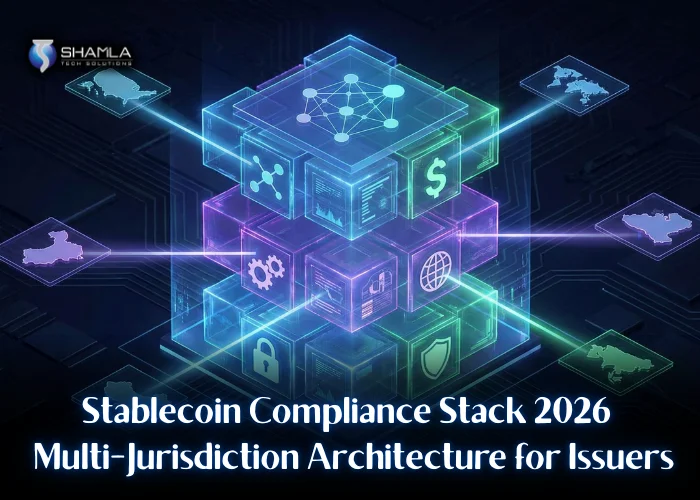

Stablecoins are no longer treated as experimental software products. As of late 2025, more than 60 jurisdictions have introduced or proposed regulatory frameworks governing stablecoin issuance, reserves, custody, and reporting, positioning them firmly as regulated financial instruments rather than neutral code. This regulatory fragmentation creates a complex operating environment, where the same stablecoin may be subject to different licensing, reserve, and disclosure requirements across regions.
As a result, compliance can no longer be handled as a legal layer added after deployment. It must be designed directly into the protocol, treasury systems, and operational workflows. This has led to the emergence of a stablecoin compliance stack, a structured combination of regulatory logic, reserve controls, identity verification, monitoring, and reporting systems that operate cohesively across jurisdictions.
For stablecoin issuers operating globally, compliance architecture is now the foundation that determines scalability, resilience, and long-term viability.
Global Regulatory Frameworks Shaping Stablecoin Issuance
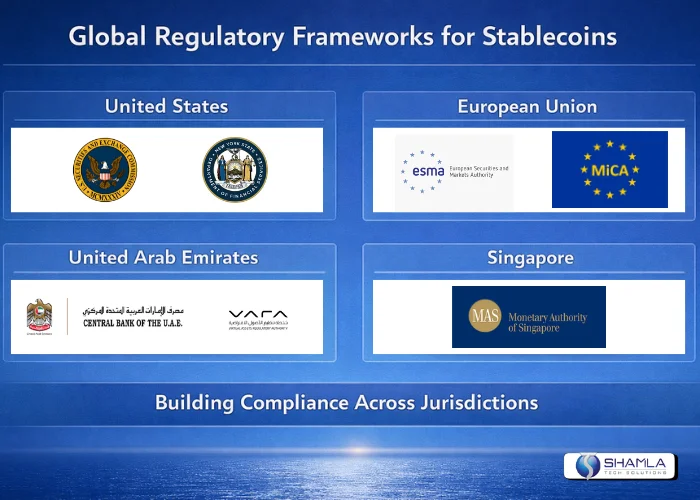
United States: Multi-Agency Oversight for Payment Stablecoins
In the United States, stablecoin issuance is governed through a multi-regulator model rather than a single framework. Oversight typically involves the Federal Reserve, Office of the Comptroller of the Currency (OCC), Financial Crimes Enforcement Network (FinCEN), and, at the state level, bodies such as the New York Department of Financial Services (NYDFS).
Key compliance expectations include:
- Full reserve backing for payment stablecoins
- Clear redemption rights
- Ongoing AML and sanctions monitoring
- Custody and operational risk controls
From a systems perspective, this requires integration between issuance logic, reserve reporting, and transaction monitoring tools to satisfy both federal and state requirements.
European Union: MiCA and E-Money Alignment
The European Union provides a more centralized structure through Markets in Crypto-Assets Regulation (MiCA), supervised by the European Securities and Markets Authority (ESMA) and national regulators, with reserve and prudential oversight coordinated through the European Banking Authority (EBA).
MiCA treats stablecoins either as:
- Asset-Referenced Tokens (ARTs), or
- E-Money Tokens (EMTs)
This classification affects capital requirements, reserve composition, issuance limits, and disclosure obligations. Technically, issuers must support real-time reporting, segregated reserve management, and jurisdiction-aware issuance controls to comply across EU member states.
United Arab Emirates: Dual Regulatory Structure
In the UAE, stablecoin issuance falls under a dual regulatory model. The Central Bank of the UAE (CBUAE) oversees payment and monetary stability, while the Virtual Assets Regulatory Authority (VARA) governs digital asset issuance and operations within Dubai.
Compliance requirements emphasize:
- Licensing at both federal and emirate levels
- Custody segregation and reserve transparency
- Transaction monitoring aligned with local AML frameworks
Issuers operating in the UAE must architect systems that can enforce region-specific controls without fragmenting global operations.
Singapore: MAS and Payment Services Alignment
Singapore regulates stablecoins under the Monetary Authority of Singapore (MAS), primarily through the Payment Services Act (PSA). Stablecoins classified as digital payment tokens are subject to licensing, reserve backing, audit, and redemption requirements.
From a technical standpoint, MAS compliance favors:
- Strong identity verification
- Continuous transaction monitoring
- Clear separation between issuance, custody, and settlement layers
Reserve Management and Asset Backing Compliance
1:1 Fiat Backing as a System-Level Requirement
Stablecoin compliance begins with a strict expectation of 1:1 backed by high-quality liquid assets. Each token in circulation must be matched by an equivalent value held in reserve, enforced not just legally but through issuance logic.
Key expectations include:
- One token issued only when one unit of fiat value is reserved
- No over-issuance or fractional backing
- Issuance directly linked to verified reserve balances
This approach makes reserve backing a technical control, not a manual process.
Permitted Reserve Assets and Composition Controls
Regulators typically restrict reserve holdings to low-risk instruments that preserve value and liquidity.
Commonly permitted assets:
- Cash held at regulated banking institutions
- Short-term government securities
- Cash-equivalent instruments with minimal duration risk
Stablecoin systems must enforce asset eligibility rules at the treasury layer, preventing non-compliant instruments from being included in reserves.
Segregation of Issuer Funds and Customer Reserves
A core compliance requirement is the legal and operational separation of issuer funds from stablecoin reserves.
This is achieved through:
- Segregated custodial accounts
- Separate ledger tracking for operational and reserve funds
- Controls that prevent commingling at both legal and system levels
Segregation protects token holders in insolvency and supports regulatory clarity.
Redemption Rights and Liquidity Guarantees
Stablecoin holders must be able to redeem tokens at par within defined timeframes.
Supporting mechanisms include:
- Pre-funded redemption accounts
- Liquidity buffers for stress scenarios
- Automated redemption workflows
These safeguards ensure redemption remains reliable during peak demand.
Real-Time Reserve Visibility and Automation
Modern reserve compliance depends on continuous monitoring, not periodic audits.
Technical capabilities include:
- Direct integration with banks and custodians
- Real-time balance visibility
- Automated reconciliation between on-chain supply and off-chain reserves
- Alerting for mismatches or threshold breaches
This infrastructure-driven approach makes reserve management transparent, auditable, and enforceable at all times.
AML, KYC, and Transaction Monitoring Architecture
Onboarding Controls vs Ongoing Monitoring
Effective AML architecture separates who can enter the system from how activity is monitored over time. Identity verification occurs at onboarding, while risk assessment continues throughout the lifecycle of a wallet or account.
Core onboarding controls include:
- Identity verification and entity validation
- Beneficial ownership checks
- Jurisdiction and risk classification
Once onboarded, monitoring shifts to behavior, not identity alone.
Wallet Screening and Sanctions Enforcement
Stablecoin systems must continuously screen wallets against sanctions lists, watchlists, and high-risk jurisdictions. This applies to both inbound and outbound transactions.
Key technical requirements:
- Real-time wallet screening at transaction execution
- Continuous list updates from compliance providers
- Blocking or flagging of restricted counterparties
These controls must operate inline with transaction flows, not as post-processing checks.
Transaction Risk Scoring and Monitoring Logic
Rather than relying on static rules, modern systems use risk scoring models that evaluate transaction context.
Signals typically include:
- Transaction size and frequency
- Counterparty risk level
- Geographic exposure
- Behavioral deviations from historical patterns
High-risk activity can trigger alerts, delays, or manual review without halting compliant flows.
Travel Rule and Data Exchange Considerations
Where required, systems must support Travel Rule compliance, enabling secure transmission of sender and receiver information between regulated entities.
This requires:
- Secure off-chain data exchange
- Clear mapping between identity and wallet addresses
- Selective disclosure without exposing transaction data publicly
Modular Compliance Architecture
Scalable AML systems are built as modular layers, not monolithic blocks.
Best-practice architecture includes:
- API-based compliance services
- Separation of identity, transaction, and settlement layers
- Independent updating of compliance logic without redeploying core systems
This design allows regulatory controls to evolve without disrupting issuance or settlement infrastructure.
On-Chain and Off-Chain Reporting & Auditability
On-Chain Transparency
On-chain reporting provides a permanent and verifiable record of all stablecoin activity. Every issuance, transfer, and redemption is recorded on the blockchain with a timestamp and transaction reference. This ensures token supply and movement can be independently verified at any point in time.
On-chain reporting enables:
- Traceability of token flows between wallets
- Verification of issued and burned supply
- Immutable transaction history
However, on-chain data alone does not include identity, regulatory context, or financial reporting structure.
Off-Chain Reporting
Off-chain reporting adds context and compliance structure to on-chain activity. Blockchain data is combined with customer identity, custody information, banking records, and jurisdictional classifications to meet regulatory and audit requirements.
Off-chain reporting typically covers:
- Regulatory filings and disclosures
- Reserve attestations and bank confirmations
- AML and transaction monitoring reports
- Accounting and financial statements
This layer translates raw blockchain data into regulator-ready information.
Unified Reporting and Audit Model
Area | On-Chain | Off-Chain |
Transaction records | Immutable blockchain ledger | Enriched with identity and jurisdiction data |
Supply tracking | Issuance and burn events | Reserve confirmation and reconciliation |
Transparency | Public and verifiable | Controlled and permissioned |
Reporting frequency | Continuous | Periodic and real-time dashboards |
Audit support | Permanent transaction history | Financial records and compliance evidence |
Why This Model Works
Stress Testing, Risk Controls, and Audit Tooling
Liquidity Stress Testing and Redemption Scenarios
Liquidity stress testing evaluates whether reserves and redemption infrastructure can handle sudden spikes in demand. Systems simulate high-volume redemptions over short periods, testing reserve availability, settlement timing, and banking integrations. These simulations help validate that redemption commitments can be met without delays or manual intervention.
Redemption surge scenarios also test:
- Simultaneous redemptions across multiple jurisdictions
- Bank cut-off and settlement constraints
- Temporary liquidity bottlenecks
Operational Failure and System Resilience Testing
Operational resilience is tested by simulating failures across critical components such as custody providers, banking connections, or blockchain nodes. These tests verify fallback mechanisms, data integrity, and recovery time objectives.
Typical simulations include:
- Custodian or bank API outages
- Network congestion or chain interruptions
- Internal system failures or access issues
Controls, Alerts, and Governance Enforcement
Risk controls are enforced through automated system-level mechanisms, not manual oversight.
Key control features include:
- Real-time alerts for reserve or transaction anomalies
- Issuance throttles tied to reserve thresholds
- Emergency kill-switches to pause issuance or transfers
Governance workflows ensure that any exceptional actions require documented approvals and are fully auditable.
Cross-Border Issuance and Operational Challenges
Stablecoin issuance is often global by design, but regulatory authority remains local. A common challenge arises when a stablecoin is issued under one jurisdiction while being used, distributed, or redeemed across others. This creates operational complexity that extends beyond token deployment into licensing, reporting, and ongoing supervision.
Most jurisdictions do not offer true regulatory passporting for stablecoins. Approval or licensing in one region does not automatically permit issuance or distribution elsewhere. As a result, systems must support region-specific rules for issuance, redemption, and transaction limits without fragmenting the underlying token infrastructure.
Cross-border operations also introduce differences in FX handling, capital controls, and settlement timelines. Some regions impose restrictions on fund movement or require local settlement accounts, which affects how reserves are accessed and how redemptions are processed. These constraints must be reflected in issuance logic and liquidity routing rather than handled manually.
Coordinating multiple regulators adds further complexity. Each authority may require distinct disclosures, reporting formats, and audit timelines. Without centralized compliance orchestration, this leads to duplicated processes and increased operational risk.
The key challenge is that compliance orchestration is significantly harder than token issuance. Successful stablecoin platforms embed region-aware issuance logic, jurisdiction-based controls, and adaptive reporting at the system level. This allows global operation while respecting local regulatory boundaries, making compliance an integrated capability rather than an ongoing constraint.
Final Thought: Compliance as a Competitive Advantage in 2026
Stablecoin compliance is shifting from a reactive, documentation-driven exercise to an engineered system capability. As regulatory expectations mature across regions, platforms that embed compliance directly into issuance, reserve management, monitoring, and reporting architecture are able to scale faster and operate with greater resilience.
Multi-jurisdiction readiness is no longer optional; it is the factor that determines whether a stablecoin can expand sustainably or remain constrained by regulatory friction. A well-designed compliance stack becomes a foundation for trust, operational stability, and long-term viability.
Shamla Tech is a stablecoin development company that builds compliant, production-ready infrastructure for global issuance. Our solutions are designed with regulatory alignment at the core, covering reserve controls, AML/KYC architecture, reporting, and cross-border compliance orchestration. By treating compliance as system architecture rather than an afterthought, Shamla Tech enables stablecoin platforms to operate confidently across jurisdictions while maintaining transparency, control, and scalability.
Partner with Shamla Tech to Build a Compliant Stablecoin
Building a global stablecoin in 2026 requires more than smart contracts – it requires compliance engineered into every layer. Shamla Tech partners with issuers to design, build, and deploy production-ready stablecoin infrastructure aligned with global regulations.
From reserve-backed issuance and AML/KYC architecture to real-time reporting and cross-border compliance orchestration, we help you launch with confidence. Work with Shamla Tech to turn regulatory complexity into a scalable, competitive advantage.
Contact us to build a compliant stablecoin architecture across global jurisdictions!