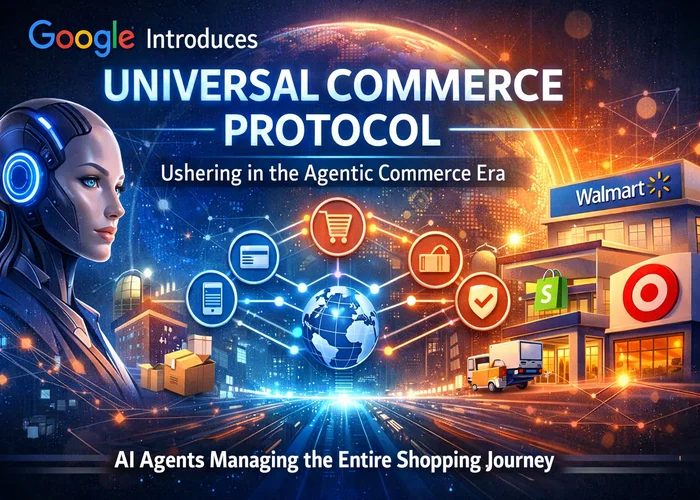

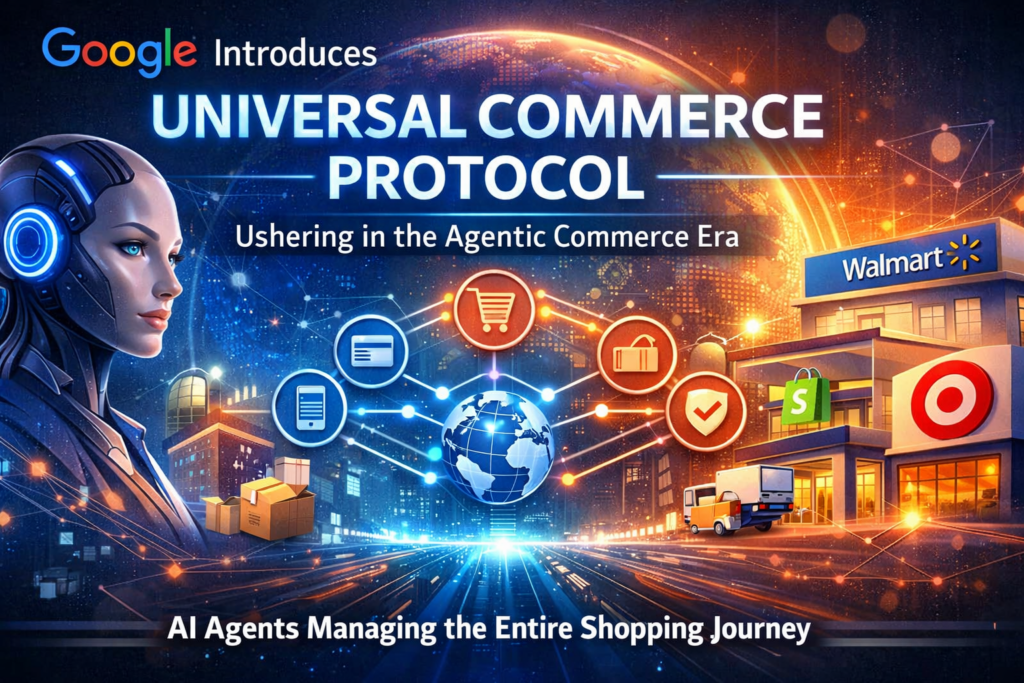
Google Introduces Universal Commerce Protocol in 2026: Ushering in the Agentic Commerce Era

Universal Commerce Protocol
Home » Artificial Intelligence » AI Agent Development Company » Google Introduces Universal Commerce Protocol in 2026: Ushering in the Agentic Commerce Era

In January 2026 at the National Retail Federation (NRF) conference, Google unveiled the Universal Commerce Protocol (UCP) — a new open standard designed to enable AI agents to handle the full shopping journey from discovery to checkout. This announcement marks a pivotal moment in the emerging agentic commerce era, where progress in AI Agent Development is beginning to move beyond recommendations into real transactional execution.

By creating a common protocol for how AI agents connect with merchants and payment systems, Google aims to reduce the complexity and cost of integrating AI-driven shopping experiences across platforms.

The agentic AI market is rapidly expanding, with AI agents projected to grow from USD 7.84 billion in 2025 to USD 52.62 billion by 2030 at a 46.3% CAGR and 70% of shoppers willing to let agents autonomously book services in 2026. In this blog, we will explore what UCP is, how it works, its industry implications, key retail partnerships, challenges, and the future of autonomous AI-driven commerce.

Launch UCP-Enabled AI Commerce Infrastructure

Implement secure, compliant AI-driven checkout, payment, and order-execution systems aligned with Google Gemini and Universal Commerce Protocol.
Universal Commerce Protocol

Transformative Impact of the Universal Commerce Protocol

UCP is designed to act as a shared standard that allows AI agents to interact with retailer systems in a consistent way. Instead of each merchant building custom integrations for every AI assistant or platform, UCP defines how product data, availability, pricing, and checkout information can be accessed by agents across different environments.
Google has positioned UCP as a way to make AI-powered shopping scalable, so that agents embedded in Search, Gemini, or other interfaces can access the same commerce capabilities without bespoke integrations for every retailer.
This approach supports Google’s broader push to make AI agents a practical interface for online shopping, rather than limited to search or recommendation roles.
Fixing the Core Problem in AI-Driven Commerce
One of the main challenges in AI commerce today is fragmentation. Retail systems for catalogs, inventory, checkout, and payments are all built differently, which makes it difficult for AI tools to complete transactions.
UCP addresses this by providing a standardized way for AI agents to request commerce functions, such as:
  • Viewing products and availability
  • Retrieving pricing and offers
  • Initiating checkout
  • Sending payment and order information
  • Receiving order status and fulfillment updates
This allows retailers to expose their commerce capabilities once and make them usable by many AI-driven shopping experiences.
Industry Backing Accelerates Adoption
Google launched UCP in collaboration with a group of major retail and commerce partners. Companies including Shopify, Walmart, Target, Etsy, and Wayfair are participating in the protocol, ensuring it reflects real-world retail and payment workflows.
These partnerships indicate that UCP is not a theoretical standard but one being designed for production retail environments, enabling AI-based shopping experiences to be deployed at scale.
What This Enables for Retailers and Platforms

With UCP in place, retailers and platforms can:

  • Make their products available to AI agents across Google Search, Gemini, and other AI interfaces
  • Support direct checkout inside AI-driven experiences
  • Reduce the engineering work required to integrate with multiple AI platforms
  • Reach consumers who increasingly rely on conversational and automated shopping tools
This creates a new channel where AI systems can guide users from intent to purchase without leaving the AI interface.

Technical Foundations of UCP: How the Protocol Actually Works

The Universal Commerce Protocol (UCP) is not a single API or SDK. It is an open protocol layer that allows AI agents to communicate with merchant systems in a consistent, secure, and extensible way across the entire commerce lifecycle. UCP brings together APIs, agent protocols, and payment standards so that retailers, AI platforms, and payment networks can interoperate without custom integrations.
1.Unified Commerce Capabilities and Discovery

UCP uses a capability-driven model to describe what a merchant can do.

Merchants publish a UCP profile that declares:

  • Product catalog and search access
  • Pricing and discount models
  • Checkout and order creation
  • Payment methods
  • Fulfillment and returns

AI agents use this profile to:

  • Discover which merchants can fulfill a user’s request
  • Understand what operations are supported
  • Select the correct workflows for checkout and payment

This removes the need for:

  • One-off API contracts
  • Hard-coded logic per retailer
  • Manual platform-specific integrations
2.Flexible Transport and Integration Methods
UCP supports multiple ways for agents and merchants to connect.

Standard REST APIs

  • Merchants expose commerce functions through REST endpoints
  • These endpoints are mapped to UCP capability schemas
  • AI agents know exactly how to call them

Agent-to-Agent (A2A)

  • Allows autonomous AI agents to communicate directly
  • Supports delegation of tasks between systems
  • Enables agent-driven commerce flows without traditional web APIs

Model Context Protocol (MCP)

  • Lets AI models call commerce tools using structured definitions
  • Allows UCP commerce functions to be invoked directly inside AI workflows
  • Makes agent tools interoperable across AI platforms

This multi-transport design ensures:

  • Legacy systems can participate
  • AI-native platforms can integrate natively
  • No single architecture is forced on participants
3. Capabilities, Extensions, and Composable Architecture

UCP breaks commerce into modular building blocks.

Core capabilities include:

  • Product discovery
  • Pricing and promotions
  • Cart and checkout
  • Order tracking
  • Returns and refunds

These can be extended with:

  • Loyalty programs
  • Subscription billing
  • Custom discount logic
  • Specialized shipping
  • Industry-specific workflows

This allows:

  • Small merchants to implement only what they need
  • Large retailers to expose complex business rules
  • AI agents to adapt dynamically based on merchant capabilities
4.Secure Payments with Agent Payments Protocol (AP2)

UCP integrates with Agent Payments Protocol (AP2) to support secure AI-initiated transactions.

AP2 enables:

  • User-authorized payment mandates
  • Cryptographically verifiable payment requests
  • Compliance with existing payment rails

Payments via UCP are:

  • Secure and authenticated
  • Auditable by merchants and processors
  • Compatible with Google Pay, Google Wallet, and supported payment systems

Under UCP:

  • Merchants remain the Merchant of Record
  • They control pricing, customer data, and fulfillment
  • Google or the AI agent does not become the seller
5. Extensibility and Future-Ready Design

UCP is designed to grow as agentic commerce evolves.

The protocol supports:

  • New payment methods
  • Subscription models
  • Loyalty and rewards
  • B2B procurement
  • Advanced fulfillment and logistics

All extensions are:

  • Discoverable by AI agents
  • Compatible with existing UCP implementations
  • Forward-compatible without breaking integrations

This allows UCP to evolve without forcing retailers or platforms to rebuild.

Why This Architecture Matters

Together, these foundations allow:

  • Retailers to integrate once and reach many AI agents
  • AI agents to transact across many merchants
  • Platforms to scale without rebuilding commerce logic
UCP becomes the transaction layer for AI-driven commerce, enabling AI agents to operate at real commercial scale with interoperability, security, and merchant control.

Build Transaction-Ready AI Agent Systems

Design and deploy AI Agent Development infrastructure integrated with Google’s Universal Commerce Protocol for secure, end-to-end autonomous commerce.
How Google Is Bringing UCP to Life Through AI-Powered Shopping

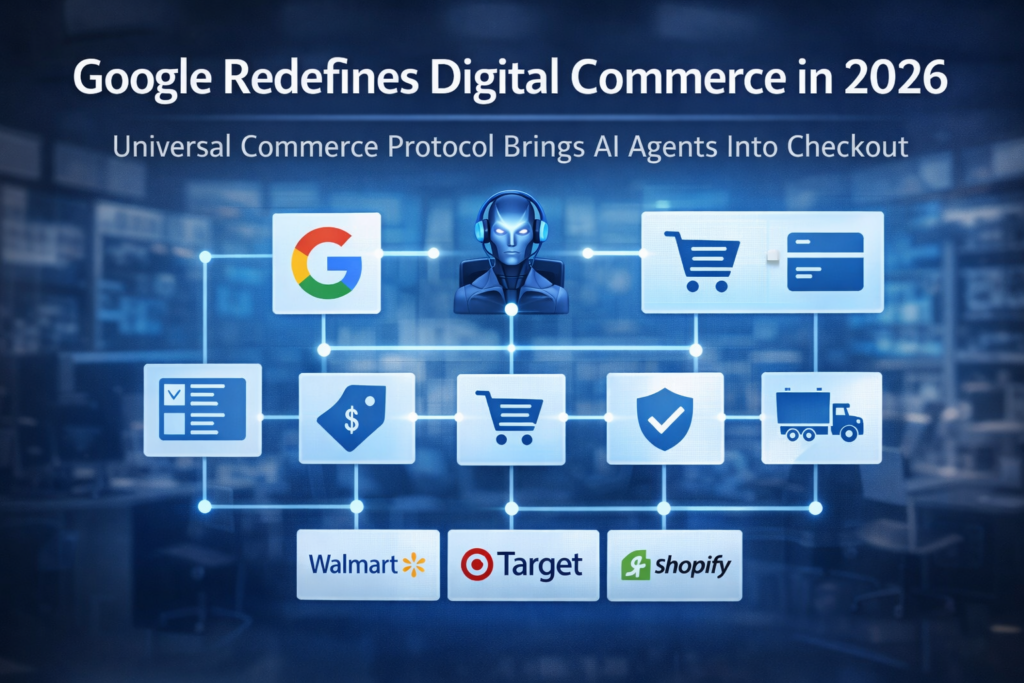
Google is not treating the Universal Commerce Protocol as a background technical standard — it is embedding UCP directly into its AI Agent development strategy, turning Gemini and Search AI Mode into transaction-capable digital buyers.
At the center of this rollout is Google’s AI Mode in Search and the Gemini app, where AI agents can now guide users from product discovery all the way to checkout without forcing them to leave the conversation. This represents a shift from AI as a search assistant to AI as an autonomous commerce agent.
Using UCP, Google’s AI agents can:
  • Retrieve real-time product availability and pricing
  • Display merchant-approved offers
  • Add items to a cart and initiate checkout
  • Trigger secure payments through Google-supported payment rails
  • Pass fulfillment and order tracking back to the merchant

This is what Google refers to as “native AI checkout” — shopping that happens inside AI interfaces instead of redirecting users to external websites.

From the retailer’s perspective, UCP ensures they remain in control:

  • Pricing and promotions
  • Inventory and fulfillment
  • Tax and compliance
  • Customer relationships

Google’s AI becomes a transaction-capable front end, not the seller.

This allows Google to scale AI Agent-driven commerce across:

  • Search
  • Gemini
  • Mobile and voice interfaces
  • Third-party AI platforms that adopt UCP
UCP therefore turns Google’s AI surfaces into a global agentic commerce gateway, where AI agents act as buyers while merchants retain ownership of the transaction.

Challenges, Governance, and the Road to Trust

While the Universal Commerce Protocol (UCP) represents a major step forward for agentic commerce, it also introduces new questions around trust, control, and governance that the industry must resolve as AI Agent development advances and intelligent agents become active buyers.
One of the central challenges is consumer trust in autonomous agents. When an AI agent can search, select, and purchase on a user’s behalf, consumers must be confident that the agent is acting in their best interest — not optimizing for hidden incentives, platform biases, or preferential merchant placement. Although Google has stated that UCP keeps merchants as the merchant of record, transparency around pricing, offers, and selection logic will be critical as agents begin executing real transactions rather than just recommending products.
A related concern is dispute resolution and accountability. If an AI agent built through advanced agent development makes an incorrect purchase, applies an unintended discount, or orders the wrong item, responsibility must be clearly defined among the AI platform, the payment system, and the merchant.

From a regulatory and compliance standpoint, AI-driven commerce must still adhere to:

  • Consumer protection laws, ensuring agents honor refunds, returns, and customer rights
  • Payment and fraud regulations, requiring secure authorization and anti-fraud controls
  • Data privacy requirements, as agents handle sensitive user profiles and payment data
  • Tax and jurisdictional rules, especially for cross-border transactions
While UCP provides a technical framework for transaction interoperability, policy, governance, and legal standards will need to evolve alongside it to govern how agents are developed, deployed, and held accountable.
The companies adopting UCP early are not just testing a new protocol — they are helping shape the rules for how autonomous AI agents will operate within the global economy, influencing the standards of AI Agent development, oversight, and trustworthiness in commerce.

Conclusion

Google’s launch of the Universal Commerce Protocol (UCP) in 2026 signals a structural shift in how digital commerce will be built and consumed. By providing an open, interoperable transaction layer, UCP allows advances in AI Agent Development to move from experimentation into real-world, revenue-generating execution. Instead of fragmented integrations and siloed checkout systems, retailers, marketplaces, and platforms can now expose their commerce capabilities once and make them accessible across Google Search, Gemini, and any UCP-enabled AI interface.

For businesses, this means lower integration costs, higher conversion rates, and access to a fast-growing channel of AI-driven buyers. For consumers, it means faster, more personalized, and more seamless purchasing experiences. As agentic commerce expands, UCP positions Google at the center of a new global commerce fabric—one where AI agents become the primary interface between intent and transaction.

Shamla Tech: Enabling the Next Era of AI-Driven Commerce

The launch of the Universal Commerce Protocol (UCP) underscores that agentic commerce — where autonomous AI agents complete discovery, selection, checkout, and payment — is no longer theoretical but becoming business critical. At Shamla Tech, we help enterprises turn these innovations into production-ready commerce solutions through AI Agent Development, agentic commerce platform engineering, and UCP-enabled system integration.
Our teams build secure, scalable infrastructures that allow merchants to expose their product catalogs, pricing, checkout, and fulfillment systems once — and make them accessible to any UCP-compliant AI agent. We also help integrate native AI checkout capabilities and ensure compliance with modern payment protocols. As the adoption of AI shopping agents accelerates and reshapes retail at scale, Shamla Tech is your technology partner for building resilient, future-proof commerce platforms. 

Table of Contents

Send Us A Message