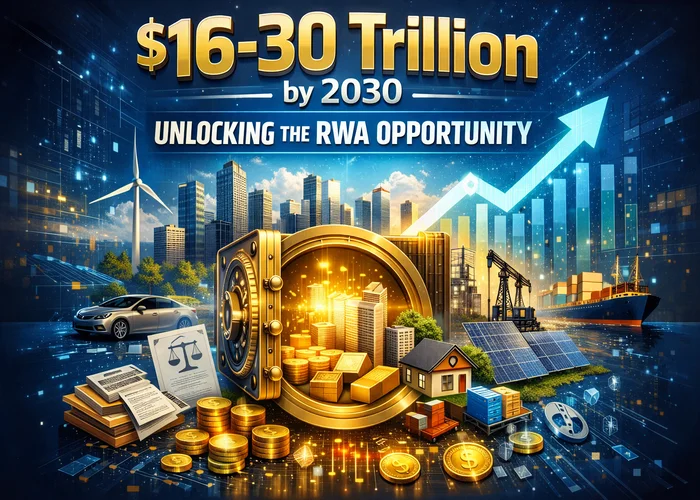

In the decade since blockchain, one of the most important paradigm shifts has been the rise of Real-World Assets Market Forecast, the practice of representing tangible assets (like real estate, bonds, commodities, credit, intellectual property and more) as digital tokens on distributed ledgers. While initial tokenization efforts focused on experimental pilots, 2025 research estimates that the RWA tokenization market could grow to between $16 trillion and $30 trillion by 2030, potentially transforming global capital markets as we know them.
This isn’t just a theoretical prediction driven by crypto enthusiasts, it reflects demand from institutional capital, regulatory interest, and practical business incentives. For enterprises, financial institutions, fintech builders, and asset owners, the RWA market opportunity is real, urgent, and mission-critical.
In this article, we’ll unpack the forces driving RWA growth, the business opportunities it presents across sectors, and the practical steps companies can take to unlock value in a tokenized world.
Turn Real-World Assets Into Scalable Digital Market
Why It Is Important to Build A RWA Platforms?
RWA market opportunity has grows 260% in the first half of 2025, surpassing $23 Billion in total valuation. Real World Asset Tokenization Market solves many of these problems by digitizing ownership and using smart contracts to execute key functions. This radical structural shift unlocks significant value, both economically and operationally.
Enhanced Liquidity
The development of a Real-World Asset Tokenization Platform makes fractional ownership possible by letting firms break up assets into smaller, tradable tokens. This higher liquidity makes it easier for more investors to get involved and makes trading more efficient.
Access to Global Markets
Improved Efficiency
Increased Transparency
Fractional Ownership Opportunities
Capital Access & Fundraising
Asset Interoperability
Asset Interoperability
Automation & Smart Contract Functionality
The development of asset tokenization platforms uses smart contracts to automate several parts of managing assets, including as paying dividends, giving voting rights, and making sure that rules are followed. It cuts down on the need for physical work and the costs that come with it.
Tokenized assets crossed $25 billion, led by private credit, treasuries and commodities. So, it is always better to position your company first in the race.
$16–30 Trillion by 2030: What Promises This Growth?
Multiple research studies, including from top consultancies and market analysts, suggest that Real-World Asset Tokenization Market will reach $16-30 trillion by 2030. This range highlights both the potential and uncertainty, but even the lower bound represents a transformative shift.
Several trends make this RWA market opportunity projection plausible:
Institutional Adoption
Banks, asset managers, insurers, and hedge funds are increasingly piloting or Institutional Adoption of RWA tokenization. Real Estate Tokenization Development, tokenized bonds, Tokenized Future of Real-World Assets market instruments, and private credit funds are already live in multiple jurisdictions. Institutional participation validates tokenization as more than a niche innovation.
Regulatory Clarity
Position Your Business for the Next Trillion-Dollar Shift
Challenges on the Path Forward
Asset tokenization is not without its problems, albeit it looks promising. A recent academic research called “Tokenize Everything, But Can You Sell It?” shows that most RWA market opportunity have poor liquidity, extended holding times, and few opportunities for secondary trade. Regulatory gating, lack of clear pricing, custodian concentration, whitelist restrictions, and a lack of decentralized, compliant markets are all barriers.
Also, technical problems come up when tokenized assets try to work on more than one chain. The new framework RWA Market Potential suggests ways to settle transactions across chains without having to reauthenticate or duplicate information.
Even with these problems, things are moving quickly. Goldman Sachs and BNY Mellon are testing Tokenized Real-World Assets Market funds, which shows that there is a lot of interest in connecting DeFi and TradFi.
How Shamlatech Helps Businesses Build RWA Platforms
Shamlatech is a trusted technology partner for enterprises seeking to build RWA platforms. We combine blockchain expertise, enterprise-grade architecture, and regulatory insight to deliver end-to-end solutions:
- Token Design: Fractionalization, revenue mechanics, and programmable functionality
- Smart Contracts: Automated cash flows, settlements, and compliance
- Secure Custody Integration: Protect digital assets across wallets and ledgers
- Multi-Chain Connectivity: Ethereum, BSC, Solana, and Layer 2 networks
Whether you’re tokenizing real estate, commodities, IP, or carbon credits, Shamlatech builds scalable, compliant platforms that unlock liquidity, attract global investors and RWA investment opportunity, and support long-term growth.
Conclusion
The $16–30 trillion RWA market opportunity by 2030 is not a distant future, it’s a present-day competitive imperative. Tokenization unlocks liquidity, democratizes access, and creates programmable financial instruments that were previously impossible. For forward-thinking businesses, from banks and fintechs to asset owners and corporate treasuries, this represents both a strategic challenge and a massive growth avenue.
Enterprises that invest early in RWA infrastructure, embrace tokenized products, and build scalable, compliant platforms will be the real winners of the next decade’s financial transformation.
The RWA market opportunity is here, and for those ready to seize it, the rewards could be monumental.
Don’t Miss the Next Wave of Global Capital Markets
FAQs
1. What types of real-world assets can Shamlatech tokenize?
2. How does Shamlatech ensure regulatory compliance for RWA platforms?
We design compliance-first platforms with built-in KYC/AML, investor whitelisting, jurisdiction-based transfer rules, and automated reporting. Shamlatech also works alongside RWA legal consulting services to align platforms with frameworks such as MiCA, MAS, VARA, and other global standards.