




Digital payments have become faster at checkout, but the money behind those transactions does not move at the same speed. A payment can be approved in seconds, yet businesses often wait days before the funds are actually available. This delay is built into traditional settlement systems that rely on intermediaries, batch processing, and banking cut-off times, creating hidden friction in cash flow, payouts, and day-to-day operations.
As businesses look for ways to reduce this friction, stablecoins are increasingly being used beyond trading. In 2025, stablecoin transaction volume crossed $33 trillion, a record high that reflects growing use beyond trading into real payment and settlement flows, led primarily by USDT and USDC.
This article explores why businesses are now prioritizing settlement speed over checkout optimization, how stablecoin payments change settlement at the infrastructure level, and what is driving their adoption as a practical settlement rail in 2026.
Build Enterprise-Grade Stablecoin Payment Infrastructure
Why Successful Payments Don’t Mean Settlement Is Complete for Businesses
Here’s why this distinction matters for businesses today:
- In traditional payment systems, settlement typically takes 1 to 3 business days, and even longer for cross-border transactions, which means revenue is locked up despite sales being completed.
- The delay is built into the system itself, driven by intermediaries, batch processing, and banking cut-off times rather than any issue at checkout.
- During this gap, businesses cannot freely use incoming funds for vendor payments, inventory restocking, or marketing spend, making cash flow harder to manage.
- As transaction volumes grow, these delays compound, creating friction in payouts, reconciliation, and day-to-day financial operations.
- For businesses operating across borders, settlement delays become even more pronounced, adding uncertainty to global revenue and expansion plans.
What Stablecoin Payments Change at the Settlement Layer
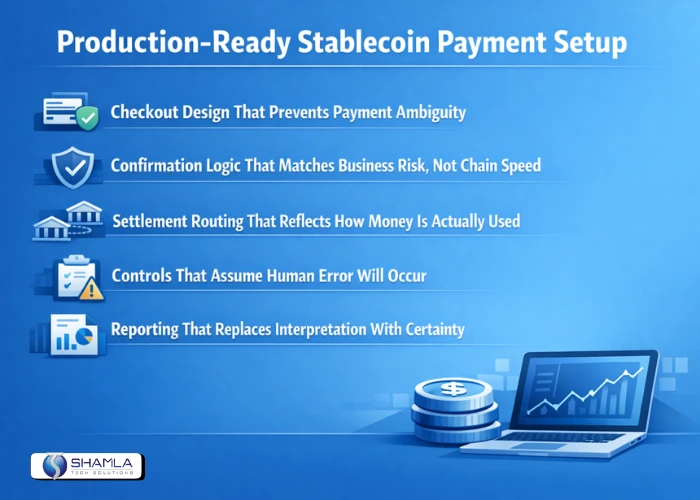
Stablecoins Introduce Settlement-Ready Digital Money
Always-On Settlement Reshapes Liquidity Management
On-Chain Finality Creates Clear Settlement Completion
Treasury, Payouts, and Reconciliation Become Structured
Why Businesses Are Switching to Stablecoin Payments in 2026
Business Pressure | What Happens With Slow Settlement | Why Stablecoin Settlement Is Considered |
Cash flow timing | Revenue booked but funds delayed | Faster access to usable funds |
Cross-border growth | Longer clearing cycles by region | Border-agnostic settlement timing |
Payout obligations | Delayed partner and vendor payouts | Quicker downstream fund movement |
Scale and volume | Settlement lag compounds with growth | Settlement speed scales with activity |
Treasury visibility | Funds in transit lack clarity | Clear confirmation and timing |
Operational risk | Manual workarounds increase | Automated, structured settlement |
1. Settlement Pressure in Subscription-Based Revenue Models
Recurring revenue models rely on predictable timing between billing and cash availability. When settlement trails behind subscription cycles, finance teams face gaps between reported revenue and usable funds. These gaps become harder to manage as subscriber bases expand across regions with different banking schedules.
Stablecoin settlement shortens the delay between payment and fund availability. This helps subscription businesses align revenue recognition with actual liquidity, improving forecasting accuracy. As recurring volumes grow, tighter settlement timing reduces reliance on buffers and improves financial confidence across monthly and annual planning cycles.
2. Working Capital Strain in Cross-Border E-commerce
Cross-border e-commerce exposes settlement friction quickly. Orders are fulfilled immediately, yet funds from international sales often move through multiple banking layers before settling. Inventory procurement, logistics payments, and marketing expenses continue in parallel, creating working capital pressure during periods of high sales velocity.
Stablecoin payments reduce this delay by allowing cross-border transactions to settle on shared, always-available infrastructure. Faster settlement shortens the gap between global sales and usable capital, giving e-commerce businesses greater flexibility during peak demand and expansion phases without waiting for extended clearing cycles.
3. Timing Sensitivity in Payout-Heavy Platforms
Platforms that process frequent payouts feel settlement delays as operational friction. When incoming payments take time to settle through traditional rails, downstream payouts to users, vendors, or creators slow down, increasing reconciliation complexity and straining internal balance management.
Stablecoin settlement helps align incoming and outgoing flows by reducing the time funds remain in transit. With faster settlement, payout-heavy platforms can maintain tighter payout schedules, cleaner ledgers, and more reliable execution as transaction frequency and user volumes grow.
4. Settlement Coordination Challenges in Marketplaces
Marketplaces depend on precise timing between customer payments and participant payouts. As seller or creator networks expand, settlement delays introduce gaps that complicate reconciliation and reduce payout predictability for participants relying on timely fund access.
Stablecoin payments bring settlement completion closer to the moment of payment, allowing funds to enter payout workflows sooner. This improves transparency for marketplace participants and supports consistent payout operations as platforms scale across regions and transaction volumes.
5. Liquidity Management in High-Velocity Digital Businesses
Digital-first businesses operate with continuous transaction flow. Revenue is generated rapidly, while settlement timelines through traditional systems may lag behind operational needs. This misalignment forces teams to maintain liquidity buffers to manage uncertainty around fund availability.
Stablecoin settlement helps align fund access with transaction velocity. By reducing settlement lag, digital businesses can operate with tighter cash cycles and fewer interim buffers, improving responsiveness as transaction volume and customer activity increase.
6. Treasury Visibility Across Distributed Operations
Enterprises moving funds across regions and entities face complexity when settlement is delayed. Capital may be operationally committed while still in transit, limiting visibility into actual liquidity positions and complicating internal transfers across business units.
Stablecoin settlement improves treasury visibility by providing clearer timing and confirmation of fund movement. Faster settlement allows treasury teams to coordinate liquidity more effectively, reduce idle capital periods, and manage distributed operations with greater precision.
Develop Stablecoin Solutions for Faster Payment Settlement
Add Your What a Production-Ready Stablecoin Payment Setup RequiresText Here
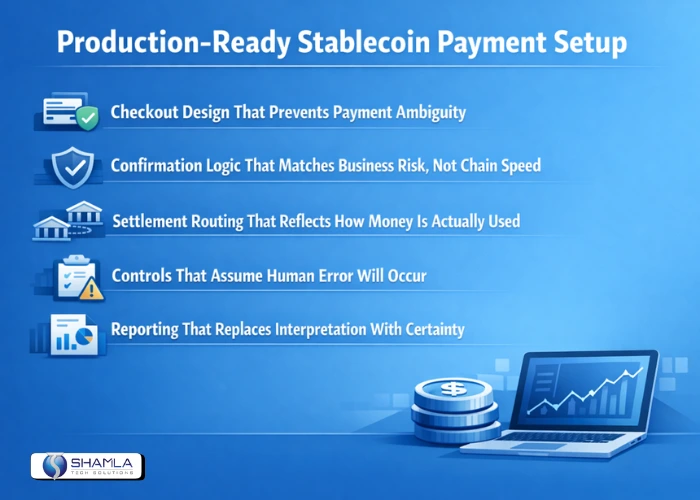
Checkout Design That Prevents Payment Ambiguity
Stablecoin Confirmation Logic Aligned With Business Risk
Settlement Routing Built Around Stablecoin Treasury Flows
Operational Controls Designed for Stablecoin Treasury Reality
Reporting That Replaces Interpretation With Certainty
Final Thoughts: Faster Settlement Is Becoming a Competitive Advantage
Stablecoin settlement is beginning to influence how businesses structure financial operations. When settlement timelines become predictable and independent of banking cycles, organizations can design workflows around certainty rather than delay. This reduces the need for interim controls, excess liquidity buffers, and manual reconciliation processes that exist primarily to manage timing risk.
As this capability matures, its impact extends beyond finance teams. Faster settlement supports tighter coordination between revenue, treasury, and payouts, enabling earlier reinvestment and more consistent execution across regions. Over time, these efficiencies shape pricing decisions, partner relationships, and growth planning in measurable ways.
Looking ahead, settlement speed will increasingly differentiate operationally mature businesses from those constrained by legacy rails. Stablecoin-based settlement is emerging as infrastructure that supports scale, control, and long-term financial resilience.
Build Enterprise-Grade Stablecoin Payment Solutions With Shamla Tech
Shamla Tech is a stablecoin development company building production-ready payment and settlement infrastructure for businesses operating at scale. Our focus is on real-world deployment, covering payment flows, settlement logic, treasury controls, and compliance aligned with enterprise and fintech requirements.
We help teams move from experimentation to dependable infrastructure by designing systems that handle volume, governance, and operational risk from day one. With Shamla Tech, multiple businesses have built stablecoin payment solutions that integrate cleanly into existing operations and remain resilient as transaction complexity grows.