
In January 2026, the New York Stock Exchange announced plans for a blockchain-based platform enabling 24/7 trading of tokenized stocks and ETFs, pending regulatory approval. When legacy exchanges move on-chain, real world asset tokenization stops being experimental and becomes inevitable infrastructure.
For businesses, building an RWA tokenization platform in 2026 has become a strategic move toward programmable ownership, instant settlement, global investor access, and compliance-native capital formation.
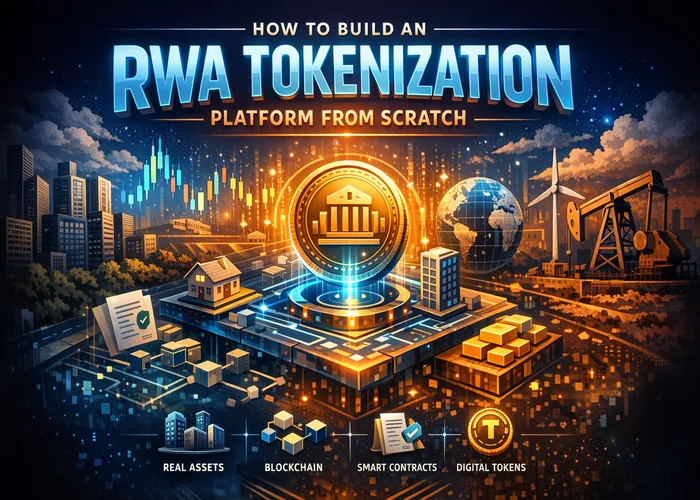
This article explains how to build an RWA tokenization platform from scratch, covering why businesses should pursue it in 2026, the legal and structural foundations, essential technical architecture, and strategies for sustainable liquidity & revenue.
Why Should Businesses Build an RWA Tokenization Platform in 2026?
Strategic Drivers Behind Building an RWA Tokenization Platform
- Access to Expanding Capital Pools: Tokenization enables issuers to access global, digitally native capital without being limited by geography or traditional distribution channels, broadening investor participation across private and institutional markets.
- Operational Efficiency in Issuance and Settlement: Blockchain-based infrastructure allows programmable settlement, automated compliance enforcement, and reduced reconciliation processes, lowering administrative overhead across the asset lifecycle.
- Enhanced Asset Structuring and Fractionalization: Illiquid assets such as private credit, real estate, and infrastructure can be fractionalized with predefined transfer restrictions, enabling more flexible ownership models without compromising regulatory controls.
- Integration with Emerging Financial Infrastructure: Digital custody, tokenized collateral frameworks, and 24/7 trading environments are increasingly being integrated into institutional finance, positioning tokenized assets within broader digital capital market systems.
- Long-Term Competitive Positioning: Early infrastructure builders influence standards around compliance architecture, token design, and secondary market structure, creating durable advantages as the market consolidates around scalable platforms.
Legal and Structural Foundations of an RWA Tokenization Platform
Building an RWA tokenization platform begins with regulatory positioning and legal structure; technology only operationalizes it. In most major jurisdictions, tokenized real-world assets are treated as securities or regulated financial instruments.
Oversight from regulatory bodies such as the U.S. Securities and Exchange Commission, the Financial Conduct Authority, and the Monetary Authority of Singapore shapes issuance, distribution, disclosure, and secondary trading requirements.
Component | Purpose | Why It Matters for an RWA Platform |
SPV Structure | Holds the underlying asset separately from the operating company | Protects investors through bankruptcy isolation and legal clarity |
Securities Classification | Determines regulatory treatment of the token | Defines disclosure, investor eligibility, and distribution limits |
Jurisdiction Strategy | Selects regulatory environment for issuance | Impacts licensing, taxation, and cross-border participation |
Embedded Compliance Controls | Enforces KYC, AML, and transfer restrictions | Prevents unlawful secondary transfers and regulatory breaches |
Custody & Governance Framework | Secures and manages the underlying asset | Ensures enforceable ownership rights and transparent reporting |
Asset Ownership and Issuance Structure
Asset Ownership and Issuance Structure
Most compliant platforms utilize a Special Purpose Vehicle (SPV) to legally hold the underlying asset. Investors receive tokenized securities representing economic rights in that vehicle rather than direct asset title.
This structure provides:
- Bankruptcy isolation
- Defined shareholder rights
- Clear dividend or yield distribution mechanics
- Legal enforceability under existing corporate law
The token represents ownership or economic exposure, but the legal claim remains anchored in traditional legal frameworks.
Securities Classification and Distribution Controls
Regulatory classification determines how the token may be offered and to whom. Depending on jurisdiction, offerings may be limited to accredited investors, qualified institutional buyers, or structured under specific exemptions.
Key considerations include:
- Prospectus or disclosure requirements
- Marketing restrictions
- Investor suitability checks
- Cross-border offering limitations
Failure to align token mechanics with securities regulations creates long-term compliance risk that cannot be corrected through technical modifications alone.
Embedded Compliance Design
Modern RWA tokenization platforms integrate compliance into the token transfer layer. Rather than relying solely on off-chain enforcement, platforms typically implement:
- Pre-transfer wallet whitelisting
- Jurisdiction-based transfer rules
- Lock-up period enforcement
- Ongoing KYC and AML verification
Embedding these constraints at the smart contract level will help you make sure that secondary trading remains aligned with regulatory obligations.
Custody and Asset Governance
Tokenization does not replace legal custody. The underlying asset must be secured through regulated custodians, trustees, or legally recognized asset managers.
This includes:
- Defined custodial responsibility
- Independent valuation standards
- Clear redemption or liquidation procedures
- Transparent reporting obligations
The credibility of the platform depends on the enforceability of asset rights, not solely on blockchain representation.
Technical Architecture Required to Build an RWA Tokenization Platform
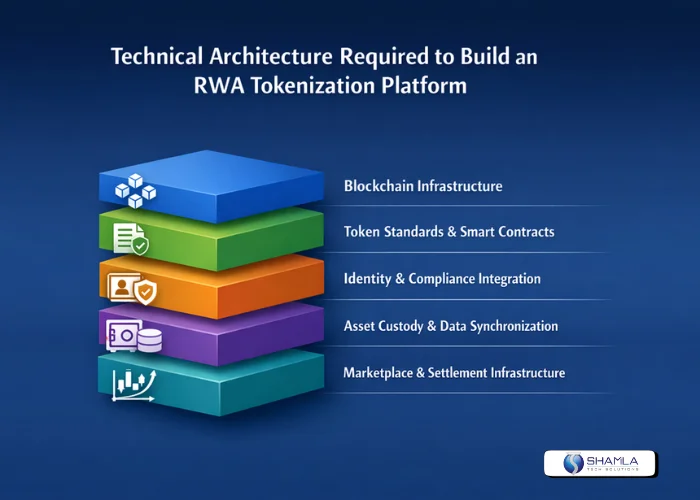
Blockchain Infrastructure Layer
This is the foundational decision, which involves selecting the blockchain environment on which the platform will operate. Most RWA platforms are currently deployed on networks such as Ethereum due to its security model, smart contract maturity, and institutional tooling ecosystem. Layer-2 networks like Polygon or Arbitrum are often used to reduce transaction costs while maintaining Ethereum settlement guarantees.
Infrastructure planning must account for transaction throughput, smart contract security audits, node reliability, and institutional custody compatibility. The blockchain layer should support upgrade mechanisms and monitoring tools to manage operational risk as issuance volumes and secondary trading activity expand.
Token Standard and Smart Contract Design
An RWA token cannot function as a simple transferable asset. It must embed compliance logic, ownership rights, and operational controls within the smart contract itself. This includes transfer restrictions, role-based permissions, and structured mechanisms for dividend or yield distribution.
Security-oriented token standards such as ERC-3643-style frameworks are often adopted to integrate compliance verification directly into token transfers. The smart contract architecture should also support corporate actions, redemption flows, and administrative oversight without compromising transaction integrity.
Identity and Compliance Integration
Regulatory compliance is operationalized through identity integration systems connected to blockchain logic. Investors typically undergo off-chain KYC and AML verification before their wallets are approved for participation. Compliance status must be continuously validated, not treated as a one-time event.
Wallet whitelisting, jurisdiction tagging, accreditation categorization, and transaction monitoring tools are integrated to ensure that every token transfer adheres to regulatory requirements. This layer bridges legal obligations with automated enforcement at the protocol level.
Asset Custody and Data Synchronization
Tokenization represents legal claims on underlying assets, making custody frameworks central to platform integrity. Custodians, trustees, or regulated asset managers maintain control of the physical or financial asset, while digital tokens represent economic rights.
Ongoing reconciliation mechanisms synchronize asset valuation, income distributions, and corporate actions between off-chain systems and on-chain records. Transparent reporting standards and audit processes are required to maintain alignment between digital representation and legal ownership.
Marketplace and Settlement Infrastructure
A complete RWA tokenization platform extends beyond issuance into secondary market functionality. This includes investor onboarding portals, order matching engines, and settlement logic designed to respect transfer restrictions and compliance checkpoints.
Integration with digital payment rails, including stablecoin settlement or tokenized collateral frameworks, enhances operational flexibility. The marketplace layer must balance liquidity facilitation with regulatory controls to ensure sustainable and compliant trading activity.
Build Institutional-Grade RWA Tokenization Infrastructure
How to Create Sustainable Liquidity and Revenue for an RWA Tokenization Platform
Liquidity is often treated as an automatic outcome of RWA tokenization. But in reality, it is a structural outcome of asset design, regulatory alignment, and capital composition. Converting ownership into a digital token will definitely improve transferability, but market depth requires credible assets, compliant trading frameworks, and deliberate incentive structures.
For businesses building an RWA tokenization platform from scratch, liquidity and revenue planning should be addressed before launch. The following pillars determine whether the platform can function well with durable infrastructure or remains a limited issuance tool.
Anchor Liquidity in Asset Quality
Sustainable liquidity begins with assets that produce measurable, predictable returns. Private credit, structured debt, income-generating real estate, and treasury-backed instruments attract repeat capital because their performance profile is defined.
Tokenization enhances access and operational efficiency, but it does not compensate for uncertain economics. Platforms that prioritize asset discipline tend to retain investors and build credible secondary participation over time.
Build Compliant Secondary Market Access
Secondary trading must operate within securities regulations. This typically requires integration with licensed intermediaries or structured marketplace models rather than unrestricted trading environments.
Embedding transfer restrictions, investor eligibility checks, and holding periods within the token logic ensures regulatory continuity. Reduced compliance friction improves participation while maintaining enforceability.
Tokenization enhances access and operational efficiency, but it does not compensate for uncertain economics. Platforms that prioritize asset discipline tend to retain investors and build credible secondary participation over time.
Target Institutional Capital Formation
Retail participation can provide initial momentum, but long-term depth often depends on institutional and accredited capital. These participants allocate based on yield stability, reporting transparency, and operational reliability.
Platforms should integrate regulated custodians, portfolio reporting systems, and stable settlement rails to align with institutional expectations. Institutional participation stabilizes trading activity and reduces volatility.
Design a Diversified Revenue Model
A sustainable RWA tokenization platform typically combines issuance fees, secondary transaction fees, and ongoing administrative servicing charges. Some operators also license their infrastructure to asset sponsors seeking white-label deployment.
Diversified revenue reduces reliance on transaction volume and supports predictable operating income across market cycles.
Bottom Line
Building an RWA tokenization platform from scratch forces a business to confront a simple question: are you creating a financial product, or are you building financial infrastructure?
The difference is material. Products compete on features and distribution. Infrastructure competes on enforceability, reliability, and integration. In tokenized asset markets, legal structure, custody design, compliance automation, and capital partnerships matter more than interface design or token mechanics.
The opportunity in 2026 is not to tokenize everything. It is to tokenize specific asset classes with disciplined structure, credible custodianship, and clearly defined investor access. Platforms that narrow their scope, control risk, and align with regulated capital pools are more likely to endure than those pursuing broad, speculative coverage.
Build a Scalable RWA Tokenization Platform with Shamla Tech
Launching a compliant and scalable RWA tokenization platform requires coordinated legal structuring, blockchain architecture, identity integration, custody connectivity, and marketplace design aligned with regulatory expectations. Founders and financial institutions must approach tokenization as infrastructure development, where technical precision and compliance discipline determine long-term viability.
Shamla Tech is an RWA tokenization development company that supports startups, asset issuers, and enterprises in building regulated tokenization platforms from the ground up. We deliver compliant RWA tokenization platforms, including security token development, compliance-enabled smart contracts, KYC/AML integration, custody integrations, and secondary marketplace modules designed for scalable and institution-ready deployment.