


Over the past two years, stablecoins have begun to appear in institutional contexts that were previously closed to crypto-native systems. Payment pilots, internal settlement tests, and treasury-related experiments involving stablecoins have been disclosed by banks, payment firms, and asset managers, often alongside existing financial infrastructure rather than outside it.
As institutional use of stablecoin has increased, uncertainty around issuer responsibility, reserve treatment, and operational oversight became harder to ignore. Existing financial regulations were not designed with stablecoin issuers in mind, leaving both institutions and builders operating in gray areas that slow adoption and complicate due diligence.
The proposed CLARITY Act reflects an effort to address these gaps. Although it has not yet been enacted, it signals how regulators are beginning to frame stablecoins in response to real usage. This article helps stablecoin builders understand what they must be ready for in 2026, starting with a clear understanding of the CLARITY Act and what it aims to clarify.
Develop stablecoins designed for real financial environments in 2026
What Is the CLARITY Act and Why It Matters for Stablecoins
The CLARITY Act is a proposed U.S. legislative framework intended to reduce uncertainty around how stablecoins and their issuers are regulated. As stablecoins move into payment, settlement, and treasury workflows, existing financial rules have struggled to clearly define responsibility and oversight. The CLARITY Act seeks to address this by providing clearer regulatory boundaries within the current U.S. financial system.
The proposal focuses on several areas that directly affect stablecoin platforms:
- Regulatory oversight: Clearer alignment between stablecoin activity and the regulators responsible for supervising issuance and operations.
- Asset classification: More consistent treatment of stablecoins that function as payment instruments within regulated financial activity.
- Issuer responsibility: Clearer expectations around accountability for issuance controls, reserve management, and ongoing operational integrity.
For stablecoin builders, the CLARITY Act matters because it reflects how institutions are already evaluating platforms. Reviews now focus on accountability, reserve operations, and control structures, even in the absence of final legislation. Understanding this shift explains why stablecoin design decisions in 2026 look different from earlier cycles.
The Stablecoin-Specific Gaps the CLARITY Act Attempts to Address
Stablecoins forced regulatory attention because they operate across payments, issuance, and custody without a clear allocation of responsibility once they reach institutional scale. As stablecoins began to appear in settlement and treasury use cases, gaps in accountability and oversight became operational risks rather than theoretical concerns.
Core gaps exposed by stablecoins
- Accountability gaps: Responsibility during depegs, operational failures, or redemptions is often unclear at the system level.
- Reserve oversight gaps: Reserves exist, but standards around monitoring, verification frequency, and control vary widely.
Oversight consistency gaps: Supervision differs across regulators and jurisdictions, creating uncertainty for institutions operating at scale.
Why these gaps block stablecoin adoption
Gap area | What works today | What institutions cannot resolve |
Issuance | Mint and burn mechanisms | Who owns failure outcomes |
Reserves | Attestations | Ongoing operational visibility |
Oversight | Case-by-case review | Predictable supervision |
These gaps slow institutional adoption more than technical limitations because they introduce uncertainty that cannot be priced, audited, or governed away.
What Stablecoin Builders Must Be Ready for in 2026
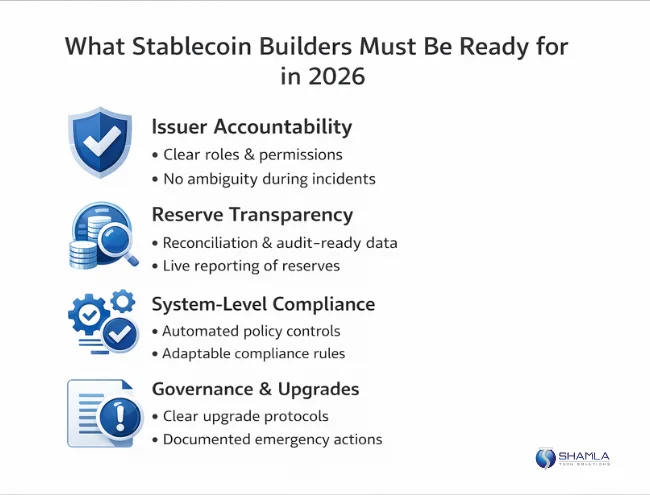
1. Issuer accountability
Stablecoin platforms are being evaluated on whether responsibility is technically enforceable, not simply described in documentation. Institutions expect minting and redemption authority to be clearly owned, access to be role-based, and limits to be enforced at the system level.
During incidents, there must be no uncertainty around who can act, what actions are permitted, and how those actions are recorded. Architecturally, this pushes builders toward explicit permission boundaries, operational segregation, and traceable control paths across on-chain and off-chain components.
2. Reserve transparency
Reserve backing is no longer assessed through periodic statements alone. Institutions expect reserve data to reconcile with issuance in a way that can be verified continuously. This introduces infrastructure requirements around data pipelines, reporting consistency, and audit access.
Stablecoin Builders are increasingly expected to treat reserve operations as part of the platform, with systems that surface balances, movements, and controls in formats auditors and risk teams can review without custom explanations.
3. System-level compliance
Manual compliance workflows break down once stablecoins move into high-volume or cross-border use. Institutions expect compliance controls to exist within the transaction flow itself, with configurable policies that can be updated as requirements evolve.
This has direct architectural implications: compliance logic must be modular, policy-driven, and decoupled from core settlement logic. Platforms that hard-code assumptions struggle when rules change or when new jurisdictions are added.
4. Governance and upgrade control
Governance is evaluated as a risk surface. Institutions expect upgrade authority to be explicit, limited, and documented, with predictable paths for emergency actions. This includes how contracts are upgraded, how parameters are changed, and how rollback or pause mechanisms function under stress.
Stablecoin developers expected to design governance workflows that balance control with restraint, supported by audit trails and internal approval processes that resemble those used in regulated infrastructure.
Get clarity on what stablecoin platforms are expected to support in institutional and regulated environments.
Bottom Line: What Will Define Winning Stablecoin Platforms in 2026
The CLARITY Act captures how U.S. regulators are beginning to frame stablecoin issuance, oversight, and responsibility in response to institutional use. Even in draft form, it reflects a shift away from informal assumptions toward clearer expectations around who operates stablecoin systems and how they are controlled. Builders evaluating their platforms in 2026 are already encountering these expectations through institutional diligence, regardless of whether the Act is finalized.
The advantage for stablecoin builders lies in aligning infrastructure with this direction early. Platforms that enforce issuance authority, expose reconciled reserve data, embed compliance controls, and document governance behavior move through audits and partnerships with less friction. These choices reduce redesign risk and improve integration readiness.
The CLARITY Act does not determine outcomes on its own. Institutional expectations do. Builders who treat the Act as a directional signal, rather than a rulebook, are positioning their platforms to operate comfortably inside regulated financial environments.
Building Stablecoins Ready for 2026 Compliance with Shamla Tech
Shamla Tech is a stablecoin development company working with teams building for institutional use in 2026. Our platforms are designed to align with existing regulatory frameworks such as the GENIUS Act, focusing on enforceable issuer accountability, reserve operations, governance authority, and operational controls that institutions already expect when evaluating stablecoin systems.
Our work centers on infrastructure that holds up under audit and regulatory review, not short-term deployment choices. We design issuer systems where issuance and redemption authority are clearly enforced, reserve data is auditable and reconcilable, and governance actions are predictable under stress. These are the foundations institutions look for long before final legislation is in place.
We also design stablecoin infrastructure to remain adaptable as new rules emerge. By separating policy from core logic and embedding compliance and control at the system level, we help teams stay prepared when frameworks like the CLARITY Act are finalized. This approach reduces redesign risk and allows stablecoin platforms to evolve without disrupting institutional relationships or operations.
Build stablecoin infrastructure aligned with institutional and regulatory expectations for 2026.