


In late 2025, Trust Wallet disclosed a security incident tied to a malicious browser extension update. The breach results in the loss of $7 Million. Crypto wallet development has moved far beyond trader-focused utilities; demand is shifting toward institutional-grade platforms capable of supporting payments, custody, identity, and regulated financial workflows. At this stage, security failures represent systemic risk. Enterprises that treat crypto wallet development as software rather than financial infrastructure risk repeating the same preventable mistakes.
This guide explores how banks, fintechs, and asset-driven enterprises can approach secure crypto wallet development services with the rigor expected of core financial infrastructure
Launch a Secure and Compliant Crypto Wallet
The Trust Wallet Incident: What Actually Failed, and Why It Matters
The Trust Wallet breach originated from malicious code introduced into an official release pipeline. Once users unlocked their wallets, encrypted recovery phrases were accessed locally and exfiltrated through endpoints disguised as legitimate analytics services.
There was no blockchain exploit. No private key math failure. No protocol weakness. This incident clearly shows that crypto wallet risk increasingly lives above the blockchain layer—inside organizational processes, internal access controls, and software delivery pipelines. For banks, fintechs, real estate platforms, and regulated enterprises evaluating crypto wallet solutions, this reframes the problem entirely.
A secure crypto wallet development service must be governed like financial systems, not consumer software. Prevention depends less on new technology and more on disciplined architecture, accountability, and operational maturity.

Why Are Crypto Wallets Becoming Core Financial Infrastructure?
Crypto wallets were once viewed as trader utilities. That assumption is now outdated.
In 2025 alone, stablecoins settled over $40 trillion in transaction volume, rivaling traditional global payment rails. Wallets are now used for payments, savings, identity access, tokenized assets, and embedded finance products across industries.
For enterprises, this signals that the crypto wallet is becoming the primary financial interface layer.
- Banks, integrating digital assets without balance-sheet custody risk
- Fintechs, expanding globally without rebuilding payment rails
- Real estate platforms, enabling tokenized ownership and programmable settlement
- Enterprises, embedding financial workflows into existing products
As wallets assume these roles, expectations around security, compliance, and uptime now mirror those applied to core banking systems
Why Fintechs Are Using Crypto Wallets as Growth Infrastructure
Fintech adoption of crypto wallet development is accelerating because wallets collapse multiple financial primitives into a single controllable layer.
A well-architected wallet enables fintechs to:
- Provide self-custodial asset ownership
Users retain direct control of assets, reducing custodial liability while increasing transparency, trust, and regulatory alignment for the fintech provider.
- Enable fiat on-ramps and off-ramps without custody exposure
Wallet-based settlement minimizes balance-sheet risk while maintaining seamless integration with banking rails and payment processors.
- Integrate stablecoin payments and cross-border remittances.
Wallet rails reduce fees, settlement time, and geographic friction compared to legacy correspondent banking networks.
- Launch yield, savings, and treasury products efficiently
On-chain integrations allow compliant financial products to be deployed rapidly without rebuilding backend infrastructure.
- Scale globally without rebuilding payment systems
Wallet abstraction enables expansion into new markets without recreating region-specific financial plumbing.
Build a Custom, Compliant Crypto Wallet Designed for Real-World Financial Use Cases.
Where Most CryptoWallet Projects Fail Before Launch
Despite rising demand, many enterprise wallet initiatives fail quietly, before they ever reach scale. Organizations often underestimate wallet scope, treating crypto wallets as frontend applications rather than systems responsible for custody, authorization, compliance, and transaction finality. Others rely on generic SDKs or cloned architectures that lack institutional controls, auditability, and long-term adaptability.
Crypto wallet development partner selection also introduces hidden risk. Tool vendors optimize for speed and demos. Enterprises require governance, accountability, and lifecycle security.
By the time regulatory reviews, audits, or incidents occur, architectural shortcuts become expensive to reverse.
Crypto Wallet Security Is a Board-Level Risk, Not an Engineering Task
Wallet security decisions directly affect financial exposure, regulatory posture, and brand trust. As wallets begin handling institutional capital, failures trigger consequences that extend beyond engineering teams.
A single breach can lead to irreversible asset loss, regulatory investigations, operational disruption, and reputational damage that outlasts market cycles.
This is why crypto wallet development must be treated as a board-level decision. Architecture, governance, and partner selection require executive oversight, not just technical approval.
Organizations that recognize this early build defensible platforms. Those who don’t inherit compounding risk.
How Businesses Can Build a Compliant and Secure Crypto Wallet?
Crypto Wallet Development in 2026 is an institutional responsibility. Businesses need to ensure that the crypto wallet development services they choose align with the same governance, security, and compliance standards applied to core financial systems.
A compliant and secure crypto wallet begins with architecture. Here is what businesses need to focus on.
Treat Wallets as Regulated Financial Infrastructure
Crypto wallets should be designed as systems that handle custody, payments, identity, and transaction authorization. This requires formal governance, documented controls, and executive accountability—similar to payment gateways or core banking platforms.
Implement Strong Governance and Release Controls
Secure wallets enforce strict software delivery discipline. Multi-party approvals, restricted deployment access, and segregated environments prevent unauthorized code from entering production and reduce insider risk.
Use Enterprise-Grade Key Management
Private key handling must follow institutional security standards. Modern wallets use MPC or secure enclave-based signing to eliminate single points of failure while maintaining user control and auditability.
Enforce Separation of Duties by Design
Sensitive cryptographic operations must be isolated from analytics, UI, and third-party integrations. This architectural separation ensures that non-critical components can never access keys or recovery data.
Embed Compliance from Day One
A compliant crypto wallet integrates KYC, AML, transaction monitoring, and reporting capabilities at the infrastructure level. Compliance should be native to wallet workflows—not added after launch.
Enable Continuous Monitoring and Incident Readiness
Secure wallets monitor behavior in real time, detecting abnormal access patterns and triggering automated responses. Incident readiness plans ensure rapid containment, regulatory communication, and system recovery.
Design for Global Scale and Regulation
Future-ready wallets support multi-currency, multi-chain, and jurisdiction-specific compliance logic. Modular architecture allows businesses to expand without reengineering the security foundation.
Choose Infrastructure Partners, Not Tool Vendors
Businesses should work with a crypto wallet development company that understands regulatory expectations, institutional security, and long-term scalability—not providers offering wallet clones or generic SDKs.
A compliant crypto wallet is built through disciplined architecture, governance, and security controls. Organizations that approach wallet development as financial infrastructure reduce risk, gain regulatory confidence, and create durable platforms for future growth.
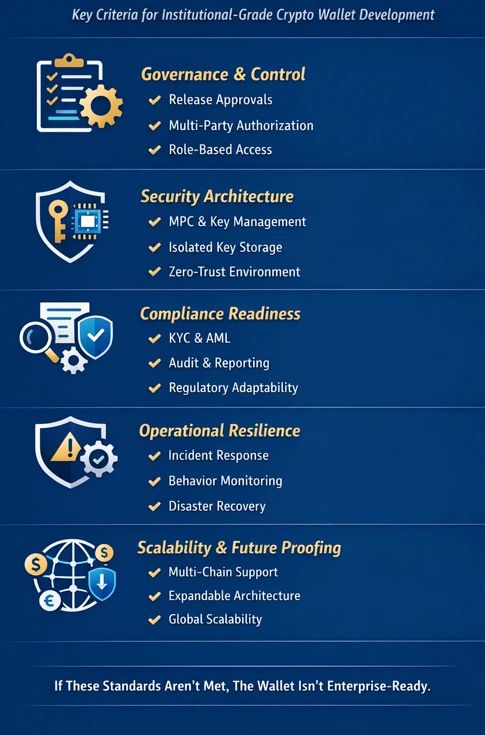
Executive Checklist: Is Your Crypto Wallet Enterprise-Ready?
If your wallet does not meet the following criteria after development, it is not enterprise-ready:
- Are release approvals and change management documented and enforced?
- Are production deployments protected by multi-party authorization?
- Is access role-based, auditable, and segregated?
- Are keys managed via MPC or secure enclaves?
- Are cryptographic operations isolated from application logic?
- Is compliance embedded at the infrastructure level?
- Are abnormal behaviors monitored in real time?
- Can the platform scale globally without re-architecting security?
Takeaway
Crypto wallet development in 2026 is an infrastructure decision with regulatory, financial, and reputational consequences. As wallets become the control layer for payments, custody, identity, and tokenized assets, enterprises must apply the same rigor used for core banking and payment systems. Secure crypto wallet development services demand disciplined governance, enterprise-grade key management, compliance-by-design, and operational resilience. Organizations that treat crypto wallets as long-term financial infrastructure reduce systemic risk, accelerate regulatory alignment, and retain strategic control as digital assets move deeper into the global financial system
Partner with ShamlaTech For Secure and Compliant Crypto Wallet Development
Shamla Tech is a leading crypto wallet development company specializing in security-first, enterprise-grade wallet infrastructure. We help banks, fintechs, real estate platforms, and Web3 businesses design and build compliant, scalable crypto wallet solutions aligned with global standards.