

Build Enterprise-Ready Custom AI Agents
Design and deploy secure, scalable Custom AI Agents that automate complex workflows across sales, finance, compliance, and operations.
Operational Constraints in Today’s Enterprise Work Models
Many core business functions still rely on repetitive tasks executed manually by employees.
- Data entry, invoice processing, reconciliation, onboarding, and reporting today require extensive human hours.
- Manual work scales linearly with volume, driving up costs as business activity grows.
- Human error increases with workload, impacting accuracy and compliance.
These constraints limit productivity and divert skilled talent from higher-value strategic work.
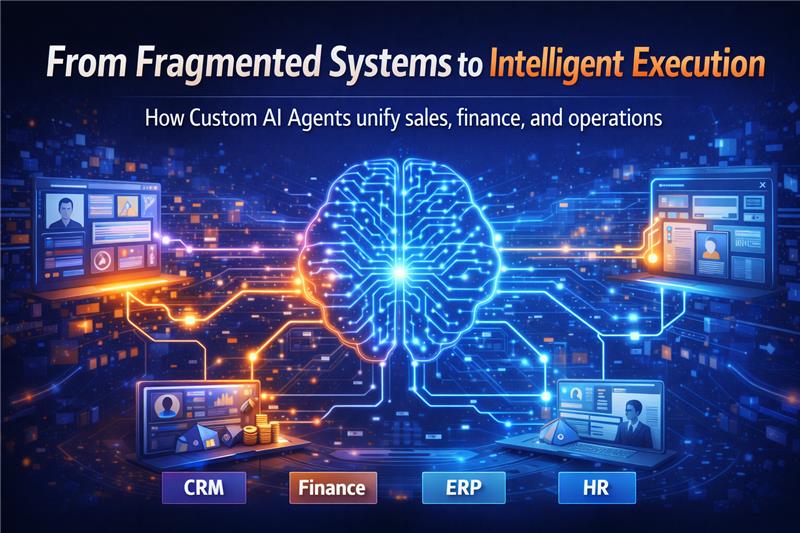
Organizations typically operate multiple disconnected software systems—CRM, ERP, billing, support, compliance, and HR platforms.
- Disparate data requires manual consolidation for reporting and decision-making.
- Cross-system workflows break or stall without human intervention.
- Delays and inconsistencies reduce operational visibility and agility.
This fragmentation slows execution and increases risk.
Modern customers expect real-time engagement and personalized service.
- Delayed follow-ups reduce conversion rates and customer satisfaction.
- 24/7 responsiveness is difficult to deliver with human teams alone.
- Peak volumes expose capacity bottlenecks.
This results in lost opportunity and weaker competitive positioning.
Traditional automation and rule-based systems (e.g., RPA) automate simple, predictable steps but cannot autonomously handle workflows involving unstructured data or decisions.
- Cross-functional processes require human handoffs, slowing throughput.
- Complex decision chains remain manual.
- Bottlenecks emerge at system interfaces.
These limitations make true end-to-end workflow automation elusive.
Regulated industries require stringent controls, audit trails, and continuous monitoring.
- Manual logging and periodic checks are slow and incomplete.
- Disconnected systems create oversight gaps.
- Regulatory penalties and operational failures increase compliance cost.
This constrains growth and heightens operational risk.
How Custom AI Agents Are Solving Enterprise Workflow Challenges
Custom AI Agents equipped for task automation take over high-volume activities across functions.
- AI agents for task automation process invoices, validate records, qualify leads, and manage follow-ups autonomously.
- Agents continuously learn workflow patterns, enabling adaptive execution over time.
- Cycle times decrease from hours to minutes without proportional increases in headcount.
Outcome: Lower cost per transaction and greater throughput with fewer errors.
Through AI agent system integration, custom AI agents connect and synchronize data across all critical enterprise platforms.
- Agents access CRM, ERP, finance, support, and compliance systems via APIs and secure connectors.
- Real-time workflows eliminate manual data handoffs and reconcile data inconsistencies.
- End-to-end processes execute seamlessly, improving visibility and control.
Outcome: Unified workflows and synchronized execution across departments.
Custom AI agents provide continuous operation without downtime.
- Sales agents engage leads instantly upon arrival.
- Support agents manage customer interactions 24/7.
- Operations agents monitor alerts and trigger actions immediately.
Outcome: Improved customer satisfaction, faster deal closure, and round-the-clock business continuity.
Agent platforms embed governance, auditing, and policy enforcement into every agent’s behavior.
- All actions are logged with traceability, ensuring audit readiness.
- Role-based permissioning prevents unauthorized access or execution.
- Compliance policies are enforced programmatically.
Outcome: Reduced regulatory risk and consistent policy adherence.
With structured agent deployment frameworks and partnerships with an AI Agent development company, enterprises accelerate time to value.
- Standardized deployment pipelines streamline launch and updates.
- Centralized monitoring and versioning enable safe expansion.
- New custom AI agents can be added modularly as needs evolve.
Outcome: Rapid scaling across functions with predictable governance.
By offloading routine work to AI agents, human teams can focus on judgment-intensive functions.
- Employees engage in high-value decision-making, creativity, and relationship management.
- Custom AI agents handle execution, freeing human capacity for strategic work.
Outcome: A higher-value workforce and improved organizational agility.
By addressing these core enterprise bottlenecks, custom AI agents are not just automating tasks—they are transforming how work gets done. With intelligent automation integrated deeply into operational processes, companies are unlocking new levels of efficiency, responsiveness, and strategic growth.
Where Custom AI Agents Deliver the Highest Business Impact
With a custom AI agent:
- Every lead is engaged instantly across channels
- Prospect behavior is analyzed in real time
- Pipeline updates are triggered automatically through system integrations
Business impact
- Higher lead-to-deal conversion
- Faster sales cycles
- More predictable revenue
A custom AI agent ensures no opportunity is lost due to human delay.
Support teams face rising volumes and increasing service expectations.
With a custom AI agent:
- Tier-1 and Tier-2 tickets are resolved autonomously
- Account, billing, and history data is retrieved instantly
- Escalations happen only when human judgment is required
Business impact
- Lower cost per ticket
- Faster resolution times
- Higher customer satisfaction
Finance, Accounting, and Treasury
Manual finance operations slow cash flow and increase error rates.
With a custom AI agent:
- Invoices, expenses, and payments are processed continuously
- Reconciliation and reporting run in real time
- Anomalies and fraud are detected automatically
Business impact
- Faster month-end close
- Improved financial accuracy
- Reduced operating cost
Compliance, Legal, and Risk Management
Regulatory complexity requires constant oversight.
With a custom AI agent:
- Transactions and communications are monitored continuously
- Policies are enforced at execution time
- Audit trails are generated automatically
Business impact
- Lower compliance risk
- Reduced audit cost
- Stronger governance
Operational inefficiencies drive up costs and delays.
With a custom AI agent:
- Inventory levels are monitored in real time
- Reorders and vendor coordination are automated
- Exceptions are resolved immediately
Business impact
- Fewer stockouts
- Lower inventory carrying costs
- Faster fulfillment
HR teams are burdened with repetitive administrative tasks.
With a custom AI agent:
- Onboarding, payroll, and benefits requests run automatically
- Compliance checks are enforced continuously
- Employee data stays synchronized across systems
Business impact
- Faster onboarding
- Lower HR overhead
- Better employee experience
IT Operations and Security
Modern IT environments require constant monitoring.
With a custom AI agent:
- Systems are monitored 24/7
- Incidents are detected and resolved automatically
- Security threats are escalated in real time
Business impact
- Reduced downtime
- Faster incident response
Across every enterprise function, a Custom AI Agent replaces fragmented, manual execution with intelligent, always-on digital operations—allowing organizations to scale faster, operate more efficiently, and compete more effectively in the AI-driven economy.
Turn AI into a Digital Workforce
Transform manual, fragmented processes into intelligent, always-on enterprise execution with custom-built AI Agent platforms.
How to Design and Deploy Custom AI Agents at Enterprise Scale
Every successful custom AI agent starts with a clearly mapped business process.
- Identify which workflows generate revenue, reduce cost, or control risk
- Define trigger points, decision rules, and success metrics
- Determine which systems the agent must read from and write to
This ensures the agent is designed around business outcomes, not generic AI capabilities.
A custom AI agent must understand how your business works.
This includes:
- Training on company policies, product data, pricing, compliance rules, and customer history
- Embedding decision logic that reflects real business constraints
- Defining what actions, the agent is allowed to take autonomously
This transforms the agent from a generic assistant into a digital employee that operates with business-grade precision.
Enterprise value comes from execution, not conversation.
Through secure system integrations:
- The agent reads data from CRM, ERP, billing, compliance, and support platforms
- The agent writes back actions, updates, and decisions in real time
- Workflows move across departments without human handoffs
This is how custom AI agents become part of the operating fabric of the organization.
Every custom AI agent must operate within defined guardrails.
Enterprise-grade deployments include:
- Role-based permissions
- Approval workflows for sensitive actions
- Full audit logs and traceability
- Policy-based enforcement
This ensures AI-driven execution remains compliant, secure, and accountable.
Once deployed, custom AI agents must be continuously optimized.
Enterprises use centralized platforms to:
- Monitor agent performance
- Track errors and exceptions
- Update models and rules
- Roll out new agents across teams
This allows organizations to scale from one agent to hundreds without losing control.
A Custom AI Agent is not a tool—it is a programmable unit of enterprise execution. When designed and deployed correctly, it becomes a permanent part of how the business operates, grows, and competes in the AI-driven economy.
Conclusion
Build Your Own Custom AI Agents with Shamla Tech
Launch Your Custom AI Agent Platform
Create a governed, production-grade AI Agent infrastructure that delivers faster execution, lower cost, and continuous compliance.
FAQs
2.How do Custom AI Agents improve enterprise productivity and cost efficiency?
4.How long does it take to deploy a Custom AI Agent in an enterprise environment?
5.What types of business functions can Custom AI Agents support?