
How to Build an AI Agent Platform: A Complete Development Guide

AI Agent platform
Home » Artificial Intelligence » AI Agent Development Company » How to Build an AI Agent Platform: A Complete Development Guide
Developing a next gen intelligent systems require more than automation. Companies and businesses are moving toward systems that blend human intuition with machine intelligence that works on its own. This has led to a new type of digital system that can think, learn, interact, and help make important decisions across many functions. This change starts when businesses choose to build AI Agent systems that operate well with people, giving them insights, forecasts, contextual replies, and completely automated workflows. When companies learn how to make these systems, they get a competitive edge that changes how they do business, how customers feel about their experience, and how they plan for the future.
In today’s businesses, the need for AI agent platforms, AI development, custom software development, ai chatbot development, and advanced ai agent development keeps growing since companies want to make their workers smarter instead of replacing them.This change makes AI agents crucial partners instead of just tools, which means that the design and strategy behind these platforms are very important for their long-term success.

Why AI Agent Platforms Are Gaining Momentum

Unlike traditional AI models that respond to single prompts, AI Agent platforms developed with AI-powered data analysis are persistent, goal-oriented systems capable of reasoning, acting, observing outcomes, and iterating continuously.

Key Market Drivers

Operational Automation at Scale

Enterprises face rising pressure to reduce costs while increasing speed and accuracy. Custom Generative AI agents can:

  • Execute multi-step workflows autonomously

  • Coordinate across tools, APIs, and databases

Reduce human intervention in repetitive decision loops

Advances in Foundation Models
Large Language Models (LLMs), multimodal models, and reasoning-optimized architectures now support:
  • Long-term memory

  • Tool usage and function calling

  • Chain-of-thought reasoning

  • Multi-agent collaboration
Tool-First Enterprise Architectures
Modern enterprises already rely on APIs, SaaS tools, data lakes, and event-driven systems, making them ideal environments for agent orchestration layers.
An AI agent is a piece of software that can plan and carry out tasks for a user or system on its own by using the tools that are already accessible. AI agents are great at making decisions, solving problems, interacting with the environment, and carrying out actions, in addition to comprehending normal language. There are many ways to group AI agents, such as:
  • Simple Reflex Agents: These Generative AI Development services follow basic “if-then” rules. They respond right away to what they see without thinking about what has happened in the past or what might happen in the future.
  • Model-Based Reflex Agents: These agents keep a mental picture of the world that helps them make choices based on what they know about the circumstance at hand.
  • Goal-Based Agents: These agents know what they want to do and make choices to get there. They employ algorithms for searching and planning to figure out the ideal order of actions.
  • Utility-Based Agents: These agents have a utility function that tells them how desirable different states are. They choose what will give them the most expected utility.
  • Learning Agents: These agents can get better at what they do over time by learning from their mistakes. They change how they act by using different machine-learning methods.

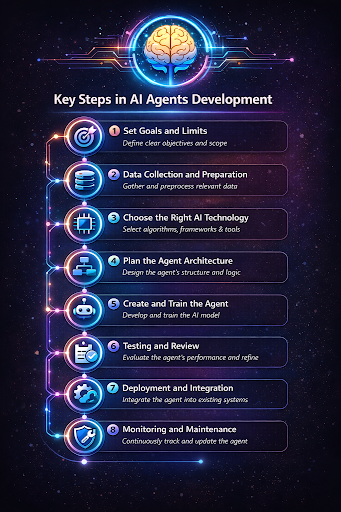
Key Steps in AI Agents Development

Making AI agents from the ground up is a complicated process that needs to be planned and carried out carefully. Here are the most important steps:
Step 1: Set goals and limits:
  • The first stage is to make sure everyone knows what the Custom Generative AI agent is supposed to do and how far it can go. This means figuring out what activities the agent will do, what data it will need, and what results are expected. This clarity is really important for making AI agents that work well.
Step 2: Data Collection and Preparation:
  • AI agents need data to learn and make choices. So, it’s really important to have high-quality, relevant data. The AI agent won’t be able to use this data correctly unless it is cleaned, preprocessed, and presented correctly.
Step 3: Choose the Right AI Technology:
  • You can utilize machine learning, natural language processing, and computer vision to make AI agents. The agent’s needs and the jobs it will do will determine which technology is best for it. Hiring a business that specializes in developing AI agents will help you choose the best one.
Step 4: Plan the Agent Architecture:
  • The architecture of the AI agent shows how its parts work together. This encompasses how the agent sees, thinks, and acts. For the agent to work properly and be able to grow, the architecture needs to be carefully thought out.
Step 5: Create and Train the Agent: 
  • This means putting the chosen AI algorithms into action and teaching the agent how to use the prepared data. This process of repeating steps improves the agent’s ability to do its job correctly and quickly. This is where an AI agent development company’s knowledge is quite useful.

Step 6: Testing and Review:

  • To make sure the AI agent works as it should, it needs to be tested thoroughly. This means checking how accurate, efficient, and strong the agent is in different situations.
Step 7: Deployment and Integration:
  • After the agent has been fully tested, it may be put into the production environment. This means connecting the agent to current systems and processes.
Step 8: Monitoring and Maintenance:
  • After deployment, it’s important to keep an eye on how the agent is doing and do regular maintenance. This includes giving the agent fresh information and improving its algorithms to make sure it still meets business needs.
Key aspects in AI Agent development

How to Choose the Best AI Agent Development Company?

Building an Custom Generative AI agent platform is a high-stakes technical initiative, and many organizations struggle with whether to build internally or partner with a specialized provider. Choosing the right AI agent development partner can significantly impact time-to-market, platform reliability, and long-term scalability. Below is a refined framework to help you evaluate and select the right service provider.
1. Prioritize Domain-Specific Expertise
AI agent platforms perform best when designed with real industry context. Shortlist partners who demonstrate hands-on experience in your sector, have delivered comparable AI agent solutions, and understand applicable regulatory or safety requirements. Domain expertise enables teams to anticipate edge cases, reduce rework, and deliver production-ready platforms faster.
2. Validate Core Technical Strengths
A capable Personalised AI Developments services should showcase deep technical proficiency, including expertise in modern agent frameworks, multi-agent orchestration, RAG pipelines, memory systems, and tool integration. Strong architectural design for reasoning, planning, and decision-making is essential to ensure scalability and performance.
3. Examine Portfolio and Client Proof
Review real-world evidence of execution, detailed case studies, client testimonials, and live or documented agent deployments. Proven delivery in similar use cases signals practical expertise beyond theoretical knowledge.
4. Ensure Observability, Safety, and Compliance
Your partner should embed observability, debugging, and monitoring into the platform by design. Look for robust safety mechanisms such as human-in-the-loop controls, risk mitigation strategies, and compliance with regulations like GDPR, HIPAA, or sector-specific standards.
5. Look for Flexibility and Long-Term Collaboration
The right partner offers modular architectures, supports diverse agent types, and provides continuous optimization and maintenance. This adaptability ensures your Personalised AI Developments services evolves alongside emerging use cases.
6. Align on Pricing and Engagement Models
Finally, assess commercial alignment, transparent pricing, defined milestones, realistic timelines, and strong post-deployment support. A well-aligned engagement model lays the foundation for a sustainable and successful partnership.

Enterprise Use Cases Driving Adoption

Here are some of the Generative AI implementation use cases

Customer Support & CX

  • Autonomous ticket resolution

  • Knowledge base reasoning
    Sentiment-aware escalation

Sales & Marketing

  • Lead qualification agents

  • Proposal generation

  • Campaign optimization

Finance & Operations

  • Invoice matching

  • Expense audits

  • Forecasting agents

IT & DevOps

  • Incident response

  • Infrastructure optimization

  • Security monitoring

AI Agent Platform Architecture (High-Level)

Layer

Function

Interface Layer

Dashboards, APIs, chat interfaces

Orchestration Layer

Task routing, coordination

Intelligence Layer

LLMs, reasoning engines

Tool Layer

APIs, databases, services

Memory Layer

Vector DBs, knowledge stores

Governance Layer

Security, compliance, logging

Takeaway

AI agents are moving from experimental tools to core enterprise infrastructure. The shift mirrors the evolution from single applications to cloud platforms. Organizations that invest early in scalable, governed AI agent platforms will gain a decisive advantage in speed, efficiency, and innovation.

Build a Production-Grade AI Agent Platform With Shamlatech

Shamlatech helps enterprises design and deploy end-to-end AI agent platforms, from architecture and model strategy to orchestration, governance, and system integration. Our solutions include multi-agent coordination engines, secure tool integration frameworks, enterprise memory systems, and compliance-ready control layers. Whether you’re launching an internal automation platform or a commercial AI agent SaaS, Shamlatech delivers scalable, secure, and future-ready AI infrastructure.

Begin Your AI Agent Build

Table of Contents

Send Us A Message
christmas offer