
Global financial markets are already allocating measurable capital into tokenized assets. As of early 2026, more than 21.35 billion dollars worth of real-world assets are active on public networks, spanning government debt, commodities, private credit, and institutional funds. United States Treasury products alone exceed 9 billion dollars, indicating that tokenization has moved beyond trials into active financial deployment.
Real-world asset tokenization in 2026 reflects a transition from experimentation to execution. Forecasts from major consulting firms project sustained acceleration. Boston Consulting Group estimates that the total value of tokenized assets could reach 16 trillion dollars by 2030, representing close to 10 percent of global GDP, shaping the future of real-world asset tokenization as a core financial infrastructure.
This article explores the top five industries that will be transformed by real-world asset tokenization and the growing demand this creates for RWA tokenization platform builders. As adoption accelerates toward 2026, platforms that offer secure, compliant, and scalable infrastructure will be essential to support asset onboarding, issuance, and trading across multiple industries.
RWA Tokenization Market in 2026 and What It Signals for RWA Platform Builders
The RWA market in 2026 shows clear signs of structural maturity rather than speculative growth. Capital is flowing first into regulated, yield-generating assets, led by institutions with long-term deployment horizons. For RWA platform builders, this data signals where demand is concentrated, what compliance expectations look like, and which capabilities are now non-negotiable.
(All data referenced in this article was current as of mid January 2026.)
Institutional capital defines platform requirements.
Distributed real-world asset value has reached 21.35 billion dollars, with the total represented asset value exceeding 350.08 billion dollars. This gap signals strong demand for platforms that support asset representation, custody integration, and compliant issuance rather than retail-only distribution.
Government debt sets the compliance benchmark.
Tokenized United States Treasury debt exceeds 9 billion dollars, establishing regulatory-grade standards for identity verification, reporting, and settlement. Platform builders must design for institutional compliance from day one.
Commodities and private credit validate modular platform design.
Commodities at 3.7 billion dollars and private credit at 2.4 billion dollars show that asset classes vary widely in structure, lifecycle, and risk. Builders need modular architectures that adapt across industries using real-world asset tokenization.
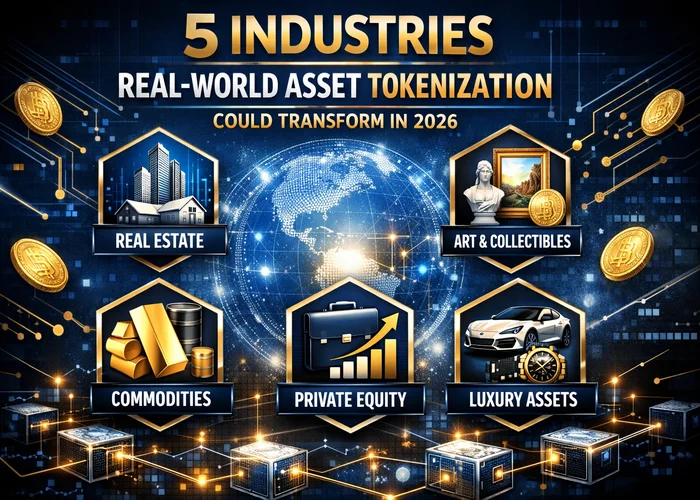
5 Industries RWA Tokenization Could Transform in 2026
Industry | Core Shift | Resulting Change |
Real Estate | Fractional, on-chain ownership | Faster settlement and secondary liquidity |
Commodities | Verifiable custody and quality | Lower counterparty risk and programmable delivery |
Private Equity & Credit | Programmable fund operations | Controlled liquidity and near real-time reporting |
Infrastructure & Energy | Performance-linked capital flows | Milestone-based payouts and transparent governance |
IP & Royalties | Tokenized rights and revenue | Automated payouts and tradeable royalty streams |
1. Real Estate
By 2026, real estate is positioned to be one of the most visibly transformed industries through real-world asset tokenization. Traditionally illiquid property assets are becoming easier to fractionalize, transfer, and finance as ownership and cash flow logic moves on-chain. Tokenization addresses long settlement cycles caused by fragmented records, manual processes, and jurisdiction-specific rules.
For RWA tokenization platform builders, this transformation requires replacing paper-driven workflows with deterministic processes while preserving legal certainty through document orchestration and role-based approvals. Real estate tokenization development must focus on natively supporting title representation, lien priority, escrow logic, and automated payouts so ownership changes remain legally enforceable rather than existing as parallel digital records.
What RWA tokenization changes in property markets:
- Property ownership shifts from whole asset transfers to fractional, investable units
- Settlement timelines compress as title, escrow, and payouts execute on-chain
- Rental income moves from manual reconciliation to automated distribution.
Cross-border property investment becomes feasible through embedded compliance. - Illiquid assets gain observable pricing through secondary market activity.
2. Commodities
Commodity markets are being transformed as tokenization enables physical assets to be financed, traded, and settled with greater transparency and speed. By 2026, demand is increasing for digital representations that reflect custody, quality, and redemption rights in near real time.
This shift places new requirements on platform builders to model physical supply chains accurately while integrating inspection, warehousing, and logistics data. Token structures must align tightly with physical reality so digital units remain trusted by producers, traders, and financial counterparties rather than introducing new reconciliation risk.
What RWA tokenization changes in commodity trading:
- Physical commodities become continuously financeable through digital units
- Counterparty risk declines as custody and reserves become verifiable.
- Asset quality becomes transparent rather than dependent on periodic inspection
. - Delivery and redemption shift from manual coordination to programmable logic
- Provenance and sustainability data become auditable at the asset level.
3. Private Equity and Private Credit
Private equity and private credit are undergoing structural change as tokenization introduces programmability and selective liquidity into historically closed markets. By 2026, investors increasingly expect faster settlement, clearer reporting, and more efficient fund administration.
For RWA platform builders, this transformation requires mirroring legal fund structures on-chain while automating capital calls, distributions, and performance tracking. Permissioned access, layered compliance, and controlled transfer logic are essential to maintain regulatory alignment while enabling limited secondary activity without compromising fund governance.
What tokenization changes in private capital markets:
- Fund administration shifts from manual processes to automated lifecycle events
- Liquidity evolves from nonexistent to controlled and permissioned.
- Capital calls and distributions move from periodic cycles to programmable flows.
- Reporting becomes near real-time instead of quarterly or annual.
- Valuation signals emerge through regulated secondary transactions.
4. Infrastructure and Renewable Energy
Infrastructure and renewable energy projects are being reshaped as tokenization links capital deployment directly to measurable performance outcomes. By 2026, investors and developers increasingly expect funding structures that align payouts with milestones and real-time operational data.
Platform builders must integrate telemetry and performance feeds with payment logic so distributions reflect actual output rather than estimated reporting. Supporting staged issuance, long-dated settlement, and governance models aligned with concession terms and regulatory oversight is critical for tokenized infrastructure assets.
What RWA tokenization changes in project financing:
- Capital deployment aligns directly with measurable project milestones
- Investor payouts move from estimates to performance-driven distributions.
- Long-horizon assets become accessible to smaller and more diversified investors.
- Operational data becomes a direct financial input rather than a report.
- Governance shifts toward transparent, rule-based oversight.
5. Intellectual property and royalties
Intellectual property markets are being transformed as tokenization introduces clarity, transparency, and liquidity into rights management and royalty flows. By 2026, creators and investors increasingly demand enforceable ownership records and reliable revenue distribution.
RWA platform builders must represent rights with precise metadata, encode usage terms, and automate payout logic across stakeholders. Ensuring legal mapping and verification across jurisdictions is essential so tokens represent enforceable claims rather than abstract digital certificates.
What RWA tokenization changes in rights and royalties:
- Royalty streams become standalone, tradeable financial assets
- Revenue reporting shifts from opaque statements to verifiable usage data
- Creator payouts move from delayed cycles to automated settlement.
- Licensing evolves from bespoke agreements to standardized digital rights.
- Ownership disputes decrease through immutable rights records.
Building RWA Tokenization Platforms with Compliance and Security
Regulatory Oversight Shapes Platform Architecture
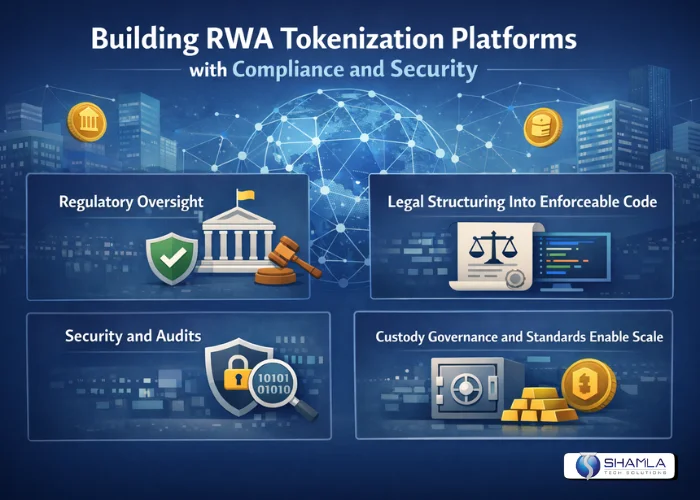
Real-world asset tokenization platforms operate under direct and indirect supervision from bodies such as the United States Securities and Exchange Commission and regulators like VARA in Dubai. Compliance is embedded through identity verification, transaction monitoring, and eligibility controls aligned with securities and asset-specific regulations.
Builders must design systems that adapt to jurisdictional differences without rewriting core logic. Rule engines, permission layers, and reporting workflows allow platforms to expand across markets while maintaining alignment with local regulators and evolving legal expectations.
Legal Structuring Must Translate Into Enforceable Code
Every token represents a legal right tied to off-platform agreements. Platforms rely on clear legal structuring to define ownership, transfer rights, and revenue entitlements before any code is written. This alignment determines whether tokens remain enforceable under regulatory scrutiny.
Translating legal terms into smart contracts requires precision. Many RWA tokenization platform development teams acquire RWA Legal Consulting Services to ensure digital logic reflects shareholder agreements, debt covenants, and disclosure rules without ambiguity or execution risk.
Security And Audits Define Institutional Trust
Smart contracts control asset ownership and cash flows, placing security at the center of platform credibility. Independent audits, formal verification, and continuous monitoring reduce operational risk and meet expectations from regulators and institutional counterparties.
Security planning extends beyond launch. Upgrade governance, emergency controls, and incident response frameworks allow platforms to address vulnerabilities without disrupting live assets or compromising compliance commitments.
Custody Governance And Standards Enable Scale
Custody frameworks determine how assets are protected, reported, and reconciled. Platforms must integrate with qualified custodians or compliant segregation models recognized by regulators to support institutional participation and audit readiness.
Governance models define how decisions are made under regulatory oversight. Token standards that support permissions, metadata, and lifecycle events allow platforms to scale across asset classes while maintaining consistency and control in real-world asset tokenization.
Takeaway
Real-world asset tokenization has moved beyond experimentation and isolated deployments. Current data shows RWA tokenization platforms being built for long-term operation, regulatory scrutiny, and institutional scale. The systems gaining traction are those grounded in legal enforceability, asset-specific workflows, and infrastructure that regulators and market participants can evaluate with confidence.
What separates durable RWA platforms from short-lived ones is architectural discipline. Builders who account for jurisdictional nuance, custody requirements, and asset lifecycle complexity create systems that strengthen over time as new asset classes and regions are added. In this model, compliance and security function as foundations for growth rather than operational constraints.
The next phase of real-world asset tokenization will be shaped by teams focused on infrastructure built with care and precision. As adoption expands across real estate, commodities, private capital, infrastructure, and intellectual property, platforms that prioritize resilience, adaptability, and trust will influence how value is created, transferred, and managed in emerging financial markets.
Partner with Shamla Tech to Build RWA Tokenization Platforms for Any Industry
Shamla Tech is an RWA tokenization development company that has worked with clients around the world across industries such as real estate, mining, commodities, and more, helping teams build scalable RWA tokenization platforms designed for real-world deployment.
We bring hands-on experience in compliance-ready architecture, secure asset workflows, and platform scalability from day one. Our teams work closely with asset issuers and enterprises to translate complex real-world assets into robust platforms built to operate within regulatory and operational realities.