

Stablecoins are no longer viewed as experimental payment instruments in the United States. By 2026, they are increasingly treated as financial products that must meet formal regulatory and compliance standards at launch, not after adoption.
This shift reflects the scale of the market. Global stablecoin circulation has surpassed $150 billion, accelerating regulatory action as stablecoins move deeper into payments, settlements, and enterprise financial infrastructure.
This article presents a clear legal checklist for launching a regulated stablecoin in the U.S., outlines the laws and regulatory developments shaping 2026, and explains how founders can design stablecoin systems with compliance embedded into their legal and operational foundations.
Design and launch a stablecoin aligned with U.S. regulatory expectations
U.S. Stablecoin Laws & Upcoming Regulations in 2026
Key Laws and Upcoming Regulations Affecting Stablecoins in USA
Existing and Enacted Laws
- GENIUS Act (Guiding and Establishing National Innovation for U.S. Stablecoins)
The GENIUS Act governs payment stablecoins. It requires full 1:1 reserve backing, clear redemption rights, transparency, audits, and regulatory oversight for stablecoin issuers. - Bank Secrecy Act (BSA)
Applies AML, KYC, transaction monitoring, and reporting obligations to stablecoin issuers and intermediaries operating in or serving the U.S. - State Money Transmission Laws
Require many stablecoin issuers to obtain money transmitter licenses at the state level unless operating under a qualifying federal or banking charter. - OFAC Sanctions Regulations
Mandate sanctions screening and controls to prevent stablecoin transactions involving sanctioned individuals, entities, or jurisdictions.
Upcoming and Pending Regulation
- CLARITY Act (Pending)
The CLARITY Act is a market-structure bill designed to clarify how digital assets are classified under U.S. law and whether oversight falls under securities or commodities regulation. While not stablecoin-specific, it directly affects how stablecoins interact with exchanges, trading platforms, and secondary markets.
Legal Checklist for Launching a Regulated Stablecoin in USA
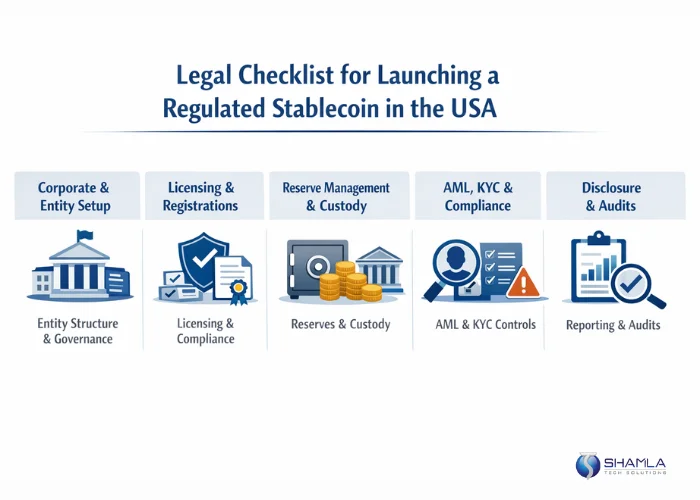
1. Corporate & Entity Setup
Stablecoin projects should begin with a U.S.-compliant corporate structure that clearly separates token issuance, reserve management, and operational services. Regulators expect a defined issuing entity with a transparent ownership structure, documented governance, and clear decision-making authority over minting, burning, and redemptions.
Many projects establish a U.S. parent or subsidiary specifically for stablecoin issuance to align with domestic regulatory oversight. Board oversight, internal controls, and documented risk management processes are critical at this stage, as they influence licensing eligibility and banking relationships later. The entity’s constitutional documents should explicitly authorize stablecoin issuance and reserve handling, ensuring legal clarity before engaging regulators, banks, or custodians.
2. Licensing & Registrations
Licensing requirements depend on how the stablecoin is issued, redeemed, and distributed. Most U.S.-facing stablecoin issuers must evaluate state money transmitter licensing, unless operating under a qualifying federal or banking charter. This process helps regulators assess capital adequacy, compliance readiness, management experience, and operational resilience.
In parallel, registration obligations may arise under federal financial crime regulations, particularly where the issuer controls user onboarding or redemption flows. Licensing strategy must be aligned with the stablecoin’s operational model, as poor structuring can trigger unnecessary regulatory exposure. Founders should treat licensing as a launch-critical dependency, not a post-deployment task.
3. Reserve Management & Custody
Reserve architecture is one of the most scrutinized aspects of a regulated stablecoin. Issuers must maintain verifiable 1:1 backing using approved, high-quality liquid assets such as cash or short-term U.S. Treasuries. Reserve funds should be held with regulated financial institutions and legally segregated from operating capital.
Custody arrangements must define control rights, access limitations, and redemption mechanics under normal and stress conditions. Regulators increasingly expect formal reserve policies, real-time tracking, and reconciliation procedures that match on-chain supply. Weak reserve governance is a primary cause of enforcement actions and loss of market confidence, making this a foundational compliance area.
4. AML, KYC & Compliance Programs
Stablecoin issuers are expected to operate bank-grade financial crime controls, particularly when they manage issuance, redemption, or user-facing services. This includes customer due diligence, transaction monitoring, sanctions screening, and suspicious activity reporting aligned with U.S. financial crime laws. Compliance programs must be documented, staffed, and operational at launch.
Regulators assess whether controls are tailored to stablecoin-specific risks such as rapid liquidity movement, cross-border flows, and on-chain transparency gaps. A weak compliance framework can restrict banking access, delay licensing, or expose the issuer to enforcement risk even if the stablecoin design itself is sound.
5. Disclosure, Audits & Reporting
Transparency obligations for stablecoin issuers extend beyond marketing disclosures. Regulators and counterparties expect clear, periodic reporting on reserve composition, circulation, redemption activity, and material operational risks. Independent audits or attestations are often required to validate reserve backing and internal controls.
Disclosure language must accurately reflect how the stablecoin operates, avoiding ambiguity around redemption rights or asset backing. Reporting obligations may also include regulatory filings, financial statements, and compliance reviews. Well-structured disclosure and audit processes improve regulatory credibility and institutional adoption, while inconsistent or delayed reporting is a common trigger for regulatory scrutiny and loss of market trust.
Launch Stablecoins for regulated USA market entry
Key USA Stablecoin Regulatory Bodies To Deal With
USA Stablecoin Regulator | Primary Focus |
U.S. Department of the Treasury | Policy direction, systemic risk |
FinCEN | AML, KYC, sanctions, reporting |
Federal Reserve | Payments, banking access |
OCC | Bank and trust-issued stablecoins |
SEC | Yield, investment features, markets |
State Regulators | Money transmission licensing |
Major Regulatory Bodies and How to Work With Them
1. U.S. Department of the Treasury
Role: Sets overall policy direction for stablecoins and coordinates federal oversight.
Operational Implication: Align stablecoin design with federal policy objectives such as financial stability, reserve safety, and consumer protection. Treasury alignment matters when engaging banks and federal regulators.
2. Financial Crimes Enforcement Network (FinCEN)
Role: Enforces AML, KYC, transaction monitoring, and reporting requirements.
Operational Implication: Build AML and sanctions controls directly into issuance, redemption, and wallet flows. Compliance programs must be operational at launch and integrated into backend systems.
3. Federal Reserve
Role: Oversees payment systems and banking relationships connected to stablecoins.
Operational Implication: Design settlement and redemption mechanisms that integrate cleanly with regulated banks and payment rails. Banking access often depends on Federal Reserve expectations.
4. Office of the Comptroller of the Currency (OCC)
Role: Supervises national banks and trust entities involved in stablecoin issuance or custody.
Operational Implication: If issuing through a bank or trust structure, governance, risk controls, and reserve custody must meet bank-grade standards from day one.
5. U.S. Securities and Exchange Commission (SEC)
Role: Oversees investment-like digital assets and securities markets.
Operational Implication: Avoid yield, profit expectations, or investment-style marketing unless intentionally pursuing a securities-compliant structure. Stablecoin design decisions determine SEC exposure.
6. State Financial Regulators
Role: Enforce money transmission and consumer protection laws at the state level.
Operational Implication: Licensing strategy must align with issuance and redemption flows. State compliance often affects where and how the stablecoin can be offered.
Common Legal Mistakes Stablecoin Founders Make
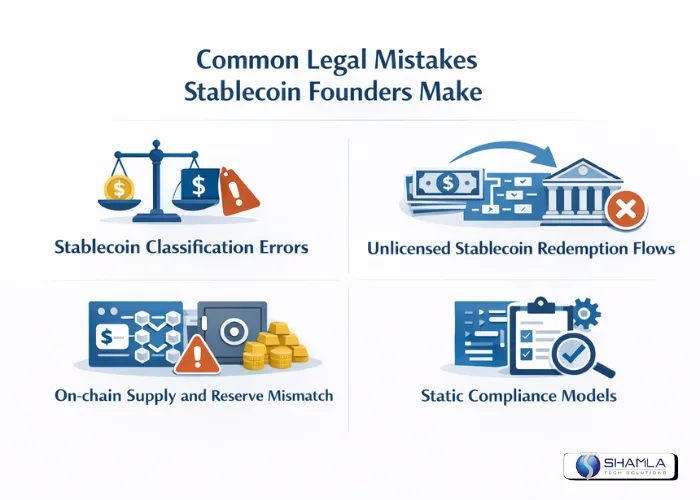
1. Stablecoin Classification Errors
2. Unlicensed Stablecoin Redemption Flows
3. On-chain Supply and Reserve Mismatch
4. Static Compliance Models
Final Thoughts
Stablecoin development in the United States requires legal structure at the earliest stages of design. Issuance mechanics, reserve controls, redemption workflows, and compliance systems directly influence operational continuity and access to regulated financial infrastructure. Legal alignment shapes how a stablecoin interacts with banks, custodians, payment rails, and supervisory authorities throughout its lifecycle.
Regulatory expectations increasingly inform technical architecture. Decisions around custody models, reserve composition, transaction monitoring, and user access define the scope of oversight and the durability of compliance frameworks. Stablecoin teams that integrate regulatory considerations into product design maintain flexibility as circulation grows and regulatory review deepens.
For stablecoins intended for sustained usage, legal readiness supports predictable operations and long term resilience. A stablecoin built on a well defined regulatory foundation is positioned to operate consistently across market conditions, partner requirements, and supervisory review processes.
Develop and Launch a Compliant Stablecoin in USA with Shamla Tech
Shamla Tech is a stablecoin development company that has developed and launched compliant stablecoins in the United States. We design issuance, reserve controls, redemption workflows, and compliance architecture aligned with federal and state regulatory expectations for regulated market entry and banking integration.
Our approach supports payment focused and yield structured stablecoins through compliant custody models, audit ready reporting, AML integration, and regulator aligned documentation. Teams work with us from architecture design through launch readiness, ensuring stablecoin systems meet operational, legal, and supervisory requirements.