
The tokenization of real estate is rapidly evolving from pilot projects into a regulated, high-growth financial market. Within this trend, Deloitte projects the global tokenized real estate market will grow from approximately USD 300 billion in 2024 to nearly USD 4 trillion by 2035, reflecting a CAGR of about 27%. The Dubai Land Department’s (DLD) government-backed PRYPCO Mint platform facilitated the first tokenized property sale—fully subscribed in under 24 hours by 224 investors—and its second fractional listing sold out in 1:58, drawing over 10,700 on the waitlist.
Under Dubai’s Economic Agenda D33 and Real Estate Strategy 2033, the Real Estate Tokenization Project is projected to contribute more than AED 60 billion (approximately USD 16 billion) by 2033, positioning tokenized property as a core driver of Dubai’s USD 16 billion tokenized real estate market. With oversight from the Virtual Assets Regulatory Authority (VARA) and rising institutional participation, success in Dubai real estate tokenization now depends on real estate tokenization platform development—building regulation-ready infrastructure that enforces ownership, compliance, custody, and investor controls at scale. This blog explores how Onshore, DIFC tokenization, and ADGM tokenization frameworks shape the future of compliant, scalable real estate tokenization in Dubai.
What We Do
How Dubai’s Regulatory Architecture Shapes Real Estate Tokenization Platform Development
Dubai’s Onshore, DIFC, and ADGM frameworks do more than permit real estate tokenization — they define how a compliant tokenization platform must be built. In Dubai, regulation is not a constraint on innovation; it is the design blueprint for production-grade real estate tokenization.
Each regulatory layer creates a specific technical and operational requirement for platforms.
1. Fractional ownership requires registry-linked asset architecture
Through DLD-led tokenization initiatives, real estate tokens must be tied to legally enforceable ownership or economic rights. This means a platform cannot rely on blockchain records alone — it must maintain a verified link between each token and the official property registry.
What platforms must support
- Asset digitization aligned with land registry records
- Mapping of tokens to legal ownership or beneficial interest
- Audit-ready ownership records
2. Global investor access requires built-in compliance engines
Under VARA oversight and Dubai’s RWA rules, real estate tokens cannot be freely traded like cryptocurrencies. Platforms must enforce who is allowed to buy, hold, and transfer tokens based on jurisdiction, investor type, and regulatory status.
What platforms must support
- KYC and identity verification
- Investor eligibility rules
- Jurisdiction-based restrictions
- Whitelisted transfers
3. Digital ownership requires controlled transfer infrastructure
Tokenized property cannot move without compliance checks. Every transaction must respect regulatory rules, lock-ups, and investor limits.
What platforms must support
- Transfer restrictions and approval logic
- Automated compliance at the transaction level
- Full audit trails for regulators and issuers
4. Institutional participation requires financial-grade systems
When tokenized real estate is structured under DIFC or ADGM, platforms must meet financial-services standards — not just blockchain standards.
What platforms must support
- Regulated custody and key management
- Reporting and investor statements
- Governance and corporate actions
- Integration with banking and settlement systems
Dubai’s regulatory model makes one thing clear: real estate tokenization platforms must be built like regulated financial infrastructure, not crypto apps. This is why choosing the right zone — Onshore, DIFC, or ADGM — is not only a legal decision, but a core architecture decision for any tokenized real estate platform.
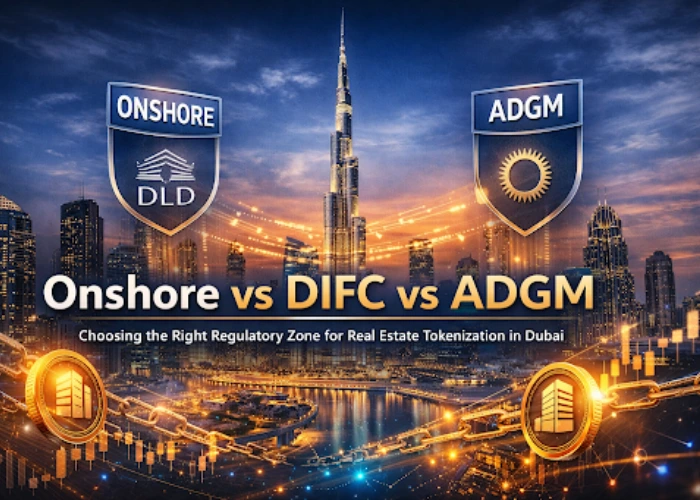
Understanding Dubai’s Regulatory Zones for Real Estate Tokenization Platform Development
Dubai does not operate under a single financial or digital asset regulator. Instead, it uses a zoned regulatory model that allows different types of economic activity to be governed by frameworks designed for their specific risk and complexity. This structure is a major reason Dubai has been able to move faster than most global markets in deploying regulated real estate tokenization.
At a high level, tokenized real estate activity in Dubai can fall under one of three jurisdictions:
Onshore Dubai: The Legal Backbone of Real Estate Tokenization Platforms
In Dubai, real estate tokenization platform development must start Onshore because this is where property legally exists. Every apartment, villa, and commercial building in Dubai is created, recorded, and enforced through the Dubai Land Department (DLD). No platform can claim to tokenize a Dubai property unless it is ultimately anchored to this registry.
From a platform architecture perspective, this means that tokens are only as strong as the legal records behind them.
What DLD means for tokenization platforms
The DLD controls the source of truth for all property data, including:
- Title deeds and ownership history
- Beneficial and fractional ownership
- Transfers, liens, and legal claims
- Dispute resolution and enforcement
When DLD introduces blockchain-linked ownership records and property token ownership certification, it creates a legal API for tokenization platforms. This allows platforms to link on-chain tokens to off-chain property rights in a way courts, banks, and regulators will recognize.
How platforms must map tokens to property law
A real estate token can represent:
- Ownership interest
- Rental income rights
- Share of sale proceeds
But for a real estate tokenization platform, these rights must be formally encoded in legal structures and reflected in registry-aligned records.
That requires platforms to support:
- Special-purpose vehicles (SPVs) or nominee structures that hold the property
- Token-to-beneficial-ownership mapping
- DLD-verifiable ownership records
Without this, a token is just a digital promise — not a legally enforceable asset.
Where VARA fits into platform design
Once property rights are issued as digital tokens, the platform moves into Dubai’s virtual asset regulatory layer, governed by the Virtual Assets Regulatory Authority (VARA).
For platform developers, this means:
VARA regulates how tokens are:
- Issued
- Marketed
- Traded
- Custodied
So a compliant Onshore real estate tokenization platform must operate across two regulatory systems:
Layer | What it governs |
DLD | Property ownership and legal rights |
VARA | Token issuance, trading, and custody |
Your platform must be able to satisfy both — or it cannot scale.
What Onshore Dubai is best for in platform strategy
Onshore Dubai is the right foundation when a platform is designed for:
- Fractional ownership of Dubai real estate
- Retail or broad investor access
- Government-linked tokenization programs
- Registry-grade legal enforceability
For platform builders, this means maximum legal certainty but also higher compliance requirements — which is exactly what institutions demand.
DIFC Tokenization: Building Regulated Real Estate Tokenization Platforms
While Onshore Dubai defines who owns property, the Dubai International Financial Centre (DIFC) defines how property exposure is turned into a regulated investment product. For real estate tokenization platform development, DIFC is where property becomes a financial instrument rather than just a physical asset.
DIFC is a common-law financial center regulated by the Dubai Financial Services Authority (DFSA). Platforms operating here are treated like investment platforms, not crypto startups.
What DIFC requires from tokenization platforms
DFSA regulates all financial activity in DIFC, including:
- Investment funds
- Securities and structured products
- Brokers, custodians, and market intermediaries
This means that when a platform tokenizes real estate in DIFC, it must treat those tokens as financial instruments with full investor protection, disclosure, and governance.
How real estate is structured on DIFC platforms
In DIFC-based tokenization models:
- The property is owned by an SPV, fund, or trust
- The platform issues tokens representing economic or beneficial ownership
- Investors hold regulated digital interests, not raw property titles
This gives platforms the ability to manage:
- Dividends and rental distributions
- Voting and governance
- Reporting and compliance just like a traditional investment product — but on blockchain rails.
Why institutions build on DIFC
Institutional capital demands:
- Regulated issuers
- Transparent asset classification
- Audited financials
- Enforceable investor rights
DIFC provides the legal certainty and financial-market infrastructure needed for large-scale tokenized real estate platforms.
What DIFC means for platform architecture
Platforms operating under DIFC must support:
- Investor onboarding with eligibility rules
- Regulated issuance workflows
- Corporate actions and reporting
- Custody and governance controls
This adds complexity — but it is what makes DIFC platforms investable by funds, banks, and institutions.
Best use cases for DIFC tokenization platforms
DIFC is ideal for:
- Tokenized real estate funds
- Private placements
- Professional investor offerings
- Regulated property investment products
It is not designed for retail trading — it is designed for institutional-grade real estate tokenization.
ADGM Tokenization: Building the Digital Asset Infrastructure for Tokenized Real Estate
While DIFC focuses on investment products, the Abu Dhabi Global Market (ADGM) is built for digital asset infrastructure. It is one of the most mature regulated environments in the region for blockchain platforms, custody, and token marketplaces—making it the natural home for real estate tokenization platforms that operate tokens as digital assets.
ADGM does not govern Dubai property itself. What it governs is everything that happens to the token once that property is digitized.
What ADGM requires from tokenization platforms
ADGM is regulated by the Financial Services Regulatory Authority (FSRA), which oversees:
- Token issuance and distribution
- Crypto and digital asset exchanges
- Custody, wallets, and key management
- Broker-dealers and market operators
This means any platform that wants to issue, hold, or trade property-backed tokens must be licensed and supervised by FSRA if it operates from ADGM.
How real estate tokens are implemented on ADGM platforms
In an ADGM-based architecture:
- A Dubai property is held by an SPV or trust
- Tokens represent economic or beneficial rights to that asset
- The token layer—issuance, wallets, and trading—is regulated by FSRA
This creates a clean legal separation:
- Property law remains in Dubai
- Token market infrastructure operates under ADGM
This model is standard in institutional finance and enables regulatory clarity across jurisdictions.
Why ADGM is ideal for marketplace and custody platforms
ADGM is the right choice when a platform aims to:
- Run a regulated token exchange
- Provide custody and settlement services
- Support secondary market liquidity
It allows tokenized real estate to function like other regulated digital financial assets rather than informal crypto tokens.
What ADGM means for platform design
Operating from ADGM requires platforms to support:
- FSRA licensing and governance
- Secure custody and key management
- Market surveillance and compliance
- Ongoing audits and regulatory reporting
This makes ADGM particularly well suited for infrastructure providers, exchanges, and institutional trading venues, rather than simple property issuers.
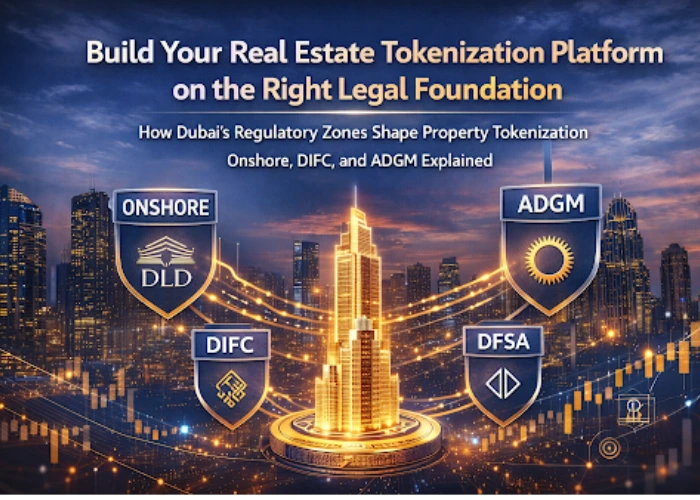
Why Regulatory Zoning Determines the Success of Real Estate Tokenization Platforms in Dubai
In Dubai, real estate tokenization platform development is not governed by a single set of rules. Instead, it operates within a zoned regulatory structure that separates property law, financial services, and digital asset oversight. This is what allows Dubai to support large-scale, compliant tokenized real estate Dubai projects while still protecting investors and the property market.
For platform builders, this means the regulatory zone you choose will determine how your product is designed, licensed, and operated.
How zoning affects platform architecture
A real estate tokenization platform must handle three critical layers:
- Property layer – Who legally owns the asset and how ownership is recorded
- Token layer – How digital units are issued, transferred, and held
- Investor layer – Who is allowed to participate and under what rules
In Dubai, these layers fall under different authorities depending on where the platform is based.
Why this matters for real estate tokenization in Dubai
A platform built in the wrong zone may be:
- Unable to link tokens to official property records
- Restricted from onboarding international investors
- Prohibited from offering secondary trading or custody
By contrast, a correctly structured platform can:
- Align tokenized property with legal ownership
- Enforce investor eligibility and compliance
- Support liquidity, reporting, and regulated growth
This is why understanding Onshore, DIFC tokenization, and ADGM tokenization is not a legal formality — it is a core design decision for any real estate blockchain Dubai platform that aims to scale.
Launch a Secure, Compliant Tokenized Property Platform
Build institution-grade real estate tokenization infrastructure with registry-linked assets and compliance-by-design, developed by Shamla Tech for scalable deployment in Dubai.
Conclusion
Dubai has moved beyond experimentation to become one of the world’s most structured environments for real estate tokenization, where regulation, technology, and capital markets now converge. The choice between Onshore, DIFC tokenization, and ADGM tokenization is not merely a legal formality—it defines how ownership is recorded, how tokens are issued, and how investors participate. Platforms built without the right regulatory foundation risk being unable to scale, attract institutional capital, or support secondary liquidity. By contrast, a well-designed real estate tokenization platform can combine registry-linked assets, compliance-driven token controls, and regulated market access into a single, scalable system. As tokenized property moves deeper into mainstream finance, success will belong to those who treat regulatory architecture as a core design layer, not an afterthought, and build platforms that are secure, compliant, and institution-ready from day one.
Build Regulation-Ready Real Estate Tokenization Platforms with Shamla Tech
Dubai is rapidly establishing itself as a global hub for real estate tokenization, driven by clear regulatory frameworks across Onshore, DIFC, and ADGM. As real estate tokenization in Dubai moves from pilot projects to large-scale deployment, success now depends on how well platforms are designed to meet legal, compliance, and institutional requirements.
Shamla Tech specializes in real estate tokenization platform development for regulated environments. We build end-to-end infrastructure that connects property registries, compliance engines, and blockchain-based token systems into a single, secure platform.
Our solutions support:
- Registry-linked asset digitization
- Investor onboarding and eligibility controls
- Token issuance, custody, and compliant transfers
- Audit-ready reporting and governance
Whether you are launching a fractional property platform or an institutional-grade tokenized real estate marketplace, Shamla Tech delivers the technology foundation needed to operate with confidence in Dubai’s regulated ecosystem.