

The asset tokenization market size is growing faster than almost any other blockchain sector, and by 2030 it is expected to reach multi-trillion-dollar levels. Today, banks, asset managers, and fintech companies are moving real estate, bonds, commodities, and private equity onto blockchain rails because it reduces costs and opens global liquidity.
This shift is creating a new phase of Real World Asset Tokenization, where traditional assets become easier to trade, fractionalize, and manage. In this blog, we break down the numbers, categories, forecasts, and key drivers shaping the asset tokenization industry through 2030.
What Is Asset Tokenization & Why It’s Becoming a Global Megatrend
Asset tokenization is the process of converting real-world assets like real estate, bonds, commodities, or private company shares – into digital tokens that can be traded on secure blockchain networks. Instead of dealing with slow paperwork, limited liquidity, and regional restrictions, investors can buy and sell tokenized ownership within minutes. This shift is a major reason the asset tokenization market is drawing interest from banks, asset managers, and regulators around the world.
The rise of the blockchain tokenization market is not coming from hype. It’s coming from real operational benefits. Tokenized assets are easier to settle, cheaper to manage, and can move across global markets without intermediaries slowing things down. Institutions see this as the next step in modernizing financial infrastructure.
Why is asset tokenization becoming a global megatrend?
- It unlocks liquidity for assets that were traditionally hard to trade.
- It allows fractional ownership, enabling smaller investors to enter bigger markets.
- It reduces settlement times from days to minutes.
- It improves transparency and compliance reporting.
- It opens the door for 24/7 global trading.
As more regulated platforms emerge, asset tokenization is shifting from experimental technology to a mainstream financial tool. The momentum is only accelerating.
Asset Tokenization Market Size 2030 - Multi-Trillion Dollar Forecast
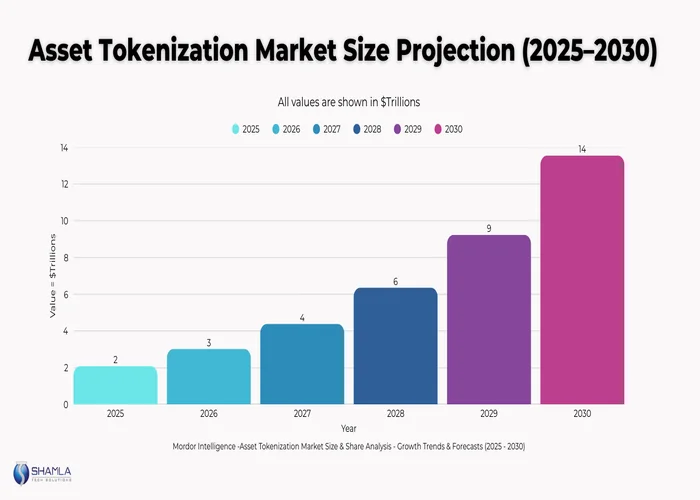
The asset tokenization market size is expanding much faster than most financial analysts expected. Between 2023 and 2025, tokenized real-world assets moved from small pilot programs into real deployment by banks, funds, and regulated platforms. By the end of 2025 it is projected to cross USD 2.08 trillion. This forms the baseline for understanding how large the RWA market size could become by 2030.
Based on industry research, the core asset tokenization forecast shows multiple growth paths. Conservative estimates place the tokenized asset market near USD 12-13 trillion by 2030. More aggressive models, which assume faster institutional inflow and clearer regulations, project a USD 14–15 trillion opportunity. These ranges are credible because tokenization affects several trillion-dollar sectors at once: real estate, private credit, government and corporate bonds, commodities, and private equity.
The tokenization market 2030 outlook is shaped by four main drivers:
- Institutions shifting real assets onto blockchain infrastructure to reduce settlement times and custody costs.
- Tokenized bonds, funds, and credit products generating steady adoption from traditional finance.
- Regulatory bodies offering clearer rules around digital securities, making large issuers more comfortable entering the market.
- Better blockchain rails, which now support secure settlement, on-chain compliance, and cross-chain communication.
With these factors lining up, analysts expect the asset tokenization market size to break into the multi-trillion range well before 2030, with accelerating momentum year after year.
Breakdown of Tokenized Assets Market by Asset Type
Real Estate – $1T+ Tokenization Potential
Real estate is the easiest, earliest candidate for tokenization because buildings and land are already valued and recorded. Tokenization lets a property be split into many small pieces, so more buyers can invest without buying whole assets. Expect these trends:
- Faster deals: token transfers cut long paperwork and lower closing costs.
- Fractional ownership: small investors can own parts of commercial and residential assets.
- New liquidity: tokens let real estate trade on secondary platforms, raising demand.
Given how big global property markets are, a conservative path could put real-estate token volumes above $1 trillion by wide adoption. This pace is driven by Real Estate Tokenization Development in regulated platforms and how it expands the asset tokenization market size overall.
Private equity & venture capital - $3–5T segment
Commodities (Gold, Oil, Metals) – $1–2T Tokenization Scope
Fixed Income & Bonds – $5–10T Tokenization Window
RWAs In Supply Chain, Invoices & Revenue Financing – $500B+ Segment
What’s Driving the Global RWA Market Size Expansion?
Several clear forces are pushing real-world asset tokenization toward a much larger scale. Institutional demand leads the list: pension funds, asset managers, and insurance companies are shifting allocations to tokenized products because they offer faster settlement, clearer ownership records, and lower custody costs. This institutional flow is a major input in projections for the global RWA market.
Cost reduction is another core driver. Token issuance, settlement, and record-keeping remove layers of middlemen and manual work, cutting ongoing fees and one-time issuance costs. Lower costs make previously uneconomic deals viable and expand the addressable market in the asset tokenization forecast.
Liquidity unlock creates fresh pools of capital. Illiquid assets like private equity stakes, commercial property, and long-dated debt become tradable in smaller lots, which attracts new buyers and enables continuous secondary markets. That change converts static holdings into active capital.
Fractional ownership widens the investor base. Tokenization allows assets to be split into many small units, so retail investors, family offices, and niche funds can own slices of large assets. This democratization increases demand and supports price discovery.
Other technical enablers matter too: improved custody solutions, on-chain compliance checks, and settlement rails that link token platforms to fiat systems. Together, these factors shorten time to market for issuers, reduce counterparty risk, and scale trading venues. With these forces in motion, forecasts expect steady RWA growth 2030 as infrastructure and rules mature and capital moves to more efficient rails.
Tokenized Securities Market & Institutional Adoption Trends
Large financial firms are moving from pilots to real products, pushing the tokenized securities market into real use. Big names are testing tokenized funds, tokenized collateral, and tokenized deposits to speed settlement and cut custody costs. These pilots show how the asset tokenization market can scale when fund managers, custodians, and primary dealers trust the tech. Banks are building permissioned rails and token custody, while asset managers design token-native funds that let shares and fund units trade on-chain.
Regulated marketplaces and better secondary trading are the next step. Exchanges and regulated platforms are launching token-friendly venues and partnerships that link crypto liquidity with traditional markets, enabling near-24/7 trading and easier cross-border flows. As rules firm up in major jurisdictions and interoperability improves, dealers and market makers will expand quote books and tight spreads, making on-chain trading more attractive. That combination – regulated venues plus deeper secondary markets creates a self-reinforcing cycle that grows the tokenized securities market and broadens investor access.
RWA Legal Landscape - Regulations & Compliance Frameworks
Regulators and compliance rules sit at the center of any token deal. Firms must run strict KYC and AML checks, keep audit-ready records, and follow securities compliance when tokens represent ownership or debt. That means clear prospectus-style disclosures, transfer limits, and registry systems that tie on-chain tokens to legal contracts off-chain. Smart contracts need code audits, and custodians must prove safe custody and reconciliation processes.
That’s why RWA Legal Consulting Services are in high demand: lawyers and compliance teams build the legal wrapper, advise on filings, and set up the operational controls needed for the asset tokenization industry to run without legal surprises.
Rules vary by country, so choosing where to issue matters. Jurisdiction analysis should cover whether a token counts as a security, tax rules, data privacy laws, and cross-border transfer limits. Token issuance rules must specify who can buy, how secondary trades work, and what happens in a dispute. Legal clarity also requires linking the token to a clear ownership record or trust, so courts can enforce rights if needed. For Real World Asset Tokenization, predictable laws and simple issuance rules are the key to unlocking big institutional pools of capital.
RWA Tokenization Development Companies in India
India has become a go-to place for tokenization work because of deep engineering talent, lower costs, and growing fintech hubs. Developers here build smart contracts, custody integrations, and compliance layers at scale. Local incubators and a strong payments industry make it easier to connect tokens to fiat rails. That mix of skills and infrastructure puts many firms in position to serve global issuer needs.
Among these players, Shamla Tech is one of the top RWA Tokenization Development Companies in India, focused on end-to-end delivery. Services include token issuance, legal and KYC/AML compliance modules, custody integrations, and regulated marketplace development.
Teams also build or integrate oracle feeds, reconciliation tools, and reporting dashboards so issuers can meet audit and tax rules. With this capability set, Indian vendors help lower time to market and cost for projects targeting the Blockchain tokenization market and the wider Asset tokenization market.
Technology Stack Behind the Blockchain Tokenization Market
Base Chains: Public & Private
- Public chains (Ethereum, Polygon) for global settlement and open liquidity.
- Private chains (Quorum, Hyperledger, Corda) for privacy, permission control, and regulated workflows.
Smart Contract Standards
- ERC-20, ERC-1400, ERC-3643 for digital securities.
- Features include transfer rules, KYC-gated trades, lockups, and payout logic.
Compliance & Identity Layer
- Built-in KYC/AML checks.
- On-chain identities to block restricted transfers.
- Rule engines that enforce securities compliance automatically
Custody & Wallet Infrastructure
- MPC/HSM custody for institutions.
- Recovery flows, audit logs, and safe investor wallets.
Issuer Tools
- Token minting, burning, freezing.
- Cap table tracking, reporting, and payout modules.
Integrations & Marketplaces
- Bank rails, price oracles, APIs for exchanges.
- Marketplaces with order books and automated compliance
Future of Asset Tokenization - RWA Growth 2030 & Beyond
The next phase of tokenization depends on systems talking to each other. Interoperability across chains will let assets move between public and private networks without breaking ownership or compliance rules. This shift is a major force behind expected RWA growth 2030, since it removes the friction that keeps large institutions from scaling token programs.
Regulation is also moving toward clearer global standards. As more countries define rules for digital securities, custody, and settlement, the asset tokenization market size will expand in a controlled way instead of scattered pilot projects. Institutions want predictable rules and reliable settlement paths.
Institutional-grade rails will complete the picture. Banks and asset managers are building infrastructure for token issuance, secure custody, on-chain reporting, and 24/7 secondary trading. These rails are what unlock long-term RWA growth 2030, because they allow trillions in real assets to operate on digital tracks. With stronger networks and better compliance frameworks, the asset tokenization market size is expected to rise steadily through the next decade as tokenized assets become a normal part of global finance.
Conclusion
The asset tokenization market size is set to scale rapidly as more assets move to blockchain rails and institutions adopt digital workflows. With rising global demand, clearer regulations, and better infrastructure, the RWA market size is expected to expand steadily through the decade, making Real World Asset Tokenization a core part of modern finance.
Shamla Tech is one of the leading Real World Asset Tokenization development companies, building secure platforms for token issuance, compliance, and marketplace creation. Our teams design end-to-end systems that help businesses launch tokenized assets safely and efficiently, supporting the growth of the global RWA market with proven development expertise.
Contact us to build, launch, and scale your RWA tokenization project!