


In 2025, approximately $250 billion in stablecoin supply is issued and governed through smart contracts, supporting $20–30 billion in daily on-chain transactions across settlement, treasury movement, and cross-border flows. At this level of circulation, smart contract design defines how monetary controls, permissions, and intervention rights operate across markets and jurisdictions.
For stablecoin issuers, weaknesses in smart contract structure translate directly into delayed regulatory response, constrained operational control, and higher exposure during liquidity stress. Post-incident reviews across the sector repeatedly link failures to architectural decisions around upgrade authority, access separation, and error handling rather than to reserve composition or peg mechanics.
This article outlines the smart contract design patterns commonly used in stablecoin development and explains how these patterns shape control structures, upgrade paths, and operational safeguards in live stablecoin systems.
Why Smart Contract Design Determines Stablecoin Viability
Stablecoins are structurally different from most on-chain applications because they operate under continuous financial obligation. Issuance, redemption, and supply controls must remain predictable under normal conditions and enforceable under stress. In this context, smart contract design determines whether a stablecoin can function as a controlled monetary instrument or becomes operationally fragile at scale.
Unlike consumer applications, stablecoins face simultaneous pressure from multiple directions:
- Regulatory scrutiny: Contract logic must support audits, controlled upgrades, and provable authority boundaries. Designs that lack clear governance paths introduce compliance delays during regulatory change.
- Liquidity stress events: Minting, burning, and transfer controls must respond to rapid demand shifts without exposing the system to unilateral intervention or execution bottlenecks.
- Operational control requirements: Stablecoin issuers need defined mechanisms to adjust parameters, restrict actions, or intervene during abnormal conditions without undermining market confidence.
- Emergency response readiness: Incident handling depends on whether safeguards are embedded at the contract level or improvised off-chain under time pressure.
Smart contract design patterns sit at the center of these pressures. They define how authority is distributed, how changes propagate through the system, and how failure is contained. For stablecoin issuers, these patterns effectively encode governance into software, shaping long-term resilience more decisively than economic models alone.
Core Smart Contract Design Patterns in Stablecoin Systems
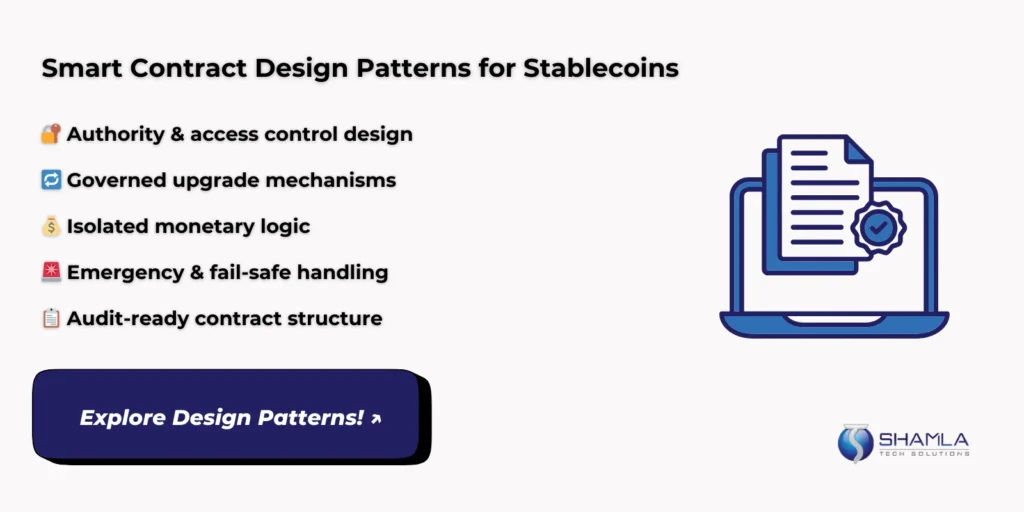
Stablecoin development relies on specific smart contract design patterns to establish who holds authority, how changes are executed, how monetary actions are constrained, and how failures are contained. These patterns directly shape how a stablecoin operates once issued, circulated, and redeemed at scale.
Each pattern outlined below reflects a design choice that carries operational, regulatory, and governance consequences. Together, they determine how control is distributed, how intervention occurs under stress, and how risk is limited within the contract boundary.
Pattern | Primary Purpose |
Control & Access Management | Defines who can issue, intervene, and change system behavior |
Upgradeability & Governance | Controls how contract logic evolves under oversight |
Monetary Logic Isolation | Constrains supply changes without affecting circulation |
Emergency & Failsafe Mechanisms | Handles stress events without halting the system |
1. Control & Access Management Patterns
Control and access management patterns define how authority is allocated across critical stablecoin functions, including issuance, redemption, parameter changes, upgrades, and emergency actions. In production systems, these patterns replace informal operational controls with explicit, enforceable permission boundaries at the contract level.
In stablecoin architectures, control is typically structured through:
- Role-based permissions separating minting, pausing, upgrades, and configuration changes
- Multi-party authorization for actions that affect supply, system behavior, or user access
- Execution delays for non-emergency changes to allow review and external visibility
When these controls are poorly designed or overly concentrated, operational authority becomes fragile. Centralized keys increase governance risk, unclear permission boundaries, slow intervention during incidents, and compromised access paths can propagate failure across the entire system.
Well-defined access patterns allow stablecoin issuers to demonstrate enforceable governance in code. They provide regulators, auditors, and institutional counterparties with verifiable evidence of how decisions are made, who can act, and under what conditions authority is exercised.
2. Upgradeability & Governance Patterns
Changes to stablecoin contract logic carry immediate operational and regulatory consequences. Upgradeability patterns exist to ensure that contract evolution occurs within explicit authority and visibility constraints, rather than through ad-hoc intervention.
In production systems, upgrade governance is typically enforced through:
- Approval sequencing, where authorization and execution are handled by separate roles
- Publicly inspectable upgrade histories, allowing external parties to trace when and how changes were applied
- Conditional execution windows, including delays for non-urgent upgrades
Market response during upgrades is shaped less by the change itself than by how upgrade authority is exercised. Unclear governance amplifies speculation around discretionary control, while transparent upgrade paths reduce uncertainty during compliance or security-driven changes.
These patterns determine whether a stablecoin can adapt contract behavior in response to regulatory shifts or security findings without destabilizing circulation or undermining counterparty confidence.
3. Monetary Logic Isolation Patterns
Stablecoin systems must support high-volume issuance and redemption, periodic supply adjustments, and regulatory review of monetary behavior while remaining live. Monetary logic isolation patterns define how supply-affecting actions are enforced so these operations remain predictable under load and reviewable under scrutiny.
In production stablecoin deployments, isolation is used to:
- Constrain mint and burn operations during issuance and redemption surges without impacting transfers
- Separate monetary enforcement from payment execution, allowing circulation to continue during policy or compliance changes
- Localize failure impact when defects, oracle issues, or misconfigurations occur outside monetary paths
- Enable targeted audits when regulators or counterparties review supply behavior over defined periods
When monetary logic is embedded across transactional code paths, operational scenarios such as large redemptions, compliance-triggered pauses, or post-incident reviews require system-wide intervention. Isolated monetary control allows these situations to be addressed through defined contract paths with limited disruption and clear accountability.
4. Emergency & Failsafe Patterns
Stablecoin systems must handle situations where issuance, redemption, or backing mechanisms are under stress while circulation continues. Emergency and failsafe patterns define how these situations are managed directly within smart contracts, without relying on ad hoc operational decisions.
In live stablecoin deployments, these patterns are used to:
- Restrict minting or redemption during abnormal liquidity events or reserve-related issues
- Apply rate limits when redemption demand exceeds modeled thresholds
- Isolate failures in external dependencies, such as price feeds or reserve reporting mechanisms
- Maintain peer-to-peer transfers so holders can continue using the stablecoin while monetary actions are constrained
When these controls are missing, issuers are forced to intervene outside the contract system while issuance or redemption continues unchecked or is halted entirely. This increases response time and creates gaps between on-chain behavior and regulatory expectations.
When controls are overly broad, circulation is disrupted even when only issuance or redemption needs to be constrained. This amplifies market uncertainty and operational impact.
Well-defined emergency patterns allow stablecoin issuers to limit monetary actions without freezing circulation, apply predefined responses during stress events, and demonstrate that incident handling follows enforceable rules embedded in the contract system.
How Stablecoin Builders Should Approach Smart Contract Architecture
Most architectural weaknesses in stablecoin systems surface after issuance, when contracts are already live and decisions become hard to reverse. At that point, response speed, scope of intervention, and clarity of authority are dictated entirely by earlier contract design choices.
Encode authority where it will be exercised
Issuance, redemption, upgrades, and emergency actions should be enforced through explicit contract roles rather than operational convention. Authority that exists only in documentation or internal process tends to collapse under incident pressure.
Design change paths before they are needed
Regulatory updates, security findings, and policy adjustments should map to predefined contract behavior. Systems that treat upgrades as exceptional events accumulate risk each time a change is required under time constraints.
Keep monetary control structurally narrow
Supply-affecting actions should be limited to clearly defined contract paths. This allows issuance and redemption controls to be modified or restricted without introducing side effects across transfers or accounting logic.
Treat stress as a recurring condition
Redemption surges, dependency failures, and compliance restrictions should be handled through contract mechanisms that already exist. Architectures that rely on coordination or improvisation during stress tend to overcorrect and disrupt circulation.
Make accountability inspectable
Contract systems should leave a clear on-chain trail of how authority was exercised during normal operation and incidents. When explanations depend on off-chain reasoning, governance credibility weakens.
Stablecoin issuers that approach architecture this way avoid governance bottlenecks that only become visible after scale, when remediation is costly and confidence is harder to restore.
How to Choose a Stablecoin Development Partner for Smart Contract Design
When assessing a development partner for stablecoin smart contract design, the following criteria indicate whether the partner is equipped to handle production-scale stablecoin systems:
Issuance and redemption control: The partner can show how minting and burning authority is structured, constrained, and adjusted under redemption pressure without disrupting circulation.
Governed upgrade handling: The partner designs clear upgrade paths for responding to regulatory changes or security findings without introducing uncertainty around discretionary control.
Stress-aware contract design: Redemption surges, partial dependency failures, and compliance-driven restrictions are handled through predefined contract behavior rather than manual intervention.
Monetary logic protection: Supply-affecting logic is isolated and auditable, allowing review and restriction of monetary actions without touching transfer or accounting paths.

Key Takeaway for Stablecoin Smart Contract Design
At scale, stablecoin reliability is shaped less by stated controls and more by whether those controls are consistently enforceable under constraint. Smart contract design patterns provide the repeatable structures through which enterprises translate policy, compliance, and risk tolerance into executable behavior.
Enterprises that adopt well-defined patterns around authority, upgrades, monetary isolation, and failure handling gain predictability in environments where conditions shift faster than governance processes. Where patterns are absent or inconsistently applied, decision-making moves off-chain, response becomes discretionary, and operational risk compounds quietly over time.
Solve Stablecoin Smart Contract Design Challenges with Shamla Tech
Stablecoin smart contract design challenges tend to emerge after deployment, when contracts are already live and decisions become difficult to reverse. Addressing these challenges requires an approach that treats smart contracts as long-term control systems rather than delivery artifacts.
Shamla Tech is a stablecoin development company that approaches stablecoin development by grounding architecture decisions in operating conditions such as issuance scale, redemption pressure, regulatory change, and incident response. Design choices around access control, upgrade governance, monetary isolation, and fail-safe handling are made to ensure authority remains enforceable and behavior remains predictable as systems mature.
This approach enables stablecoin issuers to deploy contracts that support regulatory review, absorb stress events, and adapt policy without relying on discretionary intervention. The result is smart contract architecture that aligns with institutional expectations around governance, accountability, and operational resilience as stablecoin usage expands.
Partner with Shamla Tech to design stablecoin smart contracts built for scale and oversight!