

Stablecoin exchange inflows reached $81 billion by the end of 2025, drawing attention to a shift in how stablecoins are being positioned within crypto markets. This movement occurred during a period of relatively stable prices and limited volatility, suggesting that capital was relocating closer to execution venues in anticipation of increased operational activity.
For enterprises developing stablecoin platforms, exchange inflows provide insight into how stablecoins are being used across financial systems. When stablecoins move onto exchanges at scale, it signals growing demand for reliable settlement layers, efficient liquidity access, and infrastructure capable of supporting continuous activity.
This article examines what the increased inflow reveals about stablecoin usage patterns, the resulting infrastructure demands, and how builders can design stablecoin systems for sustained, enterprise-grade adoption in 2026.
Develop Stablecoin Infrastructure Ready for Institutional Usage
Stablecoin Exchange Inflow Hits $81B: What This Signals
Stablecoin exchange inflows reaching $81 billion indicate a structural shift in how stablecoins are being positioned across crypto platforms. The movement reflects deliberate preparation for operational use, especially in periods of muted price activity.
What this signal reveals for stablecoin builders:
- Stablecoins are being staged closer to execution layers, increasing the importance of settlement reliability, exchange connectivity, and consistent liquidity access across venues.
- Higher inflows point to growing dependence on stablecoins as collateral, requiring stronger balance management and predictable redemption mechanisms.
- Concentrated movement into exchanges highlights the need for resilient distribution strategies that avoid overreliance on single liquidity endpoints.
- Increased flow activity places greater pressure on compliance, monitoring, and reporting systems during peak usage windows.
- Usage-driven movement emphasizes the value of designing stablecoins for sustained circulation, where performance under load becomes a primary success measure.
Rising Stablecoin Flows and Growing Stablecoin Infrastructure Demands
Flow Pattern | Resulting Stablecoin Infrastructure Demand |
Large exchange inflows | Prolonged settlement availability |
Liquidity clustering | Intelligent distribution controls |
Frequent wallet ↔ exchange movement | Predictable redemption execution |
Sustained transaction volume | High-integrity operational systems |
1. Exchange Inflows Signal Pre-Trade Capital Staging
The rise in stablecoin flows reflects capital being positioned ahead of execution, not after it. This staging phase places sustained load on exchange-facing infrastructure long before visible trading activity begins.
Stablecoin systems must support prolonged idle-to-active transitions, where balances sit on-platform awaiting deployment. Builders need infrastructure that remains stable during these holding periods while preserving instant availability once capital is activated.
2. Concentrated Flows Expose Liquidity Placement Weaknesses
The $81B inflow was not evenly distributed; capital clustered around specific venues and pairs. This concentration reveals how quickly liquidity imbalances form when stablecoins are moved at scale.
Stablecoin infrastructure must anticipate where capital accumulates and ensure sufficient availability across connected systems. Builders who ignore distribution mechanics risk localized shortages despite healthy overall supply.
3. Higher Flow Velocity Increases Redemption Sensitivity
As stablecoins move more frequently between wallets and exchanges, redemption paths are exercised under tighter time expectations. Even small delays become visible at scale.
Infrastructure must support predictable reserve access and automated execution, especially when redemptions coincide with inflow-heavy periods. Systems built for occasional redemption struggle when usage becomes continuous.
4. Operational Readiness Becomes a Competitive Factor
Sustained inflows place quiet pressure on reconciliation, monitoring, and reporting layers. These demands surface before compliance teams or dashboards flag issues.
Stablecoin platforms that maintain accuracy under elevated flow conditions gain trust with institutional users. Builders must treat operational readiness as part of product design, not a downstream process.
Building Stablecoins in 2026 Amid Rising Institutional Adoption
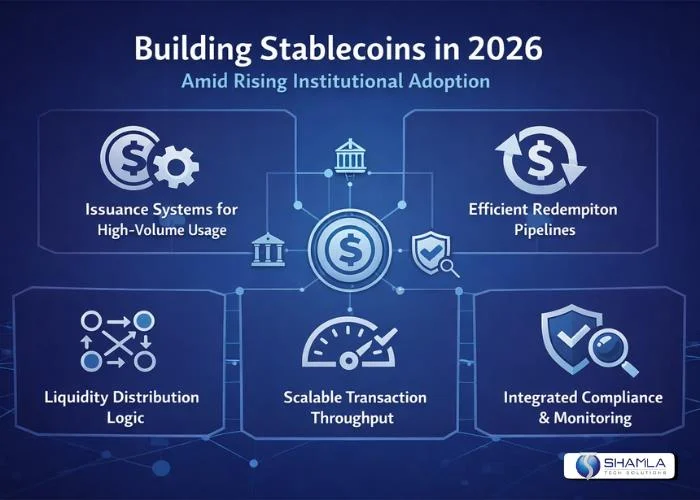
1. Designing Issuance Systems for Continuous, High-Volume Usage
Stablecoin issuance systems in 2026 must assume constant circulation rather than episodic demand. Institutional usage patterns show sustained minting and movement cycles tied to settlement and liquidity operations. With the stablecoin market capitalization exceeding $300 billion, issuance infrastructure must support predictable scaling without manual intervention.
Stablecoin Builders should focus on deterministic minting logic, clear issuance limits, and automated safeguards that operate reliably under steady load. Systems built around burst assumptions struggle when issuance becomes part of daily operational workflows.
2. Engineering Redemption Pipelines as Primary System Paths
Redemption is no longer an exceptional path exercised during stress events. Institutions redeem stablecoins as part of routine treasury and liquidity management. Builders must treat redemption pipelines as primary execution paths, ensuring low-latency processing, automated reserve access, and transparent settlement outcomes.
Architectural decisions should prioritize queue handling, prioritization logic, and failure recovery. Redemption systems that depend on manual coordination or opaque processes introduce operational risk and limit institutional integration. Predictable redemption behavior has become a baseline requirement for stablecoin platforms.
3. Building Liquidity Distribution Logic into the Core Architecture
Stablecoin liquidity does not distribute evenly across venues. Exchange inflows, custody concentration, and settlement demand create localized pressure points. Builders must embed liquidity distribution mechanisms directly into platform design, supported by real-time visibility into flow patterns.
Static allocation models fail under sustained institutional usage, even when reserves remain sufficient at the aggregate level. Infrastructure should enable controlled rebalancing across venues without disrupting availability. Liquidity management has become an engineering problem, not a downstream operational task.
4. Scaling Transaction Throughput Without Degrading Finality
Institutional usage places stablecoins under sustained transactional load. Daily transaction volumes illustrate this shift clearly, with USDT processing over $126 billion in daily transfers, far exceeding the throughput of volatile assets. Builders must ensure transaction handling maintains settlement finality, ordering guarantees, and reconciliation accuracy under continuous activity.
Performance optimizations that compromise determinism create downstream accounting and risk issues. Stablecoin platforms must balance throughput with correctness, as institutions prioritize predictable settlement over raw speed.
5. Embedding Compliance and Monitoring into System Design
As stablecoins integrate into regulated financial workflows, compliance and monitoring can no longer operate as external overlays. Builders must embed transaction screening, audit trails, and reporting capabilities directly into the platform architecture. Higher flow volumes increase monitoring load, making scalability and accuracy essential.
Systems must maintain observability without introducing latency or operational friction. Stablecoins designed with compliance as a core system function are better suited for institutional environments where reporting and accountability are continuous requirements.
Get Stablecoin Infrastructure Ready for Institutional Usage in 2026
Preparing Stablecoin Infrastructure for Sustained, High-Volume Usage
Stablecoin platforms are entering a phase where usage is continuous and volumes remain elevated across long periods. Infrastructure must be designed to remain stable under constant movement, with predictable performance across issuance, circulation, and settlement layers.
What sustained, high-volume usage demands from stablecoin infrastructure:
- Issuance systems must operate deterministically, with clear controls that prevent over-extension while supporting frequent mint and burn cycles driven by operational demand.
- Settlement pipelines need to maintain ordering, finality, and reconciliation accuracy even when transactions arrive without clear peaks or downtime.
- Liquidity availability must be managed dynamically across venues, ensuring access where activity concentrates while preserving reserve integrity.
- Redemption paths should function as routine execution flows, with automation and predictable completion times under regular usage.
- Monitoring and reporting systems must scale alongside transaction activity, maintaining visibility and audit readiness without slowing core operations.
Bottom Line
The $81 billion stablecoin exchange inflow reflected a change in how stablecoins are being positioned across financial systems. Capital moved closer to execution layers ahead of visible activity, signaling preparation for settlement, liquidity deployment, and operational use. This behavior exposed infrastructure demands that emerge before market responses appear.
For stablecoin builders, the implication lies in how stablecoins are exercised under sustained movement. Continuous flows, repeated redemptions, and liquidity concentration place pressure on issuance controls, settlement reliability, and reserve access. Systems built for intermittent activity encounter limitations when usage becomes routine and expectations tighten.
As stablecoins assume a deeper operational role, infrastructure decisions shape long-term viability. Platforms designed for consistent performance under elevated volumes are better positioned to support the next phase of stablecoin usage as activity continues to mature.