


As per data from the Bank for International Settlements (BIS), cross-border payments using traditional banking rails can take one to five business days to settle, largely due to intermediaries, cut-off times, and fragmented liquidity pools. During this period, capital remains idle and treasury visibility is limited. At the same time, enterprises operating across regions face increasing exposure to FX volatility and delayed cash positioning.
As of late 2025, research from Cornell University highlights that a growing portion of stablecoin circulation is being used for payments, settlements, and treasury-related liquidity movement, rather than trading or speculative activity. The study notes that enterprises and financial institutions increasingly rely on stablecoins as digital cash equivalents for cross-border transfers, short-term liquidity positioning, and operational settlements.
This shift reflects stablecoins’ evolution into infrastructure-level instruments, where value lies in real-time settlement, transparency, and programmability, rather than price exposure or yield generation.

Stablecoins as a Real-Time Liquidity Layer for Enterprises
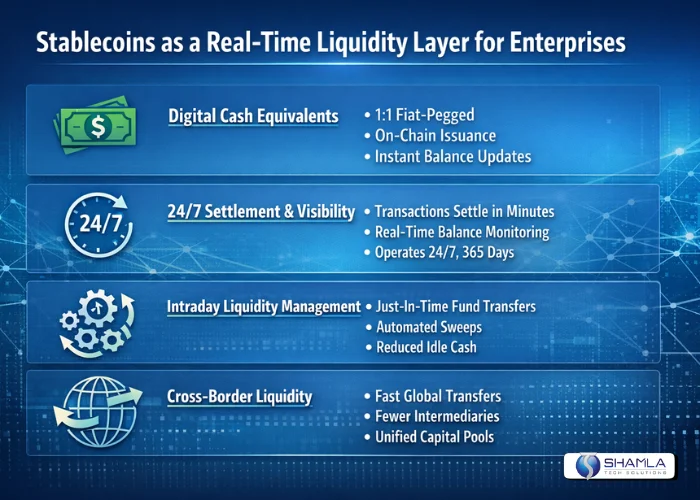
Stablecoins as Digital Cash Equivalents
Stablecoins are most effective when positioned as digital representations of cash, rather than financial instruments. Technically, they are fiat-backed units issued on blockchain networks, enabling value transfer without reliance on batch-based clearing systems. Because transactions occur on shared ledgers, balances and movements are visible in near real time.
Key characteristics include:
- 1:1 fiat peg backed by reserves
- On-chain issuance and redemption
- Immediate balance updates across systems
- Compatibility with existing on/off-ramps
This structure allows stablecoins to function as a programmable extension of cash management infrastructure.
24/7 Settlement and Real-Time Visibility
Traditional treasury operations depend on banking hours, cut-off times, and delayed reconciliation. Stablecoin networks operate continuously, settling transactions within minutes regardless of geography or time zone.
Operational impact:
- Continuous settlement, including weekends and holidays
- Real-time confirmation of funds availability
- Reduced reliance on end-of-day or T+1 reporting
- Improved cash position accuracy
This shift enables treasury teams to move from reactive reporting to continuous liquidity oversight.
Intraday Liquidity Management and Automation
Stablecoins support same-day liquidity orchestration without waiting for clearing cycles. Because transfers settle quickly, funds can be deployed, rebalanced, or recalled within hours rather than days.
Common intraday capabilities:
- Just-in-time funding of accounts or wallets
- Automated transfers based on predefined thresholds
- Rule-based approvals using smart contracts
- Reduced idle cash across entities
This turns liquidity management into a policy-driven process rather than a manual intervention.
Cross-Border Liquidity Consolidation
For enterprises operating across multiple jurisdictions, liquidity is often fragmented across local accounts. Stablecoins act as a neutral settlement layer, allowing capital to move between regions without passing through multiple correspondent banks.
Compared to traditional rails:
- Fewer intermediaries involved
- Faster cross-border settlement
- Lower operational friction
- Improved capital mobility
Banks remain entry and exit points, but stablecoins reduce the time and complexity capital spends in transit.
Infrastructure Impact on Treasury Decision-Making
By operating as software-driven infrastructure, stablecoins improve:
- Liquidity agility across regions
- Capital efficiency through reduced idle balances
- Decision speed through real-time data access
When integrated alongside existing treasury systems with proper governance, stablecoins function quietly in the background, enhancing speed, visibility, and control without disrupting established financial processes.
Treasury Use Cases: Cash Management, FX Control, and Settlements
Use Case 1: Cross-Border Operating Liquidity for Global Subsidiaries
Many global organizations operate with cash spread across multiple countries, often locked in local accounts and subject to banking cut-off times. Stablecoins are being used as an intermediate liquidity layer between entities.
How this works in practice:
- Local currency is converted to fiat-backed stablecoins via regulated on-ramps
- Stablecoins are transferred on-chain between entities in minutes
- Funds are converted back to local currency where needed
Operational benefits:
- Faster movement of operating capital between regions
- Reduced reliance on correspondent banking chains
- Improved visibility into consolidated liquidity positions
Banks remain the entry and exit points, while stablecoins reduce the time capital stays in transit.
Use Case 2: FX Buffering for Volatile Currency Environments
Enterprises operating in regions with currency volatility are using stablecoins as a temporary FX buffer, not as a long-term holding asset.
Typical flow:
- Revenue received in local currency
- Converted into USD-pegged stablecoins during favorable windows
- Held briefly to avoid forced FX conversions
- Redeployed or converted back when required
This approach:
- Reduces exposure to sudden currency swings
- Improves predictability of operating margins
- Separates FX timing decisions from payment execution
Technically, this is enabled by fast settlement and transparent on-chain balances, allowing tighter control over timing.
Use Case 3: Vendor and Partner Settlements with Just-in-Time Funding
Stablecoins are increasingly used for B2B settlements, particularly where vendors or partners operate across borders.
Common implementation:
- Stablecoins funded only when payment is due
- On-chain transfer triggered via treasury systems or APIs
- Immediate settlement confirmation shared with counterparties
Results observed:
- Faster vendor payments without pre-funding accounts
- Lower reconciliation effort due to shared transaction records
- Improved working capital efficiency through just-in-time funding
This model improves control and predictability while keeping banks involved for compliance and conversion.
Risk, Governance, and Compliance Considerations for Treasury Teams
Key Risk and Governance Dimensions in Stablecoin-Based Treasury
Dimension | What It Means in Practice | How Risk Is Managed |
Issuer & reserve structure | Fiat-backed stablecoins representing real-world cash | Use of audited issuers with transparent reserve disclosures |
Custody & asset protection | Secure storage and transfer authorization | Institutional custody, multi-signature approvals, role-based access |
Regulatory alignment | Compliance with financial and jurisdictional requirements | Regulated on/off-ramps, KYC/AML enforcement, jurisdiction mapping |
Auditability & reporting | Ability to trace and reconcile transactions | Immutable on-chain records, time-stamped settlement data |
Accounting treatment | Classification of stablecoins on balance sheets | Defined accounting policies and consistent valuation methods |
Usage governance | Restrictions on how stablecoins are used | Policy-driven treasury usage, no speculative or yield exposure |
Stablecoin Issuer and Reserve Risk
Custody, Governance, and Control Enforcement
Compliance, Auditability, and Reporting
Why This Structure Works for Treasury

Conclusion
Treasury operations are shifting from static cash tracking to dynamic liquidity orchestration driven by software. Stablecoins enable faster settlement, real-time visibility, and programmable controls across regions. When deployed with clear governance, they improve capital efficiency and predictability without altering existing financial controls or risk frameworks.
Shamla Tech is a stablecoin development company that builds regulated, treasury-grade infrastructure for enterprises. Its focus is on compliant issuance, secure custody integration, and system-level automation that fits alongside existing banking and ERP systems. Stablecoin development, when treated as core infrastructure, becomes a long-term operational advantage rather than a short-term trend.
Partner with Shamla Tech for Treasury-Grade Stablecoin Infrastructure
Shamla Tech works with enterprises to design and deploy stablecoin systems purpose-built for treasury and liquidity management. Our solutions focus on regulated issuance, secure custody integration, real-time settlement, and policy-driven controls that align with existing ERP and banking frameworks.
By treating stablecoins as core financial infrastructure rather than experimental tools, Shamla Tech enables faster cross-border liquidity movement, improved cash visibility, and operational efficiency without increasing risk or disrupting established treasury governance.
Contact us to build a secure, policy-driven stablecoin layer for enterprise-grade treasury management!