


Enterprises around the world are still stuck with slow settlement, high fees, and fragmented reconciliation from traditional finance, exposing limitations in today’s enterprise finance infrastructure that keep capital idle and delay B2B flows that should be settled quickly.
Stablecoins have been increasingly used for cross-border payments, treasury management, global payouts, and instant B2B payments in 2026, with real-world stablecoin payment volumes projected at around $390 billion in 2025.
This article helps you understand the benefits businesses can get from stablecoin infrastructure and also clarify doubts about regulation, liquidity, and the institutional trust that traditional finance continues to offer.
Design Your Enterprise Stablecoin Finance Architecture Today
Why Enterprise Finance Infrastructure Is Being Re-evaluated in 2026
The Pressures Driving This Re-evaluation:
- Traditional settlement systems still take multiple business days to resolve transactions, not aligning with the pace of global operations and trapping funds in transit, reducing usable working capital.
- Capital becomes fragmented across regions and intermediaries, forcing treasury teams to pre-fund accounts and manage liquidity manually, increasing operating costs and financial risk.
- Cross-border payments often pass through 3–5 correspondent banks, each adding delays and opacity, making end-to-end tracking difficult and reconciliation costly.
- Despite ongoing initiatives, global payment reforms have yet to meaningfully reduce friction, with targets to process 75% of cross-border payments within one hour by 2027 at risk of being missed, highlighting persistent inefficiencies.
Enterprises increasingly expect real-time financial visibility and near-instant settlement, with real-time payment solutions projected to replace traditional batch systems handling up to $18.9 trillion in B2B transactions by 2028.
Business Benefits of Stablecoins in Enterprise Finance Infrastructure
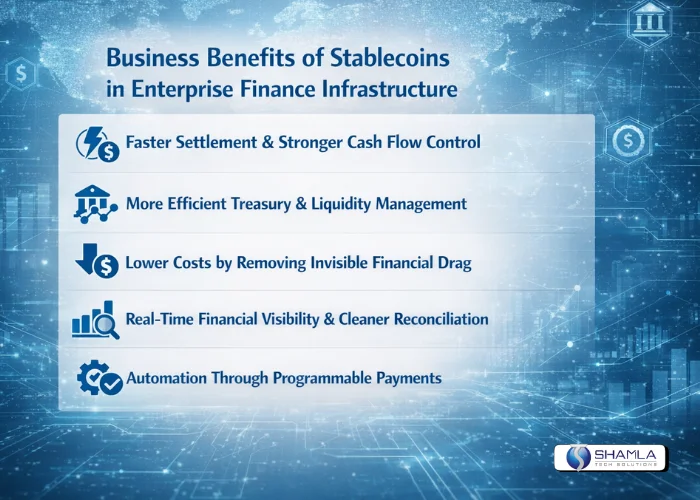
1. Faster Settlement and Stronger Cash Flow Control
Traditional enterprise payments often execute instantly but settle them days later, which leaves capital temporarily unusable. Stablecoin-based settlement shortens this gap significantly, allowing funds to move fast and become available almost immediately instead of being locked in clearing cycles.
This shift improves cash flow predictability, reduces capital held in transit, and allows finance teams to redeploy funds faster across operations, suppliers, and regions. At scale, faster settlement directly strengthens working capital efficiency and lowers the need for excess liquidity buffers.
2. More Efficient Treasury and Liquidity Management
In traditional enterprise setups, treasury teams pre-fund multiple bank accounts across regions to support operations. This will fragment liquidity, increase idle balances, and make it harder to move capital quickly between entities when demand shifts.
Stablecoins allow liquidity to be held and moved on a unified rail, reducing the need for prefunding across jurisdictions. This enables more centralized treasury control, faster internal fund movements, and more efficient capital allocation as global operations scale.
3. Lower Costs by Removing Invisible Financial Drag
Enterprise payment costs rarely come from a single fee. They accumulate through correspondent banks, FX spreads, manual processing, and exception handling, which creates a constant financial drag that grows with transaction volume and geographic reach.
Stablecoin rails help enterprise financial infrastructure reduce reliance on layered intermediaries and batch processing. Fewer touchpoints mean fewer fees, less leakage, and more predictable transaction costs. Over time, this shifts finance from cost containment to cost efficiency, especially for high-volume, cross-border operations.
4. Real-Time Financial Visibility and Cleaner Reconciliation
Enterprise finance teams often operate with delayed or partial visibility into cash positions, relying on batch updates and post-fact reconciliation. This lag makes it difficult to understand true liquidity in real time and increases dependency on manual adjustments.
Stablecoin-based enterprise finance infrastructure provides transaction finality as payments occur, with balances updating immediately. This enables faster reconciliation, fewer exceptions, and cleaner audit trails. Over time, finance teams spend less effort tracking discrepancies and more time making informed capital decisions.
5. Automation Through Programmable Payments
Many enterprise payments still depend on manual triggers, approvals, and follow-ups. Supplier payouts, escrow releases, refunds, and incentive payments often require coordination across teams, which increases processing time and the risk of human error.
Stablecoins enable payments to execute automatically when predefined conditions are met, such as delivery confirmation or invoice approval. This largely reduces manual intervention, speeds execution, and improves operational consistency. Over time, finance operations shift from managing processes to overseeing systems that run predictably at scale.
Stablecoins vs Traditional Finance: A Side-by-Side Comparison
Finance Consideration | Traditional Finance | Stablecoin-Based Finance |
Settlement Speed | Typically settles in 1–5 business days, especially for cross-border payments | Near-instant or same-day settlement across regions |
Cost Predictability | Fees vary across banks, FX spreads, and intermediaries | More predictable transaction costs with fewer intermediaries |
Liquidity Management | Requires prefunding accounts across geographies | Enables centralized liquidity with on-demand movement |
Financial Visibility | Cash positions updated in batches or end-of-day statements | Real-time balance and transaction visibility |
Reconciliation Effort | Manual reconciliation and post-fact adjustments | Faster reconciliation due to immediate transaction finality |
Automation Capability | Process-driven workflows with limited automation | Supports conditional and programmable payments |
Regulatory Maturity | Highly established and widely trusted | Evolving and jurisdiction-specific |
Key Trade-offs Between Stablecoins and Traditional Finance
1. Speed vs Certainty
2. Efficiency vs Familiarity
3. Flexibility vs Regulatory Clarity
Start Your Enterprise Stablecoin Implementation With Our Experts
Regulation, Liquidity, and Risk Considerations in Enterprise Stablecoin Finance
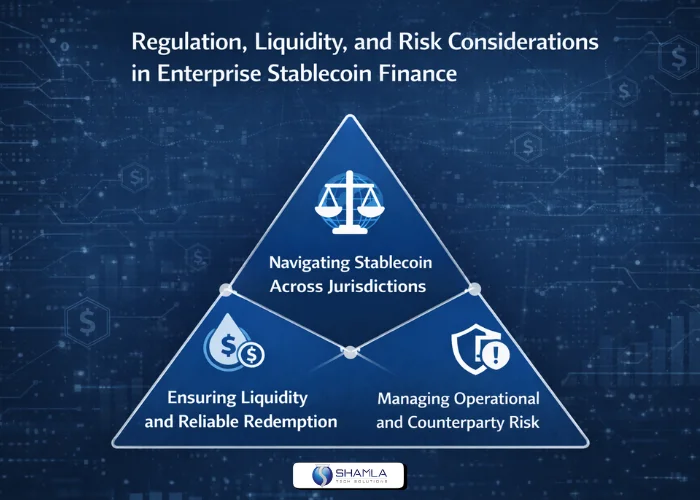
Navigating Stablecoin Regulation Across Jurisdictions
Enterprise use of stablecoins is shaped by multiple regulatory authorities rather than a single global rulebook. This includes the U.S. Securities and Exchange Commission, the Financial Conduct Authority of the UK, European regulators operating under MiCA, and Dubai’s Virtual Assets Regulatory Authority.
As these regulators apply different standards, enterprises must assume full responsibility for stablecoin compliance across regions. In practice, this would mean approving specific stablecoin issuers, aligning policies to the most restrictive regulatory expectations, and maintaining consistent controls for reporting, audits, and ongoing oversight.
Ensuring Liquidity and Reliable Redemption
For enterprises, stablecoin liquidity is less about market trading volume and more about reliable redemption. The ability to convert stablecoins back into fiat on demand, at par value, is absolutely critical for treasury operations, cash planning, and risk management.
Enterprises must assess issuer reserve quality, redemption processes, and access during stressed conditions. Liquidity should be evaluated under normal operations and adverse scenarios. Stablecoins only function as enterprise finance tools when redemption is predictable, timely, and supported by transparent reserve management.
Managing Operational and Counterparty Risk
Stablecoin adoption introduces new operational and counterparty exposures that enterprises must actively manage. These include reliance on stablecoin issuers, custodians, and service providers involved in issuance, custody, and settlement, each of which becomes part of the enterprise finance stack.
To manage this effectively, enterprises need clear governance frameworks covering approval workflows, access controls, segregation of duties, and incident response. When supported by strong internal controls, stablecoins can be integrated into finance operations without increasing operational fragility or unmanaged counterparty risk.
Bottom Line: Building Enterprise Finance Infrastructure in 2026
Enterprises are not choosing between stablecoins and banks but deciding where speed, visibility, and capital efficiency matter most. Stablecoins provide a practical settlement layer that complements existing finance operations without forcing wholesale replacement today globally.
Stablecoins offer faster cross-border movement, tighter treasury control, and real-time visibility. These advantages also compound at scale, improving working capital and operational agility while preserving the governance, controls, and relationships enterprises already rely on.
Enterprises that adopt stablecoin infrastructure early gain advantages without betting the balance sheet. When adopted with clear governance, stablecoins can become a reliable settlement layer within enterprise finance, delivering measurable efficiency gains without disrupting existing financial controls.
Partner with Shamla Tech to Build Enterprise Stablecoin Infrastructure
Shamla Tech is a stablecoin development company building production-ready stablecoin infrastructure for enterprises that fits within existing finance, compliance, and treasury environments, ensuring stablecoin adoption strengthens core operations instead of sitting outside them.
We work closely with enterprise teams on architecture design, issuer integration, governance, and operational controls. Our stablecoin development solutions enable organizations to adopt stablecoins while maintaining regulatory discipline, liquidity safeguards, and the risk management standards expected in large-scale finance operations.